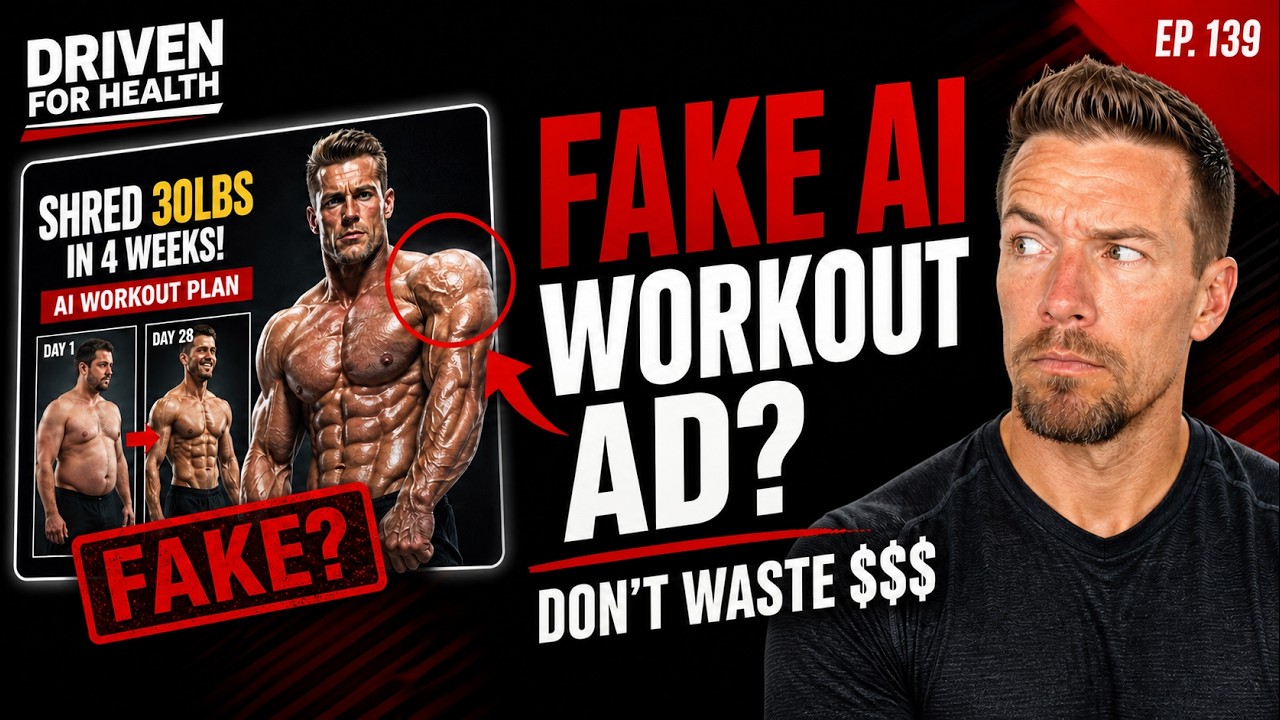
How to Spot Fake AI Workout Ads Before They Cost You Money
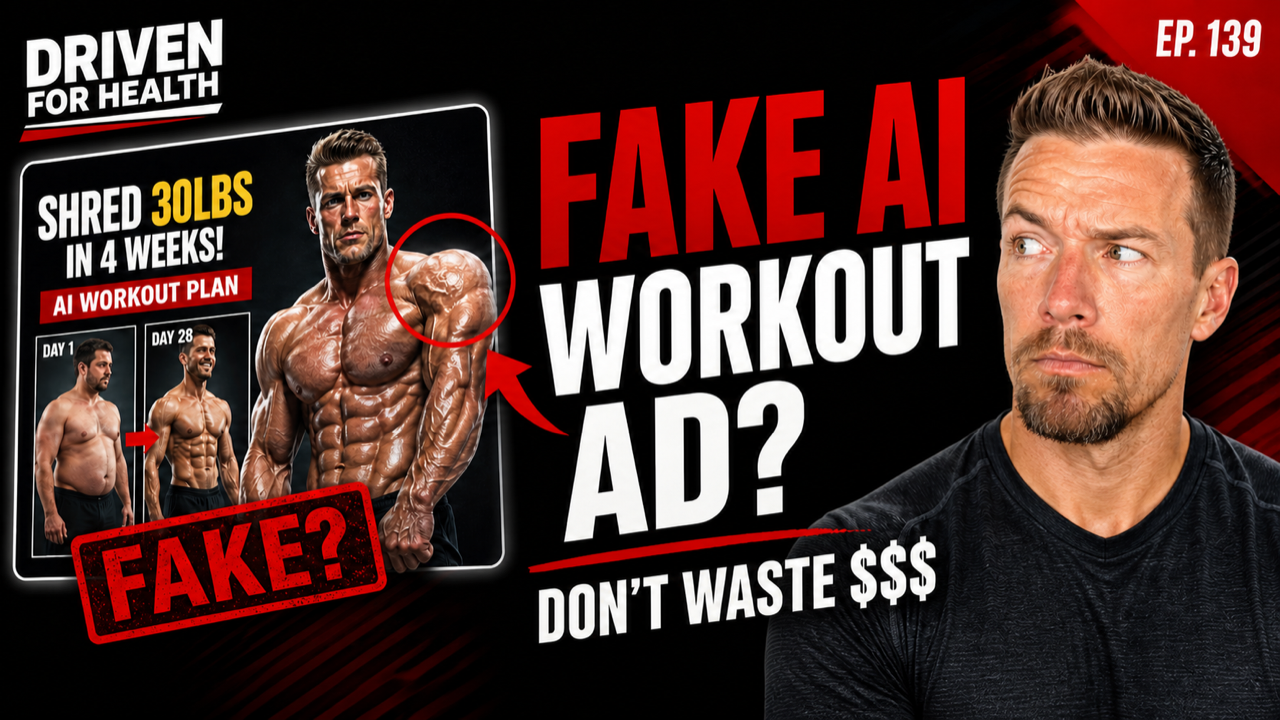
A man with an actor's jawline stands in front of a stack of tires under a countdown clock reading four hours left. It costs $19 to claim your spot and 2,000 men have already joined today. Neither number is real and the man may not be either.
A fake AI workout ad runs on one pattern. A low entry price near $19 opens a door into a monthly subscription you forget about. The video is often built by software, from the man on screen to the room behind him. Listen to Episode 139 for the full walkthrough.
What the Ad Looks Like at 11 at Night
It is eleven at night and you are scrolling before bed. A man with an actor's jawline stands in front of a stack of tires under text reading "The 30-Day Military Challenge." A countdown clock says four hours left. It costs $19 to claim your spot and 2,000 men have already joined today.
You have had a long week and the $19 feels like nothing. What the ad does not show you is where that $19 leads.
Why the Entry Price Is $19
The workout is the bait. In direct marketing the move has a name. It is called a challenge funnel and marketers teach it to each other in the open.
You price the front door low enough that saying no feels dumb. Then you build the real business on what happens after that door closes behind the customer. The $19 turns on the subscription sitting behind it.
Coach Brian's read on the math is plain. Real coaching costs time and money, and one coach can only work with so many men. A program priced under the cost of a lunch out is a loss leader, sold cheap because a percentage of those men move into the bigger program later.
The ad only has to work once. They send it to you 18 times and on the 19th you are tired enough to press it.
The workout itself is cheap to produce now. Ask a chatbot for a 30-day military challenge and it writes one in seconds. The line Coach Brian hears from men every week is that they know what to do and are not doing it, which is why he puts his weight on teaching and support instead.
The Money Is on the Back End
This is the part that costs a man the most without him noticing. These offers build a back end that gets hard to leave.
Dave is the example Coach Brian uses on the episode. He is 47 and runs a regional sales team, on the road two weeks out of every month with two kids in travel sports.
Dave paid $19 for an ad almost exactly like the one above. By week two he had not finished a single workout. By month two he was paying $97 a month for a program he had forgotten he signed up for.
That second charge was the plan working the way it was built. A charge that small sits on a statement for months and nobody goes looking for it.
What Happened to Beachbody in 2017
Beachbody built P90X, Insanity, and 21 Day Fix. Coach Brian puts those in the same category as the ads that open this episode.
In 2017 the city of Santa Monica fined Beachbody $3.6 million. The complaint said Beachbody signed customers up for renewal billing after a free trial without getting real consent first. There were no clear checkboxes and no clear disclosure of what the renewal would cost. As part of the settlement Beachbody had to add simple ways to cancel online and by phone.
Coach Brian's read on that last piece is short. The cancel process was not simple before.
He says complaints against the company repeat the same pattern. A man believes he canceled and gets charged for another year. He asks for a refund and finds the policy covers the first order and not the renewal. A cancel button that is hard to find was built that way on purpose.
That is a real company with a real legal team and a fine already on record. Now picture the man running a 30-day challenge ad from a domain he registered three weeks ago. He has no legal team and no fine on record. He runs the same playbook.
These Ads Target Men Who Are Good at Their Jobs
These ads are not aimed at men who do not know better. They are aimed at busy successful men who do not have 20 minutes to check a program before they buy it. The same drive that makes you good at your job is what the ad counts on.
You would never sign a business contract without reading it first. You read this ad for four seconds because you were tired and the promise looked good.
What Gives the Sales Page Away
Coach Brian gets this question in his Instagram DMs every week. A man sends over a link and asks whether the program is legit. He reads the page word for word and can usually call it inside 30 seconds. Here is what he looks for.
The language. A page that opens by praising how hard you work is selling you in the first paragraph.
The domain. A real company does not need to hide behind a domain registered three weeks ago.
The clock and the counter. Four hours left. 2,000 men already joined today. The clock resets the moment you refresh the page and neither number can be verified.
The scarcity line. Only 12 spots left, alongside popups saying this man bought and that man bought.
The exit offer. Move your cursor to leave and a VIP package or 30% off appears.
The stock photos. Testimonials attached to faces from an image library.
Coach Brian calls the copying between these pages funnel hacking. You study another company's funnel and model it to reproduce the result.
Urgency can be real. Coach Brian can only work with so many men at once, and he has run waiting lists throughout his career. An honest business does not need a clock that resets.
How to Tell the Video Is AI
For years a bad ad meant bad writing. Software writes the whole page now and builds the site with it. Tools like HeyGen and ElevenLabs put a synthetic voice and a synthetic face in reach of anyone.
Coach Brian caught one himself. A woman in a gym clip stood up and moved off camera while a man moved into a different position. Behind them the same woman sat at a shoulder press machine pulling down, and a lat pulldown bar appeared out of nothing.
Four checks he runs on the video.
Watch the face and the eyes. A real face is never perfectly even on both sides and it never holds still. AI still misses the flicker in an eye and the small unevenness a real face carries. If a face feels wrong before you can say why, trust that feeling.
Let the video keep playing. Most men judge an ad in the first three seconds, and that is when it looks the most real. AI video breaks down the longer it runs. Watch how a jump rope moves, how a weight plate falls, and how fabric settles when a man sits down on it.
Look for fidgeting. Real people adjust their grip and wipe sweat off a forehead. They blink at uneven timing and move their weight from one foot to the other between reps. A body that holds still across 30 seconds is worth questioning.
Look at where the ad came from. A man in Coach Brian's program searched calisthenics one day. Within 24 hours his feed filled with calisthenics ads promising he would be shredded in a set number of days. They shared the same fake podcast sets and street interview shots with fake crowds.
Hiring an actor and renting a studio costs far more than running the same idea through software, so this keeps growing and gets harder to spot with each new model.
The AI Label Is Not Proof
Instagram and Facebook are supposed to label AI generated content in ads. In practice that label does not always appear yet. LinkedIn marks it in the top left corner with a circle icon and YouTube asks a creator how much of the content is AI generated.
An ad can run for days and collect clicks before anyone flags it. A missing label does not mean the ad is real. It means nobody caught it yet.
Coach Brian compares the label to the nutrition panel on a package. The calories are printed right there and most men buy the food anyway.
What Works Instead of a 30 Day Challenge
Programs like this end the same way because they skip the foundations of training. A program with no foundation cannot hold a result over time.
The first level of Coach Brian's strength pyramid is adherence. He teaches it through what he calls the REF method: realistic, enjoyable, and flexible. A program has to fit the life you have and the hours you have. He lays the full pyramid out across episodes 17 through 23.
He also points at a 12-week study on adults with obesity. Resistance training cut waist size and hip size. It also cut waist to hip ratio more than low intensity cardio did, and that held true for the men in the study. Lifting two to three times a week across months does more for a man's body than a 30-day sprint.
Here is one option you can start this week without buying anything. Load a backpack with 20 or 30 pounds and walk at an easy pace for an hour or two. That is rucking, and a hilly hike counts too. It builds real strength in your legs and your back while it burns real calories. There is no countdown clock on a walk and no upsell page at the end of it.
Andy Walked a Million Steps in 100 Days
Andy is a man in The Call To Rise. He lost 38 pounds and it took him 100 days. Listen to Episode 53 for his story in his own words.
He came in with a plan built for him and walked 10,000 steps every day. One day he told Brian he had walked a million steps in the program, and he was right. 10,000 steps across 100 days is a million steps, and it cost him nothing.
On the episode Dave cancels the subscription he had forgotten about. He starts picking heavy things up two or three times a week and he starts walking. Six months later he is still doing both.
Common Mistakes Men Make Here
Buying at 11 at night. The ad is built for the moment you are tired of starting over.
Reading the ad for four seconds. You would read a business contract. Give the sales page the same 20 minutes.
Treating the AI label as proof. A missing label means nobody caught it yet.
Treating 30 days as the finish line. Andy took 100 days and walked a million steps.
Leaving the charge on the card. Check your statement and cancel anything you are not using.
Who This Is For and Who It Is Not For
This is for the man in his 40s or 50s who is good at his job and short on time. He has paid for one of these programs or come close to it, and he wants a way to tell a real offer from a funnel before his card gets charged.
It is not for a man hunting the next 30-day sprint. The fix here runs over months.
Cross-episode links
- Episode 17: Why Men Over 40 Struggle to Make Progress and Stay Consistent in the Gym
- Episode 53: 38 lbs Lost in the 100 Day Challenge
- Episode 140: How Jamie Lost 38 lbs in 100 Days
- Episode 141: How to Spot a Fake Supplement Ad Before It Costs You Money
Call to Action
If you want a real starting point this week, the free Lose 3 lbs in 3 Days plan gives you three days of food and training structure. It is the same standard Coach Brian starts his men on. Get it at thecalltorise.com/lose3lbsin3days.
When you want the full structure, The Call To Rise is Coach Brian's 100 day program for driven men who want to lose 20 or more pounds and get their health up to the level their career is already at. It includes an individualized meal plan, an individualized training plan, weekly round table calls with the group, 1:1 calls with Brian, and a client site holding every resource in one place. The guarantee is one sentence. Lose 20 or more pounds in the 100 days, or Brian keeps working with you until you do. Apply at thecalltorise.com.
Frequently Asked Questions
How can you tell if a fitness ad video is AI generated?
Watch the face first. A real face is never perfectly even on both sides and it never holds still, and AI still misses the flicker in an eye. Then let the video keep playing, because AI video breaks down the longer it runs. Watch how a jump rope moves, how a weight plate falls, and how fabric settles when a man sits down on it.
What is a challenge funnel in fitness marketing?
A challenge funnel prices the front door low enough that saying no feels dumb, often around $19. The workout is the bait. The real business sits in the recurring subscription behind that entry price, which is where the money is made.
Why did the city of Santa Monica fine Beachbody?
In 2017 the city of Santa Monica fined Beachbody $3.6 million. The complaint said Beachbody signed customers up for renewal billing after a free trial without getting real consent first, with no clear checkboxes and no clear disclosure of what the renewal would cost. As part of the settlement Beachbody had to add simple ways to cancel online and by phone.
Does Instagram label AI generated ads?
Instagram and Facebook are supposed to label AI generated content in ads, and in practice that label does not always appear yet. LinkedIn marks it in the top left corner and labels the post as AI generated, and YouTube asks a creator how much of the content is AI generated. A missing label does not mean the ad is real. It means nobody caught it yet.
Is the countdown timer on a workout sales page real?
A countdown clock that resets when you refresh the page is manufactured. The same goes for a counter saying 2,000 men already joined today, because neither number can be verified. An honest business does not need a clock that resets.
What should you do if you already paid for one of these programs?
Coach Brian's advice on the episode is to go check your credit card statement and cancel it as fast as you can. You were outmatched by people who do this full time with a team and a budget. Then put the money toward something you keep doing.
What is rucking and does it help you lose fat?
Rucking is walking with a weighted pack. Load a backpack with 20 or 30 pounds and walk at an easy pace for an hour or two, or find a hilly hike and walk that. It builds real strength in your legs and your back, and it burns real calories while your waistline comes down.
What is The Call To Rise?
The Call To Rise is Coach Brian Parana's 100 day program for driven men who want to lose 20 or more pounds and get their health up to the level their career is already at. It includes an individualized meal plan, an individualized training plan, weekly round table calls, 1:1 calls with Brian, and a client site with every resource in one place. The guarantee is that you lose 20 or more pounds in the 100 days, or Brian keeps working with you until you do.

CEO l Head Body Tranformer
Brian Parana is a men’s health coach with 23+ years of experience helping busy professionals improve their body, energy, and day-to-day habits while still leading at work and at home. His coaching is built around practical nutrition, training, sleep, and accountability, with a plan tailored to the person in front of him.
Over the years, Brian has helped thousands of clients through his work as a personal trainer, CrossFit gym owner, and online coach. He has also coached an Olympic silver medalist, a 2-time Olympian, and a CrossFit World Champion.
Brian is the host of the Driven For Health Podcast, where he shares real-world strategies for men who want to feel strong again and stay consistent without making health a second job.
He’s also the creator of The Call To Rise, a 100-day fat loss experience for driven men who want to drop 20–30 pounds, boost energy, and rebuild confidence through strength training, personalized nutrition, and high-accountability coaching. Many men join because their blood pressure, cholesterol, or blood sugar is heading the wrong direction, and they want a clear plan that fits real life.
Brian is married to his high school sweetheart, Amber, and they have four kids. Their family has traveled to all 50 states and 4 continents, with a goal to reach all seven.

What To Order At Dessert Restaurants For Fat Loss



 YouTube