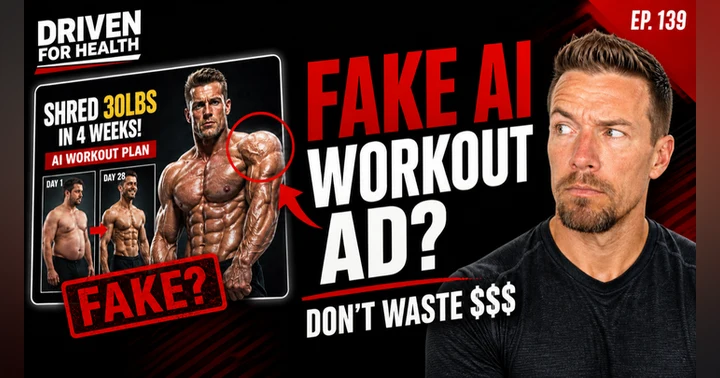
It's eleven at night. The kids are finally down. You're scrolling before bed. I totally get the eleven, down by eleven, but scrolling before bed, something I try to avoid as much as possible. We talk about that in the sleep episodes of one ten, one thirteen. But on we go to the intro. And this ad — we're scrolling, and the ad stopped your thumb dead in its tracks. Your eyeballs start scanning. What's going on? A guy with an actor's jawline stands out in front of a stack of tires. Bold text across the screen says, "The 30-day military challenge," and it's just for you. The workout the Army doesn't want you to see. A countdown clock underneath it. Four hours left. $19 to claim your spot. 2,000 men already joined today. You've had a long week. You're tired of starting over with the same workout routine, diet plan, whatever. The $19 feels like nothing, honestly. Making good income, you're like, yeah, whatever, I'll do this and see what goes. Your thumb hovers over the button and you press it. Here's what the ad doesn't show you: where that $19 leads. Who built the video you watched. What it costs a guy like you six weeks later when the real change starts to happen and hits. By the end of this episode, you'll know how to spot one of these ads before you click and spend your hard-earned money. And you'll know exactly what to do instead. Welcome to Driven For Health. I'm Coach Brian. This is episode 139: how to spot fake AI workout ads before it costs you real hard-earned money. The fitness industry has learned to create fake honesty a lot better these days. That's what they're selling. They're selling this, especially these big giant companies that are producing these type of programs of the Tai Chi workouts for men in their fifties. You'll feel like you're 30 again in no time flat. And that's the whole reason why I'm doing this episode. I see it. If you're on video, then I'm in my barn, and I have a big TV inside my barn that my buddies and I watch YouTube on, MTV TRL style. You might remember that from when MTV actually had music videos. And so we watch YouTube music videos. Sometimes we watch movies like Predator and Rambo and Rocky Balboa and all these things that are just exciting and fun and get you in the zone. So I kept seeing these ads, and I can spot the AI stuff. And I understand that this is a bunch of baloney and bogus, but I realize that a lot of people don't understand it. And that's, again, another reason why I wanted to do this episode. And best foreshadow here: episode 141 is going to be on nutrition schemes that get thrown out there of this diet or that diet. And so hopefully you'll be looking forward to that one. Episode 140 is Jamie from The Call to Rise, my men's 100 Day Fat Loss Challenge. He lost 38 pounds. We're gonna talk about how he did it and all that. So back to this episode. For years, these ads were easy to spot, right? You could tell if this was an ad. Stock photos. There's maybe some sloppy copywriting going on. An offer that looked cheap because it actually was cheap. Now the actor in the video might not even be a real person. It's getting harder and harder to tell every day. The set behind him might not even be a real room. Smart men are still buying from this ad every single day, because they keep showing it at the rate of — some of these companies are spending hundreds of thousands of dollars a month or more to get it out in front of you. And through just sheer repetition, you start to recognize it and then it becomes more attractive every single time you see it. That's the attention economy that we are in now. And the social media and the scrolling, doom scrolling, all this stuff. Now, you never saw versions of these things five years ago, even. Even two or three years ago, still blatantly obvious. Meet Dave. He's 47. He runs a regional sales team and he's on the road two weeks out of every month. He's got two kids in travel sports, a calendar that just doesn't have any room to spare for himself. Dave saw an ad almost exactly like the one you're reading — the military challenge for 30 days. He paid $19. By week two, he hadn't even finished a single workout. By month two, he was paying ninety-seven dollars a month for a program he'd already forgotten he'd signed up for. Dave wanted to make sure that he was getting in shape, and he thought this would be a really good, easy thing to do, because that's what they kept saying. It's gonna be easy, you can just do it, and all these things. And he's the exact reason these ads are built in the first place. Because you're so busy and you're driven. It's calling to these what they call psychographics of high achieving, driven people that are motivated and inspired. And they understand who you are because they've done a lot of market research and analysis, and the triggers, the hooks, the loops that they have inside these ads are built to suck you in and be magnetizing — magnetic marketing, in a sense. I get a version of Dave's story in my Instagram DMs every single week. A guy sends me a link and asks me if the program is legit, if he should do it. And it's just like, this isn't it, man. So today I'll show you exactly what these things look like. You'll also see the newest tricks these ads are using. Then I'll close out with what works instead. This is part one of the two-part series I mentioned — episode 141 will be the nutrition and supplement industry, that I'll be going pretty heavy on. All right, let's talk about the ad. Number one, these ads sell a cheap door into a subscription. The workout is the bait, so to speak. It's the carrot. It gets you in the door in the first place. In the direct marketing world, there's a name for this move. It's called a challenge funnel. Marketers teach it to each other openly, and it's literally a thing. Okay. Challenge funnels and challenges and all this stuff is to gain interest to then get you into the opportunity that they have for you. Price the front door entry at low barrier, enough that it almost feels dumb saying no to. And then build the real business on what happens after that entry door closes behind the customer. That nineteen dollars then unlocks the subscription behind it. Maybe it could be small print, or maybe it's just they are so good at their copywriting and upsell skills that you end up signing up for this recurring monthly thing. So run the math and you'll see why. Real coaching costs money. It costs time. It costs energy. That's what I do. I do real coaching in the Call to Rise. I'm actively engaged in all the people that I work with. And I can only work with so many people. And that's why there is always a limited space in the program to do it. If you've seen this throughout multiple episodes on my podcast, I produce results. I win, because that's the container that I create and foster in the guys that I work with — a winning environment so that they lose the weight, they burn fat, build muscle, and they change their lives for good because they're actually learning something. But with these things, it's a program that costs less than a lunch out or dinner. It just is things that, especially right now, you can just get AI to do. And create — like, "create me a 30-day military challenge." It will, literally in seconds, and it'll tell you what to do at each time. And that's even more why I focus on heavy amounts of education and implementation of that information, and keeping guys supported, because so many say, "I know what to do, Brian, but I'm not doing it." And that is the breakdown. And so it only has to work once, on the day that you click. So at a weak moment in time, they've sent the ad to you 18 times, but the 19th time they finally got you to click. And that's where the $19 comes. It's a loss leader. So they will spend so much money to acquire a client or a new customer, with the knowing that a certain percentage is going to go into the upsell or the bigger program afterwards. So number two, this is the one that actually costs you the most money without you even realizing it. These offers build a back end program that gets really hard to leave. This is common in the fitness world. Programs like Beachbody built P90X and Insanity, 21 Day Fix. Same category of programs as the ads that opened this episode. In 2017, the city of Santa Monica fined Beachbody $3.6 million. The complaint said Beachbody signed customers up for a renewal billing after a free trial without getting real consent first. There were no clear checkboxes, no clear disclosure of what was actually happening in the signup process, on what the renewal would actually cost. As part of the settlement, Beachbody had to add simple ways to cancel online and by phone. That tells you that the cancel process wasn't simple before. Think of timeshares. If you get into a timeshare, watch out. You are locked in for life, because they have ironclad ways to make sure that you pay money for a long period of time. Now, so Beachbody — and it's definitely right for consumers to complain against Beachbody. [unclear] 700 in the last three years, the complaints repeat the same pattern. A guy thinks he canceled, they charge him for another year anyways. They ask for a refund, their policy covers the first order, it does not cover the renewal. A cancel button that's hard to find is built that way on purpose. That's a real company with a real legal team. Beachbody, right? They have specifically designed this process. Santa Monica already fined them once for it. Now think about the guy running a 30-day challenge ad for a domain he registered three weeks ago. He's got no legal team, no fine on record, yet he's running the same playbook. The second charge on Dave's card in month two was the plan working exactly how it was built. It's the reason so many men have forgotten charges sitting on their statement anyway. And sometimes it's just, if it's a nineteen dollar recurring thing, you just forget about it. Just like, say, Planet Fitness. Like, it's just twenty bucks a month. Well, twenty bucks a month times a million people, that's a lot of money that this company is making off of the fact that they don't care. They're not giving the opportunity to cancel, things like that. Number three, I wanna be clear with who these ads are targeting. It isn't who you think it would be. These ads are super targeted to guys that — even better said, they're not targeting lazy guys or guys who don't know better. They are targeting busy, successful guys who don't have 20 minutes to check a program before they buy it. The same driver that makes you good at your job is the same thing the ad is counting on to trigger you to then purchase it in the first place. With less time to read the fine print — honestly, I mean, if you think about it, if any successful guy here is reading the fine print on anything that they're buying, it's probably unlikely. Unfortunately, I don't even read a lot of the fine print, and I just, I guess, hope that things are going. It's like every time that Apple sends me an update, I hope that this aligns in my favor, and we click it and then we update the phone anyways, and we don't think twice about reading the pages worth of fine print. So because you don't have a lot of time to read that stuff, it's the same story I hear from men every week on the show. Your discipline works everywhere except your health. This ad exploits that gap on purpose. They even call it out in the copy. You'd never sign a business contract without reading it first. You read this ad for four seconds because you're tired and the promise is looking really good, right? Burn 30 pounds of fat in this amount of time and you'll feel amazing and don't have to really do anything either. That ends up being the ploy. Number four, I see this pattern consistently, because I get a version of it in my Instagram DMs every week. They keep sending me links, asking questions. Is this something that I should do? So I go take a look and check out the website. The language is a dead giveaway from the beginning. Then you look at the URL, because a real company doesn't need to hide behind a domain registered three weeks ago. Last, I check whether the whole page runs like a funnel. You have to look at this. Is it moving you in a direction? Is all the language in the process moving you into a specific direction that they want you to do? Usually it's press the button, put your credit card information in, and then get the PDF deliverable afterwards, or sign up for this app with a recurring subscription. Because ultimately, if you haven't noticed, that's where the money's at. Instead of buying, say, movies individually, they have a streaming service which you have a membership to, and they're banking on this recurring revenue to come in every month, and then they provide you entertainment from that service and that money. So the screen will push you straight to the next one. I'll read the sales page word for word and look for the hacks stacked into the page. Sometimes there's a countdown timer, there's a limited source, there's a note about there only being 12 spots left. There's things that are popping up — this person bought from here and that person bought there. There's this stack of testimonials and reviews that say this program was life changing and things like that. And you're like, is it really life-changing? Because it says it's a 20-minute workout. And that only impacts your life so much. 20 minutes, yes, we can leverage 20 minutes a lot, but in general, we just have to be consistently working out for the rest of your life. Ultimately, like two, three, four times a week, every week for the rest of your life, will give you that look, that feel of the body you want. And then there's always another upsell that appears the second you leave. Hey, get the VIP package, or get this bonus recipe guide too. Or if you try and click off, it's like, hey, here's the downsell. Hey, we'll give it to you for 30% off if you want to reconsider. These patterns are repeated constant. They've been built up over years and years of internet marketing. And it's not that internet marketing is necessarily bad in general, but when in the hands of the wrong people, it certainly can be. This pattern repeats constantly. A different program named each time. Twelve Week Alpha Reset. A Warrior's Thread. Any different name. Like the military challenge. Tai Chi workouts. The countdown timer clock doesn't change. Even possibly the colors, or the strategy that they use, because they can copy off of each other. It's called funnel hacking. That you look at other people's funnels and then you model it to reproduce the outcome of getting people to click and buy. So you spend money on ads that go into this funnel, that gets you to have a lower ticketed entry point, that then gets you into a recurring or a higher ticket upsell of coaching. And that's the play. And you gotta look at, again, the other things too — the stock image testimonials, the photos, the sales page bragging about discipline in the first paragraph, or your motivation and all that. I've done this so many times and I can usually tell within like thirty seconds. I'll send a screenshot, circle it. Hey, look at this. This looks a little markety to me. What do you think? This looks like it's selling you something but not really gonna deliver the long term goods that you think it's going to. So I feel that it's off. And it's just something that we have to address and say out loud and get people to recognize this stuff. Number five, go back to the ad from the top of the episode. Four hours left. Two thousand men already joined today. Neither number is real. Neither number can be verified. A countdown clock that resets the moment you refresh the page. There's no honest business that needs to manufacture urgency to sell anything. All right. You can even look at the bottom. There might be some form of affiliate marketing, or something that says affiliate, or "this isn't related to Facebook." That type of language in the small print at the bottom is mandatory for these companies to put on, or they can't put it on Meta, Facebook, Instagram, and such. So these are things that you need to pay attention to. The program will have limited spots. And so if we're looking for a real program — like, urgency can be real. For example, if on Sunday I'm only taking five guys to work in my Call to Rise program, like, legit, that's it. I'm only gonna take five more people, and that is that. Then you have to wait a week or two weeks or three weeks, so I have more time, energy, and effort to be able to service you. And you just have to wait in line, be on the waiting list. I have had waiting lists multiple times throughout my career, of people just having to wait to work with me. And that's okay, because we're delivering a high quality product over here with the Call to Rise. But we don't need manufactured anything, and you don't need these funnels, in a sense. So that's what I look at for the funnel itself. Lately there's definitely a new layer on top of it. The video and the images might not even be real. So let's get into that, the whole machine process. Now, number one, it used to be that spotting a bad ad meant spotting bad writing. A machine can build that whole thing right now. Literally within minutes, you can have a full sales copy page, and the machine can produce the website as well. And the guy in the video might not be real. So that's with the AI. We have HeyGen, we've got ElevenLabs. We got these voice and AI avatars that are running around these days. The scenery, the room, the engagement — is it real? I saw this one ad, this image video of, there's a lady in the gym working out, and she was looking good in a sense, fit and all. And then there's another guy that was in the scene too. But the woman got up and moved off camera and the guy moved into a different position. But there's movement in the front of the video, but you didn't see it in the back of the video, that there was the same woman, the same image was on the shoulder press machine, but she was pulling down, and at the bottom of it a bar, a lat pulldown bar, just magically appeared. That's AI. That is definitely AI. And so that's what I mean by the room behind them could be fake, testimonials of people. I see all these insurance ads on YouTube now — you can totally tell that it is fake AI, the testimonials, customers. One man documented this happening on his own feed in my program. And he just searched for calisthenics one day and bam, within the next twenty-four hours he had all these calisthenic fitness ads that were promising he was going to be shredded in X amount of days. And they all shared these same strange behaviors — fake podcast sets or fake crowds, interview shots on the street. The algorithm was doing exactly what it was built to do, is to feed you more of what you were searching for, looking for, whether it's real or not. Meta is trying to do a little bit better of a job with this, but I can't quantify on that. I don't work for Meta or anything. But they are going to get money. And it's not that these companies aren't necessarily not delivering something. They are delivering a 30-day military calisthenic program to you. But the intentions behind it are also to get you into, say, a subscription model. That's not Meta's concern, that's you and that business's concern, in a sense. So that's something that you have to definitely, definitely pay attention to. This is becoming more and more common. It's getting harder to spot as AI develops itself. And it will be even harder in the future as it refines itself. Seems like every week or month that new models of AI are coming out that make everything more normalized. And the more that you are being fed AI content and you're seeing it, it becomes more natural to not be able to notice anymore, because of just the sheer volume of AI content that's being created these days. And it's cheaper. Hiring an actor or renting a studio is significantly more expensive than running through some of these AI softwares to create a similar but not as real type situation. Number two, here's the thing to check, and it costs you nothing but just looking a little bit harder. Watch the eyes of the face. A real face is never perfectly even on both sides, and it never is completely still. Even if you're to watch these videos of me on the podcast, I'm constantly moving my head, my eyeballs are blinking, I'm shifting my face side to side, and that's real. Now, AI still struggles with some of the smaller things — the flicker in someone's eye, a small unevenness that an even real face has. If something about the face feels slightly wrong before you can say why, you trust that feeling. It's usually right. And so again, when you are looking at videos, you really have to just take a pause and say, hey, is this real? Number three, let the video keep playing. Most people judge an ad in the first three seconds, and that's exactly when it looks the most real. AI video breaks down the longer it runs. You can watch how a jump rope moves and how a weight plate falls. They look at how fabric settles when someone's sitting on it. So you can see these subtle details, the shading of things that happen in it as well. These small errors and how objects move start to show up more frequently the longer you watch and the more that you're paying attention. So don't judge the hook. Judge the back half of it. The hook being the first three seconds is what a hook is. It's a powerful statement that's going to get you pulled into the feed, and then off we go. Number four, real people fidget. As I just said, I've been moving my face and head and body, and I usually stand on one leg when I record podcasts at all. It's just a weird thing. I just put one leg up on my desk. I have a stand up desk here with a cardboard box stacked on a computer tray with the laptop. That's my workflow here. And I have a mic with a squeezable clasp that hooks up to what was once a cell phone holder, supposed to be like a selfie stick. Here, I'll show ya. If you're on the video, you can see it. So it's basically one of these things. It's got a clasp on one side that connects to the desk. And then we have some sort of a retractable, spring-like mechanism that holds my mic. So that's my podcast setup. It's been like this since day one. It works out amazing, and I don't need to spend hundreds of dollars on podcast equipment that no one's gonna look at or see. And the nice part is, in my space I've got this barn. This is literally the workout space that I had, my barn. It's pretty cool in here. The ceiling is pallet board and the side walls are metal, and there's rubber flooring on the bottom. And it's got all the bells and whistles of a gym in here. It's really great. I love it. So, real people fidget, back to number four. They adjust their grip, they might wipe sweat off their forehead, they might blink their eyes rapidly at a wide variety of different timing. Between reps they shift their weight. Like I said, I shift back side to side without thinking about it. AI generated people tend to not follow those behaviors. They have this strange stillness that sits about them and they don't actually move. They look posed rather than they move. 30 seconds of a body that never moves or adjusts itself once is definitely something to question. Number five, here's the one that surprises most guys. Instagram and Facebook are supposed to label AI generated content in ads now. In practice, that label doesn't always show up yet, but they're getting better at it. There should be some sort of a symbol in there acknowledging this is AI content. And on LinkedIn, they actually will label in the top left corner with this circle-C looking icon that they put on it, and then they will label it as AI generated. And even YouTube will ask how much of the content is AI generated as well. So it is getting marked down, but again, as this becomes more prevalent for us, it's not gonna matter, because it's just like, say, nutrition labels on food. People still don't look at it, even if they have calories. This has a lot of calories in it. They still don't look at it, or they still buy it, and they don't ever look at the nutrition label. So if that is the issue here, even if you see that it is AI generated content, you will still just end up doing it just because of sheer volume of repetition, and that's what's actually just being fed to you in the feed. Now, some of these ads run for days, people click on them, the advertiser gets paid, like Meta, and then somebody finally flags it and calls it for spam, or calls it as AI. So don't use the label as proof of anything. Missing the label doesn't mean the ad is real. It means that nobody caught it yet, or they won't catch it. Now, after Dave went back and he watched the ad — after he talked to me about all these things and I gave him this information, he canceled the subscription. He told me that once he knew what he was looking for, he couldn't unsee it. The jaw was too symmetrical. The gym behind the guy had never had another person in it. Or if they did, they were doing weird things. The whole thing was a fake set that was built to look real. So now you know the ad is fake. It's a funnel built to you on purpose. And here's the real ending here, the fix. Here's why programs like this always end up the same way. They skip the actual foundations of training. A program with no foundation cannot get you the results that you want long term. Go listen to episode 17 if you haven't. That's where I lay out the strength pyramid. The first level of the pyramid is adherence. I teach it through what I call the REF method: realistic, enjoyable, and flexible. A program that has to fit what your life looks like, how much time you actually have. And it doesn't matter how good it looks in the ad. The full pyramid, from episode seventeen to twenty-three, will go through all of how to break down a real actual exercise routine. Adherence is where every one of these episodes starts, at the end of the day. Consistency doing the right things over a long period of time is what gets results. On the training side, the research backs us up. A 12-week study on adults with obesity found something very promising and clear. Resistance training cut waist size and hip size down. It also cut their waist to hip ratio more than low intensity cardio did. And this held true, especially for men in the study. Lifting two to three times a week over months — that does more for your body than a 30-day sprint of doing anything. That's where you're going to get the best results. And three, here's one concrete option you can start this week without buying anything. Load a backpack with 20 or 30 pounds and walk at an easy pace for an hour or two. That is called rucking. All right? Or just go find a hike and go walk that multiple times, that's hilly. Just start there. It's gonna build real strength in your legs, your back, you're gonna burn real calories and start burning real fat. And you're going to see your waistline go down, because movement is one of the big levers that I always want to pull first in working with people, is just getting them to move more. There's no countdown clock there. There's no upsell page. It's just simple. Just get out and move your body more. Compare that to what works over time. Andy is a guy in our program. He lost 38 pounds, episode 53. And it took him 100 days, more than three times that 30 days. And he showed up with a plan that was built for him. He really stuck to doing the 100 days and doing 10k steps every day. And he said, hey, Brian, I've actually done a million steps in this program. I was like, holy cow, you're right. 10,000 steps over 100 days is a million steps. That's a lot of calories that are getting burned. And it's something that he can do free without any cost to that. Dave canceled the subscription he forgot he had. He kept it simple. He started picking heavy things up two, three times a week, and he started walking. And six months later, he can still keep doing those things. And that's the real fix. My point of view on all of this: a program built to get you results doesn't need a fake body in front of a fake set. It doesn't need a countdown timer or clock. There's no domain registered three weeks ago. There's no weird name, phrase calling it. It's not a company that is manufacturing urgency, or the person manufacturing selling it. These all are tells. Think about what you're watching before you pay for it. The analogy I used before, it fits here again. Training without adherence is a leaky bucket. So training without being consistent with it is just gonna keep you leaking. You can pour in more effort and intensity, and none of it matters if the bucket doesn't hold the water in the first place. So 30 days of effort, and if you quit after that, it doesn't work. It's never a good thing. So we want to figure that out first. If you've already bought one of these things, I would encourage you to never buy it again. All right, you got outmatched by the people who do this full time. Literally, marketers are spending lots of money, time, resources. They have a team to go do this. Go check your credit card statement and make sure that you cancel it as fast as you can, because you do not need to pay any of these things. All right. So again, the exercise pyramid, if you want to get into that, is episode 17. Now, you might not have bought one yet. Your thumb might have been over that button before, and either way, you know now what to look for. The countdown clock, all these things. Just don't pay $19 a month or even $7, okay? That will lead into a $97 a month program. So if you're Dave, here's what I want you to do. You might be the guy about to become Dave the next time you're really tired and susceptible to scrolling at 11 o'clock — which you probably shouldn't be doing anyways, because you should be on your way to bed without a screen in your bedroom, because I talk about that on episode one ten, one eleven. Either way, let's do exercise for real. Now, if you need some help, I have a "Lose Three Pounds in Three Days" that is built around actual real life exercise movement and nutrition. The things that I literally start out my guys in the Call to Rise program. You can find that in the show notes. Go to thecalltorise dot com slash lose three pounds in three days. That's the number three, not the word, letters, three. You can click the red button and sign up for that. If you want actual real accountability, support, and implementation into this, that's the Call to Rise. We build everything around five pillars. The Call, which is your identity, being a fit, healthy individual. The Forge, which is the exercise, building a fat burning machine that is strong and capable. The Fuel, which is nutrition and eating the right foods at the right times in the right amounts. The Code, which is your mindset and the way you think and perceive and build up habits, routines, behaviors. And the Brotherhood, which is on fire. Now I've got a couple new guys in there that are lighting it up. They're getting tons of support, getting everyone in the group motivated, right? Guys are like that. Like, hey, this guy's doing that, I'm gonna do it too. And we're using this as a positive environment to push each other to better health. And if someone in your life is needing some help, share this with them. Leave a positive review if you get a lot out of these, on Apple and Spotify. I read every single one, and it really helps get my episodes moved forward. So look out for episode 141. It's next, and it's going to go against the fake supplement industry and the scams that that's pulling and the fake proof and all that. That's it for this episode of Driven For Health. Thanks.




 YouTube