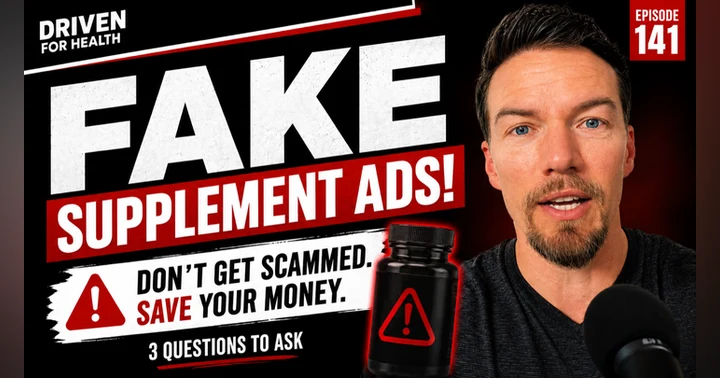
You're scrolling before bed. It's been a long day. I mean, it's like eleven, maybe even midnight. Meetings back to back. Shoot, you probably started at six something, like I did today. I had to wake up and get my kid to his first official cross country practice. I was [unclear]. And here we are, recording our podcast at seven twenty-seven in the morning, because why not? I've got time and let's go. It's been a long day, right? You might have a flight tomorrow. There's dinner you barely taste, you probably eat standing up. Think of Dave from episode 139. A video stops your thumb. A woman looks like Oprah Winfrey, or you got a dude that looks like Joe Rogan, or heck, why not Elon Musk as well? Because why not? Probably sells these things. They're sitting across from a man in a white coat, and this video starts talking about this pink salt trick. She says, or they say, that it melts fat away faster than Mounjaro does. That's a GLP-1, similar to Ozempic. And it's a fraction of the price. $19.99. It's in a green bottle. The price is $300, or it's $200. It doesn't matter what the price is, but it's just this flash sale. Her voice sounds spot on. Her face looks pretty good. It looks like Oprah, or Joe, it looks exactly like it. Every part of this sounds real. You've tried things before that didn't work. This one feels a little bit different. There's just this trustworthiness. There's this convincing, in a sense. There's this challenge of getting someone to actually know, like, and trust you, in a sense, on this video. But it's not real. Oprah, Joe, Elon never made that video. Somebody put that video into the feed, and they built her out of code and put words in her mouth that she never said. They built her voice the same way, and here we go. It took enough pieces stitched together to fool every person scrolling on Meta at eleven o'clock at night. By the end of this episode, you'll know how to catch one of these before it takes your money yet again. And we covered this in episode 139 as well on Driven For Health Podcast, to help you save your real hard-earned money and don't buy those 30-day military challenges or these questionable supplements. We don't want any of that. You'll know three questions that catch every version of this scam — not only the ones wearing a famous face, and ones that don't and they're just really convincing. This is Driven For Health. I'm Coach Brian Parana. This is episode 141. As I mentioned and alluded to in the beginning, this is a two part series. The companion was episode 139 on fake workout ads, the AI generated fitness that's going around. This one covers supplements and nutrition scams that you need to watch out for. And this con isn't new. The mask that it wears has just changed over time. One of the big reasons why I wanted to do this two-part series for you guys is to help you pay attention to what is really happening in the actual space of online marketing. I have seen this happen so much. I get constant DMs about, hey, should I try this thing or do this workout series or whatever. And at least for the workouts you're moving your body, but for these supplements you literally are buying things that you don't know what is inside them, and that's a big problem. Now, for decades, companies have sold fake supplements and celebrity endorsed products to sell you weight loss pills. They used to just lie in the ad copy. Now they have been able to build videos and audio that sound exactly like whoever the person they're stealing from is. Because the tools have changed and the target didn't. Tired men, guys that are not paying attention, and they just want a solution. Just tell me the easy way out. And unfortunately, the easy way out is you just have to be consistently doing the right stuff over a long time to lose weight. And I have gone through that to exhaustion at this point, at 141 episodes, of what you have to do to do it. Episode five starts the nutrition pyramid, episode seventeen starts the strength, muscle pyramid. And so these are things that you have to go listen to, those series, and figure out. The guys that run these companies, they lead sales teams. They close deals other people walk away from. They will keep people on the phone exhaustively to get them to pull out their credit cards. They do not let people walk away. And none of that protects you in these situations. If anything, it makes you a better target, because you're used to just trusting your own — what you read, how you see people and understand them. And like, we have this gut intuition as humans. We see people, we can evaluate if they're trustworthy or not straight from the get-go. And they understand human psychology, they understand psychographics, which are like buyer behaviors, they understand marketing sales tactics. And this has been done for — internet marketing's been around for what, two to three decades now, in a sense, since the nineties basically. And here we are with a very polished, enhanced AI process that builds these things, say the websites and all, and the ads. They are building this trust from the get go. They have strong hooks, they have strong layers on how they go about putting it in. Now, one of the reasons that got me to even do this: I've gotten a couple recent DMs on a variety of different topics on the market, like FitSpresso. They sent me a link and asked me if it's real. And another guy tells me about a meal plan he signed up for because the label called it healthy. It turns out it has a lot higher fat than what he was already eating at home. Why are we buying this more costly 500 calorie meal that's $14, $15, that takes us not in the direction that we want in our nutrition and makes it actually harder to figure it out? A third guy asked me about a supplement his buddy swears by, the one with the countdown clock and the doctor and the white coat. A different product every time. Same question, though. Is this real? Is this going to actually get me the result that I want, or is it just gonna be money I'm throwing away? Of course, I'm a coach, I'm not a doctor. Nothing here is medical advice. Always got to throw that out. So today let's jump into the fake face on these ads, and I'll show you the trap that's built behind the sale, and then give you three questions to pay attention to that will catch these ads in the act, so to speak. Number one, the actual face. October 2025, a video started circulating online. It showed what looked like Oprah Winfrey. She sat with a man presented as a doctor. We could even say maybe it was Dr. Oz or something like that, right? Because they worked together, in a sense. Now, the product costs over $300 a bottle. The seller pitched it as a cheaper stand-in for Mounjaro, the GLP-1 drug. One buyer had it shipped to her house. It arrived with no paperwork. The return address on the package traced back to a car shop in Florida. She never found the company again. Oprah herself came out and said someone is misusing her name. This is not a marketing complaint. This is not something that she's associated with. That's a woman finding out her face is being used to sell products she's never touched, has a contract for, never agreed to, wasn't collecting any cash. And somebody took what belongs to her, her face, and then put a price tag on it and started selling it online. And she wasn't careless either. She did what most of us would do. She watched a video that looked credible and made the decision under a minute. And this is the woman that bought it. And if you've ever trusted a product because of a familiar face behind it — that's exactly why these ads are being created, and we use celebrity endorsements to sell products. We've been doing that for a long time in the marketing space. Number two, the unlucky buyer. The Better Business Bureau tracked this exact product, the pink salt trick. It logged over 170 consumer reports in two months, spread across 34 states. An Illinois woman spent over $400. Sellers then contacted her with offers to spend more. They will literally call you because of the funnel and start asking you for upsells. A Florida buyer paid $300.95. She got a call from someone posing as a health coach, pushing her to spend $800 more dollars on more supplements. Hundreds of people are going through this process and losing money on whatever's in that bottle, because it's not necessarily even pink salt sometimes. In fact, say FitSpresso — FitSpresso was, take two pills thirty minutes before you drink coffee in the morning. You don't have to do anything and you're gonna lose weight. That just doesn't sound right. Okay? What it's supposed to do is that the FitSpresso, whatever's in there, is supposed to activate with caffeine and start boosting your metabolism to burn extra calories. Well, we know exercise burns extra calories, but you gotta actually move. Caffeine can burn some extra calories, but it's not this exorbitant amount of calories that ends up burning pounds of belly fat just 'cause you start drinking coffee. So these are real losses in a matter of weeks. The company behind the product denied authorizing any of the deep fake videos. They blamed independent affiliate marketers running their ads. That claim might be true, but it doesn't change what happened to the people who paid the money. And this is a system that gets built to catch as many tired scrolling people before anyone catches on, so they can make a couple, a lotta zeros, in a sense, and get away with it and disappear. Number three, the playbook isn't only running on Oprah. It isn't just on weight loss. A separate company used Steve Harvey's face to sell a product called Vision Hero. An eye supplement, with nothing to do with weight loss, but regardless, it's still the same thing. The ad routes through fake news sites, then lands on a sales page claiming the product reverses vision loss by 82% in serious conditions like glaucoma and cataracts, right? So the common eye issues where you just can't see. Now, none of this is true, but it's the same cycle that is aimed at a different fear — of losing your sight. Because holy cow, do you want to wake up tomorrow and not be able to see? That is a major life change that you have to deal with, straight up. So it's the same fake face, just a different wrapper product. And you see these all across the board. Shoot, even on my YouTube, I'm getting all sorts of different ads on HVAC, or on garage floor sealers, or the insurance ones are the best. They have these productions where this guy's on stage talking about this, that and the other, about how you could save percent, and in these states you're getting overcharged. And then it has lots of cuts, scene cuts in it. And it goes from this more authoritative guy in the front, and then when it goes to the people in the audience, there's actual mics on their face. There'll be like fifteen people with mics on their face. That's a tell that this isn't real. This wasn't filmed in a conference and someone was doing it. So yeah, you have to pay attention to these things and these methods. Number four, here's the point that should change how you see all of this. None of it needed AI to begin with. Back in 2012, the Federal Trade Commission went after a company called Central Coast Nutraceuticals over an açaí pill and a colon cleanser. Shoot, if you know those ads, those were booming back in the day. This ad claimed that Oprah Winfrey and Rachael Ray personally endorsed the products. There's no video, no deep fake, it's just a lie. It just literally borrowed their names, typed into the web page. The company settled for $1.5 million against roughly eight million dollars in consumer harm. Hoo wee. So they still made out, and they still got things taken from people, and they still made profit. All right. Back then, someone could sit behind a computer keyboard and just type a lie, because it was cheap and easy to do and hard to trace. Today, people use the video model and do the same thing, with better production value, because AI is definitely moving that way. The intent hasn't moved in decades. So we see these perpetual scams pop up. Açaí berry, this magical Amazon berry that no one's ever heard of. This secret, deep dark chocolate that has 99.9% cacao that lights fat on fire, right? You can just make stuff up off your head, and then all of a sudden convince people that it would work. So in 2012, it was just a keyboard, and now it's just AI models running stuff. Number five, if you were anywhere near a gym in the 2000s, you know the name Hydroxycut. It sat on the counter at GNC. It sat in gym bags across the country. A lot of guys our age took it without a second thought, because everyone did. And Health Sciences makes Hydroxycut. Now, in 2010, the FTC settled with them for five point five million dollars in consumer refunds. The case centered on false claims — weight loss, colds, the flu. All five products made promises that they couldn't back up. Part of it involved actors dressed up and telling you that the product was clinically proven. If this sounds familiar, especially Hydroxycut — the part that guys never heard about, that the FDA had already pulled Hydroxycut off shelves once before, back in 2009. The agency had received 23 reports of serious liver injury tied to the product. Jaundice, seizures, cardiovascular problems, heart conditions. One of the cases was a nineteen year old who died in two thousand seven. Twenty-three people, one kid who never made it home. And that happened while the bottle sat in major retail stores and in gym bags across the nation. So every case in this episode has a cost of money, but also on one's health. So you have to think twice about doing this stuff. What the trap is — let's go to FitSpresso, a weight loss coffee supplement my own audience asks me about constantly. The terms are buried in auto-billing clauses. It enrolls you into a monthly shipment without a clear yes from you on the checkout. So you buy one bottle of this stuff, turns into a credit card charge that seems endless and hard to get out of. That's what we end up seeing, and that's the version that I'm hearing a lot of guys do. The guys grab a bottle because the ad promise is an easy fix, and three months later they're still getting charged, right? And it's usually 97 or 47 or 19 or 17, something like that. Those are typically marketing numbers that are advertised to have, because it appears to be more cost effective and efficient to do that. And oftentimes these products pile up because people forget that they even were getting charged, or they bought them and they stopped — they don't know how to unsubscribe and cancel. And again, it's designed that way. As I went over in episode one thirty nine, same difference with some of the fitness stuff. It goes into back end sales processes and subscription. Number two, the guarantee shrinks after the money is already in. FitSpresso's file with the Better Business Bureau shows 23 complaints in the last three years. 20 of them never got a response. A customer service that ignores four out of five complaints was built to ignore them. Multiple customers reported the refund window changed from 180 days down to 60 without a clear heads up. On top of that, customers reported charges that they never approved, and a product that just doesn't work. So they would give you this — you have a hundred and eighty day guarantee to be able to refund the product if it doesn't work. Well, again, people forget about it, or they don't read the fine print, or they just make it really hard to jump through hoops to be able to get it in the first place. There's no clear number or email to cancel the thing. Now, this doesn't only happen with small operators running ads from a domain nobody's heard of. It also happens with bigger ones, like Noom. Noom is a diet and weight loss app millions of guys and people already have on their phone. It paid fifty-six million dollars in a class action settlement in February of 2022. The case centered around three things: hiding the trial and auto enrollment terms, restricting cancellation to a chat with a virtual coach, charging non-refundable lump sums up to eight months in advance. Hoo wee, can you imagine signing up for this? I don't know how much Noom is, nine dollars a month or nineteen dollars a month or whatever, something like that. And then you get like an eighty, ninety dollar bill charged for multiple months of service. Then you're trying to cancel it through a chat window that keeps offering you a discount instead of a cancel button. Company builds in a lot of friction on purpose so that you give up. You don't have a lot of time to deal with this, so that you just end up giving up and forgetting about it, and then you get another charge. Every day you stay in these programs costs you money, and that then makes them money. This is the one I want you to think about. Guys assume the well-known brand is a safer one, and the size of the logo has never been proof of the honesty built behind it. The court looked at the same complaint guys make about FitSpresso — canceled terms, a trial that just keeps running your bill up. And the court agreed enough to make Noom pay $56 million to cover it. That's a big one. Now, the FTC's own record shows this is a repeatable business model. In twenty sixteen, the agency went after a company called Direct Alternatives. Its supplement brand was Original Organics, and its products were named AF Plus and Final Trim. Sounds like all sorts of different fat burners and testosterone boosters and sleep aids, and you name it and they do it. All sorts of different vitamins and minerals that boost life and health and performance and whatever. Their ads claimed the pills worked while you sleep. They promised $80 gift cards that never arrived. Their risk-free trial required that you pay return shipping yourself. Can you imagine that? Like, hey, it's risk-free, then if it doesn't work you can send it back. But they forget to tell you it's gonna cost you ten dollars at the post office and all this effort to do that. Or you face a $79 and ninety cent charge on top of all that. And the company enrolled buyers in a $24 and 95 cent monthly plan that they didn't really know or agree to or understand what was going on. The judgment against them ran $16.4 million. And again, this is the same processes that FitSpresso, Noom, and a lot of others are doing. The açaí pill, the diet supplements, the diet app. So we have to pay attention. This is the DM I get more than others. It usually comes late at night — so I guess, see the time tag around eleven or midnight or so. And the guy just sends me these links and asks if it's legit. And again, consumer beware here. I just call out, hey, this is really heavily marketed, and you need to pay attention to this. So I have three questions for you to help figure out. Number one, the fake celebrity, the fake doctor, the fake FDA approval — a company can do all three of those on the bottle. That's telling you something. All right, we have to see these things. Or it says it has good manufacturing processes, but it doesn't have that certified label on it. Or maybe it does, and they're using it anyways without actually going through the real processes, because they just bought something in China, some pill combination or a supplement combination, and they're selling it to you in their blended proprietary blend, right? When something is a proprietary blend, that should raise flags too for you. So, does it have a real person behind it? Does it have this sellable name to it? Are there results of the product selling you, like, lose this much weight in this much time? You know, what's in the bottle? How does the company sell it? And could this product just stand on its own without having someone's face? These are just simple things to start thinking about in this process. Now, a supplement company that's proud of its own product signs its own name to the claim, and there's a whole bunch of backing that goes for it, with someone that actually stands behind the product that they sell. What drives fat loss is unglamorous and repeatable. Real food, you're understanding your calories, you understand nutrition, you're having protein at most meals. Most guys are gonna eat 400 to 600 calories most of the time, three to four times a day. We don't need an app, we don't need proprietary blends. The food on your plate is what does the work. And you heard that in episode 140. Literally, Jamie lost 38 pounds in the Call to Rise 100-day fat loss challenge. Why? Because he did nutrition, fit into his busy everyday life. And if you want to hear his story, literally just go to the previous episode. It's pretty exciting. He's one of my biggest losers that I've had. Just a serious amount of focused effort to get an amazing result. All right. These are the secrets that I've shared with you on how people get real results. All right. So it's the same answer that we go back on every episode. And the thing that I personally sell is a coaching implementation program that actually drives people to be successful, that causes you to take different actions and think different ways about what you put in your mouth. Not just wake up and take two pills and get on with your day and not think about whatever's coming at that client meal that night, and you just eat the giant ribeye, have the beer and whatever else, the dessert too. That's not going to help you. Here's what I want you to do before you ever pay for a product like this. 'Cause even with Jamie, I had to tell him, you're not allowed to buy supplements without me. He bought some honey thing for like 60 bucks — so, enhanced honey. What are you doing, man? Or these protein goo packet things. I'm like, dude, you're paying like five dollars a pound, in a sense, for protein, when we can just buy chicken for less than that and eat real food. Like, let's just stop and think about what's happening here. And that really helps build all of this stuff into the reasoning why you would buy something in the first place, or do something in the first place. It's thinking, right? So what we want to do is: can you find a real company name, a real address, and not just a landing page with a countdown clock? Number two, second question, can you find reviews somewhere other than the seller's own website? Like, look it up. "FitSpresso, does this work?" "FitSpresso, is it legit?" "FitSpresso reviews." And you'll start to see that come out. There's lots of websites that can disprove things as well, like Snopes and whatnot. Number three, can you find the cancellation terms in writing before your card gets charged? If the answer to any of these is no, let's run. Close the tab, press the X button, and do not pay for the FitSpresso, the pink salt bottle, the testosterone booster, all these supplements, the pre workout thing that melts fat in five days or whatever. Whenever we have these claims, that's it. This is what I tell everyone who sends me these things. I don't wanna lecture them for almost buying it. We just wanna go through these three questions — that buyer beware, and educate consumers, so that they do not buy this and waste their money. And I just want you to think about these things. If you're on the road and you end up running into this situation, now you're more equipped to be able to be successful in this process of not spending money where you don't [need to]. Because it adds up. Twenty dollars here, fifty dollars there, three hundred dollars there, for these things that you're trying — the solution is weight loss, healthier lifestyle, that we have to address other issues. And that's where you get real life coaching in of, how do you — what's your relationship with food? What happens when you go to — coming up is Labor Day here. When you go to a Labor Day party, barbecue, whatever, how do you act around food? Like, if those aren't questions you're thinking about, then that might need to be, if weight is a challenge. So don't buy these things. Please run, get away from them, and don't let it take money out of your pocket. All right. And if you are on them now, please cancel. Stop putting money into other people's accounts that have just giant supplement businesses that sell things to people. All right. Again, I'm not a doctor. I'm just a coach, but I've been in the game for 23 years helping people. And if you have someone that keeps talking about this, that and the other, share this episode with them. Share episode 139 on the fake workout ads as well. Like, be informed. Don't make buyer decisions when you're in a moment of weakness and stuff. So please share. And I look forward to keep doing this with you guys in these episodes. Coming up, a little teaser, we're gonna be doing a what-to-order series at different restaurants. So you're gonna get the good, the bad, and the ugly at different restaurants that you can eat on the go. That's a huge thing that a lot of my guys have to deal with, with travel and all. So that's an episode series that's going to be a lot — it's going to be well over 10 episodes, different restaurants, so that you can be informed on how to make better choices. So I hope that this all works. If you need additional help, certainly I have the "Lose Three Pounds in Three Days." The link will be in the show notes. And then we have also the Call to Rise, an actual implementation program on the process of actually losing weight in a sustainable way in your world. So that's thecalltorise.com. I look forward to keeping these going. Thank you so much. Off we go.


 YouTube