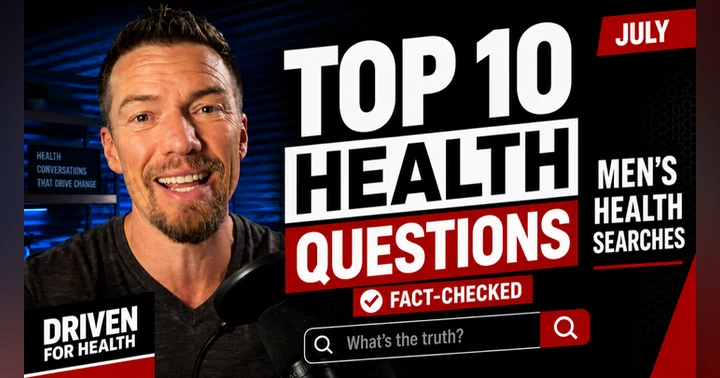
I Fact Checked The Top 10 Health Questions Men Google in July - 138


 YouTube
 Ten health questions get typed into Google by men over 40 more than almost any other search this month. One popular answer says skipping sex for a week spikes your testosterone by 45%. That claim traces back to a study that got retracted over twenty years ago. Coach Brian pulled the real search data and checked the real research behind all ten questions.
(Have you ever built a health habit around something you saw online, only to find out later the science behind it was wrong? Get the real research and a plan that replaces the guesswork at www.thecalltorise.com)
This episode runs through ten of the most searched men's health questions right now: testosterone and TRT, GLP-1 drugs and muscle loss, belly fat, training splits, Zone 2 cardio, fiber, wearables, blood work, and the mental health conversation most guys skip. Coach Brian names the real study behind each answer and gives one action step per topic. The whole episode runs under twenty minutes.
By the end you'll know which of these ten questions apply to you, and the one change to make first.
In this episode:
- Two testosterone myths worth knowing, from the FDA's new move on TRT to the "skip sex for a week" claim that's false
- GLP-1 drugs and the muscle loss they don't warn you about
- Why your beer belly comes from more than calories
- The 3-3-3 gym trend, tested against real research
- Why more guys are trading treadmill sprints for Zone 2 cardio
- The fiber gap most men have, and the real daily target
- What your wearable data means and the blood tests biohackers run that a standard physical skips
- Why the mental health part gets skipped, and the one sentence that starts to fix it
The Call To Rise is a 100-day fat loss challenge for driven men ready to take their body back. It combines strength training, personalized nutrition and real accountability. Most men drop 20 to 30 pounds and rebuild the confidence that comes with it.
This program also works if you are dealing with high blood pressure, high cholesterol or Type 2 diabetes. It was built for those men too. Many men see those numbers move in the right direction alongside their weight loss.
Inside the program you also join a Brotherhood of men doing the same work. Together you build a body you're proud of and start leading like the man you already are at work.
This is your wake-up call to rise. Learn more and apply at www.thecalltorise.com
Common questions this episode answers:
- How many days a week should you train each muscle group after 40?
The American College of Sports Medicine says train each major muscle group at least twice a week. Aim for about 10 sets per muscle group weekly if you want growth.
- Does skipping sex for a week raise your testosterone?
No. The 45% claim comes from a small 2003 study that got retracted. No study since has repeated the result.
- Do GLP-1 drugs like Ozempic cause muscle loss?
They can if you are not careful. Resistance train at least twice a week and hit your protein target every day to protect your muscle while you lose fat.
- How much fiber should a man eat in a day?
Aim for 38 grams a day. Most men only get about half that. Only 5% of men hit the recommended target.
- What percent of suicides in the US are men?
HeadsUpGuys reports that men make up roughly 75 to 80% of suicide deaths in the US. Fewer than one in five men had seen a mental health professional in the year before their death. That number is closer to one in three for women.
Want help applying this to your own health, weight, energy, or lab numbers?
Coach Brian Parana offers Health Hot Seat coaching segments for men who want a clear next step with nutrition, fitness, weight loss, blood pressure, cholesterol, A1C, or daily consistency.
Learn more about The Call To Rise, a 100-day coaching program for driven men over 40 who want to lose weight, improve their health, and rebuild confidence:
To connect with Coach Brian:
brian@brianparana.com
Disclaimer: This podcast is for education and coaching support only. It is not medical advice. Always work with your physician before changing medication, treatment, or medical care.