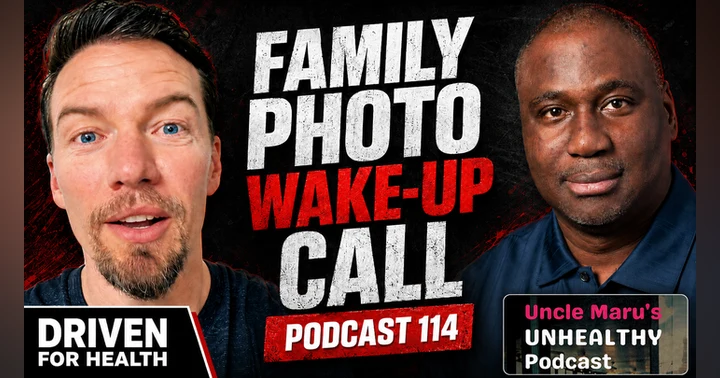
The Wake-Up Call That Finally Gets a Stubborn Man to Take His Health Seriously with Uncle Marv - 114
You know what to do for your health and you still put it off. Coach Brian joins Uncle Marv on The Unhealthy Podcast to talk about stubborn men and how to salt the oats. He breaks down his Core Four of nutrition and movement and hydration and sleep. He also shares how men stay consistent while they travel and run a business.


 YouTube
 How do you get a horse to drink water? Coach Brian says you salt the oats. That is the approach he uses with stubborn men who already know what to do for their health but never act on it.
Coach Brian Parana joins Uncle Marv on The Unhealthy Podcast to talk about what happens when business owners and entrepreneurs pour everything into work and family and stop paying attention to their own health.
(Do you already know what you should be doing for your health but keep putting it off? See what finally works at www.thecalltorise.com)
Brian breaks down his Core Four: nutrition, movement, hydration, and sleep, and why these four things matter more than any extreme diet or workout plan. He talks about coaching men in their 40s and 50s, fat loss after 40, and why most men already know what to do but struggle with consistency rather than information.
The conversation also covers stress management and work-life balance, and how men running businesses or working demanding jobs can stay consistent with fitness and nutrition while traveling or managing a packed calendar.
Brian shares examples from inside The Call To Rise, his 100-day coaching program built around structure, accountability, and brotherhood, including a client who walked his way to a 38-pound weight loss and another who kept his results while flying across the country for work.
If you run a business, lead a team, or carry a lot of responsibility and want a straightforward way to improve your nutrition, build energy, and get back in shape, this episode covers how that works in real life.
Main Topics Covered
- Fat loss after 40 and realistic timelines for losing weight
- The Core Four: nutrition, movement, hydration, and sleep
- Building real energy and focus instead of relying on caffeine
- Staying consistent with fitness and nutrition while traveling for work
- Middle gear mindset versus all-or-nothing dieting
- Why brotherhood and accountability beat going it alone
- Client results from inside The Call To Rise
- Why a 100-day timeframe works for lasting change
I'm looking for a Health Hot Seat guest for Driven For Health. This is a free coaching conversation where I walk you through what is holding you back with your health, your weight, your energy, and your consistency.
The Call To Rise is a 100-day fat loss challenge for driven men ready to take their body back. It combines strength training, personalized nutrition and real accountability. Most men drop 20 to 30 pounds and rebuild the confidence that comes with it.
This program also works if you are dealing with high blood pressure, high cholesterol or Type 2 diabetes. It was built for those men too. Many men see those numbers move in the right direction alongside their weight loss.
Inside the program you also join a Brotherhood of men doing the same work. Together you build a body you're proud of and start leading like the man you already are at work.
This is your wake-up call to rise. Learn more and apply at www.thecalltorise.com
Listen into Uncle Marv's Unhealthy Podcast here: https://www.unhealthypodcast.com/
Want help applying this to your own health, weight, energy, or lab numbers?
Coach Brian Parana offers Health Hot Seat coaching segments for men who want a clear next step with nutrition, fitness, weight loss, blood pressure, cholesterol, A1C, or daily consistency.
Learn more about The Call To Rise, a 100-day coaching program for driven men over 40 who want to lose weight, improve their health, and rebuild confidence:
To connect with Coach Brian:
brian@brianparana.com
Disclaimer: This podcast is for education and coaching support only. It is not medical advice. Always work with your physician before changing medication, treatment, or medical care.
- The line that struck out to me the most from this conversation is pretty simple. How do you get the horse to drink water? You salt the oats. That's it. And so that it actually drinks when you lead it to the water. That's what a lot of men over 40 need to hear about their health. They don't need random tips, extreme diets, all or nothing approaches, a plan that just doesn't work with their lifestyle, the responsibilities that they have at home, work, and beyond.
- But what they do need is an honest approach that helps them focus on what not taking care of themsel is actually costing them. And that's what we're gonna be talking about in this conversation on Driven for Health episode 114. You're gonna hear my conversation I had with Uncle Marv on the Unhealthy podcast. We talked about what happens when a man's health is just not where it needs to be at, especially in his 40s and 50s.
- Overweight, maybe chronic illness, not happy, no energy with about how he looks and feels. We go through the core four nutrition movements and what middle gear mentality means. It's a common thing that I share a lot for people. The question I want you to think about during this episode is this. What is the next best thing you can do for your health journey right now? And that's just part of what I call my aim framework, my aim principle, so that you can make sure that you move toward the direction that you need for yourself.
- Hello friends, welcome back to the unhealthy podcast. I'm your host, Uncle Marv. The show where we talk about those healthy and unhealthy things that we just can't seem to fix on our own. Today we're talking about something a lot of us quietly struggle with. Staying healthy while we're responsible for everything else.
- Business, family, life, specifically us men. And this is actually a situation where I am right in the segment, the target audience for our guest. My guest today is coach Brian Piranha, founder of The Call to Rise, a fat loss and lifestyle empowerment program for busy men over 40. Uh Brian, you actually put an emphasis here on especially husbands and fathers who feel like their health has slipped while Laf got busy.
- So, first of all, welcome to the show. >> Thanks for having me, Uncle Marv. And second, why would you put that emphasis on husbands and men who have let their lives slip away? >> Well, I myself am a husband. I'm a father and I'm a man. I am 43 years young and this decade seems a little bit different than other decades of my life.
- The 20s, the beginning of my 20s, how far do I need to run today? It was the hardest question that I had to answer for half of it. Yeah. >> Then I got into business in the later 20s and in the 30s was felt really good with business. Certainly there's different iterations of how I present myself in terms of being a personal trainer or a gym owner.
- Then I shifted into online coaching and now moving into my 40s. Wow, life is accelerating and the responsibilities are stacking up even faster. And goodness gracious, it's and that's why focusing on 40 plus has really shifted my my thinking, my target audience because I am that person. If I were to not pay as much attention to my health, that's something that I've just prioritized.
- It's what I do for a living. So, it's a congruency, right? I have to look good and feel good and look the part so I can coach other guys to look and feel their part of the healthiest best version of themselves. >> All right. So, let me start with a couple of basic questions. First of all, were you an athlete growing up? >> Yes. I've always been an athlete.
- I've always been in motion. >> Okay. But does that does that mean like sports in school, high school? Did you play football, run track, anything like that? >> Yeah. Let's break it down quickly. So played baseball when I was in youth and >> okay >> I was I was kind of afraid of the ball kind of never wanted to go up and swing the bat in a sense I always wanted to hit the home run but I didn't want to get hit with the ball right >> I played basketball love basketball but I had a hard time with my hands catching the ball and fast play actions when they
- were going up for the the the layup and all of a sudden here comes the ball to my face and I'm like getting I'm ready for the rebound. And they're like, "Why didn't you catch him?" Like, like, "All right." So, I started running. My one of my best friends still today, Dan Smith is his name. I saw him.
- Today is what, Tuesday? I saw him yesterday. So, we've had a lifelong relationship. And he invited me out. We we did band together. He invited me out to run. He was running cross country. I did not I had no interest in running, but in track, he said, "Hey, let's come run track with me." I said, "Okay." And then that that changed. So I I did running.
- I got into running throughout high school. Then into college, I ran at college at the university background. I shifted into endurance long distance marathons. That transitioned into triathlons, which then I started having kids and realized I didn't have time to train for hours all the time.
- That shifted in as a personal trainer. really wanted to be the best that I could be for my clients. So that shifted into CrossFit and gym ownership, which then shifted into walking and lifting weights in my 30s. And now at 43, my 16-year-old Levi, he ran the Akran Marathon last year and he challenged me to the Akran Marathon this year.
- So I am getting my body my 23y old body with a 25year-old brain starts challenge >> on training and get endurance sports and activity back in my life. So >> okay. >> All right. Well I I will I will let the audience know I I've I've said before I was an athlete most people never hear the full story. though football, basketball, track all throughout my junior high, high school years.
- Almost played in college. >> Okay, >> that's how good or how not good I was, depending on how you look at it, but did continue to play basketball recreationally, but not your typical, you know, wreck league, you know, gym run. I >> found guys that either played ball in college, high level. So I played with them all the way up until age 48.
- >> Wow. >> Until I said, I'm guarding a 24 year old, a dude half my age. What am I doing? >> Right. >> And I said, "That's it. I'm done." >> Right? >> And I've always said when I was done with sports, I would just walk away. You know, kind of like what I've done in other areas of my life. You know, I have a season.
- When that season's over, I'm done. I don't look back and wonder what could have been. >> You played that one out pretty far. People quit after high school. So, well done. >> So, I I get the, you know, always an athlete stuff and I did play through my 40s and I felt the difference >> of course >> in my body. probably not like other 40-year-olds uh who are not as active, but I imagine that for a lot of them it's not that it's abrupt because I think most of us as we go through life things are gradual.
- >> You don't just wake up one day and it's like, "Oh, I my body doesn't function like it used to." It's like, >> you know, a year ago I could do this. Five years ago I could do this. When you're meeting the guys in their 40s, how does how do they explain to you their changes? exactly that they identify with a high school athlete and that's that identity piece of yeah I used to work out and and all this stuff and maybe they did in their 20s but then we start to see the unfolding of life of college or career path and family and then kids and home
- ownership and car ownership and responsibilities and then I totally get it now being 43 what midlife crisis is like what in the world And the average male age is 76 is when like we're done here on average. You're like, "Holy cow, what's going on?" And if especially in those last that that that that 30 35 to to 45ish and that things aren't going well and like health-wise or any other I can see why you have this abrupt want to change something because you realize okay I I might be 40 50 70% done with this life and I need to take some
- action and that I mean I I think of that a lot now and I told you what I thought when I was 20. How far am I gonna run today? >> Yeah. Yeah. So, okay. I just had another question pop in my head, so forgive me for this point. >> So, if I if I have met you at 48 or 49 or even 50, you're just now 43. The question becomes, okay, you probably haven't experienced all the things in the 40s that a lot of us others have.
- How do you respond to that? Well, I I've been coaching people for since 2002, standing in front of them, talking to them, and my personal training job when I first got into it, I was at a higherend club in the area. And I exclusively did personal training and that created, you know, there's a level of capac capability to be able to afford personal training once, two, three times a week.
- So I was working with 30, 40, 50 year old business professionals, male, female, and talking with them every single week. Had relationships with them and I understand and under I understood what they were going through and then how do I help this person? So the whether I'm 43, I don't think it really matters because I've my oldest client was is 84 and I've >> Wow.
- So, I've I've worked with young, old, healthy, sick, chronically ill people who know a lot about this, who don't, who think they're busy, who are actually are busy, who they own businesses, they are stay at home. It it doesn't matter. All walk healthy chronic illness, diabetes, somebody had one kidney, one lung, like there's so many brain cancer, all all sorts of these things.
- So the the say the experience factor here is very high. >> Okay. All right. So now we can ease back here. Now I assume that your target has always been men in general. >> Not necessarily. I I'd say the majority of my career it's it's been 6040. >> 6040. Okay. So everything I've been reading about you lately has all been you know men over 40.
- So, is that something that you're shifting and targeting only or is it just like a core and you're still doing the other stuff? >> Well, if you were to go to brian prana.com, you'll see two things. cuz I have a a onetoone program and then I have the call to rise which is my men's group 100 day program and they serve a little bit different functions of one's a onetoone and the men's is more of a a men's group but it's 100 day and there's still a significant amount of one-on-one opportunity in there but it's the the the container is that you're going to be
- around other men that are going through the same challenges that you are because they've literally every single guy in there is having basically the same problems. So if you can be inspired and motivated because this person did the thing that they're supposed to do today, then oh shoot, I should be able to go do that thing.
- And so, you know, we can lean on that natural competitiveness of men. We can lean into that that drive of wanting to be, you know, alpha in a sense, but not like overly masculine or whatever. But ultimately having that that that legacy of being a healthy person. I want to be remembered as my four kids. They oh my dad was always healthy, fit, made great choices, still had ice cream with us, but we did so many fond memories of of my father being in my life.
- >> Okay. So I do want to do a quick clarification here. So, I did mention Call to Rise and that's the website that I was going to reference in the link there. First thing I want to tell people is don't just go look for Call to Rise because if you go to the YouTube channel, it's going to come up to a rock band from the Netherlands.
- Uh, so I will have the link in there. It is thealltorise.com and your other site, Brian Piranha.com, which I did not look at before. basically says, "I help uh overweight entrepreneurs and business leaders overcome poor health situations through scienceback coaching methods." So, we'll have the link to both of those in the show notes. All right.
- So now let's get to the let's get to the I guess the starting point because there are several listeners to my show I know that they are in that range 30s 40s 50s who are you know let's just say 20ish pounds you know more than they want to be or what they should be you know they look back and they're like man if I could just turn the clock back 10 to 15 years a lot of what you talk about is just the the natural course of life.
- We get busy with work. Uh we get busy with family and you know there's only so much time in a day, >> right? >> But as as guys come to you and get to the real root of what's going on, what are some of the common things that you hear beyond those life things? >> Right. Well, well, we'll certainly say that everyone I've ever worked with is B U S Y, capital B, capital U, capital S, capital Y, right? They're busy, right? So, that that is a context of it's all relevant and relative to their own light. But some of the other challenges
- that they're having is their own health. 20 pounds overweight can put you into that category of being in significantly more likely of chronic illness. Diabetes, high cholesterol, high blood pressure, those are cardiovascular heart disease type things. And not a single person wants to be a walking heart attack or a diabetic and have to measure their blood sugar levels every day or poke themselves with needles for insulin or whatnot. Not fun.
- And so those are some of the challenges there. they have the genetic and hereditary issues that might be going on with however their father was a gentleman I spoke with even yesterday his father was over 400 plus pounds and so there's this huge identity piece and this this this nuance around how his father took care of himself and how he should but he was 260 pounds at 5'9 he too heavy so and he's already been under 200 00 since co but then he gained it back because he a multitude of other reasons of the one day that this thing happened and that was the turning
- point that he did an about base from where he was at at 195 and started marching his way back up to 260. And there's so many different life demands that that came up in this gentleman's world. You've got kids. There's gentlemen in my program. There's two of them right now that they're teenage boys are giving them a run for their money and and putting up a lot more challenge.
- Fortunately for me, my kids are generally pretty good. They get good grades. They're active in sports and activities and all these things. And I haven't had to experience some of those challenges, but that that parent father factor is definitely there. and to to help to take care of in my house there's 15 relationships that I'm managing in a sense with all my family members there.
- So those are some of the things and then we got business stresses that come on and the I'm sure I know you're dealing with it with it is the incredibly rapid rate of expansion with AI. Yeah. How can you keep up right as humans? We really can't. We're not adept to be able to do that. And it's life in plaid.
- If we've ever seen the movie Space Balls, and most guys could raise their hands to that, but we're going in plaid speed, not light speed, but plaid speed. And and so those are big challenges that are showing up in men's lives or maybe even a relationship with their their partner, spouse isn't as good as it could be in a sense.
- And it can all circle back to their health not being a focal point of taking care of themselves first to be able to take care of all those other responsibilities in a sense. >> Yep. It's a lot and life moves fast as Ferris Beller would say through that. So now let's get to the core because a lot of what you talk about isn't much different in terms of simplicity the way we understand stuff, you know. Yeah.
- move more, eat less, but there's a little more to it than that. Uh, you talk about the fact that men over 40 of of course can, you know, lose fat, reclaim energy, and then you talk about the levers that matter most. And I guess it's four >> four tiers that you talk about >> core four. So, we've heard this on your podcast.
- I've listened to a couple of them and heard the same nuance of we have nutrition, we've got fitness or movement or exercise, however you want to. I like to say just movement because it can quantify from just walking to actually getting into the gym or playing sport or whatever. We've got hydration and sleep.
- Those are the core four that I see on a regular basis. And there's systems and processes that are individualized to every single person. But the general protocol is built around sciencebacked information that gets distilled and implemented into the easiest way possible for that person. And that's my job as the coach, the lead of the team, of me and my client to lead and guide them to making the next best choice amongst all the crazy that's going on so that we build sustainable systems and processes from the very first day moving forward.
- Now, out of those four, is there one that kind of moves the the needle faster than any of the others? Well, certainly we could always say sleep. Humans are the only creatures on the planet that break sleep on a regular basis. They just won't go to bed. They won't rest. Why? Because life isn't planned. >> Well, and there's late night TV and >> Oh, yeah.
- Doom scrolling now, right? That was never a thing when I was growing up, but there was late night TV when I was growing up or video game. The list goes on. And so so sleep is obviously a lowhanging fruit one, but I spend a significant amount of time talking about nutrition. Most guys can identify with doing some level of activity, whether it's walking, going to the gym, playing some type of a sport or biking or or walking the dog more.
- Th those things can have a profound effect. And in fact, story Andy was in my program from like September, October through the holidays. This guy lost 38 pounds in the 100 day program. And one of the key things that he cited was he walked 10,000 steps a day. And he, as my oldest would say, Levi would say, he locked in to doing 10K a day.
- And that was a had a profound impact. We even talked about on one call and it was it hit me like a light bulb. He said, "I'm in my 89th day of 10,000 steps, Brian. I'm about to take a million steps. I'm holy cow. This is amazing. You're right. 10,000 times 100 days is 1 million steps. And if you would have said that, hey, we're going to take a million steps, you'd be like, that's impossible.
- But because we broke it down into smaller chunks of 10K a day on average and then figuring out how to break it up into his day-to-day life, then he could move more and fit it into his schedule. and he actually found it to be even therapeutic to be able to escape the challenges and the busyiness and all the things that are going on. But so that one's easy.
- But nutrition of helping guys understand what quality food looks like, what a balanced meal looks like is is something that I've ex almost exclusively been talking about for the last 12 years is is I I wore a nutritionist hat for a long time of coaching people through making better nutritional choices. >> Interesting.
- So, of course, yeah, you're right. All the stuff you just mentioned, we've heard in some form or fashion >> before. Everybody starts off with the intention of doing all of those things. But I like to ask the question in your experience, the people that you've talked with and stuff. Where is it that we're making the most mistakes? Because a lot of us start I'll give an example.
- >> Yeah. Yeah. Please. >> 10,000 steps. Okay. I'm like, that's probably not happening with me, >> right? >> I your ring con and >> I bought the ringcon. Now, it me it measures 6,000 steps >> on average, >> and I'm like, "All right, I'll start with that." >> Yeah. >> There are days that I hit it and days that I don't.
- >> Now, I didn't put a goal to myself, so I don't have, you know, 100 days that I'm, you know, shooting towards and stuff, but I imagine that if I did, there would be a day that I wouldn't hit those steps. Now, me, I would probably push on and, you know, make it happen. But I know a lot of people they hit that first failure and they're done.
- >> Yeah. Yeah. Yeah. >> And in my estimation it's it's not a mistake, but people treat it like that. But what are some of the mistakes that you're seeing where we're we're selling ourselves short? >> Yeah. That assuming, right? What do they say about assuming? So, Uncle Marv, what happens is people assume that it the experience is going to be a certain way because of past relationships with nutrition or tracking or clean eating or overex exercising or your 48 years of playing basketball and whatnot. This is these are the the
- context that I have to understand of this person and meet them where they are. a like a phrase that I've used, I haven't really heard it anywhere, but middle gear mentality because we do the all or nothing and we white knuckle our way through all this as men and we got to toughen up and you know buck up and all those type of things and we we really don't.
- We have to figure out some form of three layers of moderation, balance, and flexibility to add into this lifestyle to be able to create a middle gear approach of, okay, you didn't hit 10K today. That's fine. Let's just keep moving on and adjust. Okay, let's look back. Is there an opportunity that you could have say taken another break or invited someone out to do an activity instead of whatever it was? Say go for a walk and then they start to think about okay I could have done this or I could have taken a break here or whatever and that allows some
- introspection in the process because it is a coaching relationship and when the coach leads and ask great questions then we can get this person to change their mindset. So assuming and thinking it the process is going to be there's another story remember this guy was down 25 lbs in 3 months and he told me after he said Brian I was ready to go to battle just not eat for 3 months or whatever not eat carbs or not dah and I just met him where he was.
- I gave him education along the way. I answered his questions as he had them. I gave him logical answers that fit into the context of his day. Then got him to agree upon this makes sense. I can take the next step now because I everyone fails. I already come to the relationship knowing you're going to fail. So it's okay.
- I spend so much time talking people out of their failures. And that's one thing that I've really spent pretty much the last like 15 years is the very first thing I ever talk about on a client call is successes. Tell me what went so well. I know you were trying so hard. Tell me. Let me hear it. And then they tell you about all the triumph and tribulations and the challenge that they were able to overcome.
- And they didn't tell you, they didn't start with the the negative of the triumphs and and challenges that they had because this one time I got 45 minutes into a phone call. I felt like I was on my heels the whole time. Just like defensive mode a little bit, like nothing was going right. And they're like, "Yeah, Brian, I lost three pounds this week.
- " And I just I just started chuckling, laughing out loud like, "Oh my god." like, "Uncle Mark, why didn't you say that in the first minute of our conversation?" Because I would had such a different context to our conversation. So, whatever you just said for the last 45 minutes, I'm I'm dumping it out my ear here because it doesn't make any sense that you shared all the Yes, that's live, but you are winning. Good job.
- And so, it just it totally rest of the call. But uh yeah, so that that's the the biggest misomer especially for guys because you really got to force and brute strength and all this. >> Yeah. Well, and then I was going to ask you the question about, you know, being rised products is lose X in X number of days and, you know, take this pill, eat what you want, lose, you know, 10 pounds and all of that stuff.
- But I think that our mentality has kind of, you know, been commercialized as well as to, well, this is what's supposed to happen. If it doesn't, we freak out and stuff. So, how do you deal with the realistic side of time frames and results? >> Often times, people have already come to me of having lost the whatever pounds in the first week or three and then totally flopped and gained more weight back.
- I see that on a regular basis. Even the gentleman I talked to yesterday, he was 19, he was 250, got down to 195, now he's 267. He not in a good spot, right? He needs to take some action or things will get >> Can I ask what time frame that was? >> That was throughout say he got down there COVID was the motivator.
- So that actually motivated him to take action. Okay. Lost a bunch of weight in the COVID time. So that was over the last five years where he lost the weight and then regained it back and here we are. So that that was the general timeline about >> he lost it and he gained it back. >> I was going to say that was it within a year. That was huge.
- >> Yeah, that would be a massive what happened to you, man? Like were you >> like ill said? Did you have a tape or something? >> That's a naked and afraid type story is what that is. >> Yeah. Right. Right. So So what happens is that guys come in and with the the expectation has to be set. Hey, one to two pounds a week is sustainable. Three is amazing.
- Four or more is overreaching. We're doing something weird. Certainly in the first week, maybe we could get off a 4 pound weight loss. Yay, you lost some extra water and muscle glycogen because you're in a calorie deficit. Woohoo. But through explaining that you have four different ways to lose weight. You have fat, which is the sole thing that I'm stacking the deck in favor of losing.
- You have glycogen. They're intertwined. Muscle glycogen is stored carbohydrates in your muscles. Think of gasoline in a gas. Tank of a car. It's your go energy. And when you deplete your ga, when you drive the car around and you use the gas up, then the car weighs less when the tank is empty. Same thing with the body.
- If you're not eating carbohydrates, you do a, you know, keto or whatever, a low carb diet, and you don't eat carbs and then you do, then you refill the gas tank, and sometimes you overflow the gas tank, and your gas is shooting out the car and getting all over you or the ground.
- And the, you know, people think the the gas station's going to blow up and the the gas attendant is just like annoyed because now they have to go clean up and all that stuff, but and your car is a hot mess cuz gas all over. And that extra overflow of gasoline is stored body fat, belly fat in a sense. And and then there's muscle.
- That's the fourth way. And we absolutely do not want to lose muscle. You're going to lose it anyways. just father time's going to take it from you slowly and surely because look at any 80 90 or 100 year old they're generally pretty frail in comparison to what they used to look like and be. So we want to protect muscle as much as possible.
- So we have to be in an appropriate calorie deficit to target fat by using nutrition, exercise, sleep, water, time management, stress management capacity or tools in our toolbox to maximize that. And I don't want someone losing water. I do not want someone you burning up muscle g because they'll just have no energy.
- Or someone will come like, "Oh, I'm just going to wear a sweat bag." I just like, well, when I work out, I actually try not to sweat as much as possible because that means that I have to drink more water and I already drink a lot of water. I already pee a lot anyways and I don't really want to drink more water, say a gallon and a half because I sweat so much.
- So, I'll just ride my bike or I'm out in my barn right now in my little like a garage gym barn gym and I'll have a giant pedestal fan that I'll have blowing on me the whole time so I don't sweat. So, >> okay. Now, forgive me for stopping you here because >> good >> every gym guy, it's all about the sweat.
- It's all about the stuff and you work your butt off and then you replenish with those electrolytes and stuff afterwards. Although I've heard, well, you drink your liquid before the workout so that you're not replenished, you know, during the work, whatever. But the whole goal has always been, man, you got to sweat.
- And you're saying, "No, >> I I prefer not to sweat. Why? I'm a hot, sweaty mess. Like, I have to peel my shirt off my back and it's gross. My wife just does not want anything to do with me then, right?" Like, I I don't want to repel her any other give her more reason to repel her, right? But it just leaves a mess.
- And so, let's take context here. I'm in my barn right now talking to you. It's a nice warm spring day. It is I think it's about 65 70 degrees. I'm in shorts and t-shirt. Very comfortable. I worked out today and I had the fan on. I left the barn without really sweating. I sweat a little bit because you you doing the things, right? Lifting the weights, but I didn't sweat too much. Rewind to January out here.
- I had to turn on a propane torpedo to heat the thing to like 4550 and we would work out in pants and a long sleeve and a jacket sometime and we're working out and we didn't sweat at all. But then fast forward a couple months, right? We get into June or July and my gosh, I'm I'm dripping buckets of water here.
- I would do the same workout at all three of those time points. Did I work out any harder or less hard? No. Not. It had no relevance to how much I sweat or not. It was all relevant to how hot my body was and how I was trying to dissipate heat because of the external environment of it being hot summer day, a really nice spring day, mild temperatures to freezing in January.
- No, I don't think it matters. >> Okay. >> The sweat. >> All right. Because I I don't remember where I heard it. And that's not to say uh but I I heard even if you're walking, you should walk till you have a little sweat going. >> Well, again, you go to the day and it's 20. We walk our dog. I I don't think I can get my dog out, my wife out to to walk in 30° or less.
- My dog is a Newfoundland, so he's he loves the snow. Just goes out lays in it and stuff, but he would love it at 20°, but she would not. You would have to walk really really fast to get hot, right? And have a sweat. It's impossible. >> Well, up maybe up where you are, but here in Florida. >> Oh, yeah. That's totally different.
- >> We just walk outside and we sweat. >> Right. Right. Right. Exactly. So, so then Okay. So, I'm over here right now pumping my arms, carrying arm hand weights and ankle weights, and I'm really working up a sweat, so to speak, walking as fast as possible, swinging my arms, and you are barely mosying to your your mailbox, and you're sweating.
- So, it's there's no context to the sweat being a a derivative of to how hard your workout is or not. It doesn't it doesn't matter. >> Okay. Um, your program is focused around 100 days. >> Yeah. >> Why 100? >> That's a nice big number, right? It's a >> it's a strong number. It gives a very definitive deadline. There's a goal.
- It gives us 16ish weeks, 15 and a half or so weeks to be able to accomplish something. We can make some massive changes in lifestyle, behavior, systems, and processes, and all these things that we've heard on your podcast before around nutrition, around fitness, around lifestyle, time management, stress management to allow this person to develop into a better identity of who they want to be in 100 days.
- Now, will that solve everyone's problem? No. If someone needs to lose 50 pounds, they're going to need more than 100 days. But it can be an easy to commit to time frame that allows someone to take massive action. And then they have a map, a a massive action plan to get from where they are to the goal that I help facilitate and say I'm the say the GPS unit as we drive on their health journey through the map to get them to the the outcome that they want, which is just better health. They want to feel better.
- They want to look better. They want to be more attractive to their partner and spouse. They want to play with their kids. They don't want to sit on the couch and scroll and be tired all the time. And they want to be more productive at work and make more money and things like that. Now, when you sit down, I assume you sit down with everybody and kind of talk about what their goals are.
- What do they want? Your program talks about losing 20 to 30 pounds in that 100 days. Uh, for some people it's probably just I just want to get rid of my belly fat. >> Oh, totally. >> Just want to look better in clothes. Do you have programs that you can structure just around those types of things or is it pretty much the same program with a little bit of variance? >> Well, everything is highly customized to the end because every single person is different.
- I could have Uncle Marv here and then Marv here and you guys are basically living a similar life but you're individual like this this version of Uncle Marv might have some stressors or so like on on some of the other podcasts they had some dietary concerns of maybe allergies to food and this person has just basic time management issues.
- They waste a lot of time that they could be more proactive at taking better care of themselves, whether at being better at food preparation or moving their body more or drinking more water or whatever, taking breaks in the day. So, it has to be highly individualized and custom to every single person.
- But the general flow is we're using science. Then we're going to break it down into the easiest, most explainable way that they say this makes a lot of sense. I can do that because I need to get them to agree to doing the thing. And that usually if someone shows up on my doorstep, they're already fed up to a certain degree of I I I don't I didn't recognize who's standing next to my wife in the family picture or I went into the the the business meeting and my suit button would fit.
- it wouldn't button because it was my belly had grown a little bit or I had no energy to show up at a confident manner when I was talking to my team or it's like a a thousand different reasons why someone finally comes. I went to the doctor and they told me I had to go on medicine and I didn't want to.
- was so many different I couldn't play with my kids because I was so tired at the end of the day or they wore me out five minutes in and I had to sit down and take a break because I felt like my my hamstring was getting a cramp or something. I couldn't chase them around anymore. So, so we have to get them to to have Unfortunately, humans don't take action until there's a a big precipitous something that makes them take action, right? But then they usually come and they're ready.
- So then it's a lot more of a an agreeable situation that I can work with them. So in that same vein, I want to just seg you know focus in on one segment. So I'm in it. I'm not as bad as some of the executives that I see who are more busy than I am. Right. >> Go, go, go. They travel. They're on planes all the time in hotels.
- How much? Because those are the type of people that I would I would imagine they get to that point where they're like, I'm going to fix it because of whatever reason. But usually they come to you or they show up someplace. It's like half desperation mode and then half executive mode, if that makes sense, to where I want to get this fixed, but I got to be able to do it within my own, you know, structure.
- How does that work? Because a lot of times I hear that, you know, as an you got to make the time. You got to make the time. It's hard for executives to make the time, at least from what I've seen. >> Describe how that works. Yeah, with that say even there's a a wide variety of different gentlemen in the program right now. One guy, he's down 15 pounds.
- He's traveled three to four times, gone fly across the US in a sense to go for three to four days. He had a station at home. He's his son's given him a rent for his money. He had a he strained his back and this was all in the last two months that but he's still down 15 pounds. I have another gentleman that I have to ask him where he is whenever we talk to each other because he moves so much.
- He's in a seuite level position. He has a home base. A home is Kansas City. He's got a second home in Florida. And then in both places he entertains customers and he goes to what he called literally I just talked to him last week and he's in conference week. His sole job at this conference is not presenting, not listening in.
- He's going after the conferences are over to smoo and network with their customers and clients and buy them drinks and entertain them. But we have to talk about that specific situation to give him the tools and resources and and get him to set goals, set boundaries, allow him to help dictate how he can be successful.
- And then I'm here to help facilitate that support and hold accountable so that when we get to the other side of conference week, he is moving in the right direction and didn't put on three pounds and feel like he's going nowhere. So, it varies. Literally, every single person's subtly different. Another guy that's in a program, he lives in Cleveland and he never leaves.
- He He just has a normal job and he just does a 9 to5. And so, but then I have another guy that originally was in Boston and then he flew out to San Francisco or San Diego area. He's on the west coast and he is he got he's getting deployed because he's in the army and and they're flying him over and to to deploy him in September.
- So he's going through trainings and stuff. >> So wildly different. There's four different guys that are wildly different schedules and different seasons of life that I have to individualize their experience while still using the basic a can we eat better? Can we move more? Can it get you to drink more water? Can it get you to sleep more? >> Right.
- >> So, >> now I don't know how far back this will go, but I know that at some point you were running gyms. >> Yeah. That was about 2010 to 2015. >> Okay. Now, running a gym, you see people physically. >> Yep. >> Every time they come in, you probably have a set schedule you can see. uh nowadays with doing stuff online, you're telling me you're talking to people that are flying around the country and doing stuff.
- So, I imagine that you may never see these people in person. >> Never. No. The majority of people I've worked with for the last 12 plus years, I haven't seen them in person. And I would say there's only a handful, like less than 10 people I've ever seen that I actually worked with. And then sometimes there in in previous programs I didn't know what they look like.
- I have no idea what they look like because they would never share pictures of themselves which is sounds pretty wild. But >> yeah, you got to see what you're working with. >> Yeah. Well, well, one would imply that, right? But you say like say this was a relationship and we've never met or talked to each other. Somehow we cross paths.
- you you crossed my path, you knocked on my door, my my my my shop, my business, and you knocked on the door, and you came in. I said, "Hey, how you doing, Uncle Marb?" And then we strike up a conversation, and you say, "Oh, this sounds great. You look like you know what you're doing, and I see all the experience and the knowledge, and you sound the part, you look the part.
- " Because they know what I look like, but I wouldn't know what you look like because I was just talking to you on the phone. And the only way that I could ever get to to be able to know what you look like is if you sent me a picture. Well, some people definitely do not want to do that. They feel insecure.
- There's a whole tons of different reasons why they wouldn't want to share a a picture of themselves, right? Most of the time it's in just like a bathing suit type thing, right? And they're really revealed in their varying levels of self-esteem and confidence and all that stuff. But if we talked every week, Uncle Marb, would you tell me if we were having success or not? Or would you just totally lie about it? Like, man, I lost 10 pounds, but you're over here.
- You gained 10 pounds. There's no way that you gave me money and you've been working with me for weeks, and you would just be lying through your teeth, saying that you gained weight for weeks on end, and not tell me that you had challenges problem because humans default to negative. They'll they'll definitely tell you if things aren't working right.
- And that's why I go back to that story of feeling like I was on my heels 45 minutes in and then they say they lost three pounds and I just laughed off the whole conversation and said, "Oh my gosh, you're doing so well. How about we rewind and unroll all what you said and look at the the positives here?" Because people will tell you.
- And so that's how I've been able to I literally have listened to thousands of conversations. So I hear the the words they say, the language they use, the tonality of their language, the speed of it, what they're doing. Sometimes they're I had a guy that I talked to today. He was running while we talked. Cool, man.
- You're out getting to get your movement in. Awesome. Let's talk. Whereas other people are driving or some to have distractions in the background or or what or they're in the office. Oh, hold on, Brian. I need to go to the to the office meeting to have a private conversation with you or or whatever. So, like they through the power of listening.
- Now, my clients, you'll you'll get a good chuckle out of this. My clients say I listen really well. My wife, he disagrees with that statement. my I I have those same conversations. >> So, >> um >> I I have for the majority of my online career, I have not seen the people, but they will be wildly they'll share about their successes in testimonials and all sorts of different things.
- >> Okay. >> Yeah. What one place where I found him, I have hundreds of review, five star reviews, people showering me with compliments of Brian was so supportive. He helped me. He kept me accountable. He taught me things that I didn't know about food or he helped me this, that, or the other. So, >> so now that you've talked about all the good stuff, I'm going to ask you about any of the bad stuff because there's got to be some times in your own life.
- You mentioned you're a father, you're you're going through it. So, you have to have some of the same experience with us where some days it just it just isn't right. You know, you just whatever you do, you can't get the mind frame or something gets in the way with scheduling. I mean, four kids, right? >> Yeah. Four kids.
- >> So, your life can't be your life can't be on a clock the way you wanted to all the time. How do you deal with it personally? And how do you share that with the people you work with? >> Yeah. Humble brag, Uncle Mar. It's like 95% amazing. No, I'm joking. >> As long as you didn't say 98. >> Yeah. Yeah. Yeah. Yeah. Exactly.
- I got 5%. No, I hold a glass half full perspective. I hold that the sun is always shining even if it is a cloudy day because it's literally light out, right? So the lens at which I view life is through an optimistic mindset, an opportunity. I'm a very opportunistic person. I'm a go go go. I'm over here trying to run and keep up with the plaid in a sense.
- But I I I trip and fall and sometimes face plant too, right? Because of life. Last Friday, I was going to go about my way doing things in the middle of the day while my wife was gone. She went to Croatia. She's a travel advisor and we to we've traveled my family has been to all 50 states. We've been to multiple countries.
- We just got back from a twoe Peru trip and South America is our fourth continent out of the seven. We're committed to going to Asia, Australia, and Antarctica to finish out that that goal that we had back when we were leaving the the Arches monument of the Utah license plate in Moab many many years ago. But so so that day my wife is gone and I have sole responsibility for dropping kids off and there's four of them.
- Now the oldest drive so he alleviates himself and the second one, the older two, but the younger two are at a middle school. So we have two different school districts that we're working with in a high school and a middle school. We get to school at 7:45 like usual and Maxwell, my third one, says, "I forgot my Harry Potter robe and I need it before 1.
- " Okay, well, Uncle Mark, it's a 15-minute oneway, so let's do some quick math. So, it's 30 minutes in the morning, 30 minutes before 1, and then 30 minutes to go pick them up. So, I spent 90 minutes plus whatever auxiliary time, so let's just call it two hours of worth of my day just driving to and from to pick them up.
- And that was a day that I wanted to be super productive in the business or this that or the other. And and so like that's just one say time management challenge or stress management issue that I had there. And there are other times where hey my wife and I do a pretty fair job of of equally splitting say dinner. I made dinner tonight and I actually asked her just to be a good husband.
- I asked her on Thursday. I wrote a little note and it said I love you on it and said what could I do for you this next week that can just make life easier for you? She didn't fill it out until yesterday. I was like I was wondering if she was even going to fill it out at all or if she even saw it. I was it was pretty pretty blatant.
- It was like literally on her computer that I put it there. And this is one of This is like the first time that I've done something like this. So, I'm not going to say I do this all the time or write love notes to my wife even though I should, right? We all know we should do those things. And I I just try and go out of my way because she's, you know, mom of four and mom mom and she's got a lot going on.
- So, I was like, "All right, what's one thing?" So, food. So this week I'm gonna take over dinner. So I had to do that today. So that was very inconvenient to my work life or anything else of being productive there. So that's a mental strain on me of being a a productive business guy. But I have to do my my my my job there.
- But until I go back to to dinner, there'll be plenty of times where I see on the counter what dinner is and I'm planning that in my day and then all of a sudden to get a text, call in pizza and get it here in 20 minutes. All right, so this is what we're doing for dinner tonight. But this is real life. This is the challenges and and frustrations of the the things of whether my business is going really well or not so good or my kids are juggling any range of their emotions going through their teenage years or someone gets sick or any of
- these things. It highly inconvenience me in my life. But being a father, being a husband, and being a a strong provider mentality, I need to shift my focus and support my family at the expense of the other prerogatives that I have or or priorities that I have in my life. So, I'll have some nights of like, wow, those kids, man, they give me a run for my money.
- Is there is there a beer around? Can I get a beer or two or something here? >> Yeah. or you know it all it all happens. But the I guess the the context is that I am living real life and I have prioritized my health and I've been very successful with it. I've been in a five pound weight range for decades. Basically I literally stepped on the scale the other day.
- I was one pound less than I was in 2019 was the last time I stepped on the scale was like a week ago. That's not too bad. And I've been to a lot of places and done a lot of things and had a lot of meals that I didn't cook myself or wasn't chicken, broccoli, and rice. So, I'm living this experience while maintaining a healthy, energetic lifestyle, looking and feeling pretty much the way I want to.
- Then I'm able to convey that lifestyle and help others manage the craziness of their lifestyle because I'll always joke with them, especially if they have less than four kids, say, "Hey, I got four. I got you beat right and I'm self-employed and and all these things. So if I can do it, you can do it.
- We just have to find an operating system, a thought process, a pattern of behavior that works in your life so that you can function and and that is your new reality, your new identity, your new mindset around taking better care of yourself. Because at the end of the day, I can always pull the dad card on them. Say, "Hey, was it If you're not going to do it for yourself, at least do it for your kids so they don't have to wipe your butt in 20 years.
- " Well, that was that was a visual I didn't really want to see. >> Well, hey, if it is if I can say something and that can then Oh my gosh, he's right. If I continue on the trajectory, go back to the the gentleman I talked to yesterday. 5'9, 260. His father was over 400 pounds. His kids will be wiping his butt in a sense in 20 years.
- Like that's a reality. That that happened. >> It is a reality >> because that guy called me and he was the heaviest he'd ever been. And he never thought he when he was at 195, he there was not a thought in his brain that he was going to go back above his starting weight, >> right? >> Say these things out loud to people to get them of dude, it can get a way worse if you don't take action or something.
- So saying something like that or I I'll I'll speak in analogies and stories and circles and squares and whatever I need to to help to be impactful for them to to take action. >> Okay. All right. So, when I asked you the question, I was going to uh parlay that into not only does your program talk about structure. >> It talks about accountability, which you know, you obviously would have with the people you work with, but they would also want the same from you as well.
- But then the third component of that that I took structure accountability and brotherhood. >> Yeah. >> We didn't talk about that and I don't know that I've seen it fully explained. >> Yeah. >> But describe brotherhood in the way that you use it. brotherhood that I use is at a communal sense of a common group of guys with a similar goal that are moving in the direction that want to accomplish that goal and when I can get the the band of brothers in a sense and they can unite and they can create interwoven relationships. They're over
- the internet. So, it's not like your buddy coming over to work out with you or something. But if if they're in the group and this per Danny does this thing, then Chris was having a bad day, but saw that Danny did his thing, then Chris can be more motivated to be able to do his thing regardless of the challenges, the life circumstances, the stressors, how much sleep he got, whatever, so that he moves forward rather than falling back.
- And I like the good old Tony Robbins quote, the tide rises all boats. In my world, I'm the tide because I'm the leader. I'm the the central person and then my guys are the boats and but then even more importantly is like they're the boats, but then their their boat has boats in a sense of of different areas in their life.
- So if someone comes works with me, I am going to do my absolute best to impact him on a significant amount of different ways. Not just look better or feel better, but have a closer relationship with those around you. Let's be more productive at work. I had one guy, he lost 13 pounds in the this was just in the very beginning of the first say six to eight weeks of working together.
- He was he lost 13 pounds. He was confident and motivated enough to go look for another job. He got a lateral position, same job title, different company, 65k more a year. Who wouldn't take that, right? He's doing the same job, but he's making bank in a sense for that that position relationship.
- I literally have a guy now, John. He said, "Hey, huge thank you. My wife who was my ex-wife for a couple years is now back in my light because he John chose to improve upon himself and I was the the tide in a sense and I was able to impact and and we co-wrote right because he's the one doing it. I'm not doing I'm just guiding.
- But we we we co-authored the experience to John being a better version of himself and reattracted his ex-wife back to becoming his wife and they're living together and they have kids together. And so this is a really good thing. And John's like, "Holy cow, I am never letting this go again." Because he lived the other lifestyle of being a bachelor and and having a a dating relationship and he's like, "This is not it.
- " And he was so grateful to have that. So, so if if I'm the tide and I have this expectation on myself to provide for the guys that I work with or anyone I've ever worked with to create a better lifestyle because they take better care of themselves, a better impact in multiple different ways. That is incredibly important to me.
- And one of the underlying reasons why I do what I do is to come in and facilitate some transformation that can then result into something bigger. All right. Nice. I was going to ask you a downer question, but I'm not because I want to end this on a good note. I mean, I think we've hit on just about everything.
- And I I don't outside of, you know, starting to ask you, oh, what are some tips that we can do to get a fast, you know, quick thing to get started and stuff like that? What's probably the one thing that if somebody's just listening? >> Yeah. >> Kicking the tires or whatever they're they're doing, they know they should do something, but for some reason they're not.
- What is one thing that you would love to say to, you know, push them over the edge to make them take action? >> Right. Number one, no matter what, consistently moving in the direction that you want to go in with any area of your life is going to create the best opportunity for that outcome to happen, right? Whether it's in business or like you, you've been in your IT business for a long time and you've achieved a level of success and notoriety and reputation and all that because you just kept doing the thing.
- I've been doing this for 23 years. So, I have been successful at being able to do that because I've just done it long enough or taking care of myself, whatever. But the there's no tip or trick, but I would leave a question for you to think about listening into this is the simple question that I ask and frame for people to think about is what's the next best thing I can do that will put myself in a better position for my health? It's that simple.
- Because if someone comes to me, we go back to that example that the gentleman I talked to yesterday, 267 pounds. He's made a million decisions that have landed him where he's at throughout his course of his life, right? And he's been influenced on so many different ways of marketing and his father and his mother and all sorts of things that have gotten him there.
- So, it's going to take a little bit of time to turn that ship around and get it back to say that 195, but doing it in a way that he can actually sustain it and not just fall off again because life happened. He had a bad day. He didn't feel great. Someone offered him a a McDonald's French fry and that was the kryptonite that totally took him off track or something like that.
- All that stuff's going to happen. So, what's the next best thing you can do to put yourself in a better situation? Because it can totally reset any I failed or I'm going to just start over on Monday or I'm going to quit and start again in five years or whatever. It can it just is literally let's just get right back on. And that's what I spend a lot of time doing is just help to get people back on the track and not stay derailed.
- >> All right. Well, there you have it folks. Uh, basically I'll lead you to the main website, the call to rise. That's a place where you can go find about the main program and the brotherhood if you like hearing his voice. We didn't talk about this, but Brian also has a podcast driven for health, weight loss and nutrition for men over 40.
- And uh, we mentioned, did we mention the YouTube channel? >> Uh, that that' be coach Brian Piranha was okay. me on YouTube and uh any other social >> lose pounds, fix blood work, regain energy. So, I'll have all those links in the show notes. So, definitely if you if you're one of us over 40 and need to fix some stuff, do that.
- >> Yeah. To go to the Driven for Health, go to episode 53. >> Yeah. >> Andy, the guy that started walking more and lost 38 pounds. We'll talk about his life experience working in the program and that it's transforming because we didn't do anything special. I just educated him, got him aligned with his goals, and held him to it.
- And that is so important because everyone I've ever talked about knows what to do, but they're not doing it. I've just developed a capacity and a way that I get people to do the things that they know they should be doing. It's that old age old question. I'll ask you this, Uncle Marv. You can lead a horse to water, but you can't make it drink.
- >> Right. >> Right. We've all heard that. >> Yep. >> So, the question is, how do you get it to drink? >> Interesting. Most horses know how to drink. You just got to get them there. >> Well, they say they really It's really stubborn and it doesn't it won't ever drink. every time you take it to the water just you you kind of put its head down there and it just like whatever man drinking right I'm way stronger than you are right so how do you make it to drink >> uh that's a good I do not know that answer >> the simple
- answer is that you salt the oats that it eats before you take it to the water source >> make it thirsty >> it's thirsty so for example in your situation of being so active for so many years and then you stopped and now you're like yeah maybe I should do something. I'm looking for opportunities to salt the oats so that you are self inclined to move more to drink more water to do some the the lowhanging fruit first and then we build in more complexity into it.
- Can I get you to eat an apple because you haven't had a piece of fruit in week? Can I have you do a second helping of vegetables at dinner tonight and maybe a little less starch? You know, something like that. Can we pack a lunch tomorrow instead of just defaulting to go buy fast food or something? And so then you're like, "Okay, I can do that.
- " And so we start to salt the oats and then you go do it and you feel confident, more energized, and all this stuff. So there you go. That's that's how I how I do it. >> All right. Yeah, it's >> well well I'll give you a little bit of insight. >> All right. >> So even though I did stop at 48 and got to the point where I'm like so I have made the switch.
- You know we talked before the show. I got the I got the ring >> right >> on my finger that gives me a little, you know, a little information that I can use. We've we've redone the diet. >> Yep. So no programs but just simply uh went about finding different foods and a lot of salads and lunch. >> I would say this too. >> Salad can be >> what I would perceive as you saying salad is vegetables on a bed of leafy greens.
- >> Yeah. This is this it's a big salad. I don't want to get people wrong. It's not some little side salad, you know, that we do. This is a big healthy salad. It's got some tuna in there, vegetables, you know, so it's it's it's pretty and it's easy cuz my house is 1,000 ft in that direction. So, >> you know, my wife works with me, so she can go home, make lunch, we do dinner, all that stuff.
- So, >> and with salad, we can have it a number of different ways. It could just be say chopped tomato, cucumber. It doesn't have to be on a giant bed of greens or something. So it can be salad in a lot of different ways. So then we change your perception or perspective of like, oh, I could do it like this instead.
- And maybe that's a lot more enjoyable than you feeling like you're a rabbit every day trying to eat a salad at lunch as an example. Now, if you go listen to episode 53 of Driven for your health podcast with Andy, he lost 38 pounds and he did not eat vegetables. >> No. No, he flat out says it in there. And I tried all sorts of different way.
- I tried to salt the oats a thousand different ways. It was a running joke in the group when he was in there. He didn't eat vegetables. I mean, occasional carrots here and there, but he did not eat vegetables the whole time and he lost that much. And I checked in with him months later and he's like, "Dude, I'm still down in the five pound weight range.
- " Why? because we talked about the science of nutrition and there's calories are the most important. Then we prize protein and fibrous foods the staple. He did eat fruit and then he limited his calories and he tracks some of the time but then half the time he didn't and he committed to walking and we found the easiest way for him to be able to not only lose weight but be able to keep it off and do it at repetition.
- So, if you're over there thinking, I have to eat a salad every day at lunch, I would say if you enjoy that, cool. If not, maybe a couple days a week, but let's find an alternative in there that gets you adequate amounts of protein, a reasonable amount of calories, say 500 calories, and then fills you up until dinner.
- And then you're like, if I do it that way, then that that makes a lot more sense for me. And then you can still lose weight in a sense to to to facilitate the changes that you want and the goals that you want for yourself. Energy and all that. >> I said that not to have you critique my >> No, no. I wasn't I was I was just using it as a a coaching. Yeah.
- >> I mean, you could eat salads all the time. I don't I don't care. If it works for you, then great. But also, let's look at other opportunities. So, someone listening in because that's the that's the thing that they assume. Oh, I have to eat chicken, broccoli, and rice on repeat to be successful.
- And that's just not true. No, >> I've ever done that on repeat. >> No, I'm not doing that. >> A lot of different foods. So, >> all right. So, I'm going to go in here. I You see me with my phone. I'm going in to mark episode 53. I actually So, when I went to your podcast, I don't know which one I started with, but the last one was EP9, the artificial sweeteners. Oh yeah. Yeah.
- >> And the next one in my playlist, F100, where your special guest interviews you. >> Yeah. That was so much fun. I thought of it. I was like, "Oh my gosh, this would be such a good idea." So Emiline, my 10-year-old, we got a number of questions together and she just asked me fun questions.
- And if you watch the video, it's even funnier because she's sitting here dancing around and she just abruptly takes the microphone from my hand. I had such a blast with that episode. So, >> so if there's anything folks is go listen to or watch the 100th Driven for Health episode is a special guest. That should be pretty good. >> It's a little a little bit of Brian, you know, let's get away from the science and the nutrition or the mindset, blah blah blah.
- Get to know Brian a little bit more. That's the the point of the episode. >> All right. Well, Brian, thank you very much. I think this has been fantastic. Yes, I appreciate the time, energy. I hope the people listening in got a lot of value and will take action. Remember people, what's the next best thing you can do for your health and that can spur on the the shift in the change and transformation that you need to look and feel way better, way different in the next 5 to 10 years of your life.
- >> Yeah. So, listen to what Brian said. I guess I'm not going to do a closing and call to action. That'll be it. and uh uh go listen to episode 100 and then 53 or 53 then 100 either way >> and let them know what you think. So uh that's going to do it folks. We'll have all the links in the show notes for all the ways you can get in touch with Brian.
- Uh Brian, thanks again for being here and for everyone listening. If this hits home, don't just nod along. Take one thing from today, put it into action. Uh and just start that movement like you said. So until next time, live healthy and be happy. >> Right, that wraps up my conversation with Uncle Marv. The point I want you to take with you is pretty simple.
- Your health changes when your next decision lines up with the direction you say you want to go and move in that direction. So for one guy it could literally just mean taking more walks especially around say meal times. For another means packing healthy lunch that they can eat on a consistent basis instead of just grabbing whatever they end up getting introduced to in the day or someone says hey let's eat this or another guy means getting to bed early.
- You should set an alarm to go to bed so that you actually have time to get to sleep and feel better and you're not wrecked the next day with low energy and making bad choices. Pick the move that works best in your life and let's repeat it again tomorrow and the day after. A good example is episode 53 with Andy. He lost 38 pounds in the call to rise 100day fat loss challenge.
- simple, easy, realistic plan that was built for him. And that's what's important. Better food choices, daily walking. He had very specific targets because these are the things that we talked about inside of program so he could have amazing results and his story was really awesome. Anyway, so listen into it. Episode 53. Now, if you're looking for help on your own plan, I have a health hot seat for guests on my podcast here.
- I'd love for a to have a free coaching conversation with you where I walk you through exactly what's holding you back, look at your current goals and habits, and then give you a clear plan of action that you can start literally immediately. The goal is to help you lose weight or improve your energy, be more consistent with your habits and behaviors, get away from boring restricted meal plans, spending hours in the gym, and improving your blood panels.
- All sorts of different things there. If your body weight isn't where you want it to be, the way you look and see yourself in the mirror is not it, then comment health hot seat, email me, fill out the form that I'll be linking in the show notes, and we'll schedule something and I'll have a conversation with you.
- Thanks for listening in to Driven for Health. Coach Bryan sending
Founder, Men's Roundtable Series