Why You Keep Blaming Your Schedule for How You Feel
Why Blaming Your Schedule Is Keeping You Unhealthy
You know exactly why you stopped working out. The job got heavier. The kids needed more from you. Travel wrecked your routine three weeks in a row, and by the time things settled down, six months had passed and you were back to ordering takeout four nights a week.
That explanation feels true. It probably is true. Your week really is harder than it used to be.
Here's the part that doesn't get said enough: that explanation, accurate or not, is the exact thing keeping you stuck. Not the job. Not the schedule. The story you tell yourself about why the job and the schedule are in charge of your health.
Why the Honest Explanation Still Traps You
Think about what happens when you hand the reason to something outside yourself. If your job is the reason you don't train, then only a different job fixes it. If your wife's schedule is the reason dinner is fast food again, then only her schedule changing fixes it. You've just made your own health dependent on something you don't control.
That's the trap. Not denial. Not laziness. A perfectly reasonable explanation that happens to remove your hands from the wheel.
A health coach who's spent over a decade working specifically with men over 40 puts it plainly: when you blame something external, you've given away your ability to make a change, because the only person who can act on an external cause is whoever controls that external thing. Your career doesn't control what you ate last night. Your kids didn't choose the four hours of phone scrolling instead of sleep. You did. And until that distinction is named out loud, nothing moves.
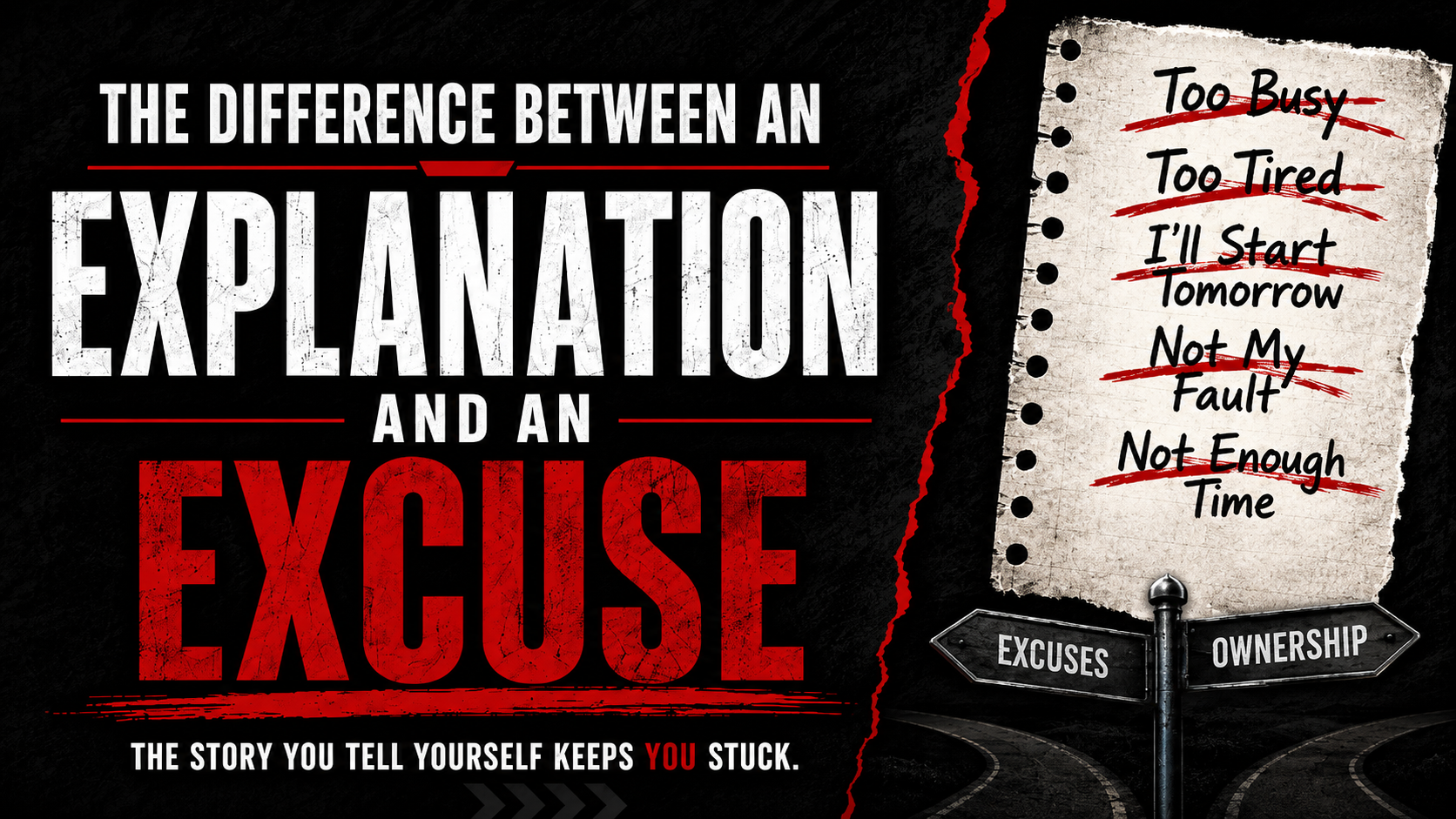
This isn't about self-blame. Beating yourself up is just another way of staying stuck, now with extra shame attached. Ownership is calmer than that. It sounds less like "I'm a failure" and more like "this is what I actually did, and here's where I actually am."
That distinction matters because self-blame paralyzes you, while ownership hands you a starting point. Saying "I haven't trained in ten years because I stopped prioritizing it" isn't an insult. It's data. It tells you exactly where to begin. Saying "I haven't trained because work has been insane" tells you nothing you can act on, because work being insane isn't something you're going to solve this week.
One version gives you ground to stand on. The other keeps you waiting for circumstances to improve before you're allowed to start.
Why This Shows Up Hardest in Your 40s
A lot of men don't end up here through one bad decision. They end up here through a decade of small ones, stacked quietly while attention stayed on the career, the marriage, the kids. None of that is a character flaw. Providing for a family is a legitimate use of your time and energy.
But somewhere in the 40s, the body sends a bill for all those years. Energy drops. The waistband doesn't fit the way it used to. A doctor's visit turns into a conversation about blood pressure or a medication you didn't expect to need yet. And the instinct, completely understandable, is to point at the decade. The job. The years of putting everyone else first.
That instinct is where men get stuck longest, because it's the hardest one to argue with. Of course your job took time. Of course your kids came first. The circumstance was real. But the circumstance didn't decide what showed up on your plate, what time you went to bed, or whether you used the twenty minutes you did have. Those choices were yours the whole way through, even during the busiest years.
A Simple Way to Tell the Difference This Week
You don't need a long process to start applying this. You need one honest sentence.
Pick one specific way your health has slipped. Not a vague feeling, a specific thing: missed workouts, the way you eat at night, the hour you're actually falling asleep. Write down, in one sentence, why that happens.
Then look at how the sentence ends. If it ends with something that happened to you, like "because work has been crazy," you've found an explanation that feels true but leaves you with nothing to do. If it ends with something you did, like "because I stopped scheduling the workout and let the calendar fill in around it," you've found your actual starting point.
This isn't about getting the sentence right on the first try. It's about catching yourself mid-explanation enough times that the pattern becomes visible. Most men, once they start checking, notice the external version showing up far more often than they expected.
What Changes Once You Make the Switch
Nothing about your week gets easier the day you do this. The job is still demanding. The kids still need rides to places at inconvenient times. What changes is smaller and more useful than a complete life overhaul: you stop waiting for the circumstance to improve before you act.
A father with a packed schedule and a father who's taken ownership of his health both face the same packed schedule. The difference is what each one does with the twenty minutes he actually has. One spends it deciding whether today is really a fair day to expect anything of himself. The other already decided that question last week and just does the twenty minutes.
That shift, small as it sounds, is usually the actual turning point. Not a new program. Not more willpower. Just one honest sentence that puts the next move back in your hands.
The One Thing to Do This Week
Write down one specific area where your health has slipped. Write one sentence explaining why. Check whether that sentence ends with something that happened to you or something you did. If it's the first one, rewrite it until it's the second. That's the whole exercise, and it's the one that has to happen before anything else on this list works.
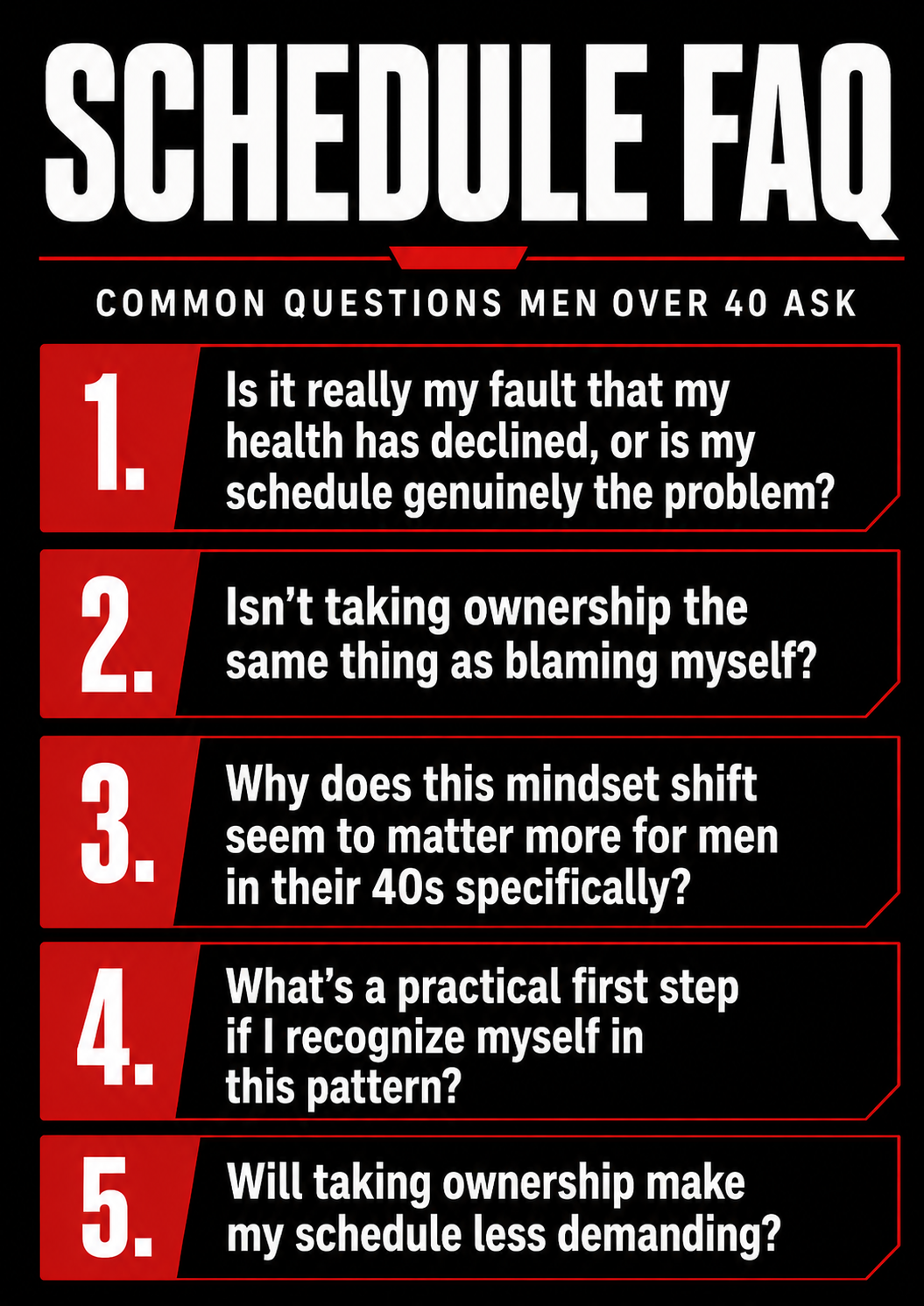
Is it really my fault that my health has declined, or is my schedule genuinely the problem?
Your schedule can absolutely be demanding and real at the same time as you still holding the ability to change your response to it. Both things are true together. The goal isn't to decide whether the circumstance was hard. It's to notice whether your explanation for the outcome ends with something that happened to you or something you chose, because only the second version gives you somewhere to start.
Isn't taking ownership the same thing as blaming myself?
No, and the difference matters. Self-blame is judgment aimed at who you are; ownership is a clear-eyed look at what you actually did. One leaves you stuck in shame, and the other hands you a specific starting point you can act on this week.
Why does this mindset shift seem to matter more for men in their 40s specifically?
Many men spend their 30s and early 40s prioritizing career and family, which is a reasonable use of time, but the cumulative effect on health often surfaces later as a wake-up moment like a doctor's warning or clothes that no longer fit. At that point, pointing to "the busy years" as the cause feels accurate, but it's also the explanation most likely to leave a man waiting instead of acting.
What's a practical first step if I recognize myself in this pattern?
Pick one specific way your health has slipped, write a single sentence explaining why it happened, and check whether that sentence ends with something that happened to you or something you did. This small exercise, repeated honestly, starts to reveal how often you've been handing the explanation away.
Will taking ownership make my schedule less demanding?
No, and that's not the point. Your job, your kids, and your responsibilities will still take the time they take. What changes is whether you wait for those demands to ease before acting on your health, or whether you start working with the time you actually have right now.

CEO l Head Body Tranformer
Brian Parana is a men’s health coach with 23+ years of experience helping busy professionals improve their body, energy, and day-to-day habits while still leading at work and at home. His coaching is built around practical nutrition, training, sleep, and accountability, with a plan tailored to the person in front of him.
Over the years, Brian has helped thousands of clients through his work as a personal trainer, CrossFit gym owner, and online coach. He has also coached an Olympic silver medalist, a 2-time Olympian, and a CrossFit World Champion.
Brian is the host of the Driven For Health Podcast, where he shares real-world strategies for men who want to feel strong again and stay consistent without making health a second job.
He’s also the creator of The Call To Rise, a 100-day fat loss experience for driven men who want to drop 20–30 pounds, boost energy, and rebuild confidence through strength training, personalized nutrition, and high-accountability coaching. Many men join because their blood pressure, cholesterol, or blood sugar is heading the wrong direction, and they want a clear plan that fits real life.
Brian is married to his high school sweetheart, Amber, and they have four kids. Their family has traveled to all 50 states and 4 continents, with a goal to reach all seven.

What To Order At Dessert Restaurants For Fat Loss



 YouTube