This Client Broke All Or Nothing Cycle To Lose 25 Pounds - 129
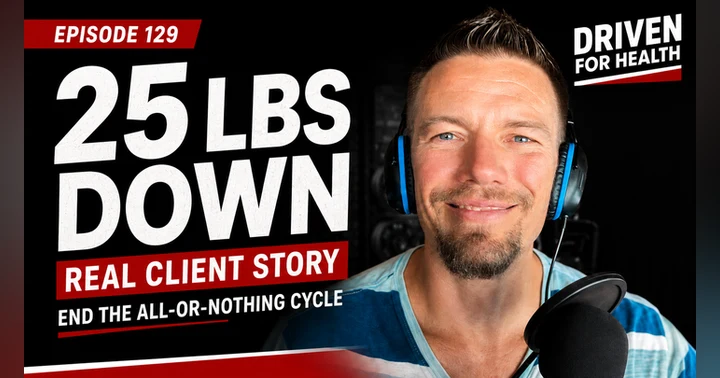
Chandler had lost weight four or five times and it came back each time. One bad day at the office would turn into a full week off track. Coach Brian talks with Chandler about how he lost 25 pounds in 100 days inside The Call To Rise. You will learn the middle gear mindset that ended his all or nothing pattern.


 YouTube
 Chandler had already lost weight four or five times before he found The Call To Rise. Each time it came back within a few months. One bad day at the office would turn into a full week off track. Then the scale crept right back up.
(Have you lost the weight before, only to gain it back? See what makes this time different at www.thecalltorise.com)
In this episode Chandler shares how he lost 25 pounds in 100 days inside the Call To Rise program. He learned to cook simple meals like chicken and rice with his dad. He stayed on track through a full week without power after tornadoes hit Illinois. At a festival with friends who looked fit on paper, he had more energy than any of them. Brian and Chandler talk through the middle gear mentality that finally broke his all or nothing cycle. This happened right before Chandler moved from Illinois to Indianapolis for a new job in political and addiction policy.
By the end you will know how to break the all or nothing cycle for good. You will see what real consistency looks like, even when life gets messy.
Main Topics:
- Breaking the all or nothing dieting cycle
- Losing 25 pounds in 100 days
- Staying consistent during a move to a new city
- Learning to cook simple meals like chicken and rice
- Handling stress and disruption without falling off track
- Building real energy and stamina through consistent training
- Using the middle gear mentality to keep weight off long term
The Call To Rise is a 100-day fat loss challenge for driven men ready to take their body back. It combines strength training, personalized nutrition and real accountability. Most men drop 20 to 30 pounds and rebuild the confidence that comes with it.
This program also works if you are dealing with high blood pressure, high cholesterol or Type 2 diabetes. It was built for those men too. Many men see those numbers move in the right direction alongside their weight loss.
Inside the program you also join a Brotherhood of men doing the same work. Together you build a body you're proud of and start leading like the man you already are at work.
This is your wake-up call to rise. Learn more and apply at www.thecalltorise.com
Want help applying this to your own health, weight, energy, or lab numbers?
Coach Brian Parana offers Health Hot Seat coaching segments for men who want a clear next step with nutrition, fitness, weight loss, blood pressure, cholesterol, A1C, or daily consistency.
Learn more about The Call To Rise, a 100-day coaching program for driven men over 40 who want to lose weight, improve their health, and rebuild confidence:
To connect with Coach Brian:
brian@brianparana.com
Disclaimer: This podcast is for education and coaching support only. It is not medical advice. Always work with your physician before changing medication, treatment, or medical care.
Brian: Welcome to this episode of Driven for Health 129. Holy cow. We got another testimonial from Chandler. He is in political and addiction policy. He's from Illinois, but he's moving to another place, Indianapolis, and he wanted to leave his old behaviors, patterned self, unwanted weight. He just didn't want to bring that with him. And that's what we were able to help him overcome, some of these ingrained all or nothing type behaviors, was one of the very first things we talked about in our process of trying to find out what middle gear mentality meant for Chandler and how to sustain this, cuz he'd lost and gained weight before but still wasn't at a place where he was happy with. So, welcome to the call here, Chandler. Excited to have you and sharing this cuz there's someone going to listen in and your story is going to resonate. So, let's start off. What were the results? What were you able to accomplish here in the 100 days with the Call To Rise program?
Chandler: Yeah, thanks Brian. So, I managed to take off about 25 lbs throughout the course of a 100 days. And managed to really just improve my general health and well-being at large, which is more than I've been able to do for quite some time now.
Brian: Yeah, definitely. I like to drop a pebble in your pond and let it ripple out to a lot of different areas beyond just, hey, we lost some fat. That's helpful, right? It builds confidence and energy and all the things that you need, but then it also improves a lot of these other areas in your life, which is important. Now, let's jump into one of the big reasons why you were seeking out some coaching support in the first place, is finding that all or nothing. And I will tell you from doing this for 23 years, this is very common. Unfortunately, because marketing, the "diet ads," all these things promote this eat this, not that type food list, and you just get this ingrained behavior of I can't ever eat these foods or whatnot. And it keeps you stuck in this loop of losing weight but not being able to maintain it.
Chandler: Yeah, that's been the greatest struggle with me for many years because, as you mentioned in the beginning, I've been successful at reducing weight and doing that in the past, but it's always been from times of going way too overboard, going way too hard with it, probably in not super healthy ways in retrospect, and ultimately not being able to maintain those weights after a while because subconsciously I would treat it as, oh, here's a temporary thing I'm going to do and then I can go back to my old behaviors. And then the reality is I'm trying to work towards lifelong solutions here so that even if I do at certain points gain weight again or anything happens, I know proper steps to work towards it and know ways that I cannot just keep going for the all or nothing because more often than not it's nothing rather than everything. So that's been a great struggle but I think this has helped a lot with that.
Brian: Yeah, most definitely. How many times do you think you've been through that cycle of losing weight but not being able to maintain it?
Chandler: I feel like I would say there's been about four or five major times where that's happened and it was over the course of anywhere from three months to upwards of a year, but then it always eventually slips back into something just due to any factors and excuses I could have to go down the rabbit hole, and then when it's for a few days that's fine, but it's mostly when a few days turn into a few more days and a few more days and that's the real struggle.
Brian: Right, right. And we build momentum one way or another, whether we're building momentum toward positive behaviors, and you start to get the streak going, one day after another, oh, I'm losing weight, I'm intentionally picking these good food choices. And you didn't just live at home, you had a couple things going on in your life throughout this process with your parents, with travel, an awesome festival that you went to, an EDM festival. And these are important things to be able to participate in without it blowing you up and taking you the other way. Ultimately, I also have a long-term weight goal, a five pound weight range that you can just stay in the rest of your life. Sure, you're going to gain weight up and down, the human body is not static. But losing 10 pounds will actually take you four to six to eight weeks of effort to do, and nobody wants to do that. But if we can catch it early, say the scale bumps up a little, two-ish, maybe three pounds on average higher, then all of a sudden you're able to make course corrective behaviors in two to three days and then it goes back down. It's not so much effort to get way off track to have to come back. Now, let's talk about some of the day-to-day life of how this all or nothing approach was stuck in your head, because so many people struggle with that, especially guys, we just have to grind it out. All or nothing is really what they think.
Chandler: Yeah. So the day-to-day, I think, well in the past it's been much more of, oh, I can always start tomorrow, everything's going to be whatever. But I think in this process over these last 100 days or so, especially in the last half of the program in particular, it moved from, okay, I'm not going to allow myself to have anything on any of these days, to where, rather than if a co-worker was like, hey, we got these cookies here, I wouldn't always immediately go, I cannot have even one because otherwise something else is going to happen. I was like, okay, maybe I can have one here, or let's figure out for the day to adjust accordingly from there, make sure I get my steps in a little bit later. It was more of things like that instead of just feeding into the aspects, because it was still hard sometimes to reset or to not fully indulge, but it was easier to do that than it was to go off the deep end and go back up.
Brian: Yes, and you know the pain of it, just keep going in the wrong direction, and that realization of yet again I've regained a bunch of weight that I worked so hard to lose. That's very painful to come to that realization when the scale hits that number again.
Chandler: Exactly, yeah. And then it's quite demotivating.
Brian: Quite demotivating, right. So we end up moving in the wrong direction with motivation, in the sense of motivated not to do it. Now, also the office setting, like the cookie showing up, literally had a guy today in the program just said, "Yeah, I planned out my day and I have a very full day and I brought my lunch to work and all this stuff and someone already brought me a muffin and someone else brought me a cookie." Well, Eric, we have to make choices here. It's very nice and kind that they brought food. Food is love, happiness, it's friendliness, it's like kindness, right? But that's not helpful in Eric's journey because he's fallen for that in a sense and taken those things. And a cookie and a muffin at the office could be five, six hundred calories in the wrong direction. And that would then again trip up this all or nothing type pattern behavior of, well, I guess I'll just start over tomorrow, and then the rest of the day gets willy-nilly. Now for you, what were some of the other processes, things that happened as your results outside of just losing 25 pounds?
Chandler: I think the greatest benefits that I've seen so far, one which was one of the most important things to me was just being able to have a lot more energy. I noticed myself even walking for more than 15 minutes feeling like I was somewhat exhausted, which is obviously, especially at my position in agent 2, just not ideal. And I've had times where it wasn't like that ever. And so being able to adjust that and be able to actually have so much more energy, like when I went to the festival you mentioned a few weeks ago, I felt great during the whole time, even though I was still at a higher weight than my other friends there who were all on paper in good shape. They were all much more exhausted than I was during most of the experience just because they weren't getting their steps in, they weren't doing the things too in general. So it's like, despite that, I think that was one of the greatest pros in addition to just noticing that clothes were fitting a little bit better, right? My belt loops would move down a little bit, I could see different things fit that weren't fitting before.
Chandler: It's a lot of things like that that I was really looking for more than anything else. It was just having that, because the weight is whatever, like I understand literally it's on a scale and it's important for BMI and all that good stuff, but really it's more about how I actually feel, how I actually find myself looking, more than anything else.
Brian: Right, definitely, look and feel is important. And it was, there's a big reason too, that happened, you were looking for some job, acquiring some new jobs in a new place that you're moving to, and that whole sequence was in our back mind as well. Hey, near the end of this 100 days I will be moving, okay, cool, we're going to build in a process that can be as seamless as possible so that when you move, you still can operate at a high level and be able to be successful, but also find jobs and show up and interview and look good and feel good and confident and all this stuff, because you need it, or people won't hire you if they don't feel your confidence vibes.
Chandler: No, exactly, because I think it got to a point where it was just hard to go out and do a whole bunch of stuff consistently, and knowing that I was ultimately moving too, was ultimate motivator, because I've in the past moved or done other things and gone, oh, once I get here I'll start to do whatever, and while that's occasionally been true, far more often it's a lot more difficult trying to move somewhere and then try to start this whole new process while you're already meeting new people, starting a new job, learning a new city. It just becomes so difficult, then it's easy to always make excuses cuz there could always be an excuse. There's always an opportunity, no matter what. So I think actually getting ahead of it now, to where I'm not doing perfect or anything, but being more consistently solid doesn't make me as worried about going into this time and knowing what I can do. It doesn't make me stressed out at all.
Brian: Yeah, I've got MBF, three letters that I always say, and that's moderation, balance, flexibility, has to get brought into this equation. Yesterday was my wife's birthday, so we celebrated. I had ice cream cake and I had some FCO because we were celebrating her Italian trip that she booked, and all sorts of things, and pizza and all this stuff came, and we had a blast and I didn't really worry about it. One, because I knew that yesterday I did make some appropriations in terms of my food choices to make sure I had calories available, but I also moved my body. I ran yesterday and I lifted weights. And then I also today I've ran and I've cycled. I'm training for a marathon. So I'm constantly burning calories. So it was like yesterday was a blip on the radar in terms of the 7-day cycle here in a week's time frame, and it really didn't matter. And that's an important part of zooming out to see the bigger picture, of okay, we can have some ice cream, we can have some of these things, it just can't be the constant in your everyday life. You have to have balanced meals and all this stuff. So, what were some of the processes, the diets or the routines and stuff that you had before we started working together?
Chandler: Yeah, so, well, in the months beforehand, there was almost nothing going on. It was always hoping to have something happen. But in the past, what I'd done a lot of times was, what was kind of successful for a little bit of time was doing intermittent fasting, eating limited things, but also just really depriving myself of the proper amount of calories I should be having, and then getting my body used to being sort of hungry like that so that it didn't feel bad. But then what I would overlook, it would be this whole crazy thing and my metabolism is all messed up, and then it was working out on top of that, so burning way too many calories for not consuming nearly enough too, that it would result in quicker things and quicker success and everything too, but not long-term success or happiness or everything too. And that had been a while since I'd done that, cuz prior to this, for at least I'd say about 6 months or so, I just couldn't get myself to have more than maybe three days where I was doing okay at best, and then it was immediately back to a week or two of full indulgence, and that was really the struggle. It was once again the all or nothing mentality, right.
Brian: Definitely. And you had to work around, in our approach, we had to work around your living situations, different people that were there. You had a lot of different life things that happened because life's always going to be throwing curve balls. What were some of those obstacles that you had to actually have real conversations, actually develop and build skill sets around, like cooking in a sense, to be able to feed yourself? What were some of those things that actually helped work through in the time that we worked together?
Chandler: Yeah, yeah, cuz this spring in particular was pretty challenging. Even though my personal life was fine, I mean, between a million tornadoes coming through here and turning off power multiple times, and family having to travel—
Brian: You had what, it felt like a week of no power?
Chandler: My god, I mean, altogether probably pretty close too, right? I mean, you know, this year had the most amount of tornadoes in Illinois in history, so at least in recent history, which is insane, but we had all that plus family had different health stuff going on, so traveling back and forth and people unavailable for different things, which is all fair and reasonable. So what I was really learning was a couple of different things that I learned to cook, because before in the past I had rarely cooked on my own, or if I had it was just like one-off things. So learning some things, especially around chicken and rice and different things that I really enjoy, and different eggs and whatnot too, just learning how to cook those a little more effectively with my dad was ultimately pretty effective and great lifelong skills to have. So I'm still working on that, but we've been improving that along with just figuring out, okay, what can we actually properly budget as opposed to just never eating out, but realizing, okay, if I am going to eat out this thing, what can I do to be healthier about it? Can I go walk to go pick it up, was something that I've been doing especially more recently too. Like, oh, if I'm going to go get something, can I walk nearby to go grab something? Like things like that, cuz there's always challenges, always stuff happening too, and it's always easy for me to make some excuses for whatever, but there are things I can at least do to adjust to at least make it better. Even if it's not exactly where I want to be, it's still, these things have been pretty effective.
Brian: Yeah, definitely. Obviously cooking for yourself, a lot of guys just balk at that one, and it's so important. Healthy people are in control of their food most of the time. And that's a really important revelation that people need to have, is that if you're letting other people manage your food, like cook and prepare, you just don't know what's in it. Even if it is "healthy," it could still have 300 hidden calories on the plate that you just don't see, and you are unfortunately ignorant to the fact that there are those 300 extra calories and they're causing you to not be as healthy, which is a problem. So, now what were some of the main ones, moving being a big life stressor for a lot of humans, and moving, why do you feel more confident in this life transition moving into a new place, especially being down the weight, and most importantly be able to keep it off after you get there?
Chandler: Yeah, I mean, like you said, physically just feeling better and seeing these changes is always a great motivator, regardless, knowing that it can be done, because I think there were definitely times where even though I was making progress, it didn't feel like it, it was just mentally so challenging and so much turmoil. But knowing that you can make it through and actually seeing that, which was great. But I think also just in general developing the consistent habits and just general skills, between a little bit of cooking, since I'll be living on my own, along with going for more walks consistently. So it's like even when I'm not at the weight I want to be, I'm still able to do one, two hour walks every day without any sort of issue, as opposed to before where doing more than like I said 15, 20 minutes was pretty brutal sometimes. And I think these type of things make me feel better going into it, along with just feeling like I understand the food I'm consuming a little bit more than I had before, some preconceived notions that I wasn't aware of, just with all sorts of different things. And I think just feeling more confident going into that, so that I'm not starting at square one.
Brian: Right, right, and that's huge, because now you actually have a plan that you can take action on and implement, and then not feel like you are bogged down with, what do I eat when I get to this place or whatever, and that's important to not have to worry about those things, most importantly. Now, what about, say, the middle gear mentality approach, made the biggest difference coming from me to you, because that was something that I want to impart on everyone that I ever work with. I'm super busy, I'm self-employed, my wife has two businesses, we have four kids, we've got four cats and a dog, we travel a lot, we're constantly busy. This just is nonstop. Even right now, the first energy gas guy came to our house and we're doing this interview and I don't quite know how to manage that, because we're doing this and he's just going to have to wait until I get done to deal with it. So what was it from me to you, how did middle gear mentality help you manage really well?
Chandler: Well, I think it's been really helpful in the sense of being able to eat different things that I've actually wanted to eat, because there's been a million things from people's birthdays to general events to people traveling, all sorts of good stuff. And as a result, just being able to be more consistently able to do these things without immediately freaking out or worrying about, oh, is this going to be enough to damage me for some amount of time? And I think what you were particularly helpful about is that when I would have moments where I would definitely slip or go further down too, learning how to adjust with that, like, okay, yes, you still had these days where you had too much of this dessert or too much of these fried foods or whatever, what can we do now to adjust over the next couple days to get you back on track? Because sometimes I think it was hard for me to know how much damage exactly I had done, or how much was different too, and I'm like, oh, I feel like I didn't need that much, but then it's much higher, or vice versa. And I think that's been one of the most helpful aspects.
Brian: Yeah, definitely. It's constantly juggling with people's real life. Honestly, I've been doing this for 23 years, I've had thousands of conversations. Literally I'll be on a conversation with someone on a phone and real life happens. Like, Brian, I have to go right now. Okay, well text me later, we'll figure out what the next steps are, because that's what life is, it's just a journey, it's not a destination, as Eric Smith says, and we have to just be able to evolve and be lean, agile, bendable with what's going on so it doesn't throw us off. Now, what was the biggest challenge, like initially getting signed up and taking this step and ultimately trusting yourself? I mean, that's a big part of what happened here in this process, is trusting yourself that you can make good choices, have fun, and still stay on track.
Chandler: Well, I think probably, I was thinking about this, probably the three biggest things that were a difficulty, I think, is that one, feeling like, oh, I can just do this on my own, I can always succeed whatever too, cuz many things in life I think we can, but there are times where we just all need help in different things, which is not easy to do, I think especially for a lot of guys, but realizing that is vital, and actually addressing that I have a real eating disorder and that I have real issues here, and not just being like, oh, I can just fix it by just feeling like I'm going to fix it.
Brian: Be manly through it.
Chandler: Yeah, just doesn't work. And I'm not typically that type of person, but I found myself doing that, and I was like, oh, let's avoid that. A lot of just general, figuring out who actually offers a decent service, right, and who actually offers things for a decent price, because a lot of times it's hard to tell if things are maybe not, per se, a scam, but not always really effective tools. When I was initially messaging people, I messaged about three other people outside of you when I uploaded some stuff to a website, and some of them were not nutritionist people at all, there were just people focusing on like bodybuilding type stuff and just like weightlifting things too, but then they would act like, oh, yeah, we'll do some nutrition stuff, but we'll focus on this. I'm mostly interested in nutrition stuff. They're like, well, that's fine, just pay me double whatever. And it's all these things too, I just was like, I don't like these systems. But you were very upfront with it, and you had a lot of great materials right away too, to look over. So I wasn't doing the guesswork of is this something that actually serves my needs and my focuses. But I think that was certainly a big challenge, and just a reasonable fear going in, cuz I know it's a real thing out there. But this worked out.
Brian: Wild west on the internet, you're like, am I even talking to a real person these days?
Chandler: Oh, especially nowadays, for sure.
Brian: Holy moly. Yeah, and I will see this because there's a lot of people even in my industry that just charge thousands of dollars and all this, and it's like, I want to offer real value to people. It has to cost something, but it doesn't have to cost thousands upon thousands of dollars to get someone to eat healthier and take better care of themselves. And so that was really important. But then also giving people confidence in that, that's one reason why I started the podcast, is to offer a lot of value on the front end. Hey, there are 125 published podcast episodes as we record this now, there are almost working on 6,000 spoken minutes of content that you could have access to, plus all the other stuff. So there's a lot of things that you can get to start understanding who I am, how I help people and all. So I appreciate you saying that, and definitely in the very beginning it's important to get you started on the fastest, easiest path to being successful, and that's what that first call prep video was. Watch this video, outline the important information that we need to know so that when we're on our phone call, you and I can actually talk brass tacks. How do we implement the right calories, the right strategy around picking food, how to build balanced meals, start talking about how we're going to start cooking food and being a little bit more self-sufficient and all, which is super important. Now, Chandler, last question here is, if someone were back in that position where you were, thinking, I need some help and I don't really know if I want to do it or who should I go to or whatever, what advice would you give that person sitting in those shoes?
Chandler: Well, I think one of the biggest things is just not continuing to ignore it, or just find all sorts of ways and continue to delay any sort of process, right? Because the truth for everything, and I'm especially guilty of this, is that when I want to start some things I feel like I want to be as prepped as possible and go in as hard and do all this stuff too, I mean part of that all or nothing, but also just even the preparation, but the reality is that most people don't get to the points where they're doing all the right things, taking all the right supplements, doing all the exact workouts, all the stuff too, day one, reasonably so. It's a lot to learn, it's a lot to implement, and I think it's allowing your mind and body and feelings to adjust with it too, cuz I can understand logically I'm supposed to do XYZ, but I think with actual practice and time and habit is where the feelings actually change for that. So I think looking into resources and people like Brian out there, who actually do these type of coaching services, is great, and everyone's going to have different things and solutions of what they're looking for. But I think what was helpful with Brian is that he does a good job of tailoring it to what you're looking for, cuz some people are looking for super engaged involvement every day, talking over a million things, and I found myself just messaging him, like, every other day with meals that I've been eating, he'd send back if it was good or if he needed to adjust, we have like a bi-weekly call, but I didn't do all the check-in materials all the time, I didn't do everything, I looked at the guides consistently, but I found that that worked for me. I wasn't sure at first, but I found that for me that was an effective system. So I think it's being able to allow yourself to slip a bit, allow yourself to just make some progress here and there, because even if it feels bad for a while or not exactly where you want to be, within a few months it's going to feel much better than anything else you were doing before, that's for sure.
Brian: A lot more life lived, right? You're just living life now. And yes, you have to think about food, but the effort, energy, and intensity of like, what am I going to eat today, is significantly less. So what am I going to do when I'm stressed and I'm tired, I'm Netflix and want to chill and put a bunch of food in my face or something.
Chandler: Yeah, exactly.
Brian: And I appreciate that, everyone does engage differently, and with Chandler and I, we found a suitable pace. So there's always opportunity to engage more, but also if they're good, people operate on different wavelengths and someone might need more than another person, that's perfectly okay, and we just find what works. I always joke with people, we just talk as long as we need to, to get the effective results that we want. And maybe even next week we had to talk longer just because there's more questions or life happened and how do I overcome these things. Chandler, I want to thank you so much for coming on here. I appreciate you joining into my program, allowing me to help you lose 25 pounds here, and then also set you up for what even more importantly is sustainability. And that was the key undertone that we had, is alright, just embed him with that middle gear mentality so that no matter if he's moving or whatever, life and jobs and family and health and all these things that pop up with just normal life, you can stay successful with your health and actually maintain it, the look, the feel of the body that you want. So I really appreciate you.
Brian: Now if you're listening in and you hear Chandler's story and it's inspiring to you, then consider TheCallToRise.com. It's a five-pillar system around your identity, around exercise, nutrition, your mindset, and ultimately doing it in a brotherhood of like-minded individuals to help encourage and push and motivate. You certainly have me as the website outlines it in great detail, went to great lengths to answer so many questions. There's lots of opportunities to see and hear about other people that have had success on the website, but even on this podcast as well. And so join, if you're stuck in this all or nothing approach, if you can't just find some level of balance and you're always starting over on Monday and you have a lot going on in your life, then this might be for you, and check it out. So alright, Chandler, thank you so much for coming on. Thanks everyone for listening in. I truly appreciate the hard work effort that you have done, and off we go.
Chandler: Thanks so much, Brian.