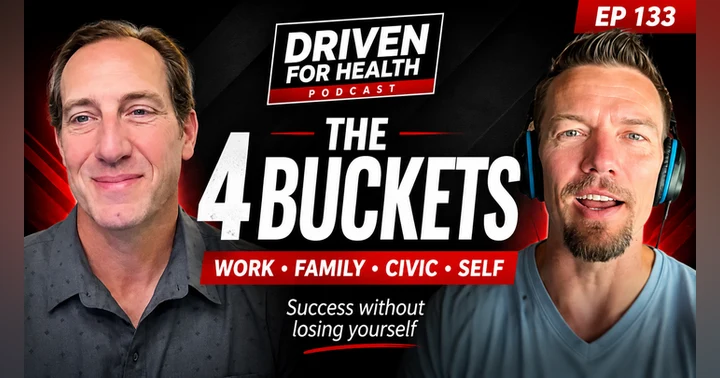
A billionaire once sat across the table from my guest today and told him the truth. He said, "I chose poorly. I chose work and self over family and civics." I've been trying to make up for that ever since. He's 65 years old now at the time that he said that. And his own kids were already in their 30s with families of their own. That conversation really changed how Jeremie thinks about success, what it means to him. He's built and sold multiple companies. He's also raised a family the whole way through all of that. We'll be talking about that. And he's found out that he doesn't want to lose himself in that rat race either with poor health and all. And we're going to go over some of his story. So, if you're running a business and raising kids at the same time, you keep telling yourself you'll get healthier when things slow down, it's never going to. There's always something else. Schedules hold back and that's just the way it is. And lots of men are hoping that things will slow down and they just don't. Welcome to Driven for Health podcast, episode 133. I'm Coach Brian Piranha and we have Jeremie here today. Welcome. Welcome. Let's start off with a really good what what do we need these guys to listen into for our conversation today. Thanks for having me out, Brian. I think if I were to put it on sort of one uh sentence, I would say that uh physical health, mental health, family health is really these are common denominators for success and for high performance individuals. Plain and simple. Oh yeah, most definitely. And without that, then you just aren't going to have the the sheer vast amount of productivity and opportunity that you you think you should at this. So, you have a story that we talked about with some of the catalyst for you to take care of yourself before we get into all the business stuff, but let's start there so that the guys can identify you were in their bucket and then you worked out of it by prioritizing your own health. Sorry, I think that we just had a little uh little blip. I did. I think so. I lost you halfway through the question. I'm sorry. No worries. No worries. I'll edit this out. The magic of editing. Yep. So you had a your own story of where you were working working getting caught up in it and someone really close and special to you called you out on it and you took it as a a really good challenge to start taking better care of yourself. Let's let's jump in there so that the guys listening in can really identify with you know you lived it. Yeah, I think that's a great place to start way back at the beginning. So he first and foremost met my wife, my now wife. She is the special young woman who at the time helped to kick me into gear. But my wife and I met when I was a grad student and she was an undergrad student. Uh we were both studying at Japan interestingly enough. And we met fell in love and like and you know it's almost 30 years ago now and we're still together thankfully she's stuck with me. But when I finished uh when I finished grad school I came back to the states and I went to work for Goldman Sachs. A dream of mine for a long time was to go work at Goldman. And I mean I had an absolutely fabulous experience. I people ask me all the time uh what's the greatest thing about Goldman? I say there are many great things about Goldman. But uh if you ever have a chance to work at Goldman, you should. You just absolutely should. Yeah. Right. But so I joined Goldman. I was I was 25 years old when I joined Goldman. And I had just you know finished life as a grad student. My wife and I were engaged at the time. Um I was in really good physical shape. Uh, at the time I was probably 217 218 pounds and like 8% body fat. Big guy, too. Okay. So, yeah, he carries that weight well. So, pretty Yeah, pretty pretty thick and pretty I mean, just in really good shape and and that was very important to me. Physical health has always been important to me. And so, with that as the backdrop, started working like a dog, 60, 70, 80, 90 hours a week doing what you do, loving every minute of it, having a great time. But my wife and I also started having a family pretty early. And so in my few years at Goldman Sachs, I went from, you know, 217, 18, super healthy, uh, to having a child and to being about 240 and exceptionally unhealthy. And the reasons why were pretty clear and pretty obvious. I think most of us go through this phase as hardworking men and women. We have to prioritize, right? And so at the time, I was prioritizing my career and trying to figure out how I was going to do what I was going to do. uh trying to prioritize the time that we had with our young baby, right? And trying to prioritize time with my wife and there wasn't much time left over for me. And so I was eating my stress, eating my stress, not burning my stress. And interestingly enough, at the same time as I was doing the Goldman thing, I was also thinking about what I wanted to do with the rest of my life and the rest of my career. So without giving you too much of a boring background, I grew up writing software and programming and on the side and having a great time with it. I studied finance and economics in school, but I've always loved computer science, always loved engineering, always wanted to build software companies. So, one of the reasons I was at Goldman actually is because I wanted to find some really good ideas for building software for financial services companies. What better place? What better way to do it than there? Yeah. So, fast forward to the end to to to 2003, I made the decision to leave the firm and start my first software company, which uh at the time we had one child, we were pregnant with a second, and uh here I go off on the startup adventure. It's like me. I started my first business with my son was due in six weeks. My wife is, "Weren't you supposed to do this in January, February?" Like, "We got to get ahead of the the It was a gym, so we got to get ahead of the the New Year's rush, right?" Yeah. When opportunity knocks, you have to go you have to go take it. And so, you know, I was I was in that same boat. And so, you know, pregnant with the second, have the first, I'm like, "Yeah, let's leave this fabulous career at Goldman and go start a software company because I you know, it's funny to do. what I'm here to do. Uh, and that didn't help my health either, obviously. So, to to to cut this sort of like bring it all together, I ended up in a situation where, you know, by the time I was 28 and a half, almost 29 years old, um, I was super out of shape. I was feeling terrible about myself and really, really stressed, eating worse and worse every day. Kept gaining weight. And I'm remember I sat down with my wife one night and uh, this is just after our second child was born. And I just started complaining. I was like, I'm just getting bigger and this is gross. I feel so terrible. blah blah blah. And she looked at me and she knows exactly how to push all the right buttons in me. And she said, "Yeah, well, you know what? I gave up. You're done. You're going to be like 400 lb and and and and die at age 50. It's going to be terrible. You may as well just give up now." Which of course she knows me well enough to know that's exactly the thing to say to spark uh the fire, right? And so I said, "Okay, well, good point. Good point. I will show you." And uh you know, literally challenge accepted. Away I went. So on January 1st of 2004, I weighed 240 lbs and by September 1st of 2004, I weighed 173 pounds. And started competing as a triathlete uh that very same year in semi-professional triathlons across the country. So um you know, she she helped me realize and remember that look, you have to find whatever form of balance you can in your life whenever you can, however you can with the people that you love and they have to be part of it. And sometimes you got to get, you know, dragged kicking and screaming sometimes. Yeah. There has to be an intervention sometimes. Yeah. But that was what it was. And so that for me that defined really from that point forward, it's like, okay, how do I think about my career and my personal life and my family life and my civic life into in in buckets and how do I start planning appropriately? And so, you know, really from that point forward, I've always built dealt my life and every single day looking at it from the the these four buckets like family, work, civic, and self. That's that's what drives me. and I try to figure out ways to make sure I'm able to to give in each of those four categories every single day. That's awesome. That's awesome. Now, let's just touch a little bit on what were some of the pathways that you chose and had found to basically move more and be in a calorie deficit to lose weight and then we'll move on to those buckets and how you're doing it at a higher level. Yeah, absolutely. So then that is a that that is the right place to start because you know at the end of the day obviously it matters what you put into your body but if you're trying to lose weight you just need to make sure you're putting in a lot less than you're actually burning. Right. Right. Friends always joke you know you that weight is lost and gained in the kitchen. And it's totally true. And so for me right the the way that I sort of structured my path toward getting back into good physical shape was I said look what's my what is my caloric needs? And so to do that, I didn't just sort of like look at the general stuff you might find on the internet. I went and I got a full like DEXA scan, a full body workup. I went said, "I'm gonna figure out exactly where I'm at, what my status is, so I can target the parts of my body that need the most work without getting hurt because I didn't have time to get injured, right? I'm running a software company. I've got kids and you cannot afford sliver of time and it has to be effective and efficient." Exactly. Right. And so then we said, "Great. Well, here's where I'm at. Establish that baseline. everything from B2 max to body fat composition and body composition structurally everything else and say great now for me to sort of optimize my one to one hour and 15 minutes a day I'm going to get working on myself right how do I do that and so then I put together a plan and that's what I did and so um for me that was a combination of cardiovascular work working up until the point where I was I mean ultimately I I I do ultramarathons and so you know I went from doing very sedentary stuff very slowly but surely worked my way into a position where I could run a mile and then three miles and then five miles and then 10 miles and same thing with biking and same thing with swimming. But I also integrated, you know, physical weight training into the mix very very early as you as we need to whether we're 20 or 50 or 70 and we're just very methodical about how I approached my daily workout. Um, and I also am a big fan of of this thing. I heard you I read this probably originally in the early 2000s probably in Freconomics. Great book if you ever read it. Yeah, good times. Anyway, you talk about temptation bundling. Maybe it wasn't in the book, but it might have been the early podcast. I can't remember, but basically have to give credit where credit's due to this notion of temptation bundling. And so, I also started finding ways to temptation bundle into my workout times. So, my trainer I if I wanted to watch a show, well, I would say I can only watch this show if I'm working out. Um, if I want to read this book, I'm going to read this fun fiction while I'm working out. And yes, it doesn't optimize the workout, but sometimes, especially when you're losing weight, sometimes you just need low fat, you know, low low impact fat burning. I will definitely agree. One thing, my son, he's 17, Levi or 16, he challenged me to marathon. I hadn't run a marathon in a couple years over, it's like 2008 was the last one I ran. 12 maybe 50 mile two. Cool. I went in triathlons after that. But he challenged me, said, "All right, challenge accepted." Finally in January started. And then I've been having some injuries here getting back into the running game. I had gotten injured playing in the snow on a hill, sled riding hill. My two two my middle two boys, they would not let me up the hill. They were just tackling me and dragging me down and and all that. So, tons of fun. But 20 minutes later, I went to go run and and hide and we were playing hide-and-seek or something and then pop my glute hurts like, "Oh my gosh." So, I basically didn't run at all in February, March, but I figured out to bike. ended up buying a a spinning bike and then I set it up and I created a bed slat desk that fit over top of the bike and I will ride one to two hours most days zone two. It's not like the best spinning belt on workout or something, but my heart rate's 120 130. I'm able to get work done and and be able to optimize that time because there is absolutely no way since I started biking. I've biked February to July 7,000 minutes over 7,000. There's no way I would have been able to do that in my schedule if I had to go out on the road or, you know, ride in a class or any of that stuff. It just wouldn't work with poor kids business, you know, it's just there's always demand. So figuring out that uh that temptation stacking or or optimal ways to do it is so essential. Or even say the walking treadmill while you're doing maybe lower quality work. Not not lower quality but lower mental load work. Yeah. So yeah, that's excellent. For sure. Yeah. I mean to this day, so I I try to schedule calls and meetings and things around times where I know, okay, I can take a walk in the woods during this hour because I am I'm a semi participant for this one. Um, and obviously, you know, and there's all kinds of great scientific research, too, that shows we are stimulated when we're walking, we're moving, not at a not at a crazy pace, but at a at a healthy pace. And like it actually leads to more creativity. It's great. Like we should all do a heck of a lot more of it. Agreed. I do it. Yeah, for sure. Love it. So, yeah. So, the journey is always a fun one. And then you know as you're thinking about how do you find uh your way back into health and or maintaining that health while balancing everything else. For me that's where the the framework around defining my time for family work civic and south like really came to really came to to bear. That being said though what works for one person never works for the group. Right? And so you like I have four kids over time. We had four kids and my wife and I have had to figure out like every couple has to figure out who's going to do what, who's going to sacrifice what, who is going to be able to do what, when, where, and how in their in their own personal journey as well. And I imagine there is give and take. There has to be. It can't just be we can't fall into these societal roles of the 1950s or something like, well, my wife always cooks dinner. Like unfortunately I run into so many guys they don't know how to cook at all and I start to get them to take responsibility or go into the kitchen while things are go help chop vegetables and learn how to put food together and it ends up enhancing their relationship and also takes that burden off their spouse to always have to cook. Like guys, you you need to be able to cook at least some food more than just boiling pasta and and calling that dinner like for the and open up a can of vegetables or whatever. Yeah. Yeah. No, absolutely. You're right. But it is tough to find. It is is tough to sort of figure out where you fit. Like in my case, I'm kind of not allowed in the kitchen mostly. I mean, I'm happy to I'm happy to jump in there and do stuff here and there. Um but as all my kids, I'm tell you like it's not my biggest strength. It's not something I spend enough time doing to be really great at it. And so uh and I always count myself lucky. My my wife, she and I, we we have a few rules for our family. One of the rules we've always had from day one is uh we will eat dinner together every single night of the week. Beautiful. With the asterisk being that except when dad has to travel, but if mom is here, the kids were here eating every single night together. Even when I was traveling a lot during their during their younger years, but even when I was traveling a lot, I was like, I'm going to be home five nights a week for dinner. That's what's going to happen. And so as a result, like what that usually meant is I'd be, you know, coming back in from a meeting or us shooting in from out of town or coming in the, you know, coming out to the to the house from the city from work on the train or whatever. And I'd get in, first thing you do, you walk in the house, you sit down 6:15, we have dinner as a family. And that was so important. So, interestingly enough, I bring it up because my wife was able to share like the thing of cooking with our children. And to this day, all of our children are really good and they're very handy in the in the kitchen. And you know, one of the things they love doing for mom and and sometimes for me um especially on Mother's Days and Father's Days and holidays and things that is actually make really fabulous meals for us as a way to say thanks to the mother who, you know, works tirelessly on their behalf to enable um our family to work the way that it does. Oh yeah. My wife, oh my gosh. One thing with the aspects of what we do in our family is we read every night. So my wife will read to the kids and then I end up reading to the kids too. about three stories every night for 16 years. That's great. And and it's been a blessing because like you you see the fruits of your labor, right? They're all like, "Wow, I can't wait for Father's Day to come again or my birthday or whatever and they can do that." Well, you see my kids reading self-reading Harry Potter series three times and all this and it really has impacted their their academics, their just their nice people as a result of reading and the power of reading. Yeah, absolutely. I mean we are we are as human beings we're social creatures and social interaction is obviously important but we're we're blessed with this ability with the facility to think and to reason and you know we're a langu language is culture culture is language and so we we have always felt the same way you know for us it's music and and the written word are the things you have to do in our house you just have to Oh yeah and we all do it so it's great it's it's wonderful that's great so we're obviously covering family bucket what what else is important. That defines it for you even more. So, I know we're we're still cruising here, but let's just like firm up even more what it is. Another thing for me and my family bucket is we go for family walks and we usually walk the dog. Anytime we go to Cleveland or anytime the kids can wiggle out, we usually do family ice cream together. That was something that I decided a long time ago that I was going to participate every time. I don't have ice cream any other time except in a family setting. I usually just get the small. The the little boy inside says, "Get the largest kitchen sink sundae with all the toppings." Right. But I say small. I usually get a unique flavor that is different every single time. Just what the the one of the most interesting. We're in Cape Cod area and ginger was a flavor of ice cream. Like sign me up. Let's do it. So do it. It's awesome. So how about you? Yeah. So for us, a lot of the similar things to be honest, we're we're kind of in some ways we're a little bit strange relative to I guess maybe the norm that we are, aren't we? Yeah. When we take family vacations for us, it's usually like, "Hey, what state park or national park? How many can we get to on this trip?" And so most honestly, you most of our trips, they involve us going to a place, uh, finding fun fun interesting places to eat and then finding all the hiking we can possibly do in that area. Whether we're going we've had it, you know, we've taken the kids internationally a number of times and you know that's that's we're looking for the trails and we're looking for the weird places that only the locals generally know and where you can see the real folks living in the real area doing the real thing. But you know largely being outside and moving and having a great time enjoying experiencing nature. My wife's a travel adviser and and totally agree. We she has taken us all 50 states, multiple countries, continents and stuff. So we we seek out adventures and that authenticity in in the place that we're at. So I absolutely love that and I you obviously you cherish the travel to be exposed to see other people and other cultures living other different ways than your little tiny like 10 block radius or something. Exactly. Yeah. And yeah obviously the earlier you can you can expose your children to the rest of the world the better, right? and and yourself for that matter just because it is such a big big world but it's also so so small at the same time we're all just we're all the same just trying to make it just trying to do what's right for our families yeah I love that yes they any my same experience joy people are looking for joyfilled lives they want to be happy they want to be around the people they love and and be treated with love and kindness that's all I've seen too that works whether you're talking specifically about your tribe your home tribe or your work tribe right uh and than your city tribe and your national tribe. It's this it's all connected, right? It's all the same thing. We for the vast majority of us, we just want to do well while doing good. And it's possible to do that as long as we stay focused. And you know, in our family, my wife and I talk about this all the time because, you know, I'm I'm an entrepreneur by birth. I I cannot not look at shut out. Let's start a business or let's get to you. Seriously, like to the point where I mean, it's obnoxious. It's ridiculous. And sometimes it gets me into all kinds of trouble because I I inevitably talk way too much about business or ideas or this or that. Oh, we're doing this deal right now and oh, look at this. I can't believe, you know, it gets a little bit overwhelming at times. Agreed. You know, but again, that's part of the entrepreneurs personality. I think sometimes we can be a little overwhelming um because we're visionary dreamers like let's just go. Let's just go. Let's climb that mountain. Yes. But the one of the the reason I sort of like want to segue into this is because you know as you're raising your family you're ra and if you're building a business well that business is an extension of your family. It's an extension of your personal culture and your personal values. And so one of the things I found along the way here having so I started and sold four software companies between 03 and 2020 and I've started some other businesses that are still operating today and I now and I have a venture capital fund. We we invest and we are helping support lots of other companies doing great things. But there are so many similar bits and pieces of family culture that you can bring to your business to help you not connect the two because you need separation of church and state. Like you do not want to bring your work problems home. I mean we all have a tendency to do that. It's impossible not to, I think. Right. But like being aware of it and trying to keep them out of the out of the front and center situation. Agreed. I think it's important. But that doesn't mean you can't bring and share some of the same value sets uh and that you won't bring some of the same value sets and share them with your with your teams as you're trying to grow business. For me, I found that like, you know, focusing hard on culture early in the companies that I've run, started, and now that I invest in is it pays dividends every single time. Every single time. Yeah. Yeah. Good. Those are the things that you're you're seeking out in those type of deals and relationships that that you're want to foster and then grow. finding people that are of like mind and humble enough to know what they don't know and to ask for help and ambitious and enough with just enough ego to be crazy enough to think they can go do it, right? Like that's the that's kind of the mix you're looking for as an investor or, you know, as as as a person building a business. You have to find that. Again, it comes down to this this balance. How do you find that balance? And of course, there is no such thing. It's this really wobbly seesaw teen thing you're sitting on all the time, but you're you're trying to make it work. But yeah, I think it's I think it's super important and that that sort of notion of we're family and work values from family and work. Then they bleed over into values for civic service that you that you can do. And ultimately all that bleeds into yourself and who it helps reinforce who you are and helps you sort of refine and redefine yourself throughout your life as as you need to based on circumstance, situation and wants, needs, etc. Right now with civic, let's define a little bit more. maybe give an example of what's important for your life and in your civic bucket. What are you doing to to pour into that one? Yeah, I I appreciate the question. So, there are I guess you know, as a kid, I was I was brought up in a household where we were always taught by my mom and my dad that giving back is is is is not just important, but it's a requirement. Sort of this notion of where where much is given, much is required. That sort of framework and ideology certainly permeated our house. And so from the time I was a very young kid, we we just we were taught like we're going you you you give of yourself, you serve other people because through serving other people, yeah, through serving other people, you really serving yourself and and you get so much joy and value out of helping others. And so I've been blessed to be able to grow up in a household and then in our own household where we we do our best to give. And so for me on the civic front there's there's it's always been a big and important thing for me to try to get involved in things I'm passionate about. So I've had the you know had the opportunity to for de for gez I guess it was for about a decade. I was very deeply involved in an organization um called help for children that uh where we raised tens of millions of dollars while I was there and now it's I I haven't been on the board there for 10 or 12 years at this point. I'm sure they've, you know, tripled what they've raised in the past, but, you know, tens of millions of dollars raised and then given straight to organizations that are helping to combat and treat child abuse and neglect. That was a big thing for me. All right. Um I've been part of organizations. Uh there's a fabulous organization for example in Chicago called Icy Stars which is a big impact low number of people at a time civic organization that focuses on creating life-changing social enterprise opportunities for tech workforce enablement and development in underappreciated underserved uh and undersupported areas within cities. And IC stars is all is has got branches all over the country. And so that was an example of civic service where you know I was able to tie in my professional work software development, software engineering, software development, software sales into civic because I'm a technologist uh and have always been thinking about and looking at the you know the latest and greatest trends in tech. Um I also have had the opportunity for G since 2003 to be pretty deeply involved in tech in technology associations in the state of Illinois and in our region. So for for a very long time I was the the vice chair and then the chair of an organization called the Illinois Technology Association. We had several thousand members companies all technology and tech enabled services companies which we were basically a service agency trying to help businesses to figure out how to grow their businesses hire find capital scale all doing well while doing good for the for the communities in which those businesses were you know were doing business. And ultimately we took that that organization and we we uh merged it with an organization in Chicago called 1871 which is a maybe one of the largest civic platforms in the world at this point that uh is focused on helping startups and growth stage companies and you know leading like Fortune 10 companies to explore ideas, build solutions, think about corporate innovation and entrepreneurship at every level of civic society and at every level of of organization. So you supporting people with an idea that want to think about starting a business through to supporting Google and Microsoft and companies that are obviously going to make it. Right. Right. And have to be able to figure out well where's the next wave of talent? Where's the next wave of opportunity? How can we invest in our civic in the communities in which we we work to drive more good. And then lastly, I know this is kind of a lot, but another passion great I think for me is has always been the environment and ecology. I think one of the reasons that I've I like spending so much time outside. I've always been a hiker, a camper, a runner, a biker. I grew up in Colorado and so in the mountains. Yeah. So, yeah, I've been out there. It's it's great. And and so, you know, ecological restoration and environmental conservation stewardship has always been important. So, a number of years ago, I co-ounded an organization called the Wilder World Trust where we do we we plow profits from one of our operating companies into uh into this nonprofit and we do environmental restoration work. So we pick sites and we go out and that are you know postindustrial wastelands and we slowly but surely um over 10 and 20 and 30 year periods like we're converting them back into as pristine a habitat as we can make based on the fact that you know it's been disrupted and disturbed. And there's a heck of a lot of joy that comes from that because there you're seeing not just the the the community be able to come out and enjoy uh authentic nature and authentic experiences and see wildlife and touch a tree and understand get to learn about natives and invasives and all kinds of fun stuff. But obviously you see the animals and the plants and the life that comes back in these places and it's just spectacular. So it's pretty one point on that is delay gratification. Yeah, that is something that as a human that you have to come terms with. And in our society, we are broken and and disconnected from delayed gratification of doing something, learning a skill, repeating it, and then getting to the outcome of of skill mastery. It's like, why didn't I why am I not a master in a day? And and so that that just it it kind of goes into a lot of any your story of of of your yourself, of your work and your career, of building your family, of restoring and in this type of a civic nature of of finding ways to you call it temptation bundling, right? find find ways to to to bundle delayed gratification so that we see joy experiencing happiness through doing productive things that and you see it over time. Yeah, for sure. Sure that that to me that's one of the one of the reasons to volunteer and to get involved in any cause like it takes time to impact things and people and places and it takes time to affect change and so like these you know these restoration projects they're 20 year plans and you know we're the the one that's the furthest along for us right now is we're six years in right so there's 14 more years to go but you see season after season just how much changes bit by bit right and it's so these small acts and small things that great things happen Just like building a business, it's the small act. It's that it's that that one critical conversation with a customer. It's that one situation with your with your best employee that changes everything, right? And so being present in the moment now and but thinking about the long-term impact of what you're doing like it to me it again it helps pull things together and keeps things in focus. So sometimes you know sometimes people will say geez Jeremie you do a lot of things like aren't you do you feel scattered? And what's interesting is if I mean when I do do a lot of things but again it's all focused on this family work civic and self buckets but everything I do is I intentionally connect it to something else either because I want to learn more about a thing or I I try to recognize the parallels between industries or segments or categories. Well I can learn a lot about managing teams and building teams and finding great people by spending time in the nonprofit world by spending time in the academic world. I also teach at University of Chicago and um and so you get all these wonderful ways to to sort of again it's very selfish because you're learning and growing and getting all these interesting experiences but they just help to reinforce the things you really are are trying to do and and and and if you can build the sort of fabric that lets you take the things you love and pull them together and work on them every day in a way that's moving your your your goals forward and your business forward it's it's it's the best. It's not work, it's play. It's you have fun every day. It's great. The word that comes to my mind is cross-pollinate. Sure. Yeah. You're able to just pull from one thing or other. And then what happens when that happens? We get flowers. We get, you know, life that comes from being able to see those those capacities grow and and connections grow. So that's that's really awesome. One thing I was want to move into is the the opening hook, right? We got to satisfy that one. We got to scratch that. itch that scratch scratch the itch there on on how you even came up with these buckets in the first place or why you have prioritized so much. I I believe you said that you even have them on your calendar and they're they're colorcoded so that you can quickly easily understand and see what the important focus is so that uh and we also said this in our our pre-call was the best laid plans of mice and men often go astray so that they don't go astray and then you can stay focused because again attention and everything that's going on with this instant gratification type society that we're living is is hard to balance. months. Hey, we have a 20-year plan here. We're only in six. Like, this is what we said we were going to do and we're just going to stay the line. Totally. Well, one of the reasons why I do color code everything and I do look at it and manage it accurately week to week to week is because I also I bucket out every single year and I say, "How much time can I allocate to each of these buckets?" Right? How much can I allocate to family, to work, to civic, and to self? And then every single week when I'm looking at my calendar and planning out the next few, I'm looking at things by those buckets. and I'm keeping a running tab. So, if I said I've got 300 hours this year for, you know, cutting down invasive trees in the woods, that's what I'm going to do, right? Uh, and I'm going to schedule my time accordingly to find the time to make the time for 300 hours of cutting down trees in the woods, right? And what's exciting is like that I use that as an example because in that case that also helps me with myself because it's exercise, activity, physical movement, hard movement, it's hard labor, right? So, again, your temptation bundling, you're getting your exercise and your and your physical workout in while also doing doing a good thing. And so that for me that's why it's so important to sort of bucket these things out and then say, "Well, shoot, where am I missing?" And inevitably when you do this and you look across like you're going to find the thing that's missing, the thing that's getting underserved and you know, for everyone who's saying that thing's probably different. For some it might be family, for some it might be self, for some it might be, for some it might be work. Right. Right. But uh but I'll uh throw myself out here. Do a great job with family. The family first is a huge thing. pour into my family as much as possible. I do pour into work a lot too. Obviously, I pour into myself. I got up and ran five miles. I did a bunch of exercise yesterday. So, and that bucket's pretty good, but civic and trying to allocate time toward doing things bigger than myself. And that's part of say what I'm trying to do with my my business, the culture rise and working with men to help get their health bucket unlocked so that they can go do bigger powerful things. So, that's that. But that would definitely be the the weakest of the four for me personally. Well, the thing we're all gonna we're all going to have there's no such thing as balance, right? And or should there be, right? Like it should be fractional based on what you do for professionally, right? What is your what is your calling in life? What are you doing? And I would argue that like the things you're doing, whether they're civic, self-service, or sorry, civic, self, or or work should all ultimately lead to that thing that provides your livelihood to be better. Right. Right. And that makes complete sense. So, you know, um there are there are ways to there's always ways to to try to look for balance, but again, I mean, I don't have balance in my life. And and sometimes no one does. And I don't I don't think it's real. And that's that's okay. I think that's part of the fun is the pursuit of right the pursuit of happiness, the pursuit of balance. It's all it's all really the same thing at the end of the day. Yeah. Totally. So, let's take us back to that that conversation with the billionaire that Yeah. that really reshaped some of thoughts on success for you. For sure. So, it was interesting the context there too was um I was talking with this person about about managing their their private investment pool. He had at the time I was looking to I was starting another software company and he's like, "Well, I don't want to I don't really want to fund your software company. Uh but, uh but would you be interested in coming in here and managing our venture capital portfolio for us?" And for listeners that don't know what venture capital is, basically in in this context, you might have heard of venture capital funds, right? Dedicated funds, pull capital to go invest in early early stage companies. Every company is a not every company's a venture backable business, but lots of them are. And every company starts out taking in outside money generally, whether it's from friends and family or from venture capital funds, but very very wealthy families generally will set up what's called a family office, and that's how they manage their wealth. It's a business that literally takes care of their money for them and helps them to uh to invest it to make sure that it doesn't just get blown. And so anyway, so and and within a family office, they'll typically have a bucket of the capital they're they're going to invest directly into private companies, whether it's through a private equity structure or a venture capital structure. So anyway, that's that's what he was asking me if I wanted to do. I was like, well, that's a honor and obviously it would be amazing to be able to do this for you, but I don't want to do this for you. And so I, you know, I uh gracefully I think turned down the opportunity and and uh when he said, "Well, why? Why would you not want to do this? Like I've got so much money. You could do a great thing here and and you know do really well yourself." And I said, "Well, the the honestly the reason that I'm not interested in this particular role is because I mean I've been investing myself now at that at that point for over 10 years had my own little vehicle doing doing private investments in venture capital. I was like, "Look, I I don't want to work for you. I'm going to make my own. I'm going to do it myself." And that's what I've been working toward. And so, like, as much as I'd love to help you out, like 20 year plan, and you're on your correct, my plan is, and at the time it was that by 2020, I was going to start spending most of my time as an investor. And this is in 2015 when we had this conversation. And sure enough, by 2020, you know, then I had my my plan was in place. And I'm spending most of my time on not just building my own companies. I still have companies I that I'm very deeply involved with, but helping others to build theirs as a as a as an investor. And so, um, that was that was sort of the context for that conversation. But it was very was was really humbling to hear him say that, you know, he he felt he thought he had chosen wrong because you can't have you can't do 25% across four buckets. You cannot do it right. You have to pick and you have to choose. And he had said yeah he he he felt he had chosen poorly because you know for 50 40 years he chose work work work work work self self at the at the you know often times at too much of a if you would say just say percentagewise obviously this is just self assessing but out of a hundred where would you put his percentage of work and self in a sense compared to family and and civics Okay. So, obviously this is from the outside looking in. This is just from a relationship. So, so just want to get those contexts out here before you. Yeah. I'm just curious because this is something that you're trying to get not necessarily 25% across the board, but probably within a 20 to 40% across the board. So, that is relatively balanced for you. So, I'm just curious how you'd rate it for him. Yeah. So I would be willing to bet that he was probably just absolutely vast majority on on work. Yeah. You know, and the So I don't know if he's working let's say he worked 60 hours a million dollars or or whatever. Like there's a lot. Yeah. I'm going to guess he worked a he probably worked a 60 to 70 hour work week like most people who run a business. And you know he started his business in the late 19 in the mid1 1980s maybe late 80 maybe it was 88 89 when he started that company and he sold it bought it back and then sold it again by 2010 uh and that's that and he that's where he hit the billion dollar number is it maybe 2010 2011 something like that on the exit and um so yeah I mean most of his life right the entire time he's having children raising children. So, you know, and he said, "Yeah, our nannies raised our kids and and um I didn't I didn't see them. I was gone like five and six days of the week for years at a time." So, I mean, you know, again, and and it they for what it's worth and to be totally clear, like he had come when he finally realized, oh my gosh, like I really wanted to be a better dad. Like he put in the work and put in the time and put in the effort and he was very much doing so when you know when I met him. It's one of the reasons why I was trying to out, you know, outsource this role, right? Right. because he wanted to spend much more time with his kids. But, you know, he missed the he missed the little league soccer and baseball games and he missed the middle schools and the high school changing diapers as much as they're fun. I mean, it is part of the process. Missed all that. And so, end up building a good relationship with those kids, but it's different, you know? It's it's a different kind of relationship. Yeah. You don't have that youthful nostalgia or memories of just being in the backyard playing with your father. Totally. Yeah. Exactly. So you ask, you know, so how do I bucket my time when I think about like family, professional, civic, and self? Like I break it down by like literally hours of the week. So there's 168 hoursish in the week to like eat, sleep, drink, work out, have found time with your family, go to work, etc., etc. And so the self hours when you consider the fact that sleep has to be part of your self hours, like that is the biggest bucket always has to be because you're sleeping for eight hours a day, right? If you're if you're doing your best, seven or eight hours a day. If you want the ROI on sleep and it's a capacity and productivity, you do need so like eight hours, 7 to eight hours minimum. That's exactly right. So the way that that a amen and so the way I break break mine out is in my current block of five years, you know, I spend 65 hours a week on me. Hold on real quick. I just want to you said five years. in his current block of five years. I just want to call that out because most people are thinking about in the day that they're awake and and you're zoomed out that much. So, just if you're listening in, put that in your brain, okay? In a fiveyear time frame, you can do a crazy amount of whatever you put your mind to and put a little bit of elbow grease into. So, I just wanted to call you out on that. No. Yeah. Well, thank thanks for hitting that. I I should have I should have opened with that probably. So, I I do plan my life in blocks of five years. Uh, and there's a five-year plan and then and along the way you're changing it, revising it, figuring out like what you're going to do for the next 5year block, right? And that's the way I've always been wired. And so, in the current 5-year block, my self hours per week or 65 hours. So, it's eight hours of fitness a week. I'm not doing ultramarathons anymore. I'm not doing the big crazy stuff anymore. So, eight hours of fitness a week, one hour of friend time. Um, everyone needs friends. Um, but I'm blessed because I do I I work with a lot of people within my area. You have a lot of social network there. Most of my friend time falls into the professional bucket to be totally blunt and blatant about it, right? But the friend time I do make is for people I wouldn't necessarily get a chance to work with, right? Or I'm not that I'm not friend work work work friends with. That makes sense. And then sleeping 56 hours a week. You have to. So that's 65 hours of my life every single week. Um, for me, civic and service, that's 10 hours a week of my life. Um and and and then professional hours is 63 hours a week is what I allocate to my working time which leaves me 30 hours a week of family time. And so and where family time breaks down as meals together, hanging out together, taking walks together, watching TV together, just playing a playing a silly game together, just having fun. Right. Right. So it's a decent amount. I'm at 17 if I do the math 7 17.8 eight fiveish% of my time is with my family. 37 and a half's with work. Okay. 39%ish is me going to sleep and eating and stuff. And then um Yeah. And then civic is sixish% of my time, right? Just saying too. We can hear the the we can hear the business. Yeah. Yeah. Yeah. The numbers and time, the digits and you can tell you've been in software and something just funny. Yeah. There's a P&L here somewhere. Yeah. Yeah. Yeah. Exactly. KPIs for ROIs. That's a a popular phrase I I use a lot and totally is is where we're at here. So that's excellent. I love it. Yeah. Yeah. So, but so it does but I mean all joking aside, it does come down to this notion of like measuring what matters, right? Like if you're not measuring, you're not going to do it. That's just plain simple. So if you don't set it down, put on paper, look at it every single day or every single week at least, you're not ever going to get there. Just like you're never going to get your business where you want it to be if you're not doing it. So like maybe it's a little bit extreme, but like it's actually to me it's like well of course you have you have to do this if you want to achieve anything. You have to be meticulous because then going back to something you said a minute ago, you also have to choose what to say no to. So when you know like what your calendar looks like I got four requests yesterday alone from stuff that like that I'm like I'm sorry can't call me in literally nine months and maybe it'll fit into the bucket but I can't do it now. I won't do it now because then I'm going to I'm going to miss out on the more important things for right now, right? based on where the plan is. So that's huge. That's huge. There's two more things in that I I want to go over it. one with with from our our precall managing massive wealth is often a burden, not actually freedom because oftent times so many guys are are so heavy leverage and the the success is tied to work or financial. And that's something that the one reason for this whole podcast is to find balance and and put yourself as a more of a priority. So then you're taking care of yourself to then be able to spend time with your family and and right and everything else. So then there's that and then redefining success. Happiness is not tied to a number in the bank, but the quality of the life that you lead. So let's start with the the the massive wealth burden thing and and move into what happiness should look like tied to a number or or could Yeah. So, so for a little bit of context, the for the first 20 years of my career, I spent most of my professional time uh working with or building software platforms for uh managing vast amounts of wealth. Yeah. And so, as a result of that, you're around to a lot of wealthy people. And so, we mentioned this concept of family offices before, right? So when you think about like money uh there are everyone that has a dollar saved in the bank is what's is an asset owner right you own a physical asset now you might have more debt and equity and therefore you might you know be you might have a negative net worth might have negative net value but like everyone that has investable assets is an asset owner asset owners own everything end of the day because why the way our stress system works if I I have money I give it to you to do to to build a productive asset to make something happen like we're creating econom economic value et so we want to be asset owners, right? Everyone should think about every day, how do I become an asset owner? Because there's safety in owning assets. There's safety in owning the means of production, right? You have if you don't own the means of production, you own absolutely nothing. Zero. And you are not going to be able to build multigenerational or even generational wealth. So, um have to figure out how to own assets that have value. Um so, but you know, for some people, they've managed to do this and they have amassed very large sums of money, right? because they've either started a business that it went exceptionally well and they sold it or they have they may have been born into it or they may have won the lottery. Right? However you got it, if you have you get to a certain point, you have enough, you need to think about how am I manage this responsibly to accomplish my goals, my vision in my case for family, work, civic and self and your case might be something different, right? whatever buckets are important to you. But it come becomes really important you start thinking about how you manage this stuff and how you bucket it in a way that protects it from your where you're protecting yourself from yourself and all and importantly your children and your children's children from their weakest impulses right a lot of people uh when you don't when you don't grow up around money I didn't I grew up not with with nothing significant and when you you know typical middle-ass family and blah blah blah but when you don't know when you don't know what it is you don't know how to use it sounds a long preamble to say like when you do have it it becomes a really really really big responsibility to manage it appropriately because there's two things you can there's three things you can do with money right one you can blow it all right you can just buy stupid stuff and and spend it which happens all too often on dumb material instant gratification totally exactly you can stick it all you can save it all and then never and do nothing with it right put it all in tea bills or whatever and just say great I'm just going to live off some interest or whatever which is also a travesty or you can or you can al travesty because it's not doing the most good either for you or for society. Just a medium vehicle at of monetary gain at best. Correct. Exactly. And that's wonderful. It serves you but it doesn't necessarily serve the broader good. And so or you can do what like you can do the optimal thing which is allocate it uh appropriately across a whole bucket of assets right including private companies and uh and uh and and public companies. So, but in doing that like what happens is you know you end up in a situ if you end up in a situation where you're lucky enough to have a billion dollars everyone knows it and everyone wants something from you right and so like spending building software companies for that were servicing family offices people with huge amounts of money like I would always have these conversations like man having a lot of money kind of sucks because you you you no longer know who your friends are right because everybody wants something from you everybody sees you as a prospective investor in their startup idea everyone sees you as someone who could who can afford to give them a handout. Not everyone because not everyone's built that way, but you get my point. Like a lot of people, everyone's always got an angle, right? And so it becomes really difficult to know. Other thing that happens is, you know, families grow, right? So like I have four kids. There's six of us in my family. If each of my kids get married and if each of my kids get married and has a kid or two or three or four, right, before you know it, by the time their kids are having kids, like the family gets very very big, right? And so there's this there's this traditional I mean there's a ton of research you can go pull in this and and read about it and see it. But like most family wealth is created in generation one. Mom and dad work really really hard, right? They sacrifice, they scrape, they make they make something, right? Let's say like in today's and age, they're they work their butts off and they're lucky enough that when they pass they've left 10 to$25 million for their kids, let alone a billion, right? But like a bunch of money, right? Well, then generation two says, "Geez, I saw how hard mom and dad worked, right? They worked really hard. I have to steward this. I have to protect it. I cannot waste it. And so they're generally really good about taking the 25, let's say the 10, let's say, whatever the number is, and double, triple, quadrupling it, right? And so say, say your kids end up your estates for the $und00 million, right? Well, then by Gen 3, you end up, you got enough people, gold diggers start to find their way in, people who were like manipulating your family, and you start to see like the the foundation starts to get a little shaky, right? Because Gen 3 knows grandma and grandpa, but like you know they're we're all loyal to our grandparents stories or gen right by gen four it's just money right and how much of it can I get and how much can outsiders get and so what you see is there's a cycle of money right like gen one two three and usually it starts to fall apart in four and by gen five it's gone and you're back to gen six starts over some families have figured out ways to go gen one through gen 10 I there's a family I'm I'm I'm friendly with that's on generation 10, Right? And their their wealth is staggeringly crazy, huge amounts of money. They've managed to do it because they were very smart and planful from day one. Also, nobody knows they have the money. And so, they've managed to they've managed to sort of build this massive amount of wealth that actually is invested in the economy directly, providing jobs, giving access to resources, doing all kinds of wonderful things, right? And you know, in my opinion, that's that's the way you do it. But it's a burden for these people. I used to have one of them come and give us a presentation to one of my companies where you know the the title of his slide deck was why it sucks to be a billionaire and because you know no one thinks it sucks to be a billionaire but no it's yeah not it right you can't you got a target on your back right everyone's always coming out for a piece of it right so and expects that you because you got a billion bucks like sure you can afford 100 here you can give me five you can give me a million there what's it to you it's nothing if you're a billionaire a 100,000 is like a penny right yeah you're that much an hour, right? But how you allocate that much every single hour is what matters. It's also why if you if you if you achieve that level of wealth and you don't have a plan and you don't have structure, it just it's it's pointless. It's meaningless, right? And it doesn't bring happiness. It's why, you know, the happiest people whether they've got a hundred bucks in the bank or a billion bucks in the bank are the people who have a purpose for that money, right? What they're doing with it, what what good is it serving? If it's not serving any good, then it's doing then it's worthless, right? It's like swine, you know, pearls before swine. It just means nothing. So, right. Right. And ultimately, we go back to the second point is how do we redefine success so that happiness is what you're allocating all your buckets of life toward with the common good. So, for me, about 23 years in, it's always been filtered toward helping people self-improve through weight, through chronic illness, performance gains, through Yeah. People are like, "Are you sure you just talk about nutrition or whatever?" Like you're you feel like a life coach here, Brian. I'm like, "Yeah, I've got I wear many hats and I'm like a Swiss Army knife Rambo style because of just sheer volume of conversations, interactions with people to help them move through whatever challenges that they have. So, it's always been this I like to think of it as an ethical way of making money of helping people self-improve and and ultimately that's what any business should be and in terms of offering that value for for monetary gains. Yep. No, there has to there has to be a higher purpose, right? Transactional relationships are not healthy. No, not usually. Yeah. They will take and take and take. Now, uh, a core message that we had, what are you giving up to get what you think you want? That was another core question that you thrown out there. Yeah. I I mean, I think that it's it's important to there's there's a lot of sorry, a lot of things going on my head in real time as I'm thinking about what are you giving up to get what you want or or to get what you need. I think I think the the the the answer to that question and probably the way that you fra that for me anyway the answer to that question and the way that I frame it to myself changes all the time. Sure. Because partly well it it depends on which bucket you're talking about right it depends on which cycle you are in which bucket with what thing you're doing right at the time which sounds kind of convoluted and crazy but like there are some things that some some some choices that you can make that that that uh that you need to give a heck of a lot of thought and a heck of a lot of attention to um because they have they'll have major ramifications on the on that plan on in my case on a five-year plan right a bucket within five year plan. And so the proactively deciding what I'm going to give up today to get what I think I want based on my plan in two, three, and four years is an exercise I go through in my weekly and bi-weekly scheduling of of my time. So, you know, there's a I'll I'll sort of there's a wonderful Japanese proverb. It's it's Chinese and Japanese, actually. I'm not quite sure which country came up with it first. which goes back to both like thousands of years ago. But the story is it's it's called Saiuma. It means Mr. Sai's horse. Okay. And um it's it's a wonderful story, a wonderful parable. And basically here's what it is. So one day Mr. Sai, right, who's living in the he's got a he's a farmer, a peasant farmer in the countryside. His horse runs away and the folks in his neighborhood and in the village say, "Oh my gosh, Mr. Sai, that's terrible. You're you've lost your horse. What a terrible situation. I hope you're gonna this is awful." And he's like, "Well, yeah, maybe it's good luck, maybe it's not good luck. I don't know. We'll find it. We'll have to see what happens. We'll take it as it comes." 2 days later, the horse comes running back into the village, right? And it brings another horse that it had found out in the wild, right? And so, everyone jumps up and down and screams, "Mr. Mr. Sai, Mr., oh my gosh, what great fortune you've had. Your horse ran away and it came back with a second. Now you're a rich man in the village because you have two horses." And he's like, "Yeah, maybe, maybe not. We'll have to see." Not more than a week goes by. his son is a teenage son's riding on one of the horses out in the woodlands having a good time and he gets bucked off and he falls and he breaks his leg and sure enough he you know and he he he's brought back into the village and the villagers all say oh my gosh Mr. Mr. Sai, your your fortune is so terrible. How sad how sad your son was hurt and broke his leg from this horse that wasn't yours that came in, you know, to live with you. And he's like, "Yeah, maybe it's good, maybe it's bad. I don't know. We'll have to see how it goes." And then a week later, the, you know, the the shogunate with the samurai shows up and says, "Hey guys, we're conscripting all of the young men to come fight in this feudal war." And Mr. Sai's son, because he has a broken leg, can't go. And so his life is he's spared the life of a soldier and spared probably, you know, sure death in in battle. And so again, everyone in the village says, "Oh my gosh, what great fortune that your son fell off that horse that came into your came into the village from nowhere and he broke his leg." And Mr. Sai says, "What?" I don't know. Maybe it's lucky. Maybe it's not. Right? The point being, we have absolutely no idea what is coming down the pike ever. No matter how much we plan, no matter how smart we are, no matter how cool we are, we have no idea what today is going to bring, let alone tomorrow or a year from now or two years from now. So the best we can ever do is sort of a take what we take what comes to us based on the on what we're putting out there and do our best to to to leverage it and take advantage of it to hopefully guide our to steer our ship in the direction we're trying to go. And so that's a very long-winded way of saying it means every single day we have to think about well what am I giving up today for what I want in two five and 10 years and is it the right thing right and it might feel like the right thing absolutely right now and if you have that conviction then you should act on that conviction but you can never quite know you can never be totally certain that you're making the right choice um all you can do is hope you're making the right choice and giving up what you what you want right now for what you think you might want or think you might get down the road for it but it's also why to me being mindful of in my again my world the four buckets is so important because I can always sort of weigh in my head well this thing I'm going to do or not do right now today or tomorrow how is it going to impact my ability to perform for my family for my colleagues uh for my civic uh uh responsibilities and and for myself right that that's a wonderful story and you're right you don't know you can't assign a value to something that happened to you at this time because you don't know what's in the future and how that impact is going to have on your life and obviously in these sequences of situation we look backwards it had evolved to saving the son's life but it might not have worked out that way as well. There could have been something else that happened and and but that's just the power of being present when your current situation being intentional with what you are doing with the time, the energy, the resources that you have and going back to the four buckets being so important to to have this somewhat of a balance. And and I I guess if if someone is not strong in a bucket or they're too lopsided, what's the advice there to help to start to create more balance so that we are present and we are intentional with our time, energy, effort, resources that we have now. Yeah. In in my opinion, what I what I try to force myself to do is stop and think and sort of evaluate what am I doing? And so sometimes, you know, again, this is where like having having people who love you around you is so important. Like just the other day, my wife slapped me across. She didn't literally slap me, but she, you know, she gave me a bonk on the head. Not a literal one, a figurative one, an emotional one, a a verbal one where she's like, "Dum dum, wake up." Right? And that forces when when that happens, it forces me to say, "Oh, hold on a second." Like, "Am I getting out of whack here? What am I doing that that I don't that I'm even aware of that's causing me to sort of bail in this bucket more than normal?" Right. Right. And so, so I I'd say like listening to out like putting yourself in a position where you can accept and you can you have people who care enough to like say, "Dude, is this what you is this what you're trying to accomplish? Is is this getting where you're trying to go?" So to do that, you have to have shared these goals, right? You have to have people you can trust to say, "This is my five-year plan. This is how it works. This is why I'm doing this. This is this, this, this, and this. So I know that, believe me, there's a method to the madness. How do you feel about that? Are we bought in?" especially with with our spouses, like are you bought into this vision? Because if you're not, then I'm going to change it, right? And you got to let me know because I need to make sure that it fits both of our lifespans, both of our lifestyles, both of our perspectives and that kind of stuff. So, I think just stopping and thinking about it is the best way to reevaluate. Go, hold on, is this going to get me where I'm trying to go? What is my goal in two, three, and five years, right? And if I don't have a goal for two, three, five years, then that's problem number one. Like, you need to have one, stop everything and figure it out. Otherwise, you're just like flailing, right? And then you're going to drown and it's not going to be good. Yeah. Right. Right. You'll end up like I did in 200 early 2003 weighing, you know, 50 pounds more than you should being like, what's going on? Like what what am I what am I really doing here? What's my purpose? Right. Right. And you feel very disconnected to yourself. Oh, for sure. Because it's out of body like experience like this is not me or how I want to define myself or show up for myself or others in the space that I'm in. That's right. Things that I'm doing. Oh goodness. This has been great. I've really appreciated this conversation and and understanding the the key takeaway for me saying going back to some of the buckets are last night's an example ended up my second son ever. He invited a bunch of his middle school friends over. I I don't know. All I saw was he was over there and he had 11 ladies in the pool hanging out with him and stuff. I was like, "Dude, this guy is lady killing it." And they're all just close friends that but they all love him. Like they just really appreciate who he is and and everything. And I want to I got to say something to my oldest Levi. I said, "Dude, did you see your brother? He had like a dozen ladies just just hanging out with him and just having a good time." Well, I'm sure I'm sure he's a gentleman and and is and respectable, which is why which is why they like being with them, right? Exactly. This guy is Oh my god. He's got so many skills. Like he cut my hair. Like he bakes bread. He does like he does he sews. He's make he's his own tailor. He's 6'4 so no jeans spin him. So he just starts making his own. He's gifted in theater and and singing and visual arts and so he's just got smart. He's got straight A's like whatever and all these things. So he definitely people see the the value that he brings into their orbit and stuff and it's really cool to just see this. But so that happened last night and all I saw in my brain was a lot of open time to work, but I had to spend time to facilitate this party for him. We had to go to the grocery store to buy goods and foods and such. We had to I had to make a fire. I had to tend the fire. I had to tend cleaning and getting food and all this stuff. And so I wasn't able to in my brain work. and and I had to put that the passer for the rest of the day. It's like I'm not going to work so I'm just going to enjoy and I just soaked in all of and then old Levi brought his friends over. So they he had four other friends over so it was just there's like 20 kids in our backyard, a fire, pool, hot tub. I wake up tonight. I walk out and there's little hug little hugs, you know, the the canister barrel things of them. They're everywhere. It's like just little hugs everywhere that I get to clean up. But it's just joy and understanding like family and and how why that's important to me and stuff. So that's great. Well, I'm glad you got to have that experience. That's awesome. It's fun to see in the wild. Pretty fun. So, wrapping up here, Jeremie, you bring a lot of really good value here. We've got a couple buckets that we have to focus on in our everyday life. And when we stop, we take time to think about it in a five-year plan to then to map that out, at least have grossly understand, hey, this is where I'm at. This is where I want to be here in the next couple years, and these are the itemized things. If we just play backwards and and create a blueprint to work it from where I want to be at and where I'm at now, what do I need to learn, grow, understand? who do I need to be surrounded with? Like all these skills and and things that need developed. That's what we need to do. And then periodically, you have to have people close to you to call you out to make sure that you're staying on track. You yourself most importantly have to stay on track. We have to have focus on delayed gratification as we go through this process and and skip the and abandon the instant and say no to the things that take you off course. And so often that that happens in every area of these buckets of health, of work, of family and and and civic opportunities that we we get sidetracked by the the squirrel, the the woman in red dress, so to speak, and and that throws off your plan. And so we always have to find time to to pull back into the res and understand what are the sacrifices of today to to create the opportunities of tomorrow so that you truly experience joy, happiness and and wealth not in terms of money but wealth in terms of life in in this journey that we call life together. Yes. 100%. Wealth and wealth and health, right? Like wealth is what you define it. Health is is easy more easy to define, but you got to know what you want to get. You got to know what you're going to do to get it. And you got to get out there and then go do it and have the people around you that can support you in in in in getting that thing right. And then you got to you got to reciprocate. So supporting those around you in the exact same way they're supporting you back, right? Where where you can how you can. Love it. Absolutely love it. Where can they find you? What do you want to give to the audience? How do we we get more of Jeremie in your life? Well, How do you get That's a great question. There's uh there's a few hours a week that I have allocated to just kidding. But uh the easiest place to find me is the internet generally, but if people want to reach out and and chat um you can find me on LinkedIn. Uh you can find me on my website. It's a super simple one page or just jeremybacon.com. But yeah, I'm always happy to connect with folks and and share ideas and share thoughts. And who Yeah, who are you specifically looking to connect with? So I spend a lot of my time because I'm an investor, right? I spend a ton of time with uh what was seed and preede uh companies. uh my my focus is traditionally on what I would call sort of deep tech, hard tech stuff around embodied AI, physical AI, biohybrid AI, uh and then cybernetics and I call it acceleration infrastructure, but the tools and the the the picks and shovels that are being designed, built, and ultimately implemented to help enable the next wave of and really the future of human health span and lifespan. So, anyone that's looking at or or or or uh playing in those those arenas is is uh is I'd love to chat with them for sure. Um that's, you know, neuroscience through to uh through to uh complicated energy systems, but to power all all kinds of great stuff. But generally too, you know, the like I said, I'm I'm on LinkedIn and I'm always happy to always happy to share ideas and thoughts with people if they just have even questions about their own business, whether it's a startup software company or it's a or it's a rug importer like business is business at the end of the day. Yeah, business is ultimately Yeah, business is business and you run one like you run them all if you want to be successful and productive. So, excellent. Well, everything will be in the show notes and you can click down there to find them. And Jeremie, I really appreciate our conversation today. Just a reminder of life is multiple things that we need to be focusing on and finding balance as best you can and then take it there and and be present, be intentional and and live a happy life. So, absolutely. Well, thank you so much everyone. Off we go. Have a wonderful day. We'll catch you in the next one. Thank you.




 YouTube