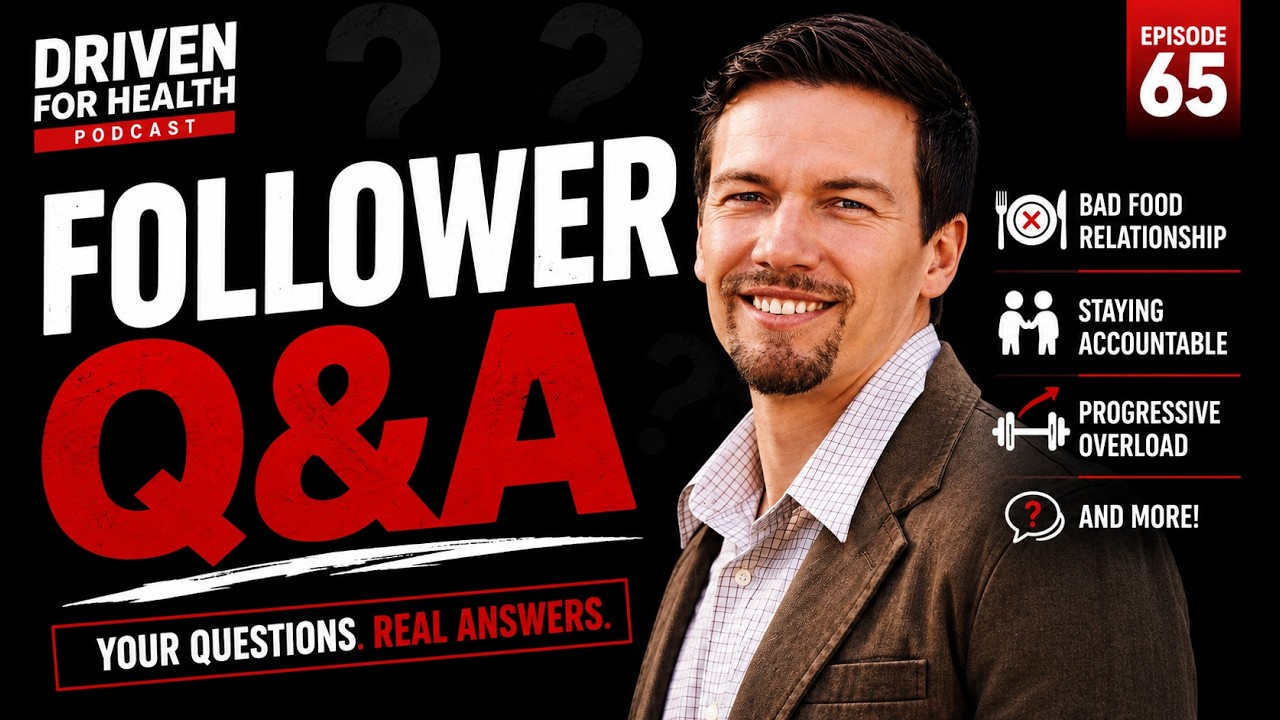
Follower Q&A: Food, Accountability & Progressive Overload | Ep. 65 Driven For Health
This episode is for the man who hit his goal and then watched his progress slip away. Brian answers the four questions he fields most from men over 40 who have tried programs and stalled, covering accountability, food patterns, gym progression, and plateaus in a single straight coaching session.
Summary: Coach Brian Parana answers four listener questions in Episode 65 of Driven For Health, each one closing with an action step to run in the next seven days. The questions cover maintaining results after a program ends and fixing the nighttime overeating pattern. He also tackles when to add weight in the gym and what to do when fat loss stalls for more than four weeks.
Episode 65 is a straight coaching Q&A. Brian answers four questions he gets from men over 40 repeatedly, and each answer ends with one action step to run this week.
Take the Next Step
This episode covers four patterns that keep men stuck long after they know what to do. If you want a place to start, Brian has a free resource to get the number on the scale moving this week.
Download Lose 3 lbs in 3 Days. This is a free guide Brian built for men who need to see momentum before committing to a bigger program. Get it at brianparana.com.
Apply for the Health Hot Seat. Brian takes applications from men who want a free live coaching session on the podcast. You come on, share what you are struggling with, and he coaches you in real time. You leave with a plan to run the following week.
Frequently Asked Questions
How do I stay on track after a fitness program ends?
Long-term success comes from two things: environment and checkpoints. Surround yourself with people who take their health seriously and keep a few tracking habits in place. Weigh in at least five days per week. Take a weekly progress photo. Track one metric daily such as protein, steps, or workouts. Set a new target so you have direction when the previous goal is behind you.
What causes overeating at night for men over 40?
Overeating at night is typically built in the first half of the day. When you skip food until late afternoon, your body arrives at dinner severely depleted. Your brain seeks fast relief and dinner becomes overeating. Starting the day with a real meal that contains 30 to 40 grams of protein interrupts this cycle at its source.
How do I fix a bad relationship with food?
Start by eating one real meal within 90 minutes of waking and aim for 30 to 40 grams of protein. This addresses the under-fueling that drives stress eating later in the day. Remove the one food you consistently reach for when stressed from your home environment. A stress urge can be interrupted with a pause. Drink a glass of water. Walk for five minutes. Check in with what you are feeling before eating.
What is progressive overload and how do I apply it in the gym?
Progressive overload means gradually increasing the demand placed on your muscles. A practical method: pick a rep range such as 8 to 10 reps. Choose a weight you can do for 8 reps with clean form. Each session, try to add one rep. Once you hit 10 reps across all working sets, add weight and start back at 8.
When should I increase the weight I am lifting?
Increase weight once you hit the top of your rep range with clean form across all working sets. If your range is 8 to 10, add weight after completing 10 reps in all sets. Rest 2 to 3 minutes between compound lifts and stop each set when you have 1 to 2 clean reps remaining. Track your reps each session so you know exactly when you have earned the next increment.
How do I know if I have hit a true fat loss plateau?
A real plateau means four weeks with no movement across multiple markers: scale trend, body measurements, strength levels, energy, sleep quality, and how clothes fit. If fewer than four weeks have passed, give the process more time. Many men who feel stuck find gaps in their consistency when they audit a full week of tracking, steps, sleep, and training.
What should I do when fat loss stalls for four or more weeks?
Run a 7-day audit with four daily habits: track all food, hit your step goal, train on scheduled days, and aim for 7 hours of sleep. If four weeks of those habits show no change, make one small adjustment. Drop daily calories by 200 to 300, increase your step count, or add a modest amount of cardio. If you have been dieting hard for months, consider a planned diet break where you bring calories up while keeping protein and training consistent.
What is the guardrail approach to staying on track with health?
Guardrails go on a mountain road because fog, long days, and distraction are coming regardless. Brian applies the same idea to health systems. Tracking your weight and monitoring a key daily metric act as guardrails against drift. A group that holds a health standard serves the same function.

CEO l Head Body Tranformer
Brian Parana is a men’s health coach with 23+ years of experience helping busy professionals improve their body, energy, and day-to-day habits while still leading at work and at home. His coaching is built around practical nutrition, training, sleep, and accountability, with a plan tailored to the person in front of him.
Over the years, Brian has helped thousands of clients through his work as a personal trainer, CrossFit gym owner, and online coach. He has also coached an Olympic silver medalist, a 2-time Olympian, and a CrossFit World Champion.
Brian is the host of the Driven For Health Podcast, where he shares real-world strategies for men who want to feel strong again and stay consistent without making health a second job.
He’s also the creator of The Call To Rise, a 100-day fat loss experience for driven men who want to drop 20–30 pounds, boost energy, and rebuild confidence through strength training, personalized nutrition, and high-accountability coaching. Many men join because their blood pressure, cholesterol, or blood sugar is heading the wrong direction, and they want a clear plan that fits real life.
Brian is married to his high school sweetheart, Amber, and they have four kids. Their family has traveled to all 50 states and 4 continents, with a goal to reach all seven.

What To Order At Dessert Restaurants For Fat Loss



 YouTube