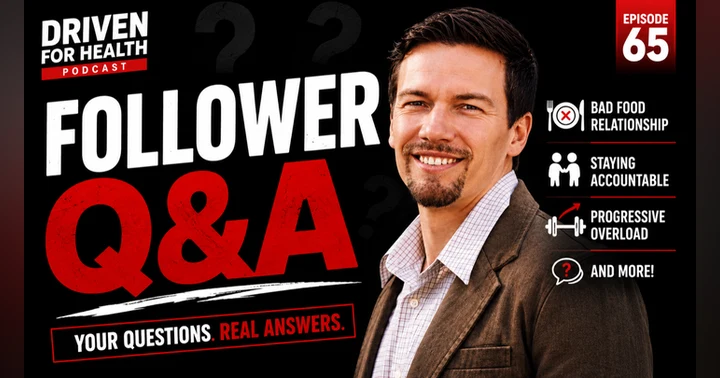
Bad Food Relationship, Staying Accountable, Progressive Overload & More Follower Q&A - 65
Your plan works fine until the week gets chaotic and you slide into cruise mode. Coach Brian answers follower questions on fixing a bad relationship with food and staying accountable when no one is watching. He also covers progressive overload for building muscle. You leave with systems and guardrails that keep your habits steady on busy weeks.


 YouTube
 Most men who lose weight gain it back within a year. Coach Brian says the problem is rarely the diet, it is what happens the moment life gets chaotic and the plan falls apart.
(Do you fall into cruise mode the second things get busy? Here is how to build habits that hold up anyway.)
Coach Brian answers real follower questions on fixing a bad relationship with food, staying accountable when no one is watching, and using progressive overload to keep building muscle. He explains the trap of cruise mode, how internal and external accountability work together, and why systemizing your routines and using guardrails keeps you from backsliding. He also shares real stories of men who lost dozens of pounds by tracking the right metrics instead of guessing.
By the end you will know how to build habits and systems that hold up when life gets chaotic, not just when things are easy.
Main Topics:
- Fixing a bad relationship with food for good
- Why cruise mode is the biggest threat to long-term progress
- Building internal and external accountability that actually works
- How progressive overload keeps you building muscle over time
- Systemizing your routines so good habits run on autopilot
- Using guardrails and tracking key metrics to stay in control
The Call To Rise is a 100-day fat loss challenge for driven men ready to take their body back. It combines strength training, personalized nutrition and real accountability. Most men drop 20 to 30 pounds and rebuild the confidence that comes with it.
This program also works if you are dealing with high blood pressure, high cholesterol or Type 2 diabetes. It was built for those men too. Many men see those numbers move in the right direction alongside their weight loss.
Inside the program you also join a Brotherhood of men doing the same work. Together you build a body you're proud of and start leading like the man you already are at work.
This is your wake-up call to rise. Learn more and apply at www.thecalltorise.com
Want help applying this to your own health, weight, energy, or lab numbers?
Coach Brian Parana offers Health Hot Seat coaching segments for men who want a clear next step with nutrition, fitness, weight loss, blood pressure, cholesterol, A1C, or daily consistency.
Learn more about The Call To Rise, a 100-day coaching program for driven men over 40 who want to lose weight, improve their health, and rebuild confidence:
To connect with Coach Brian:
brian@brianparana.com
Disclaimer: This podcast is for education and coaching support only. It is not medical advice. Always work with your physician before changing medication, treatment, or medical care.
- Let me hit you with something that might sting a little bit. You've been losing weight before, but it always comes back. Okay, this is a problem because you didn't make it part of your life. You couldn't figure out how to make it last. And the hardest part is that you do the programs that they tell you.
- You go restrict, you white knuckle, you are all in. and you even sacrifice other areas of your life to make it happen, but it's not real true success if you can't maintain the weight. Oftentimes, I don't think it's a weight loss issue. I think it's a weight maintenance issue that a lot of people struggle with for long-term success.
- And that's what I've made a living on for 23 years is helping people maintain long-term weight loss. Episode 65, Driven for Health. Welcome. Today we're going to be answering a couple live Q&A questions that I get from my audience and Instagram and Facebook. Let's dive in. So guys, question number one. How do you stay on track when you go off the program? Oh my gosh, I get this question all the time. Coach Brian, here it is.
- How do I stay on track when the weekend comes or when an event happens or the holidays or a friend invites me out or any of that stuff? Yeah, it's it's hard because a lot of guys can lock in for four weeks or four months, but the test is what happens in six months, eight months, eight years on a random Tuesday when it's tacos and your buddy invites you out or it's Friday and your kids have a pizza mutiny on you and they're they're chanting pizza, pizza, pizza.
- That happens in my house. Uh or I'll get a text from my wife, hey, you're going to go pick this food up. Oh, okay. I guess that's dinner tonight. Maybe you feel that. And a lot of guys will do great when they are in all-in mode, but they falter when they don't have the check-ins, they don't have a plan, they don't have a coach, they don't have a lane to stay in because they think they need to be in a lane to be able to be successful.
- that when when the say the the time frame or the accountability and the structure end, they go back to whatever normal was before. And it's the habits and behaviors that haven't changed. The takeaway is long-term success comes from two different things. Number one, the right environment and a few simple checkpoints to keep up with your everyday life.
- First we'll talk about the environment. External accountability matters and we also have internal accountability as well. External it can come from a coach, a group training facility like a gym, a community, even maybe your your buddy. I have a lot of buddies that I work out with.
- The three amigos, Andy, Chris, and Dan. Those are the guys I work out with. So, makes working out really easy. I wouldn't recommend having your partner or your spouse being an accountability person. You don't want to put them into that place. Hey, why didn't you tell me not to eat that thing? Or why didn't you wake me up and go to the gym? So, your wife doesn't want another child.
- Okay? Does not want that. And here's what I find is most men don't have this type of an environment. They the the in my program the call to rise the fifth pillar is brotherhood. That's where we create a bond, a group, a connection between men to share in their successes to be able to win this health game for the rest of their life.
- So they don't ever have to worry about it again. Having that accountability to lean in on is paramount to their long-term success. Nothing's going to raise the bar more than another guy that you're in the trenches with putting in the work that is going to show up and do the work with you. Well, not literally, but figuratively, right? If I'm doing the work and you're in my program, you get lifted. I am the tide.
- The tide rises all boats in my program. And that's where we get a lot of success. I've coached a lot of men that kill it at work and and they show up in that environment, right? Because it's there. They they show up, they got teams, they got goals, they got deadlines, they got the boss, or maybe they are the boss and they want to be successful.
- Therefore, they're super driven that way. But when it comes to health, they totally miss the boat. Can't tell you how many millionaires I've worked with that have cholesterol issues and a 43 inch waist and they need to drop 50 plus pounds. That's that's not actually being wealthy. That's you're going to die young and you can give all your money to someone else afterwards. That's not it.
- Why did you work so hard to not enjoy it? Okay, this is a very common thing. And now they just don't have a place where being fit is normal in my life. The way I eat, the way I move, the body, all this stuff. This is just normal to me. And it makes it easier to be able to maintain it.
- And that's what we want to put yourself in is that external environment. no one skips today or starts again on Monday or it's just for one week or it's the just doesn't isn't going to work that way. The internal side is internal accountability. This is what you do when nobody is looking, no one's around. This is really the alarm goes off, you get up or you hit the snooze button.
- I'm violently against the snooze button. You get up and you go and you don't start your day not aligned with the decision that you made yesterday of when should I wake up and when is the best time for me to get going and start my day. Even today I was a little tired. I got up when I need to to get the kids to school.
- I have to I drive my kids to school. We listen to audiobooks and and all. That's actually a a very strong memory I have for years now listening to audiobooks with my kids in the car. But I was tired, too. It's just the way it is. But when I got back home, I went into work mode. This is actually my second podcast recording today to make sure I get more out to you guys and been able to just get going.
- Right, the day is alive. Let's get to it. It's 9:25 in the morning. Need to record some podcast. Get some good content out there for you. Here's a simple analogy. I like [clears throat] to think of systems because you have systems in your business, but you don't have systems in your life and your health around this. They're like guardrails on a mountain road.
- You don't put guard rails up because you plan to crash. put them up because you're human and there might be fog, there might be rain, there's distractions, long days, windy roads. You don't want to fall off. Things like tracking or having a coach or getting to the gym, having your workout buddy or a class partner or whatever, they are your guard rails that help keep you on track to make sure you stay focused.
- Now, what happens when a guy hits their goal? He starts cruising. I love this analogy, too. You when someone starts working with me, they're going to put their hands on 10 and two on the driving wheel. The windows are up. I'm in the passenger seat. They're looking down, radio's off, just us in the car.
- High focus. But just as you learn to drive, what happens? You end up getting more comfortable. All of a sudden, you're driving with one hand. You have the music on. The windows are down. There's our people in the car talking to you. And there's distractions. And we don't drive with phones. So that's not a worry, right? But those are what happened in humans when they get accustomed to something and they get orientated, they go into a cruise mode.
- And that is a true challenge for them to not be successful here. When they are getting distracted, month goes by and the see the the tenacity that they are going at their goals is not there as much anymore. And then next thing you know, two three months and the scale slowly sliding back. Even a quarter pound a week is one pound a month. Doesn't feel like a lot.
- It's 12 pounds in a year. That starts to add up and it's a big problem. Here's what I can tell you as a coach. Maintenance still requires your attention. It's so much easier than a fat loss phase, but the approach and the focus to it has to be subtly different. Yes, you will always pay attention to calories.
- Yes, you'll be thinking about food because that's how you stay alive. But the approach and the attention that you put on the food is wildly different. If you're listening to me now, you are thinking about food so much more than I am. Silly enough, oftentimes I have no idea what I'm going to eat today. Why? It doesn't matter.
- I know that when I go up there, I'm going to peruse through my fridge and find out what is in there and how to make it work best for me. What do I do? I'm going to get a protein, a fibrous carb with starchy carb. In episodes 5 through 11, I outline the nutrition pyramid on how to build that. And maybe I'll get a meal design podcast here as well in a little bit to share with you the thought process on how I build meals, but proper portions and all that stuff. Super important.
- Here's your action step for the next 30 days or even the next five. Step on the scale every single day. If you are paying attention to your weight, the scale is a very very very important metric for you to be able to acknowledge and do so that you're able to know what's in there. If you're paying attention to money, trying to save money for say a house, you want to check your bank account a lot.
- Same difference because you need to know where it's at to help. You could definitely take progress pictures because the scale does or doesn't always tell the whole truth of what's happening and at the very least maybe track your your your metrics, your steps, your sleep, how much protein you ate if you're going to track. All right.
- Then you need to reassess your plan. Do I need to shift things around? Make it practical. Hey, I lost one inch off your waist. Okay, this many steps, this many calories is working. I just need to continue. Okay, I'm going to set a goal for this many steps in a day, a week. In episode 53, I had Andy, who was wild success in my the call to rise program, the 100 day program. He lost 38 pounds.
- I talked through what he did there. and to be wildly successful and doing the million step challenge, which I didn't even know what it was until he brought it up. But day 89, Brian, I'm 89 days into 10K steps. I'm about to take a million steps. Like, holy cow, you're right. That is insane. And that was a cheat code for him to be able to be super duper successful.
- Last one is, how about for a whole week you just don't eat out? That could be a really good option for you. All right, question two. I am I have a horrible relationship with food. I starve myself until 4 pm. I'm hopped up on coffee, caffeine, energy drinks, and I have no control later in the day.
- Where do I start? This is pretty honestly pretty common. Guys want to start their day off and just get to it and stay focused on what the tasks are at hand. And work is a high priority for a lot of guys. They want to do really well in their workspace and be successful. Okay, that's that's I me too. I'm going to grind and go hard in the paint, so to speak, and make things happen.
- And I respect that that say hustle or that action taking energy. But we also have to, again, I talk about middle gear mentality is finding some balance because you will crash. So many people do it. Uh Colton is a good example. Colton is a was a client that just binge ate all night long and could never lose weight and we had to rearrange how he manages his calories and had calories available.
- It's not that you're failing at night. You just don't know how to manage your calories. And that that is a very big strong truth that we have to pay attention to is that you do need protein throughout the day. You do need calories. You do need carbohydrates throughout the day. You just need enough to fill you up. Say lunch.
- One of my favorite lunches I always suggest to guys is a a protein sandwich with a piece of fruit and two or three cups of vegetables. That works really well. It'll be filling. It's an easy repeat meal that you could endlessly do that'll be about 500 calories and hold you over for a couple hours. That's the important part is that it's going to hold you over for a long time.
- Okay? Super important analogy. Think of it like your phone. Your phone's been at 3% all day. It's not running smoothly. It's glitchy. It's slowing down. It shuts off when you need it the most. That's your body running on caffeine and empty calories. Because if you don't have quality food, then you're going to pick whatever is around and available and it's garbage.
- Usually something in a bag. If you're eating out of bags, guys, you're doing a huge disservice to yourself. You need to stop. You need real food, whole foods to put in your mouth. And that's where the bad relationship comes. Maybe you didn't learn when you're growing up or you didn't have good examples or whatever.
- But in this day and age, you can see it on YouTube. You can listen to it on this podcast on what actually establishes a good relationship with food and what proper food should look like. If you were to fix two things, here's the front end of the day. We need to start the day off with ideally 40 or 50 grams of protein.
- Could be Greek yogurt, like two good Greek yogurt by Dannon, cottage cheese. You could do a protein shake, but I'd rather have you actually eat real food. Eggs. You could do a breakfast sandwich with some Canadian bacon or something. All that stuff works. And and a turkey egg wrap, bean, cheese, egg, burrito thing, dinner from last night.
- These are all easy wins. And you start with 40, 50 grams of protein. It's definitely shown that you will be in way more control over your calories throughout the day. Whereas most guys will just skip, have their coffee, have cereal, something like that, and or they wait to work and they have a donut. This is not going to go and do well.
- The other thing, serve with water. I have my jug here. If you're watching on video, I got a 40 oz jug. It's red. I call it my fire extinguisher. Right now, I have 14 ounces of sparkly water in here. And it's 40. Let's do some quick math. 26 ounces of regular water and a little bit of ice cube. It gives this hint of bubbles.
- It tastes good. Actually, I really enjoy it. And it gets me to drink water a lot more. And I can say ration the bubbles a little bit. Certainly, I wouldn't mind drinking full go bubbly water, but when you go to refill the bubbly, it's it's about $60 for four of the air cartridges. So, I mean, it does cost money to get carbonated water.
- I manage that throughout, but that's how that's the very most immediate thing is you're gonna start off with your 40 50 grams protein. You're going to have at least 12 20 ounces of water. And I always have my water next to my coffee. I chug my water. I sip my coffee. I call that my coffee hack. It works like gang busters to keep you hydrated in the first half of the day and actually slow down the need for caffeine because you're hydrating yourself and you need to be hydrating.
- Want to take a quick moment here to call out, hey, if you're looking for some free coaching, a session on the podcast, I have a health hot seat. Episode 35, I deep dive with a gentleman on his situation to see how I could help him. We went pretty hard in the paint, so to speak.
- We were on there for a good hour going over the all of his things. What I need from you is to send me an email or hit the link below and then fill out the form and then we can arrange a time that I can talk to you. Best [clears throat] part is we're going to do this live so that I get real you you guys get a real coaching experience and I get to show you my stuff and my skill set and my abilities.
- So if you want your own personal coaching session, the health hot seat is for you. Check out the show notes and fill out the form and we will get you in business. Question three, when do I progress to heavier weights? When do I pick up heavier? Well, I'm a big fan of the 8 to 12 rep range. Now, certainly you studies have been showing that you can increase muscle all the way from 20, even up to 30 reps.
- For me, let's say lunges. I can do 30 reps, don't even feel a burn. But if I put 50 lb dumbbells on my hands, I get 10 in on each leg. And holy moly, the heart rate's up, my legs burning, I am good to go. We have to have this balance of pushing yourself and but also knowing when you should progress and this is how you don't spin your wheels at the gym.
- your progress when you earn it. And by earning it, you're training in the rep range of again mostly 8 to 12 and you track. When you move your weight up to 12 reps for that weight, that is a signal that hey, maybe you should move up five pounds and then we're starting over six, eight, nine, 10 reps for that. If you track it, then it becomes very evident when you should be doing this and where the body weight or sorry, the the dumbbells are in this [clears throat] process.
- That's really important because you don't want to waste time at the gym, right? There's finite time and everyone I work with is super busy and they got a lot of other important things going on. They want a clear, concise action plan that gets them to change their body and be successful. All [clears throat] right. So, you lift the weight.
- If you get to 12ish, 13 reps, you need to go back to a heavier weight and work on the lower rep range. That's the best way to do it. Question four, how do I break past a plateau? Okay, let's define a plateau in the first place. What does that even mean? Is it scale? Is it in [clears throat] your body? Is it in your your weights? Well, we just talked about how to break the plateau and the of the weight.
- And there's a lot of different say exercise strength training routines and supersets and drop sets and [clears throat] force reps and negative centrics and all sorts of different things that you can do to be able to push your body to get past the the stubborn weight in a sense. But for the body plateau, [clears throat] we're talking about four weeks of lack of change.
- Whether it's a scale, inches in your body, there's no strength change, no energy change for more sleep isn't improved, how your clothes fit haven't improved. If you've done it for four weeks and you're still not seeing progress, then something is not working. Not four days, not four days, but four weeks. That's what an actual plateau is.
- And then we have to figure out, okay, how do we then shift the approach in a way that stirs on more progress? Okay, that's what's really important is making sure that we're consistently doing the things. And often times soon as someone dials it in and gets tight focused again, they change because as I've talked about in the past, they're breadcrumbs that are left in the days prior of things not changing.
- And that is important. So we have to make sure that we're tracking most days, if not every day. We need to make sure that the weekends aren't falling apart, that your steps are consistent. when you look at your step tracker that there's a consistent steady line of at least 10k steps a day, you're getting at least seven hours of sleep.
- You know, hit eight hours of sleep and your body might whoosh, they call it back in the body builder days when they'd be super duper consistent for days on end, weeks on end, and they wouldn't lose [clears throat] weight. What happened was their body would finally release and they would call it a whoosh moment. It wasn't because they changed anything, just that their body was finally relaxed enough to let go of the weight and finally shift down, which is important.
- Plateaus are literally weeks, not days worth of time. And I have to remind guys this all the time. And they'll say, "Coach, I'm doing everything right." And then we look at the week I start asking 18 questions and questions don't get answered because they're overloaded with their schedules, their work, their their life.
- Just it's really busy. Oftentimes in these situations, we don't need more complexity either. We're looking for consistent basic next steps for them to find what the leaky bucket looks like and how to fix it. [clears throat] We can keep pouring more water in. Hey, I'm going to do more activity. I'm going to I'm going to work out harder.
- But if there's holes in the bucket, then you're the water's always going to go out and you're always putting more effort in than there is. What we need is a 7-day audit and we go through tracking the food, paying attention to all these things. I promise you things get right back on track then. And if we need to, we can adjust, maybe drop the calories down 200, add some steps in, maybe a little bit of getting the heart rate up, and then bam.
- And then again, the sleep that makes such a difference. One more point too to acknowledge here. If you've been dieting hard for months, sometimes moving to a planned diet break is an important piece of the puzzle. Can't tell you how many times guys will add more calories in. We start doing a refueling strategy, refeed strategy, and all of a sudden the body continues to move in the right direction as well.
- You can't necessarily diet past four or six months. It's not good. Your metabolism is adaptive and it will slow down on you. You don't want that. Then you grind and you burn out and then you don't. I mean, how many guys have you heard of the back in the keto days, I lost 40, 60 pounds and then I put more back on.
- Well, you you grinded too hard, my friend. You grinded too hard. Well, that's the wrap for those four questions. I hope that they were a deep dive for you, that you learned some insights here, how to improve some of these things. If you have more comments and questions that you'd like to ask, I'm always looking for good content. Send me an email brianbrandpirana.
- com or below comment in the in in the the thread. I look at these things all the time. And so the quick recap, [clears throat] you have to hit your goals consistently over time. We have to find a balanced approach to having a good relationship with food, being able to sustain progress and effort long term as well and make sure that everything is sustainable.
- If you're looking for a health hot seat, fill out the link below and I will have you on my podcast and we will talk over everything that we need you to do for your simple action steps to make and implement into your day-to-day life. Appreciate you being here. Thank you so much. Off we go. Episode 65.