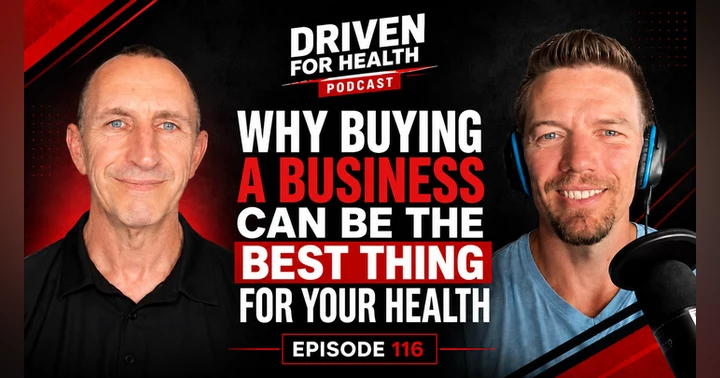
Why Buying A Business Can Be The Best Thing For Your Health: Tim T. Delaney - 116
Tim T. Delaney bought a small local business and thought that would fix everything. His weight stayed stuck no matter how much cardio he did. He tells Coach Brian how strength training, food tracking and accountability changed his health. You also hear how owning a business can give you more control over your schedule.


 YouTube
 Tim T. Delaney bought a small local business and thought that would fix everything. His weight stayed stuck near 220 pounds anyway, no matter how much cardio he did.
(Do you think hitting the next goal would finally make you feel fixed? See what actually changes it at www.thecalltorise.com)
In this episode of Driven For Health, Coach Brian Parana sits down with Tim T. Delaney to talk about the connection between business ownership, time freedom, health, weight loss, family, and long-term quality of life.
Tim shares how buying a small local business changed the direction of his life. He also opens up about his own health, including being around 220 pounds, exercising consistently but still struggling with weight, leaning too much on cardio, and eventually learning the importance of strength training, food tracking, muscle, movement, and accountability.
Brian and Tim talk about why owning or buying a business can create more control over your schedule, how that control can support better health decisions, and why financial freedom means a lot more when you have the energy, strength, and confidence to enjoy it.
Tim also explains his “buy box” concept and how building your ideal life should include your health, your family, your daily schedule, and the kind of future you actually want to live.
Tim T. Delaney is an entrepreneur, real estate investor, and the host of Business Buying for Financial Independence. More than a decade ago, he made a bold move, buying a small local business with almost no experience and very little cash down. That set him on a path to financial freedom. Now he helps others do the same through business acquisition.
Link:
Business Buying for Financial Independence Podcast
https://powerofbiz.com/podcast
Main topics covered:
- Buying a business as a path to more freedom and control
- Tim’s path from around 220 pounds to a stronger, healthier body
- Why exercise alone was not enough to manage his weight
- The problem with relying too much on cardio
- Why strength training and muscle matter more after 40
- Food tracking, portion awareness, and weight maintenance
- How busy business owners can build more movement into the day
- How accountability helps driven men stay consistent
The Call To Rise is a 100-day fat loss challenge for driven men ready to take their body back. It combines strength training, personalized nutrition and real accountability. Most men drop 20 to 30 pounds and rebuild the confidence that comes with it.
This program also works if you are dealing with high blood pressure, high cholesterol or Type 2 diabetes. It was built for those men too. Many men see those numbers move in the right direction alongside their weight loss.
Inside the program you also join a Brotherhood of men doing the same work. Together you build a body you're proud of and start leading like the man you already are at work.
This is your wake-up call to rise. Learn more and apply at www.thecalltorise.com
Want help applying this to your own health, weight, energy, or lab numbers?
Coach Brian Parana offers Health Hot Seat coaching segments for men who want a clear next step with nutrition, fitness, weight loss, blood pressure, cholesterol, A1C, or daily consistency.
Learn more about The Call To Rise, a 100-day coaching program for driven men over 40 who want to lose weight, improve their health, and rebuild confidence:
To connect with Coach Brian:
brian@brianparana.com
Disclaimer: This podcast is for education and coaching support only. It is not medical advice. Always work with your physician before changing medication, treatment, or medical care.
- But men are working hard to build a better life for themselves. They obviously focus around their family, around their career, whether they have a business or not. Finances are important too, right? And what is the future that they are looking to create on some level with with retiring? Now, here is the question.
- Are you building a life you will actually be healthy enough to enjoy? And today I'm joined by Tim Delaney. He is the host of Business Buying for Financial Independence where he teaches people how buying an existing business can create more control, more income, and more freedom than trying to start something from scratch. And I personally have started lots of things from scratch, and it's a lot of work.
- So, I'm I'm interested in Tim's perspective here, and you should be, too. He bought a wine and liquor store back in 2013. Built it from something that needed him every single day in the business to now only needing a few hours a week. And he uses the rest of the his time freedom and financial abilities to build real estate portfolio, other types of investments, and investing in his own health.
- And that's why I brought him on to talk about that connection between business and health and how it can relate to you and most importantly listening in. So certainly he has his own health story and we'll dive into that. He's tipped the scales up and down and he's finally found a clear path for him to be able to maintain a healthy body weight and not have to struggle with the ups and downs of that.
- So we'll talk about his story as well. And now, if you're a guy over 40 listening in, success and health have to be constructed together so you can create the freedom and you don't lose your health along the way. And I see that so many times. Tim, I'm so glad to have you here on Driven for Health. And before we get started, I want you to share what is one key takeaway that you want our audience, our guys listening in to leave with.
- >> Thanks for having me, Brian. I think one of the one of the biggest things that I think about with owning your own business and what I hear a lot of other people talk about is how stressful it can be, how much work it can be, and how challenging it can be. And it doesn't leave you a lot of time for yourself, especially when we're, you know, in your case and your audience's case talking about health.
- And I think that's kind of the opposite take. I I believe that owning your own business, doing it right, particularly if you buy an existing business can give you the freedom of time to take care of yourself and your family and your life, live the life you want at a much easier pace. And that's kind of like one of the key tenants of my buy box framework.
- You know, when people talk about looking to invest in a business, buy a business, if you're going out and looking for one, you need to create a a buy box. Like what are you actually looking for? And so I broke it down uh into an acronym called buy box. And that first letter B stands for build your ideal life.
- You know, think about what your ideal life looks like. Build it out. Structure it out so that you know what kind of business is going to fit into that life. Don't buy a business or start a business and then figure out how your life fits in around it. Right. And let's start with some of that here real quick before we go into some of the other even better parts about the actual business side and all.
- >> What back in 2013 was the shifting point for you to actually want to buy in? And even before that, tell us a little bit about yourself, the family life, the kids, the travel, all these important details, so that these guys listening in know that we're just guys trying to be successful and provide for our families and do fun things, too.
- >> Yeah, definitely. So, I'm going to go back to college 20012. I was all set to be a stock broker. Went to college to become a stock broker. Wanted to be, you know, just that I stocks interested me in high school. Went to college. Somewhere along junior year 2001, I had a realization that I had no interest in sitting in an office on Wall Street for 60 to 80 hours a week.
- >> Uh it just it all of a sudden didn't appeal to me anymore. So I had no idea what I was going to do at that point. business school colleagues were all getting internships and like uh one of my roommates was applying to the Peace Corps and I said, "You know what? That sounds good. Give me a couple years to figure things out.
- " >> Right? >> So, I did that. I applied to the Peace Corp. I got accepted. I served in the country of Guyana down in South America for three years. I met what is now my wife Sasha. >> That's awesome. >> Lived and worked down there. So it was a very good choice, huh? >> It was a great choice. You know, things always, you know, it's like I said thing, you know, I say often things happen for a reason and and they did.
- So >> we moved, the two of us moved to Ethiopia after my service was done. I took a job over there. I was working for an international development organization. You're kind of industrializing the country of Ethiopia, helping helping the economy, helping people come out of poverty through helping the economy, creating business, >> y, >> you know, that's a driver.
- Business is the real economic driver and it provides jobs, it provides money. >> So, we did that for a while. We moved back to Buffalo in 2010. Born and raised Buffalo, New York. We wanted to be closer to family. >> Go Bills. >> Go Bills. That's wanted to be able to watch football games again. Not >> Yeah, I'm over here in Cleveland area.
- So, we got the Browns. So, >> that's I digress on them. >> Yeah. Beautiful. Yep. And but I do not follow them. That I feel is self-punishment. >> Yep. Uh yeah. So, we when I moved back, I was still working for my employer. You know, back then, uh, remote work wasn't nearly as common, but I I was able to finagle a contract with them to work remotely.
- >> And at the same time, I was trying to start a business. I was trying to import handmade leather iPad sleeves. The iPad had just come out. It was I was like, I've got these connections in Ethiopia. I'll make these cool cheap leather sleeves. >> That just didn't take off the way I hoped it would.
- And sure change dimensions and it was a whole thing and >> right. Yeah. Yeah. As we know now what 17 efforts of the iPhone itself then there's this constant changing tweaking adjusting and your design would always have to change all this stuff. Yeah. >> Yep. It was a losing battle and you know apparently that the big shots at Apple didn't think they needed to consult me every time they wanted to change the dimensions.
- So >> right >> I was stuck. But around that time, a business opportunity fell in my lap to buy an existing business. And I had had no interest prior to that. >> Sure. >> But I took a look at the financials on this business. I had some conversations with bankers. You know, it's like getting my reps in like trying this thing and it's like actually this kind of makes sense. The business is there.
- It has certain customers. It has employees. It has some processes, >> right? >> I can get a loan to cover 90% of the purchase price. I only need to come up with a little cash and then I get a paycheck day one, too. It's not starting from scratch. I mean, you've done the scratch thing. Like, >> you never know when you can start paying yourself comfortably.
- Like, >> you got to constantly reinvest in more marketing and more systems and >> branding and marketing. And that's where this podcast exists. We're 16 episodes in here. >> That's awesome. That's amazing. And it, you know, so I that one didn't work out, but it sent me down a rabbit hole of, okay, this is a thing I'm gonna go look.
- And so I I started searching heavily, >> looking at all different kinds of businesses >> till I ended up with the wine and liquor store. >> Okay. Right. Excellent. Excellent. And it's you're still there? >> I am still. So, it was a it was a a great business. Uh, you know, and this so here's like just the breakdown of the top level numbers.
- It was they were asking $350,000 for the business, which uh, you know, that's less than a median price home in the United States right now. >> Yeah. >> And I have yet to meet a personal home that kicks off as much cash flow as my liquor store does. So, it's Yeah, I came up with $35,000 was just about everything I had to my name at that point. I didn't own a house yet.
- We had a one-year-old daughter, not even one at home. >> And I put went all in on it. You know, the bank gave me a loan for like 80 80 85%. The sellers gave me a loan for another 10%. So, I had extra cash in the bank at closing. Uh, and it was a lot of work at first, but yeah, it was well worth it, especially for that.
- You know, I made all the cash that I put in, >> I got that and more back in the first year alone. So, >> excellent. >> And the rest was just, you know, paying down the loan and and slowly working up to generate more and more profits. >> Yeah, definitely. Well, that that is a a good investment. And we'll certainly go through the buy box and and some of the other things, but what has why buy a business? And I think the the general takeaway is like I introduced you is that what comes as a result of your fruit of thy labor to
- have wealth to have a ownership in something so that you then can reap the benefits of of thy work. So what's been some of the changes especially like on the health front because that's one of the big reasons why we connected in the first place of you have time and energy and money to be able to spend to take care of yourself but even more importantly do fun things too like travel.
- >> Yes. Yeah. And that's you know that's where the idea of ownership gives me freedom. So I'm not uh you know yes I'm beholden to the business. Yes. You know there's calls here and there at different times and uh you know certain days I have to do certain things but for the most part I create my own schedule.
- I can >> work when I want to work. I have the, you know, now I've built it to the the systems where I can get up in the morning and go to the gym for a couple hours and still be home in time to spend some time with my kids before they go to school, >> right? >> And then I can start working. >> And I work from home a lot now, too.
- You know, a lot of the stuff, the way I set up the systems with the wine store is >> I can do more remote work so I don't have to sit in the car for an hour and 20 minutes a day around trip going store. That's, you know, that's where, you know, you see over the last five, six years, a lot of people have been working remote, you know, so they they're saying, "Well, I do that anyway.
- I got the corporate job. I work from from home and I'm good." But we know that more and more businesses are calling people back to the office. They're they're over the the work from home thing and >> right, >> you know, so and that time in the car is is a health killer, too. You know, that's very much so sedentary time.
- It's stressful time. I mean, there's there's been a, you know, I don't I don't know the statistics, but I know there's stats out there about divorce rates and abuse rates and all like stress rates and heart attack rates, like the longer your commute is, right? >> Especially when you're driving and >> and rush hour.
- >> Yep. Exactly. You know, we you know, we we live in smaller cities. Rush hour is not like around here, but it's >> still if all of a sudden you realize you're not getting home for another 20 or even 30 minutes, not like an hour, but it's still unnerves you. It creates some stress and and oftentimes when I talk to some of these busy guys, we have to factor in their transportation and the a loted time that they actually have in the day because it's it's literally hard time of what they're doing, why they're doing in
- and their day-to-day life. So, it has to be built in. Or even yesterday, a guy I I brought into the call to rise, he travels Monday through Friday for his family business. He's out about two one to three hours away from his house all week long in an Airbnb or hotel. So, we had to talk about how he can facilitate making his food and meals and taking time to exercise and then on the weekends he's home and this is a whole context of how do we make sure that he has time appropriate to be able to spend toward it. Now, what are some of your
- health journey? Because that was really intriguing how you you you did a lot of business and we're going to get to the buy box here in a little bit, but the health why would did health become so important to you in the last couple years here? >> Yeah, it's so it's always been important to me.
- I've always, you know, I grew up getting teased in middle school for being fat and I, you know, it was just kind of always there. That sucks. It was always Yeah, it sure does. I, you know, middle school is a rough rough thing for anybody, but you're overweight. Forget about it. >> Feel bad for anybody going through it, having kids going through it.
- >> And you have three kids that are right in that age. And I got >> They're all in middle school. >> And I've got two in high school, two in middle school. So, yeah, it's literally >> Yeah. >> feeling that. >> It's uh Yeah, it's rough. And so, you know, I would say I played football in high school for a couple years.
- We would lift weights, but then after that, I never really uh lifted too much. I I started doing a lot of cardio after, you know, during college. After college, I shouldn't say a lot during college. >> Um, but during the Peace Corp, I didn't do a lot either because it was it was just tough. There weren't gyms. It was so hot in Guyana that if you didn't get a run in before the sun came up, forget about it. It was just miserable.
- So, right, didn't care that much. Wasn't too interested, but started caring more after that. And I started doing a lot of cardio, go to the gym, >> a few days a week for most of, you know, from then on, like 2007ish on. And but I never really like my weight would go up and down here and there. Never really connected it in my mind.
- I was exercising a lot so I could eat what I wanted and drink what I wanted and like >> you know I I had given up soda and pop like whatever you want to call it years before as well like I knew that that was empty calories but it was >> it's just still uh >> you know I I don't know it was I did a lot of exercise but never really permanently lost weight in even after you know 2012 my father passed away unexpectedly at 57 years old from a heart attack.
- And that just made me double down on cardio even more. You know, that's the that's what you kind of hear, general, you know, general life is cardio is good for the heart. And >> yep. >> So, I did more of that. >> And it wasn't until a couple years ago, I'd been up and down. I'd been as high as 220 at points in my life, mostly when I was working an office job in Ethiopia.
- Uh, and I had gotten down to 180 here and there very briefly and then it would pop right back up to 200. So, a couple years ago, I read a book called Outlive and realized that I was not eating enough protein and not lifting weights enough. >> Right. Right. >> Uh, so I started lifting some weights more, but even at that, like I I bought some of those Boflex dumbbells.
- >> Oh, yeah. Yeah. The multis select. Because at that point, I hadn't I hadn't been going to the gym in years because of the timing. I was thinking time >> I don't want to drive. I can work out in my house. I had an elliptical. >> I had like some CrossFit videos and Yep. >> So, I would do that stuff.
- And so, I got the weights and I'm like, "Okay, I got 50 pound dumbbells. I'm I'm lifting weights." >> Yep. And then I joined a fitness challenge with uh some like friends and friends of friends and the the metrics of the challenge where it was a six-month program because it's meant to impact you know it was a lifelong you know the idea is that after six months hopefully everything's a habit enough but >> y >> it was we have to walk at least 10,000 steps a day on average so 70,000 for the week.
- >> So if you miss a day you can make it up. Uh, you have to lift weights at least three times a week and you have to eat your body weight and grams of protein every day. >> Yep. >> Which, you know, the first couple weeks of doing that alone, I was stuffed. Like, >> unfortunately, your body adjusts to it and then you get hungry again for other stuff, >> right? >> Yeah, that's it's a filling that changed things.
- I dropped that was first the first year. So, I did two rounds of that right away. >> Okay. in the first year dropped >> over 25 pounds >> and close to 30 pounds I guess by the end of the second round and went from like 27 28% body fat down to 15 16% body fat >> which was amazing. You felt like great feel different. You feel >> when you feel that good you it was a different feeling of being more motivated to keep it off per >> totally. Totally.
- It has to be a lifestyle no matter what. And there's countless different episodes throughout this podcast that you can listen in. Episode five starts a nutrition pyramid. Episode 17 starts a strength pyramid. And there's countless testimonials of guys that are doing the work regardless of how busy or not busy they are and whatever else is going on and that have been able to do simple things like that.
- I call it the core four. they have the the movement, the nutrition, the sleep, and the the the hydration. And those are the basic concepts of what gets you moving in the right direction. And and it's really awesome that you were able to get into something that created that consistent behavior that then ended up getting you into a healthy body.
- And this is something that you do now on a daily basis because you have time, you have energy, and you can now fit it in. And but even then earlier on it was still important to be able to fit it in. Now, let let's tie in how the discipline of of business and discipline of taking your health to care of yourself tie in and and for you, we've got the the buy box, which I I love just even the very first step is let's create a lifestyle, not something that enslaves you into working all hours of the day endlessly and in a in quotations
- business in a sense. >> Yeah. Yeah, I mean the the buy box is is meant to help people that are on the path to buy a business in identifying what kind of business is going to be the right fit for them. And so that's why that first step to be is to build out your ideal life. Like talk about what you want to do.
- I I had a guy in my mastermind that was getting close to putting in an offer on two doughnut shops and >> okay >> it was a good deal like you know it was good money you know and he's he's a very healthy fit guy too. It wasn't just uh so he didn't have the same fear that I would have buying >> right eat the product >> would end up getting high on my own supply and uh blowing up to 500 pounds.
- But he he was he was more disciplined than me. So he wasn't worried about that part. >> But as we talked more and more about it in my mastermind, he realized that >> he doesn't like getting up in the mornings. He likes his mornings to be slower, to have time to work out, to do what he wants to do. >> And he's like, >> "Not me, the right business then.
- " >> Donut shops are rolling at four o'clock in the morning. Like that's when that's your prime time. >> So he ended up not going through with that. And kind of we talked about refocusing his energy on, you know, if you want to be in that dessert type space, frozen yogurt shops. So now you don't have to be there in the morning.
- >> Start your day at lunchtime. you roll into the evening and you're still out of there at a reasonable hour. You they're not, you know, mostly catering to young kids. You're not going to be out there >> till two o'clock in the morning. So, you know, that's where that be the build your ideal life can help.
- Um, and then the next the next letter is U is kind of understanding your limitations. What whether those are personal, you know, whether it's you don't like to drive, whether it's uh financial, you know, finan like whatever your limitations are and what you can do and what you like more importantly what you cannot do.
- If you're not a good salesperson, a people person, don't get into a business that's going to require you to be a door-to-d dooror sales, >> right? >> You know, so that that's >> the next step is understanding those limitations. Why is for your role. So be u y by your role. What is your role going to be? Are you going to be the CEO? Are you going to be the president? Are you going to be the marketer? Like are you going to have somebody else do operations and you're going to be the marketer or vice versa? Are you going to be operations?
- >> You know, so just defining exactly what your what you want your role to be in a business, >> right? Because you don't want to play all the roles. Yep. >> That's that's exhaustion. That's burnout. That's >> Yep. >> building not a business, but Yeah. totally getting stuck to have to do way too much things. >> Yep.
- Um, so and then we get into the box part by box. The B is for budget. So what is your budget? What are your what is your what do your finances look like? >> Right. >> You know, I generally tell people don't not look at a opportunity just because the price tag seems high, you know, right? >> Even if you >> and you could see that in some of your episodes.
- >> Yep. of you talking through people that were able to facilitate a deal without having to leverage their house, their all their net worth on this deal, which would not be financially smart. >> Yep. Exactly. And there's, you know, there's I don't necessarily like say it's the best thing in the world, but there are opportunities to get 100% financing on businesses.
- So, your budget, you should have a budget in mind. You have should have a budget of what kind of cash you feel comfortable putting in, but don't let the price tag scare you away if it's not directly in your budget, >> right? >> And then O is for opt out. So, what are the industries or types of businesses that you want nothing to do with? For me, bars, restaurants, like I no interest, >> donuts, candy.
- I I would love to There's a chocolate factory that's been for sale here in Buffalo for a while. I would love it. Awesome building that comes with it. I I know that I can't do it. I that would it would >> break my >> I love breweries. I would love to say own one, but I would drink the product and get fat and I'd have to run every day 10 miles just to maintain my figure.
- >> Yeah. Yeah. And that's the thing like, you know, with the wine and liquor store, there's closed bottles, so there's not uh it's not as easy. >> It's not open flow, >> you know, go take a sip, >> hit the tap. >> Yep. >> Right. But even with that, with alcohol, it's a little bit easier to control because you know it's physically impacting you when you're doing it.
- When you're with like for me with candy, chocolate especially, like if it's there, it's going in my mouth and >> there's no immediate effects. It's >> Right. Right. >> And then the the X is for execute. So get out there, talk to people, talk to brokers. >> Right. share with them what what your whole box what your whole buy box looks like and and right >> you know what your vision is because there might be opportunities out there that you don't necessarily see listed on these on these websites that >> have so the more you get out there and
- talk to the better >> right there's always deals available on the back end easiest thing off top of my head is buying a house a lot of houses can just go from one realator to another because the network and and that's really important to build a manage. >> Exactly. Exactly. And so that's that's the buy box.
- It's a you know it's just meant to be a kind of a loose framework for helping narrow narrow in what kind of business that you should buy. Yeah, that that that is an excellent framework actually and it makes total sense with what you're doing now to to help some of these guys listening in that that have an interest in maybe not working for themselves or redefining what their career looks like or taking on new opportunities to leverage investments.
- What what's one success story off top of your head that you just like, oh yeah, this guy came in, he he did the buy box, he this is the fruit of his labor and and now things are working out because they don't always work out too. But that that is a one reason why you find a mentor, find a coach, find some someone to help guide you in this process.
- Same with thing with all of this can easily correlate with taking care of your body, your health, fitness, nutrition, and all this stuff. >> Yeah, it it's it's no different. I like I tell people, you know, this I I have a fitness coach as well that I hired before I met you obviously, but it's like having >> having that human accountability.
- You know, I for a little bit I was trying to use ChateBT to get my fitness program and I was getting good, you know, I was good about logging my weights, like what I was lifting for the day and doing all that, but just knowing that another human is going to look at my log now >> makes me push a little bit harder and and throw that extra five pounds on, >> get that one more rep in or whatever it is, you know, in a healthy way.
- Not I'm not trying to kill myself, but >> right, >> you know that that motivation that that little and he's not even he's not going to yell at me. He's not going to like call me out or call me a a wimp for not doing it, but it's like >> knowing that somebody else is going to look at it makes you push a little bit harder and it's good for you.
- And it's the same thing with business and with with anything in life. Like so that's why I started the mastermind to help people that are looking to buy businesses so that we can help each other. You get into a group of people that you're sharing your wins and your losses for the week and what you've done and how many brokers you've called and what deals you've looked at and okay now you got a deal with what am I missing? What what am I not seeing? Right? Where am I do I have my blinders on because I fell in love with something that I
- >> I'm sure that happens too. >> It does. it does all the time. So that's that's really where that comes from. And this is all very new. So the buy box is something I I created a couple months ago. I have not had anybody go all the way through that has told me, hey, I did this and I bought this business and now it's already running great because that would be way too short of a timeline, right? Business takes a little bit to >> acquire and then take over and get systems and >> Yeah. But I I do have a number of people
- that have like myself have successfully purchased and are operating a business. I tell a lot of those story or I have them tell their stories of course podcast as well. >> So >> yeah, >> but yeah, that that accountability like you you said that comparison to to fitness is is huge. It's >> right. >> I think it's and it goes for everything in life like just >> Yep.
- Um having having other humans that you can share your accountability with and share your goals with is is super important. >> Yeah, definitely. That's the main point of the call to rise 100 day fall challenge is come in. We're going to spend the next 100 days with other like-minded guys that have families, that have careers, responsibilities, businesses, what have you, and they're not taking care of themselves.
- And they need support and accountability to do it. not in some weird bad diet way or whatever they thought they could do when they're 20 or any of that nonsense because those aren't the things that are going to apply to their direct lifestyle right now. And having the support, guidance, and and accountability is so important to execute because you can do you can overin information all day and that analysis paralysis and procrastination and all this stuff, but you have to execute on the directive of taking care of yourself or of buying a
- business and and looking at all the opportunities that it has in place. >> Yep. Yeah. That execution piece is kind of the most important part. I mean, >> not always. >> One of my friends uh that has a real estate podcast says all the time like, you know, everybody has the knowledge of how to go get a six-pack, >> but if you don't act on it, you're never going to have one.
- Doesn't matter how many books you read about health or real estate or business or whatever it is, if you can have all the knowledge in the world. And and in theory, we all do know already. Like, we all know how to be healthy. Just eat less, exercise more, >> in general. Yeah. Not not less but >> yeah it's >> in general less eat less calories >> formula. Yep. Yep.
- >> Right. Right. Right. Right. >> Now you what are some of your bigger plans that you have for yourself moving forward having acquired the knowledge the implementation and now just continue to grow. How does understanding how buying a business how it has impacted your future? >> Yeah.
- Um, so that's the the reason that I called the podcast business buying for financial independence is I've paid attention to the financial independence finan personal finance space for a while as well and you know one of the a couple of the things that I hear people talk about in that world in the fire community if your audience is familiar is is that financial independence retire early they hammer working hard in and off, you know, in your good corporate job, saving as much as you possibly can, putting it into index funds and letting that grow into millions of dollars.
- >> It works. >> No against it, but >> it's one path. >> It works if you have time. And some people can do it faster if they have better income and really get frugal with their expenses. >> I don't want to be super frugal. I mean, I have been and I and I will continue to be in certain areas of my life, but I I want to travel.
- I want to take my kids to Europe. I want to go to South America. I like it's >> so I want my financial independence now. >> Yes. >> You know, a reasonable time. >> I think we both agree on that. We were just in Peru in April and we're going to an Alaskan cruise here in within the next month or so. And then we're going to go over to Ireland for Thanksgiving with our kids in tow so that we share them the world.
- And this is one place of abundance that my wife and I have agreed upon and it's served so much in terms of giving back to the quality of my experience in this world for sure. And so you know that so yeah you have to spend in certain places so keep going. >> Yeah and that's you know so I the other area that the fire movement talks about is real estate.
- you know, some people do is like, okay, go buy a bunch of houses or apartments and the cash flow will I be able to let you leave your job? And when I did the math on that and I own real estate, I like there are there is no consistent income coming from my real estate. It's very varies up and down. We had a an air conditioner go the other day, 4,500 bucks.
- Like that's that's more than the cash flow for the year off of that that apartment. So, >> right, >> it's it's a great avenue for long-term wealth building. It's given me a great backs stop, but it's not going to get you out of your job tomorrow. And if and then, you know, that along with side hustles in general, >> just end up making you work more.
- And and if you're if you think you're going to replace your corporate job income with a side hustle, >> you're going to put in a lot of effort, a lot of time, and that's, you know, it's not good for your health journey. If you got to go try to spend some time in the gym or, you know, just taxing your body, overt tired.
- Um, you know, I'm sure you tell your audience how important sleep is as well. like >> of course >> it's, you know, so if you got a side hustle or you're doing real estate on the side of your day job, >> it's going to be a lot and it's going to be hard to replace your income. >> One of my best friends that works out in my barn here, Chris is his name, and he'd come over, we work out, and he was talking about he owns a small business that has 11 employees.
- They're doing really well in general. They do security and IT work in residential and commercial homes. So, think of the easiest way to explain is like they'll come over and install your Ring camera in a sense, but on a much higher level, but that's the easiest way to explain one part of the business. So, he's got all these things going on and then he's trying to do this side thing with real estate but with flipping a house with two other guys.
- And we were just talking about I said, "Dude, you're pwning up 20, 30k, waiting months for this thing to turn into something if it does, and you probably could make more in your business if you just focus that money, energy, and effort into that." And so he ultimately stopped. He did about three or four, and then we had a conversation, and it just didn't make it sense anymore as a passive way of doing income because it wasn't passive.
- He had to manage it on some level quite a bit. >> Yeah, that's and that's the thing like if you if you can do it in a completely passive way, it's one thing, but >> yeah, we both know there's not much passivity and income without a an excessive amount of experience and skill usually, right? And time. So those three things have to boil into actually creating passive wealth for you and income.
- >> Yep. Yeah. And that's and so that's where I came down to the idea and trying to spread the word about buying a business. And so >> you can oftentimes get in for 10, you know, 10% down. It's not going to be Yeah. If you're if you're working a a decent corporate job anyway, you ideally have some savings of some sort.
- Even if it's in retirement accounts, there are ways to use that to buy a business for yourself without penalties and taxes. >> That's what I did. I borrowed against myself for my very first business and I'm paid myself back. >> There you go. Either borrowing against it or there's actually ways to completely pull it out if some of it if you need it, but borrowing it against it is even better.
- And you can get out, buy an existing business that has a track record. You know, it's, you know, it's never foolproof. It's never guaranteed, but >> right, >> it's got a good track record. You come in and run it, you can pay yourself a paycheck for running it the first day that you get there. So >> because you've seen the numbers, you know the cash is going to be >> and usually in the first year of a new ownership, the business goes up in revenue anyway because there's fresh blood, fresh ideas, you know, fresh >> right, >> you know, >> new energy into the old existing
- customer base and they feel it. >> Yep. They 100% feel they and it's just a couple phone call like it's a couple things that the owners usually when people are selling a business, they've been there for 10, 20, 30 years, 40 years. Yep. And complacency on some level. >> Yep. They're living a good life. They don't need to go find new things and new ways to make money.
- And so the a new owner comes in, you're you got that opportunity, boost revenue a little bit in the at first, no major changes, just boost it a little bit. And then as you go, you start implementing some some other ideas. You really ramp it up. >> You get it to a point where you can be complacent for a little while if you want.
- and right >> and then sell it another 20 years and >> you know live off the cash flow in the meantime and pay down that debt so that you have an asset worth something that's generating income for you on a regular basis you know not passive but >> right >> with less effort >> with proper systems and and understanding your key performance indicators and the day-to-day things that need done it can you can leverage it quite a bit from your first year in of you mentioned on our our pre-call was you lost a bunch of weight because
- you're moving boxes. Yes. >> And working in the store every day. >> Yep. Yeah. 20 20 pounds in the first year because I was there by myself 9 to5 most days dealing with sales reps deal you know taking care of customers stock restocking shelves. So back and forth carrying by on my feet all day. >> Yep. >> It's just the a testament to the the power of movement. Yes.
- >> It's sometimes that's all. It wasn't like I wasn't consciously trying to lose weight. It was just a >> Right. >> a thing that happened. So, >> Right. >> Yeah. Yeah. It's good. >> That's excellent. That's excellent. Now, what what's one of the biggest things that you're looking forward to in terms of say the the business itself, the your your baby? It's >> Yeah.
- What are your plans for that business? Is there are you looking to sell at some point? Are you going to just hold and and grow and and and allow it to do its thing? >> Yeah, I like the idea of holding. It's a >> Yeah. >> You know, >> Warren Buffett type mentality. Buy buy and hold. Buy right and hold. >> You know, I do I do flip a couple houses a year, but most of my real estate I hold. I want to hold the business.
- >> Yeah. We're We're always looking for improvements. We're working on a a wine program right now. We have a a great following for bourbon lovers. We are a lot of >> You get the line up on the special release and everyone comes ready to wait for >> We don't We don't do the lines. >> Okay. >> Yeah.
- Ohio is all government run, so they do it different, but we're >> Yeah. Okay. >> We Yeah, we have a system for doing it, but we >> Okay. We do a lot of single barrels. So, we we're actually heading down to Kentucky next week where we'll visit four different distilleries. We'll buy at least one barrel from each distillery that's just uniquely our our product.
- So, every when bourbon's aging, every single barrel tastes a little bit different because the wood includes different flavors. >> And so, we go down, we'll taste three, four barrels, and they'll all be different. And we will if if there's one that we really like that stands out, we'll buy that entire barrel.
- They bottle it up just for our store and those bottles get shipped up to our store. We sell them to our customers and it's a once >> it's one and done. Once that's gone and you never get that exact same flavor again. >> Right. >> Right. >> So we do that. We just released our first private label where we worked with a company to develop our own unique product.
- Uh so that just hit our shelves and we'll probably do more of that. It's >> gives us a little bit with the big >> right >> the same products every day. >> Right. Right. Right. >> It's been our focus for that for that store and we're, >> you know, just trying to stay with the times pivot. A lot of ready to drink canned cocktail stuff going on now.
- >> Yeah. But yeah, and then in my other business with the podcast, what I'm really looking to do is speak more to audiences that I feel like should hear this message about buying businesses, >> right? >> And also how buying businesses is so important for our communities. I've seen a couple, you know, >> Yeah. >> Yeah.
- So, we know I mean, you know, as a business owner in general, and we all know that small businesses really drive our local communities. We we keep the cash recycling within our communities, right? >> We're the ones donating to the churches and the fire halls and the, you know, the schools locally. >> We're providing jobs for people like that's and we're not, you know, I have a couple moms and a couple people that have had been taking care of elderly relatives that we can be flexible with.
- We're not some corporate giant where it's like, nope, this is your shift. You better be here from this minute to this minute. It's >> like, oh, your mom needs to go to the doctor's appointment tomorrow unexpectedly. Okay, we'll figure it out. The rest of us will we'll make it work, >> right? >> Your kids homesick from school, no worries. We'll figure it out.
- You know, kids got invited to a baseball tournament in Ohio, like no worries. Like, >> so that kind of >> that gives back on multiple different levels of just >> getting an income from it, but you help other people in real life situations because those that's the everyday. And the more kids you have, the more responsibility you have, the more people in your social circle, those things are going to come up just because that's light.
- And and you can't have this hard set nineto-five type thing. And be able to do that for your employees and and co-workers and stuff is is super helpful and giving in a sense. So as long as it's not abused, of course. >> Yep. Yep. Yep. Exactly. And that's, you know, and that's so I I want to be out in front of more audiences talking to people about why these small businesses, why it's important that other people in the community are buying these local businesses because otherwise they just close their doors.
- I've seen it too many times and they just lock the doors and leave and be, yep, we're done, out of business. We're we want to retire. Nobody wants it. And then also the other on the other side of that there's a lot more private equity going on and they're coming in and buying these businesses which is fine at least it keeps the jobs somewhat there but they're profit centered they'll cut people if they need >> and then those profits are going somewhere else they're not staying local in the community so >> right >> you know so I'm building this platform
- of the podcast speaking opportunities and the mastermind to help people buy the businesses uh in hopes of building a bigger movement to help people that have small businesses sell them to caring people that want to continue the community engagement that they've built. Yeah, that's that's excellent because yeah, we need small business with big players like Amazon is a huge one obviously that they are just changing the landscape of business in general and how we do retail and a lot of other things even service in a sense.
- So it it does impact a lot of everyday people and there's someone in your circle if you're listening in that is running a small business that is being impacted on these mega corporations and such and we have to find a way to again keep the money in the community and not just ship it out because >> of of just Amazon in a sense.
- Amazon's great, but also we need to not not just let them take all profit and monopolize everything because that won't work for us. >> No, >> we will lose. >> Yeah. Yeah. The the end game is not great if they're they're doing everything, >> right? Exactly. Excellent. Excellent. Well, in closing up, let's talk about some of the places people can find you.
- >> Yeah. So, my podcast is the best place to find me. Business buying for financial independence. I go more in depth on that buy box in episode 46 of the show. >> 46 that out. Yep. And it's anywhere you you get podcasts, >> right? >> I'm super active on threads with at Tim T.
- Delaney, which is where you can kind of find me anywhere. Tim Delaney is my handle. >> Okay. You know, um, yeah, those are those are really the best best ways. Just listen to the podcast. All the other links are >> Yeah, definitely. And that's the best part about being on a podcast when you have a podcast. People listening in that are want to listen and find out more can.
- So those that stuff will obviously be in the show notes. And if the idea of buying a business was of some interest, this is a topic that I have not had on the conversation here with Dream for Health and I want to bring in a lot of subject matter people into this podcast as well. I'm doing a lot of the health, nutrition, fitness, lifestyle stuff, but then it has to go somewhere.
- We have to get the healthy body, but then you have to do something with it. And today's guest, Tim, is just an avenue to explore another different way to leverage better health and how can you then create financial freedom with your health freedom to then have a life that's worth living and exciting and talk about and all that.
- So, check out Tim, his podcast, and his business buy box. And if it's right for you, I I'd love for you to jump on over there and listen in. I've had listen heard some of his podcasts and the stories are excellent. Great conversations about the process of finding deals and and looking into how do we get to actually acquiring a business and such.
- So, it's it's excellent content to be able to listen into. >> So, thanks Tim so much for being on the show and any guy listening in. If you need some help with the fitness side, the health side, the nutrition side, the lifestyle, then obviously that's what we do with the 100 day fat loss, or you could even jump on to a health hot seat and get live coach during an episode and you'll walk away with a very clear blueprint on what to do, how to do it, and make progress.
- Even Dominic, the last guy that I had on a couple episodes, I believe it was 105, I keep in touch with him, and he's doing really well. So, it's it's awesome that people actually do something, which is what we talked about today with Tim. >> So, execute. >> Speaking of doing something, Brian, I I just like to share with your listeners, please.
- >> If they're still listening, >> take a two seconds and leave Brian a fivestar review and a rating. >> Thank you. >> Us podcasters need those. And Brian's doing an awesome job. So, make sure you you give him some love and give him that. >> Yeah. Yeah. Exactly. It is the easiest way to give back is to like, subscribe, follow, and leave a review.
- And uh that that that does wonders to be more engaged and more followed and do better, do more good, right? I think that's what you do with your podcast too and everything. Like literally, I want to help grow small businesses to do more good in the communities that we live in so that we all prosper and again don't ship money out from uh underneath us.
- So, all right, Tim, thanks so much for your time today. Thanks everyone listening in. Off we go. Thank you, man.