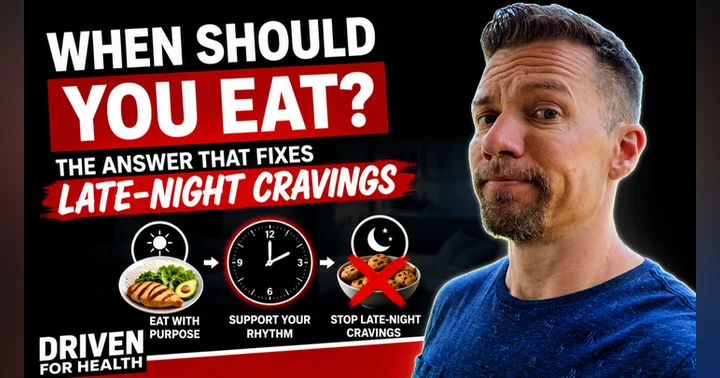
Stop Late-Night Eating: Meal Timing for Men Over 40 - 8
Late night eating and random meal times can stall your fat loss. Coach Brian explains how often to eat and when to eat for fat loss and muscle. He covers calorie cycling and diet breaks and weekly refeeds. He also shares stories of men over 40 who got past a plateau and afternoon energy crashes by changing when they ate.


 YouTube
 When you eat can matter almost as much as what you eat. In this fourth part of the Nutritional Pyramid series, Coach Brian breaks down nutrient timing and frequency.
(Do you eat on a schedule that fights your goals instead of supporting them? Learn how to time meals for better results.)
Coach Brian covers how and when to eat to maximize fat loss, muscle retention, and performance. He breaks down macro and calorie cycling, including diet breaks and weekly refeeds that help you avoid plateaus, along with the ideal meal frequency for fat loss and lean gains. He also explains what actually matters for pre and post-workout nutrition, and shares real stories from men over 40 who broke through plateaus and energy crashes with strategic meal timing.
By the end you will have practical nutrient timing strategies you can put to use immediately.
Main Topics:
- Macro and calorie cycling to avoid plateaus
- Diet breaks and weekly refeeds explained
- The ideal meal frequency for fat loss and lean gains
- What actually matters for pre and post-workout nutrition
- Real stories of men who broke through plateaus with better timing
- How strategic nutrient timing fixes hunger and energy crashes
Join 30 Tips in 30 Days, a free daily email plan with one practical tip to help you eat smarter, move better, and build routines that actually last.
go.brianparana.com/30days
Want help applying this to your own health, weight, energy, or lab numbers?
Coach Brian Parana offers Health Hot Seat coaching segments for men who want a clear next step with nutrition, fitness, weight loss, blood pressure, cholesterol, A1C, or daily consistency.
Learn more about The Call To Rise, a 100-day coaching program for driven men over 40 who want to lose weight, improve their health, and rebuild confidence:
To connect with Coach Brian:
brian@brianparana.com
Disclaimer: This podcast is for education and coaching support only. It is not medical advice. Always work with your physician before changing medication, treatment, or medical care.
- Skip breakfast, work through lunch, and suddenly you're standing in front of the fridge at 10 p.m. wondering how you got here. It has nothing to do with willpower, motivation, or discipline. Quite frankly, you are just starving. I started working with Coach Brian after seeing a photo of myself and my sister's wedding and hating the way that I looked.
- Initially, I was just looking for a health coach to make a diet plan and tell me what to eat. But coach's philosophy of teach you to fish, not hand you the fish, really stood out to me. I was hesitant about the cost at first, but can now easily say that it's one of the best investments that I've ever made. Not only have I lost weight, but I've learned so much, like how to cook, grocery shop, and eat healthier versions of the foods that I already enjoy.
- Coach's philosophy around food has also helped me solve a lifelong stomach issue that I've had, and I've never felt more confident in my body. If you're on the fence about joining his program, just do it. It'll be one of the best investments that you'll make for your long-term health. Welcome to Driven for Health, the podcast where men over 40 get serious about their health.
- I'm Coach Brian Prana, and with over 23 years of experience, my mission, personal mission, is to help you, the listener, take control of your body and your life. We're done with quick fixes and weird exercise routines. In every episode, we'll dive into real life solution strategies that are backed by science for fitness, especially nutrition and mindset.
- My promise is to give you the exact playbook you need to get leaner, stronger, and healthier so you can finally feel confident in the body you deserve to live in. All right, gentlemen. Welcome back to this. This is the fourth level of the nutrition pyramid series. If you've been following along, we've covered energy balance, macronutrients, micronutrients, even somehow skipped this in the series.
- I got it out of order and we went through supplements as well. But today, without further ado, we are definitely going to be talking about nutrient timing and frequency. Basically, how and when to eat to get the most out of your training and your results. Just so you know, the next episode's going to be digging into lifestyle, behavior changes.
- These are things, oh my gosh, so many people request this so much. They influence who you are, what you do, how you think, the insights, the life style that you live and and lead every single day. Let's get into it. Number one, what is nutrient timing and frequency? Well, it's all about how you actually distribute your calories and your nutrients across both the day and the week.
- People think about it's just in a time that you're awake, but it's actually a 24-hour time frame, a 7-day time frame, a 4-w week or one-year time frame, or ultimately your life time frame. Here's a principle I want you to remember. We don't invert the pyramid and put it on the tiptop as we've talked about a number of times with supplements and micronutrients.
- Those can be beneficial, but those are in the weeds, and you're not actually working on the main things. Calories and macros. So, calories first, macronutrients are second. That means you're trying to, if you are trying to actually hit a post-workout meal. Doing so would push you over your daily calories.
- If that were to be the case, you're actually, in a sense, throwing the baby out with the bath water. you're consuming too many calories. And if you're in a muscle gaining phase, cool. But if you're not and you're trying to cut, you just over consumed and have too many calories going in your body, that's not beneficial at all.
- Right? So, let's not do that. We're going to go over three key areas today. Macros and calorie cycling, meal frequency, and third your workout nutrition. We'll talk about how these work with both a weight loss, a maintenance, a muscle gain phase, and I'll give you a lot of practical actionable recommendations and other real life scenarios that this comes up with men in my program all the time.
- Let's start off with the macro and calorie cycling. The big picture, think of, say, diet periodization. If you're in a cutting phase or a fat loss phase, weight loss, ultimately you might be it might be easier for you to actually alternate lower and higher calorie periods in your day-to-day diet. It could be a the week is really say low calories, the weekend could be higher calories to allow for the break in the schedule.
- It could be these specific days you move a lot more and then you end up eating more in those days and the other days you eat less on to compensate for the extra movement to get to your goals. There's a lot of different ways and even say a diet break. If you are trying to diet nonstop for months on end, this is the classic I'm going to lose 50 pounds in a row only to gain 60 back because of the approach or the method that you did or the slowing down of the metabolism because metabolism is adaptive. And then also your mindset.
- You can only do so much in your mind as well for a series of time of in quotations dieting or having some form of restraint. Not say restriction but restraint, right? You can't just eat ice cream every night or something. You just don't get a lot of food then. Now having some diet breaks mixed into a diet framework, this really helps.
- So, if we are cutting our calories, say 16-,800 calories for a given amount of time as a typical man, and we went through calories in episode number five, then and if you want to go back to that, then you can. I explained it quite in depth there. But if we are cutting calories down and we do need to give some boost in there, the other thing is different body weights.
- I want to state that too. Most of the guys will do well at 16,800 calories with an occasional diet break in there, meaning a a in the 1980s cheat day phrasing or something, but we don't just go crazy and overeat because you could literally just eat too many calories. That's a real thing. And then we've got the some guys can do okay if they're bigger framed or more muscled or fitness inclined 18 to 100 to 2,000 or I've honestly I've had very few guys lose weight around 23 to 2500 calories unless they are really really active. Just
- throwing that out there. Now how do we get some dieting breaks into the process? It helps to prevent that metabolic adaption that slows down fat loss over time. It looks like training can be more intense at specific times because you can put more intensity and your body isn't in a constant deficit. You can get uh stronger recovery.
- You can get more bursts of effort and energy if you have a bit more calories in your day frequently throughout a actual dieting process. And also with the mental reset, you can feel like a human again. You can go out for ice cream or have a piece of pizza or enjoy a date night out. I had a date night with my wife just the other night.
- The kids were two were at homecoming. the older two. The other two were with a friend, their friends, and then we were able to sneak away and we actually went to a brewery and had a a dark porter. It was delicious. I like porter stouts when I do drink. I don't drink much at all. I do enjoy it, but it's just not part of the say day or even week.
- Sometimes it's more special occasions when it shows up. Now, here's a give you a story. A client Mike, 47y old executive. He's running his own business. He's been in a calorie deficit for five months straight. Logging every bite. Some people I log with, others I don't. A lot of it depends on who you are, what your time frame is, your capacity to do these things. But he's been logging.
- He's 20 weeks in. is feeling exhausted, stressed, and even his lifts are suffering in the gym. He just actually doesn't have a lot of motivation to even go to the gym. What we did, we ended up planning a a oneweek diet break, which he was able to eat at maintenance. We added an extra, say, 300 calories a day all throughout the week.
- And this actually allowed him to cut cardio in half as well to rest, recover, get more fuel on the fire, so to speak, to get it to burn hotter. Now, by the end of the week, he felt recharged. His lifts went up, and he actually started losing fat again. It's a it's a really odd thing that happens sometimes, but the strategic breaks throughout a long-term dieting phase or a fat loss phase is strategic and that's the power of coaching and understanding when to put these things in.
- Now, if you were to do a dieting break, we want to increase calories roughly two definitely 200, but 300, maybe even 500 calories per day. And the goal you're not actually necessarily going to gain you might gain weight in a sense but not actually body fat. It's you're just literally not eating that many calories to do so.
- What it may feel like is putting say you're driving your car. It's on empty. You go drive into the gas station and you fill it up with gasoline. Good old 87 or whatever your car takes. filling it up. And when you leave the parking lot of the gas station, you literally will have a heavier car because you just put a bunch of liquid into the gas tank.
- Think of the liquid being your muscle glycogen. Think of the gas tank being your muscles and the car being your body. It's the best way to describe it. If you are going on very long diet or calorie deficit for a long time, your gas tank will be quarter tank full or less or on fumes if you're doing low carbs. And yeah, no wonder you end up gaining a bunch of weight because you never have a lot of gas in the gas tank anyways and you fill it up and you're like, "Oh, I'm ruining my progress.
- " And no, you're just replenishing muscle glycogen and all. The other idea is to cut down some cardio. Maybe just walk and and keep the cardio intensity down. That helps make things a little bit easier for you to rest recover and refresh your body. Every four, six, eight weeks, somewhere in that time frame, depending on where you're at in your dieting phase, is a good time to do it.
- Now, refeeds and carb cycling for the leaner guys, if you're already at a good body fat percentage, say 15% body fat or lower, or anyone who stalls during a cutting or calor fat loss phase, a refeed day can actually be just a game changer. So, you don't necessarily need a week, but we can do those strategically in say a three, five month time frame.
- But having reefy days, maybe every Saturday we actually have to have more calories in the body. And you pick the busiest most uh the the challenging days. Usually a Friday, Saturday, Sunday are good days to have a refeed for most people at work on Monday through Friday in a sense and have a shift in their routine.
- They're around food and family and and fun ideally. And then you can actually eat up maintenance that day to keep your levels of progress moving up. Keep protein and fat similar to your low calorie days, but you're going to increase the carbs to be able to help. I did this with John. He's 42. He hit a plateau. He's about 16% body fat.
- We do do some body fat testing in my program as well to make sure that we are leaning out. Now, we started actually this is about 48 days in or so. He's a little about halfway through and and he actually needed to have a weekly refeed day. Now, in my program, I'm always attuned to my guys.
- It's important to have a pulse on what's going on. It's not a set it forget it. I'm actually highly engaged in the process with what the guys are doing, how progress is going to ensure that we are making these fine tune and tweaks to get you the results that you want. What we did, we ended deciding for him for John to do it once a week. We picked the Saturday and within two weeks his fat loss started up again and he felt less cranky, more energetic.
- his wife noticed quite a bit as well. If you are in a lean gain phase, you're trying to put on some muscle, you don't really need calorie cycling, you just need a subtle surplus over time. Now, if your weekends are tough to track and it's just literally easier throughout the week, maybe end up having the week to be nice and tight in a sense and calories might be subtly lower and the weekends will make up for those calorie missed calories in the week and that gives you say that level out balanced number or total volume of calories that
- you need at the end of the week to reach your goals. Then cool, that works. Some insights is studies suggest that distributing calories differently across the days can help with lean mass retention and optimize your metabolism respond to food especially while dieting. And you could have this a number of different ways of having it built around Monday, Wednesday, Friday being higher, Tuesday, Thursday being lower, or you if the weekend is a little bit higher calorie, Monday and Friday be lower, Saturday, Sunday be higher, maybe
- Wednesday as well. You can be a lot more strategic. I find that the majority of people I ever work with, they don't want that level of complexity. They're looking for set it and forget it type things. And in that situation, then we go over everything that we talked about so far, but also going into different parts of the lifestyle behavior stuff.
- Understanding strengths and weaknesses around this person, their ability to navigate food, their ability to see how many calories are on their plate, their ability to make sure that they are able to stick in a calorie deficit to reach their goals. And those are things that again we actually talk about to understand and make sure people stay on track.
- Meal frequency. How many meals should I eat in a day? Yeah, this is a common question that we get every time. And you have your OMAD, one meal a day. You have bodybuilders from the 1990s. If you didn't eat six times a day, you were failing. and that was the reason why you didn't lose weight. Or shoot, bodybuilders, the the ones that are really into it and they need a lots of calories, sometimes they actually will wake up in the middle of the night and put food in their mouth, too.
- For any person listening to this podcast, I wouldn't recommend that. Don't eat when it's in the middle of night. That's not a good time to put food in your mouth. It ends up just adding calories in the day. All right. There is minimum amount of impact for most people if they're eating three, five, eight times in a day.
- I find that we're looking for what matters is consistency in society, satiation. That's what we want. Fewer than three meals in a day. Here's the challenge. You go long stretches without food, which can potentially spike hunger. Increased cravings make it harder to adhere to the schedule. The human can generally go three to four, maybe five hours without food.
- Then they probably should put food in their mouth. Why? Because you think of this, you specifically listening right now. If you go 6 hours without food, what's going to happen when you actually come up for air and you breathe and say, "Hey, I have a moment in time. I'm actually really hungry now." Are you going to make the best choices or are you going to just eat whatever's available? Right? Chances are it's going to be the latter.
- you're just going to eat and eat and eat because you're bamished and you didn't execute or well plan that time frame. Okay, fewer than three makes it I think just harder to manage unless I guess you do a intermittent fasting type thing where you're in a smaller food window. But quite honestly, I find that doing the 1950s rule of eat after don't eat after dinner time, which is say 6 or 7 p.m.
- and you wake up and you have breakfast at 6 or 7 a.m. or ideally I like to call it first meal. Then I think that's the actual win is that you have a say a 12 hour time frame, maybe 13 to possibly 14. I think for 16 hours for me quite honestly I am starving. My body is screaming for food. It just feels famished and ready to eat.
- I just can't allow myself to get to that point because I too will make not the best choices just like you. I'm human too guys. I am human. If we have more than five meals in a day, just smaller consistent meals, I think you actually think about food way more and think of a quotation snacky type routine that actually doesn't necessarily help especially in your fat loss phase.
- If you need more calories to build muscle, then sure then let's have say three, four, five, four or five meals. Let's just make sure that we're accurate on how many calories are there in a sense. All right? Because if you even off say 30 to 50 calories for five meals, that could be 150 to 300 more calories in a day that you didn't realize was actually inside your day.
- It's really easy to just grab something or take an extra bite of something or lick something and now you have an extra two- 300 calories which will get you out of a fat loss phase for sure more toward maintenance. Or if you're trying to gain lean muscle, you might just gain more body fat along the way too because you're say a little sloppier than you should be.
- Actually, I personally always recommend about three to four. The majority of people I've ever worked with for 23 years are eating about three to four meals because it fits in their day. They don't have to think about their their food so much and it allows a natural structure. Natural times to eat in a day are built around your calendar around what happens in a normal day.
- Take from me, my meal frequency generally is 10 to 11, 3, 6, 10 p.m. Well, Brian, well, you can't eat that late, right before you go to bed. That's against the fat loss rules and the diet rules and all, I guess. But remember how I told you about the 1950s way of don't eat after dinner at 6 or 7 p.m.
- and you eat your first meal at 6:00 or 7 a.m.? Well, for me, I just shift that to make it make sense in my schedule. When I wake up in the morning, I am full go with kids going to school. Literally spend the first 90 minutes of my day making sure kids are organized, they have food, they've got water, they are on their way to school.
- It's convenient that my oldest drives now. That's actually been a lot easier. So he takes Levi and Everett go to school with a car and then I take Maxwell and Emiline to school at their middle school. But again 6:30 to I get home around 8:00 is all school. Fun fact here guys, if you have young kids, especially say my exwells and mine's age of 10 and 12, h they love listening to p uh excuse me, audiobooks.
- They love listening to audiobooks. It's been such a connection point for myself and my kids that we listen audiobooks in the car. My kids don't ever answer any of my questions anyways. They stare at me when I ask them a bunch of questions. How was school? What'd you do today? All those typical things.
- And I tried different ways to do it and keep it fun. But yeah, they they still don't really give me any info. I found that the podcast or the audio books are the things that really connect allow us to connect over stories and we can talk about them and that makes for better bonding and just a honestly a better car ride.
- The fun fact, little tip, if you have younger kids and listening in audiobooks, we're right now we're listening to KR Alexander Dark Room. We've listened to so many different ones. Probably I don't know 20 or 30 by this point. Some goosebumps. Um, oh, the Hearty Boys, detective stuff, fantasy, sciency, mystery, ghosts, vampires, all that type of stuff.
- It's a lot of fun. I I enjoy it, too. All right, side note, coming back in. So, we we talk about the 1950s scheduling of time of that 12 hours. mine, I just shifted it. So 10 to 11:00 am to 10 to 11 pm. And again, if my calories equated in the course of the day and I hit them to the goal and amount that I'm supposed to eat, I should not wake up and eat heavier the next day.
- Now, we could debate that I might be heavier because of extra food that I ate that might still be in my digestive tract, but that's food in the digestive track, not body fat on my waistline. All right, super important to know and understand here that you can do it. And a simple question I always, always, always ask people is to help clarify this, and this might help clarify it for you too, is this.
- If say four, five, eight weeks it takes you to lose 10 pounds. All right, yay. Good job. You're down 10 pounds. This is wonderful. Does it matter when you ate? The answer would be no. It wouldn't matter. Why? because you just literally were able to eat the amount of calories you're supposed to and you stayed in a calorie deficit over time like we said earlier in the conversation and that worked out really really well for you.
- Now, here's another story to even further explain Dave, a client that has gone through the program with me. He's a manager director type. Got a bunch of people under him at work that he's has to manage. Peopling. You if you're a manager type, you know what I mean. Or if you're owner, you you know what I mean. Peepling.
- That's probably the most interesting part of anyone's work schedule life and things that actually get spoken about quite a bit to help manage time or stress or the level of engagement impact that you have on your employees or your co-workers. Now, for for Dave, he was trying to eat two meals a day while he was trying to lose 35 pounds.
- He was at a 40 waistline. He wanted to get back to his 34 that he was in high school. And here's the problem. He was hungry. He was irritable. And he'd always come home and binging. He'd want to constant hit the drive-thru on the way home. It was just everpresent feeling and tension that he had to fight through all the time.
- But and then he walks into the house and he's just hangry. He's a little short with the kids, the wife, and uh just not a very pleasant way to to wrap the day up in your own personal real life. What do we do with Dave? Told him, hey, we're going to bump you up to actually four. We're going to have what I like to say meal one, meal two, meal three, meal four.
- We'll talk about that in a moment about how we label food. But with Dave, soon as we got him to actually eat twice earlier in the day, he wasn't hangry going home from work and he could keep things in control. He was able to be more consistent, have energy when he needed it, whether it was at work to people or at home to parent and be, you know, super spouse as well.
- All those those are all important parts and factors of who Dave is and what makes up his everyday life. You don't have to eat twice a day, once a day. Literally, I almost always make people eat three times as a minimum. So, let's go with the the meal label idea as well. Since we're talking about timing of food, everyone thinks, "Oh, I don't eat breakfast. I hear that so often.
- " Well, I like to pose it like this. If you eat before 10:30, McDonald's says that's breakfast, right? At 10:31, it's lunchtime. If we go off with that, and that's basically what society thinks as well. After 10:30, it's brunch, not not breakfast anymore. We're eating brunch. Well, if we want to be literal like Levi, then my oldest, he's gonna break it down like this.
- Well, break fast. Breakfast is breaking the fast. Technically, every single person breaks the fast at some point in their day. And if we wanted to be literal, then that's breakfast. Okay. For any of my clients, the shift, the insight, the clarity moment here is we're just going to call it meal one, two, three, four in a sense because we don't want to fall into say snanky type things.
- We don't actually follow fall into a meal type situation. You think differently when you go to pick the food that goes on your plate to help have a nutrientbalanced meal. And we'll break those down in future podcasts as well. But we're looking for a lean protein, a fibrous carb, fruit or vegetable, usually low calorie. The fruits are always going to be about 70 to 100 calories per serving or cup or piece.
- The vegetables, think of the ones that are under 50 calories. That's part of what you want to put on your plate. And then we have stretchy carbs. Those are, you know, rice, beans, potatoes, all those type of things, right? It's important to have the balanced meal throughout the day to keep your energy sustained, keep fullness go, full go, to not get hangry or irritable or short or tired or loss of productivity.
- That doesn't help you. Meal one, meal two, meal three, meal four. Simply put, take the label off of the time of the day that you eat it and all of a sudden we can eat those balanced meals and not fall victim to, oh, it's time to snack. I want to snack. Where are the goldfish or the pretzels or the the cheese sticks or the whatever falls under that category for you in your brain? Because if I say the word snack, pause and think about different foods that come up in your brain.
- That's a real thing. They're going to keep coming up like that. All right, let let's move on there. Hopefully that was insightful for you and you can stop and think about what times of the day make the most sense. Literally look at your calendar. When does it make sense? Today I actually ate at 7:30ish 7:20 before I left because I knew that I was going to go drive to school, have a morning performance with Maxwell.
- He's in theater and and at their school, they always are doing these morning performances, making kids get up on stage and do their their thing. They perform, whether it's music or spoken word, dance, all sorts of things. I love the school for doing this. Gives them tremendous confidence coming out of middle school, which they absolutely need to be bold and confident.
- So, we did that. We got coffee. My wife and I got there early. We could have some coffee together as a little say date little starter to the day. Then we did the morning meeting and then I had two hours of clients and I'm going to record this. It's important that I ate then because it's almost it's 11:18 right now.
- If I didn't eat, I'd be pretty famish and be losing energy here. You just hear me, my energy wanne as the time went on in this podcast. That wouldn't be helpful for you. What? It wouldn't be helpful for me. I'm over here hangry, yawning, and my blood sugar levels in a tank. I can't produce what I need. My next meal today will come around noon and then it'll come around 3:00 4ish and then we always end up having a later dinners because our household is full go.
- We'll end up eating around 7. Then because it's a little bit later that'll be my last meal of the day and I'll just make sure I get enough adequate protein in each of the days. But other times depending on how things go I might end up eating at 910 or 11:00 at night based on again the schedule. So schedule is the most important.
- All right, shifting into workout nutrition. Pre, during, and post-workout nutrition. This is endless debates, right? Is what should I do? Should I eat before a workout or not? Some believe you must eat carbs immediately after you train or protein immediately after you train to maximize muscle growth or replenish muscle glycogen stores.
- and and I know they swear by doing a pre-p protein shake workout and all this and and the reality is this. For the majority of the people that listen to this podcast, you don't need an immediate replenishment of protein and carbs immediately. It just no one that I no one that I work with is a superstar mega athlete elite athlete that is training 10 plus hours a week.
- If they can get an hour a day in, then they're lucky. If they can get their 10k steps and they're lucky. But also just note that if we're eating four times a day, you're adequately spacing enough food, protein, carbs, and fats throughout the day and adequate calories to not have to worry about it.
- You don't have to worry, oh, I I ended workout at 3:05. I need to eat everything by 3:10. No, you could literally just wait till 5 or 6 to have dinner because you ate an adequate amount of food at noon or 1. That makes fine, perfect sense, because at the end of the day, you did your calories, your protein, your carbs, and fats, and you would be fine.
- Okay, you would be fine. And anyways, your muscles recover glycogen over a 24-hour time frame, not just an immediate response. It's not like you just eat food and automatically you fill the tank up in a sense. All right. We also want to think about having those strategic times in the day though to initiate what we have as an insulin response.
- Really important there is when we eat carbs then it boosts your blood sugar levels and your body will respond by releasing insulin which is a storing hormone. And once you know that, then when is the best time to store anything? Well, carbs and increased blood sugar levels, your body will use that and get stored in your muscle glycogen.
- Having carbs around your workout is an important time. Starchy carbs, high carb meals, simple carbs, sugary carbs, all those things are really important to have around a workout time. And then you have the other stuff not around there. Okay? This helps keep you in a anabolic state and a not a catabolic. Anabolic meaning growth. Catabolic mean breakdown.
- Now, studies have shown there's a minimal difference between long-term muscle growth, whether you eat immediately or you take another hour or three. All right. Oh, shoot. I forgot my protein shake at home. I need to race home to get it or stop off the gas station immediately on the way home. H, not necessarily. Some good recommendations if you're in a fat loss phase do have say something an hour or two before a workout and after.
- We want to put our calories and carbs more specifically around a workout time and then we can have be a little bit more strategic in the nonactivity times. They have more protein and vegetable type meals. This will help energize your workout and help with the recovery process. Just being a little more strategic that way.
- That makes a lot of sense. And then the other times you can have lower calorie, high volume foods to keep you fully enough while keeping calories lower. You don't have to stress about exact timing. Consistency is the thing that matters the most. Now, if you're in maintaining, if we just say balance out the amount of calories, say you have to 2,000 calories, you're doing it four meals in a day.
- You're doing 500 calories each of those times, you're going to be plenty good. Cool. Maybe dinner's 800 calories and your afternoon snacks 300. Cool. It still ends up getting us about that say 500ish average no matter what. Now if we are actually say muscle gaining then we would want to have at least a high protein meal added in before training too to just help be a little more purposeful also with higher carbs at that time too.
- This allows for just fueling your body better. Special scenarios, if you're training two plus hours continuously, say doing run and endurance running or crazy CrossFit workout or any of that, if you even 90 minutes, then you probably should think of doing some sort of a carbohydrate in the workout. Levi and I did some really long bike rides this summer.
- Two, three, four hour bike rides. We would be eating every 20 or 30 minutes, getting adequate amount of carbs for sure and occasional protein. All right. Now, that could have say 30 carbs per bout to help keep blood sugar levels up and spare muscle glycogen levels. All right, putting it all together. If you are in a long-term phase of dieting or fat loss phase, having a diet break for one or even 3 weeks would be a good idea every 3, four, five months, depending on where you're at in the process and how your body's feeling and how you mentally are feeling to refresh
- your body, refresh your mind to keep at it. It's okay if it takes an extra three months to lose 50 pounds if you can keep it off the rest of your life. Okay, that's the trade-off here. And the whole process of dieting will feel a lot better. It might not be as immediate, but also it probably took you more than 3 months to put the weight on.
- It's probably decades. We want to include weekly refeeds strategically every so often to keep from plateauing. Putting more wood on the fire in a sense to get the fire hot again. Really important. We've got meal frequency. Three to five meals. I like three or four regardless. If you are in a lower calorie amount, maybe having a four or five meals could help to help just space the calories out enough to keep just adequate blood sugar levels at a reasonable amount.
- Because say you eat lunch at noon and then you have an apple at 2:00 and then you have dinner at 4. that or apple peanut butter as an example could help keep you from cruising into dinner really hungry and that'd only be 10020 calories. For the the workouts we're looking if you're in a fat loss phase and your calories are tight, we want to prioritize protein.
- Definitely stretchy carbs or high carbs before after for sure. If you are trying to put muscle on, then we definitely wouldn't want more volume of calories and carbs, protein beforehand, right? And then lastly, we just covered it, but if you're doing over 90 minutes, you should definitely have, you know, 100 to 200 carbs in that time frame before, during, after, for sure, depending on how hard and intense it is.
- Remember, these are just tools to optimize results. They're not rules to stress over. Focus on calories, protein, consistency first, then let timing and frequency be the the the knobs that you fine-tune your performance. Now, we'll just do a little episode sponsored by the call to rise. It's a 100 day fat loss challenge for men over 40 who are sick and tired of seeing a belly, not fitting in the clothes they want to and feeling just not confident in themselves.
- They don't understand nutrition. They've been hustling in their work life and there is no balance because life pulls them in 100 directions. But the truth is you can't lead at your best if you're not if you're always running on empty. You're carrying extra weight around your waistline and you wish you looked confident in the mirror when you were stepping into the shower.
- You can't have the doctor trying to give you meds for health issues. And if you don't have health issues and you're 50 pounds overweight, you will wll in all caps have those at some point in the future. And you'll either prevention is the cure is what they say. You don't want health issues to be the impetus of why you actually get better.
- Just get better and healthier. Take action. In just 100 days, you'll burn off 20 plus pounds of stubborn belly fat, build some muscle, and gain some clear systems, processes on how to handle your food, nutrition, eating, your training that fits into a busy workday. And you're able to not have to do this through quick fixes or diets or anything weird like that. All right.
- If you're interested to stop putting this on the back burner and actually make real progress, then visit the calltorise.com and let's get started today. Moving on to our fast five series questions here. Number one, what's the biggest myth about nutrient timing? Well, most guys think that they need to slam that protein shake right after the second they get done with their workout and they'll lose muscle if they don't.
- That's not the truth. We went over there and they said there's a small window of time that you can definitely say even two hours is still going to get a good response in your muscles. Number two, how do you time your meals on a busy workday? I I shared this a little bit earlier in this, but I literally look at my calendar, guys.
- I see when does it make the most sense for me to eat food in the day and I strategically put food in those times. Oftentimes I don't even know what I'm going to eat. But because I have the protocols around the right nutrition, a protein, a fibrosc carb, adequate amounts of calories in the times that make sense for me and the foods generally available.
- You get where I'm going with this. I can manage a long chunk of time away from home. I'm just going to eat a bunch of food before to get me to the next time I eat again. And a simple phrase is eat enough food to get you to the next time you're going to eat again. That makes sense. Number three, what's the most common mistake you see men over 40 making with their nutrient timing? We covered this too, but it's skipping meals.
- Oh my gosh, it's just not it. And then you're overeating at night because you're hangry. It kills energy. It disrupts your sleep. It really just makes fat loss harder. If you're putting the I had this guy James down in Louisiana, this guy would eat 200 to 600 calories overnight of peanut butter. Holy moly, this is not helpful.
- All right, so we want to fuel the day with strategic times of food and keep your metabolism going. Number four, what's one aha moment a client had after fixing his nutrient timing? Well, let's just talk about George if so today's Monday. It was Saturday that he I got a text from literally had his onboarding call and then he just started the call to rise program yesterday.
- All right. He was only trying to eat two meals a day. I got him to eat a third meal and earlier in the day and you can literally see this is October 6th. So October 4th, you can scroll back through my Instagram and see the video or my Facebook of him. His wife is noticing that he's not so bloated in the morning.
- He actually has better energy because he's eating a balanced meal as a breakfast sandwich and some yogurt and berries, which worked out really, really well. Number five, what's one food you'll never give up no matter what phase you're in? Well, for me, pizza and ice cream are going to be it. Especially Mitchell's ice cream in Cleveland when we go up there. My kids demand it.
- My wife absolutely loves it. She's a premium ice cream gal. We don't buy gallons of ice cream. We spend $35 of ice cream when we go out to get everyone a small cone because it gets expensive. But those would be things I'd never give up. Now that's a wrap for the fourth inst the the fourth yeah the fourth installment of the nutritional pyramid calories macronutrients micronutrients nutrient timing then I already did the supplements and then we're going to get to the lifestyle behavior changes and those are things that so many people
- it's heavily requested how do I fit all this stuff into my everyday life we'll jump in we'll dive in there so that you actually have a solid action plan to do with a busy life and meet your needs leads with real solutions that work in real time. I hope that you're enjoying the series and if you could take a second to leave a review on Apple and Spotify and then also invite someone in else to listen into the podcast.
- This will help get this good valuable information out as as I'm working really hard over here to put these out and keep them high quality. And if you do want, I do have a 30-day email sequence called 30 tips in 30 days. It offers simple, actionable strategies, improve nutrition, fitness, and get better with self-care.
- Each day I introduce a really basic, simple, practical tip around nutrient-packed meals, recipes, grocery lists, quick workouts, movements, break up the day, small daily habits. These are things that my clients get tripped up on all the time and help people stay hydrated, all this stuff. If you want this one tip, and I always say if you only implemented 15 of them, 50% of it, you'll get amazing results, too.
- I'll leave a link in the show notes for you to get the 30 tips in 30 days. Well, I appreciate you listening in and I hope you're getting a lot of value. Off we go. Have a great great great day and kick off this week as this is a Monday I'm recording this. I appreciate you so much.