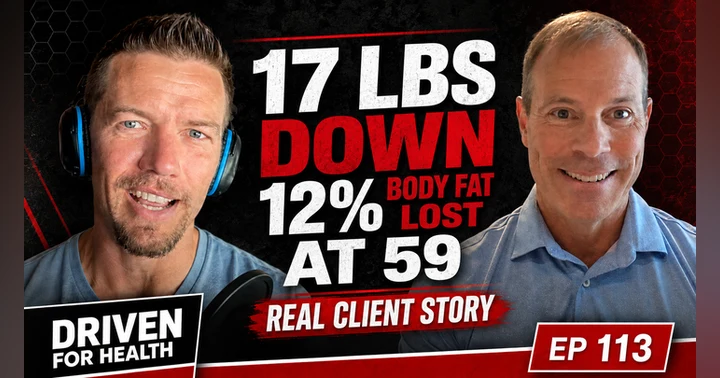
At 59, He Dropped 12% Body Fat, 17 lbs and 2 Inches Off His Waist in 100 days - 113
Mike was still working out and his waistline kept growing. After losing his mother he wanted to feel better in his own body. Coach Brian talks with Mike about how he lost 17 pounds and 12 percent body fat in 100 days. He took about 2 inches off his waist while still eating out and traveling.


 YouTube
 At 59, Mike was still working out. His waistline kept moving the wrong direction. His nutrition was inconsistent and the results never seemed to last. Then life hit a major turning point.
(Have you lost weight before only to gain it back? See what makes this round different at www.thecalltorise.com)
Mike had recently lost his mother after years of dementia related decline. He started a new job. His daughter's wedding was coming up and he wanted to walk her down the aisle feeling better in his own body.
So he joined The Call To Rise 100 Day Men's Fat Loss Challenge. In this episode of Driven For Health, Coach Brian Parana sits down with Mike to talk through what changed.
Over the course of the program Mike lost about 15 to 17 pounds. He dropped close to 12 percent body fat and took roughly 2 inches off his waist. He did it while still eating out, traveling and going to social events.
The biggest change was the way he approached food. Mike focused on portion control, protein, vegetables, water, fewer drinks and better restaurant choices. He did not need an extreme diet. He needed a plan he could repeat.
Mike also talks about the value of being in a men's group during a season when family, work and grief were all happening at once. That accountability helped him stay consistent when it would have been easy to put his health on the back burner.
By the end of this episode you will know how Mike lost the weight without giving up his normal life, and what changed in the way he eats for good.
Main Topics
- Losing weight after 59 without an extreme diet
- Staying consistent while eating out and traveling
- What changed after losing a parent to dementia
- Building a nutrition plan you can actually repeat
- Why a men's group matters during a hard season
- Dropping body fat and inches off the waist in 100 days
The Call To Rise is a 100-day fat loss challenge for driven men ready to take their body back. It combines strength training, personalized nutrition and real accountability. Most men drop 20 to 30 pounds and rebuild the confidence that comes with it.
This program also works if you are dealing with high blood pressure, high cholesterol or Type 2 diabetes. It was built for those men too. Many men see those numbers move in the right direction alongside their weight loss.
Inside the program you also join a Brotherhood of men doing the same work. Together you build a body you're proud of and start leading like the man you already are at work.
This is your wake-up call to rise. Learn more and apply at www.thecalltorise.com
Want help applying this to your own health, weight, energy, or lab numbers?
Coach Brian Parana offers Health Hot Seat coaching segments for men who want a clear next step with nutrition, fitness, weight loss, blood pressure, cholesterol, A1C, or daily consistency.
Learn more about The Call To Rise, a 100-day coaching program for driven men over 40 who want to lose weight, improve their health, and rebuild confidence:
To connect with Coach Brian:
brian@brianparana.com
Disclaimer: This podcast is for education and coaching support only. It is not medical advice. Always work with your physician before changing medication, treatment, or medical care.
- Welcome back to episode 113 of Driven for health. This is Mike's story. I've known this guy since I started my career. So, you'll be able to learn a little bit about our relationship way back in 2004 when he used to come to my group exercise classes, but he circled back now and joined the culture rise program 100-day men's fat loss challenge and I wanted to share he lost 15 lbs, 12% body fat, which is phenomenal results cuz normally you're supposed to lose 1 or 2% a month.
- This guy lost what? Almost 1 is 0.75% a week, which is phenomenal for fat loss and we did it in a way that he actually enjoyed. He learned how to eat, how to fuel his body, his lifestyle, and give him long-term success. So, I want to share our episode. Here it goes. Today we have a special guest with us. This is Mike.
- Actually, I've known this guy for over 20 years. He and I he'd come to my ab class, the phenomenal abdominal Monday nights at 5:00. He'd come to my what else? My spin classes Friday nights. He'd come to my shake and bakes. All these things I used to do back in the early days of Brian, coach Brian, before he actually was coach Brian. He just was exercised, you know, lead a group exercise Brian.
- And I'm so pleased that Mike had circled back uh years later. Now, Mike is a father of two. He's a husband of 33 years, super important there. Father of two. His daughter's getting married this weekend, which is so wild and cool and it was a a deadline and goal for him to look and feel some of his best, walk his daughter down the aisle, you know what I mean? And then his son's getting into his career down in Florida.
- He's a man of faith throughout his whole life and you can see that by the way he lives and the way he talks and speaks and and treats people. He loves fly fishing and of course working out, and that's how we got to meet. So, Mike, welcome. Excited to have you here. >> Thank you, Brian. Yeah, I'm glad I came on the journey with you.
- >> Yeah. What what was the biggest thing that we were able to accomplish together? >> Um I would say a bit of a body transformation in just 3 months. Um I had mentioned to you earlier that my goal was to really try to drop some of the body weight. I'm 59 years old. Been working out at the gym pretty regularly, but I've been starting to get it some uh bigger love handles than I cared for.
- And uh carrying around most of the weight in my ab area. And um I've tried multiple times on my own, um and it was never long-lasting. You know, I might be able to drop 5 or 10 lb pretty quickly. And then it would go right back on quickly. So, I would say the biggest transformation for me is the fact that I've had to buy new belts, and pretty much all my dress pants have had to be taken in about 2 in, which 2 in in the waist in just over 3 months, I think is a pretty good accomplishment.
- >> Uh yeah. I I would definitely say, and that's where it matters a lot for guys of our age, of over 40. And and especially the closer or above 40-in waistline guys, you are in serious trouble for some form of chronic illness, cardiovascular disease, heart disease, high blood pressure, cholesterol, diabetes.
- Those are things that will be likely coming your way if you don't get it back down and to ideally a 34 even possibly 36 or something like that. So, we You're you're super busy, right? You just started a a job in the beginning of He joined the 100-Day Call to Rise program, the fat loss challenge. And uh in the beginning he had a lot going on.
- So, tell us about what the initial setup was when you even reach out in the first place cuz it was There's a lot going on. >> Yeah, so um just being able to work with you and and knowing you, you know, I had been getting your emails about the work you were doing as the coach now and helping men over uh you know, 40 even though I'm like I said 59.
- But um just finally biting the bullet um I had been um one of the caretakers for my mother who had been in a nursing home for the last 2 years dealing with cognitive decline due to dementia. And um she passed away uh beginning of February, February 8th. And a lot of my routine was seeing her almost every morning for breakfast and that was taken away.
- And I also started a new job in the middle of February kind of coming out of retirement for the second time out of boredom. And I wanted to have a a purpose, a sense of belonging. So I was able to get that through work. But I also thought that was a good time to join you, Brian, and the other guys looking to do something for themselves and not looking at things as a cost but more of an investment.
- Um I also having been in the nursing home for 2 years with my mother, um it was a real challenge seeing people in different stages of mental decline. And there's different things that can lead to that. Obviously some of it is genetics, right? >> But thing is there are things I can control, which is what I do with my body, what I put into my body.
- And if I can put, you know, a high octane gas in my nice sports car, I sure as heck got to put good food into my body. And it's hard to do that when you don't have a nice >> place you actually live. >> Yeah, I just didn't have the knowledge. I thought I had the knowledge and I didn't. And as we go through this, Brian, I think I'll be able to share some of the wisdom that you shared with me and the other guys to help us get to where we want to be.
- >> Yeah. Definitely. Definitely, definitely. So you had a lot going on, right? It's is incredibly hard to see this the circle of life, right? That's that happens to all of us. And but living through that and coming through the other end just like, "Wow." And I my grandmother with the one I had two grandmothers, but the one she lived in multiple different assisted living places and she had diabetes and it was it was just not good.
- And you're right, a lot of people have a variety of different health challenges from just genetics, but also a lot of the environment of how they treated themselves, taking care of themselves, the food that they put in their mouth, how they move their bodies, how they even think can have an impact on what happens when they're in their 70s and you don't or 80s or 60s and you don't think about that when you're in the grind of the the 30s, 40s, 50s and growing family and getting them going and and all. So, all right.
- So, it it was a pivotal time that you had a a fork in the road. How do what do I do with myself here? And you chose to improve yourself knowing that things have just been slipping and sliding there for a little while of not taking as good care of yourself. Not not necessarily you love the workouts, so that's never been an issue, but it was the food thing and all.
- So, what were some of the results that happened, the things that you learned and all be as a result of our work together. Not beyond just losing 10, you you lost 15 lb and you lost over almost 12% body fat. So, what were the other things that that created that outcome that you learned and and helped change your mind and the way you think and act? >> Yeah, I think, you know, having accountability to someone beside myself.
- I'm a pretty accountable person. I usually achieve what I put my mind to, but often times that comes with having knowledge. And I learn through you, through the meetings you have with the guys, through all the one-on-one calls, all the individual texts that you send. You know, you're constantly sharing information with us.
- Your website is full of an amazing amount of information that you've called together from probably years of doing this. >> Years, yep. >> Um you know, none of it is really complicated. I thought it was going to be a lot more complicated. I was going to have to track this and that and measure everything. And I really didn't.
- Um you know, the fact that I've gone from about 194 lbs at the beginning of February to pretty consistently now 176, 177 body weight dropping a good 12% staying that way >> Yeah. >> has been good. I think for me to take it to the next step, I probably do need to maybe consider tracking. Um my working out actually, which has always been a strength, has probably petered out a little bit because of some back issues I've had um maybe coming from a surgery on my back >> back 9 years ago. Yeah.
- >> Um but I would say the main things that I've learned here is the importance of um portion control. I've always drank a good amount of water. That's something that you really push, drinking, you know, a good 100 oz of water. Um portion control and then the fact that veggies can actually taste good and you can {quote} have fun with veggies.
- I've taken more time and had more salads in the last several months. I've had minimal sandwiches. But to do to spend 15 minutes putting together really nice salad um and staying full um with a bunch of protein and flavor in it um has been pretty cool. Uh and making green veggies taste good, not just palatable, but taste good has been interesting.
- And then just the camaraderie, too, of the guys and realizing, you know, that we're not in this on our own. And um you know, we're all trying to do this for the long term. You know, obviously, I'd like to see my daughter who gets married, I like to see her kids. I'd like to visit Joey down in Florida and you know, not have a dad bod, you know, but be able to go on the beach.
- >> Yeah, go to the beach and give your son a run for his money. You wouldn't you take your shirt off? >> Yeah, but at least he's got hair where I don't have a ton, but you know, I the body is definitely getting better. The physical results are speaking for themselves. Also losing about 17 lbs has taken off some strain on my lower back.
- >> Oh. >> Um and so that's that's helping, too. >> Yeah, one of the last body pictures that you shared before and after style, the the abdominal definition was definitely noticeable. It's like, "Man, you're you're looking strong, man. This is great. All this muscle you've been building for years, decades, and now you're able to reveal it even more so than than ever.
- " And yeah, just so everyone listening in, we I didn't turn him into a rabbit. He wasn't just eating leafy greens all the time, right? He He ate out. He traveled to Florida at least twice. He went plenty of social outings uh throughout the time and he did enjoy himself, but there was a a redundancy of "Can you get it some more vegetables there to help fill you up?" And I imagine from our conversations and just the undertone that that you hear in the group, the goal isn't to starve.
- This goal isn't to eat on repeat. The goal is to enjoy some moderation, some balance, some flexibility in life, in food, and have fun with this so that it is sustainable. Now, how was your take on that? So, because when you came in, you're like, "Oh, I might have to eat the same things or whatever." To you have a lot more food freedom this weekend to thoroughly enjoy the wedding experience, but not feel like you're gaining 5 lbs as a result.
- >> [snorts] >> Yeah, it's just it's nice because to be accountable to yourself and then in a way to the group, um I'd say in the first couple weeks was probably the biggest challenge because if we would go out, I would normally have, you know, maybe two cocktails, have bread being Italian, have a nice meal, and then my wife and I would split dessert.
- And then and I'm like, man, this is kind of a drag, but then as you start making those tougher decisions, you feel good that you had the discipline to make those decisions. And I never drank a ton for the most part, at least not lately at my age cuz I don't feel that great the next day, but I've definitely dropped my alcohol um consumption maybe on average of three to five a week to maybe two to three a month.
- Um and I think that's made a big difference. Um >> I agree. >> But as far as early on, again, it was never like, hey, you got to do this, you got to do that. And you didn't have me eating many calories, dude. You have me target like 1,600 calories. >> Yeah, that's that's so good on you. >> would start I rarely would start starving.
- You know, I wasn't having headaches. I wasn't having cravings. The one thing I've got it I told my wife the other day, Brian, um I used to always like bread. I wouldn't go out of my way to eat it, but if there's good Italian bread, I'd like to eat it. And I don't know if it's a craving or what, but I've really not even desired to eat bread.
- I'd rather eat a salad, which I don't know if that's a is you know, a chemical reaction going on in my body or what. >> [laughter] >> Um so I can say on a scale of 1 to 10, if 10 being, you know, this 100 days being the most difficult thing to do, on a scale of 1 to 10, I would say it was down to maybe a two or a three.
- And it becomes easier as you learn to say no to things that aren't good because you're feeling the difference. So that was pretty interesting. In the past, just real quick, I got to say there's Dr. Mark Hyman, who's pretty well-known from his work from the Cleveland Clinic and a bunch of functional medicine stuff he does.
- In the past, I've done a 10-day fast where I've um had none, no alcohol, no sugar, no dairy, no wheat. And in 10 days, I didn't feel great the first couple days, and you definitely shed stuff, and you get more flexible. But it's not for me, it's not realistic to think I'm cutting those four things out of my life. In this 100-day journey, you did not ask me to cut out a single thing.
- You just asked me to be more mindful, make more informed decisions, and the results will come. You know, when you see your body, you know, when you lose a couple inches on your waist that you haven't been able to lose for years, and you see that happen that quickly, that's motivation enough to keep keep this up. >> Yeah, definitely.
- We could see the motivation compounding, right? You can't ever start with motivation with the circumstances and situations in the beginning of our journey together. There was a lot. There was no motivation. It's just you realized that I need to take care of myself so that six I'm healthier at 60 than I'm at 59, which is a great thing, and and we should aspire.
- I would love for you to be healthier and and very active at 65 and better than where you're at now as as we continue to go in time. Uh but we don't have to do these these drastic things that people have this all-or-nothing mindset to that they can't eat carbs or a whole food group has to get cut out or I can't eat at all.
- I have to fast, and I can't eat at these times of the day. It's just They're they're really weird food behaviors, and that's something that I'm super paying attention to because I need this to be lifestyle. That's what we're creating together is your future lifestyle. I always say this, and I'll say it again. What we do in 2 weeks, we should be able to do in 2 months.
- We should be able to do in 2 years. So we are building the lifestyle and the food, the routine, the patterns, behaviors of how you live your life so that it gives you the look, the feel, the body that you want. And we don't have to work so hard. Because anytime that you gain, say, over 10 lb, you're looking for a good four to eight week upper to be super consistent to be able to lose it.
- And it's just That's not a lot of fun. And so, uh where we where we >> Brian, um where I felt like I wasn't in control of my journey, so to speak. You were there to help me along my journey. I made my goals clear to you. I exceeded my goals that I set with you. I've got more goals for the rest of this year, which is get from 177 down to 170, with a stretch goal of getting down to 165, cuz I still have some fat that I can lose.
- Um but strength-wise, mental-wise, um a lot of things have definitely improved. There were times, you know, in the last 3 months, with my mom passing away, my son moving to Florida for work, I'd get kind of upset. Um may I don't want to say depressed, but, you know, just kind of in a funk, realizing my daughter's going to be out of the house.
- Um but this is something that I can >> for sure. >> Yeah, you know, and I could just look in the mirror and think, "Hey, you know what? You know, my life's going to go on. My son's in a good place. My daughter's marrying a great guy." And so, um I may as well take care of myself, cuz I I don't have a lot of fears in life, but thinking that my mind might decline like my mother's and other people with um cognitive decline scares the hell out of me.
- And I if there are things I can control, which has to do with food and exercise, I'm doggone well going to do that. You know, genes I can't control, so we'll see. >> Right. Right. Right. Right. You can put yourself in the best position. And even in if you think about the way you've lived your life, you have done that with financially, with your education, with your family, with a lot of different areas in your life.
- So, why wouldn't we want to be congruent in your health as well? That would be uh there'd be a lot of friction and a lot of a dissonance with how you felt about your life, but how you actually saw yourself in the mirror and all. So Um >> Yeah, it was nice today. Um just a quick story. So a friend of mine someone who's done quite a bit of painting at our house.
- A really wonderful guy. We've become friends. He's actually coming to our daughter's wedding. >> at that paint job behind you. >> Yeah, he did did Yeah, he did the whole house. So he and I went to dinner when the Cavs lost in game six. So that was maybe in against Detroit. So that was about a month ago and he hit saw me then and he saw me this morning cuz he's coming back to do more work and he said, "Man, you look really good.
- " So in just a month even though I haven't noticed a big difference. He says I look more tone. I look good. People haven't seen me in a little bit the consistent message boy, you know, you look really good and that just continues the motivation. I thought I really needed cuz I think I have it internally. >> Yeah. >> But it's nice that other people are recognizing it and I think at the wedding people will be pretty shocked.
- Um you know, with the amount that I've dropped. >> Right. Uh one thing that I I'd be curious to understand is from you and your perspective. Certainly you knew me from a very long time, right? You used to come to my classes and obviously I went on to do CrossFit and then did this the remote health coaching for a while, but then because of the emails and and everything you you circle back and I I appreciate that because we've done amazing work and I can continue on my legacy as being Brian in your life, right? Like, "Oh, Brian
- was awesome then and he's still awesome now." Uh but the the group aspect of the the men's group, that is something that I don't think guys can appreciate as much as they think because men feel like they have to do it alone. That they have to work hard. They have to grind. They have to hustle.
- They have to they're all in effort type stuff and they, honestly, is just doing it alone. But, how did just the the the being in with a bunch of similar, in quotations, Mike other guys dealing with having health as a priority, but having to overcome the busyness that is going on in their life through work, through family, through stress, through finance, whatever.
- How was that helpful for you to be able to just be motivated to keep going? >> Yeah, I would say, you know, by now anything I've done over the last 100 days has definitely become more of a habit than you know, trying to stretch or grow a new muscle. But, in the beginning when it might be a little tougher, you know, me dealing with all the issues that we spoke about, you know, in my personal life, just having other guys, hearing their stories.
- One of the things I've learned, not necessarily through this group, but it's been enforced with the group, is the importance of being vulnerable. Guys, we don't like being vulnerable at all. You know, we always got to put on this, you know, tough shield. Hey, I'm this and that. And it's just not worth it.
- I think we if we're willing to show that we're not perfect, if we're willing to be vulnerable with another group of guys, and realize that we're going to be accepted and encouraged, and supported, that's a pretty cool thing. So, so that that was helpful. Realizing that I'm not alone, realizing that maybe I can share something that's going to help someone else or vice versa.
- So, that's always good. Cuz when you try doing something difficult on your own, maybe you can get it done. But, I think when you do it in a group [clears throat] setting, and then especially someone like you who really hold us accountable, you don't blow smoke at all. You just you hold us accountable.
- If I'm not doing something right, you appropriately let me know, "Hey, this is the way you should be doing it." And you don't know you don't you know, pull any punches. So, that's that's been good. >> Yeah, definitely. I say one thing that you have left an impact on me. The couple just a couple weeks ago we had the push-up challenge and you I said, "Oh, hey, let's do a push-up challenge." And you said, "Yeah.
- " And I I was circling the group trying to understand, "Okay, how much do we want to do? What's the the minimum that we're going to set?" And of course, because I'm a coach and I know everyone was at a different level. So, whatever we set in that meeting, I went to every individual person and and set a personalized individual goal because what I could do in comparison to what Mike or Chris or Danny could do is different and it's all relevant to them.
- So, I I went in and set smaller individual goals like, "Hey, for you, if you do 30 push-ups a day, that's going to be awesome." And whereas like for me, I should be doing over 100. Because if if that guy did it, he'd blow a shoulder out and that would not be a good thing. Right? So, it was just a challenge to participate.
- So, just to give some quantification. But so, we threw out this push-up challenge and you said, "As many." And I was thinking 500, 800 or something like that. And you said, "As many." And then I ponder on it and I'm like, "Uh okay. All right." So, I ended up doing 1,250 push-ups in in the the 7-day cycle from Thursday morning to Wednesday night before the meeting. 1,250. I was doing sets of 30.
- I busted out one set of 50, which I was totally surprised that I could do that many cuz I hadn't done that many in a long time. >> And I watched that in your video and you were doing them real. You weren't just, you know, >> Full range of motion. Yeah, uh-huh. Yeah, that was the 50 set. Uh yeah, you got to go all the way down, people.
- You can't just do these like elbow pumps. So, we did that, but here's the cool part. So, today, for example, I I'm [clears throat] probably not going to lift weights, but I can move my body. And because we did that, I had figured out a way, oh, if I can't work out in a day, I can do push-ups. I was doing 150 to 100 to 210 cuz I was doing sets of 30 roughly.
- And I didn't have a lot of soreness or anything, but it was a good what they call in my world greasing the groove. So, and that's getting a lot of volume and reps in. What I did after the literally the day after I was actually I'm going to say this softly cuz my wife might be able to hear this, but I was late picking her up at the airport because I went to Home Depot to buy clamps to be able to put a bar a pipe into the ceiling of my basement in my house.
- So, >> [laughter] >> so now because of the push-up challenge I I will do 30 push-ups and then I will do 15 pull-ups. And I have a piece of paper in that room. It's our storage room. So, when I walk by it and I'm thinking about it, I'll I'll just pop in for a quick push-up pull-up set. But I have done probably 15 to 20 cycles of the 30 push-ups, 15 pull-ups since then.
- So, I'm just getting a lot more volume without having to say workout. So, today throughout the course of the day, I'm probably not going to lift weights, but I will do and my brain already said I'm going to do five sets, five to or six sets of it. So, I'll end up with what? 150 push-ups and 60 pull-ups or something and it's your fault.
- So, >> [laughter] >> Good. You're welcome. [snorts] But I I because push-ups are easy, but because I do this for a living, we have to have balance in in the shoulder joint. We can't just do push-ups cuz that'll cause problems with over developed chest muscle, tighten tightness in your shoulders, rounding of the shoulders, and you will get a lot of shoulder issues.
- So, we have to do some form of back work and doing 30 and 15 is a good balance for that. So, thank you for getting me a pull-up bar in my basement as a result of our push-up challenge and you saying as many. So, it's all your fault. >> Yeah. Got to set the bar somewhere. And then the ironic thing is I did none because I was dealing with back issues and you scared me that I was going to hurt myself and I let you know that I didn't feel like I needed more muscle mass, I needed more fat loss, so >> Yeah, yeah, yeah, yeah. Mike has a lot
- of muscle on him and he just needs to burn the fat and reveal the muscle. And he has some shoulder issues knowingly going into it. So, we had a conversation and it was perfectly fine that he did what he did because we wanted to make sure that he didn't get hurt because that's the whole point.
- If you get hurt, then you can't do it and then what's the point in the first place? Well, uh let's talk about uh as we wrap up, let's talk to Mike 6 months ago or even 2 years ago. Uh if someone's listening in wondering if they should get started or if this is right for them or or how should they take care of themselves or any of those things, what would you tell them? What advice would you give them? >> Um I would say if you haven't been successful in doing it on your own.
- Let's say you have a desire to lose to reach a certain goal. And if you've tried many months, years and you haven't been able to consistently achieve it, I would say instead of looking at this interaction with Brian as a cost, I would absolutely look at it as one of the most important investments you can make because all of us can make money or lose money.
- Um all of us can do, you know, whatever, but if we don't have our health, mental or physical, uh intellectual, emotional, spiritual, whatever it is, you know, I try to be balanced with physical, intellectual, emotional, spiritual health. And when all that's in balance, life's good.
- And I think the one thing that maybe was slipping away or I couldn't quite hammer is to get to the physical aspect that I wanted to. I had more of a I won't say a pear shape, but the handle love handles, you know, were big. And now to lose at least 2 in on my waist is a good deal. So, I would say if you have tried unsuccessfully, look at it as an investment in yourself, an investment in your family from the physical part.
- But in addition to the physical part, I think you're going to get a lot of other stuff with the camaraderie, the willingness to be vulnerable, the friendships that you make in the group. So, that that's what I would share. >> Yeah, definitely. I would agree. So, if you're listening in and you know you need to change and you've tried it on your own, but you actually haven't been successful, people come to me in some of the worst health situations that they've been in and it still can get even worse.
- Okay? Just want to throw that out there. It can get worse, even if you're not in a good spot. So, you have to do something that's different from what you had done in the past to get you out of that situation. Cuz Einstein says that doing the same thing over and over, I go to the gym everyday, but I don't change my weight.
- We still need to do something different then because that's how we get to think different to then take different actions. And that's what we do a lot in the Call to Rise program. It's a 100-day fat loss challenge for men over 40 to manage and deal because 40s, 50s are a really challenging place of life of aging parents, aging kids, and and Mike is a prime example of those just two situations there.
- And he needed to take care of himself so that his the third chapter when he's solo here or excuse me uh when the the he's kid-free and they've they've left the the home that he can thoroughly enjoy all the hard work and the discipline and the the choices that he's made throughout his life to set him up in the best situation type scenario because that's just who he is.
- And health is going to be an important one because I do have guys that come in that are my sage and they're dealing with stage three kidney disease or they have a really high A1C and they have diabetes and and those are I'm sure Mike you would not want those to to be in association with you. So, check out the culterize.
- com and hopefully that this Mike's story is inspirational for you to take action and do something different. Thank you so much today Mike. Yeah. >> one quick comment. You know, I came into this um I don't take any prescription medications. I just take supplements like vitamin D cuz we have no sun in Cleveland. Yeah.
- >> [laughter] >> Uh fish oils, magnesium. But, you know, for me to come into this not being in terrible shape, but being able to have these kind of results before I got even worse and worse has been motivating. It's nice to be able to do this without the help of Ozempic and GLP-1s. So, to just do it naturally and sustainably uh because of you and the group has been um very gratifying and worth every penny I put into this. So, thank you.
- >> Yeah, definitely. And people are spending way more than what the program costs to be on Ozempic. But, hey, newsflash, what happens when you stop taking the the GLP-1? What then? You're still have a problem. You put a band-aid on it and yes, a GLP-1 can help you get from a very unhealthy spot to a healthier spot to become more motivated or more incentivized or whatever.
- And so, it can it can be a tool and useful if someone is in a poor health situation. But, in your situation Mike, you didn't need a GLP-1. You needed to change the way you think and the way that you behave around food, around your lifestyle, because that would not have done it. It would have just You wouldn't have been hungry, so you wouldn't have eaten, and you would have lost weight being in a calorie deficit, but you would have changed nothing with your food, which with what we did and the the impact that the vegetables and the protein and all
- these things are keeping muscle on you, helping you burn body fat, but getting micronutrient-dense foods in you in mass quantities that you enjoy to make you healthier overall. And the harder to kill at the end of the day. So, I'm thanking you for calling that out. >> Yeah, yeah. >> [laughter] >> Thank you for pointing that, because a lot of people are doing the GLP-1 route, and it it is a tool, but we need to find a sustainable lifestyle and approach and education around how to do it, and that's what I've done for decades now,
- so. All right. Thank you so much, Mike. I really appreciate your time sharing your story, and I hope if you are listening you take some action. Have a wonderful >> Take care. >> I hope you learned a thing or two on sleep, and the way you think about sleep has a huge impact on if you're even a good sleeper or not.
- So, take that home from our conversation in episode 110 and the follow-up today in the round table of me explaining to my guys about sleep on a more contextual level in which it works [snorts] on their day-to-day life. Thank you for joining me in this episode of Driven for Health. I look forward to catching you in the next.