
Why "Zero Calories" Doesn't Mean "Zero Consequences" After 40
You switched from regular Coke to Diet Coke years ago. It felt like a win. Zero sugar, zero calories, problem handled.
Here's the question worth asking. Is it really handled, or did you trade one problem for a quieter one?
That's the real conversation around artificial sweeteners. One camp tells you they're harmless. Another tells you they're poison. Neither gives you the clear answer you actually need: what changes with daily, long-term use versus what changes with the occasional can.
The short version: an occasional diet soda is not your problem. A daily habit of it for years is worth a second look, especially if you're managing your weight, your blood sugar, or your cholesterol.
Key Takeaways
- The FDA has approved six artificial sweeteners and calls them safe within daily limits. The WHO advises against using them long-term for weight control. Both are right about different questions.
- A 2025 USC brain imaging study found sucralose increased blood flow to the brain's hunger center by 17% more than regular sugar.
- A 2014 study in Nature, replicated since, found saccharin, sucralose, and aspartame can disrupt gut bacteria and drive glucose intolerance in healthy adults.
- A nine-year French cohort of over 100,000 adults linked high aspartame and acesulfame-K intake to a 9 to 18% higher cardiovascular risk.
- Stevia and monk fruit carry FDA GRAS status and show none of the gut-disrupting or hunger-signaling effects tied to the synthetic options.
Where These Sweeteners Actually Came From
None of the major artificial sweeteners were invented on purpose. Saccharin showed up in 1879 because a chemist named Constantin Fahlberg forgot to wash his hands before lunch and noticed his bread tasted unusually sweet. Aspartame came from researcher James Schlatter, who licked his finger while flipping through lab notes in 1965. Sucralose came from a miscommunication in 1976, when researcher Shashikant Phadnis thought he'd been told to taste a chlorinated sugar compound instead of test it.
Every one of them reached your grocery store by accident, then got scaled into a massive industry. These sweeteners now show up in roughly 60% of packaged foods Americans buy. That's most of what fills the center aisles of your store, which is exactly why the advice to shop the perimeter still holds up.
Two Credible Sources, Two Different Conclusions
The FDA has approved six artificial sweeteners: saccharin, aspartame, acesulfame-K, sucralose, neotame, and advantame. They're considered safe within set daily limits. For aspartame, that daily limit works out to roughly 18 to 19 cans of diet soda for a 180-pound man. Almost nobody drinks that much.
The World Health Organization has issued separate guidance advising against non-sugar sweeteners as a long-term weight control strategy. Their concern isn't a can here or there. It's years of daily use and what that pattern may do to cardiovascular health and blood sugar regulation.
Both organizations are credible. They're answering different questions. One asks whether a daily dose crosses a safety threshold. The other asks what years of habitual use might do. If you're already managing elevated blood sugar, extra weight, or cardiovascular risk, that second question matters more to you.
Myth: Artificial Sweeteners Cause Cancer
This one doesn't hold up under current evidence. The National Cancer Institute and the FDA both state there's no consistent evidence linking artificial sweeteners to cancer in humans. The rat studies you may have heard about used doses far beyond anything a person would realistically consume, which makes the comparison weak at best.
Myth: Diet Drinks Are a Free Pass on Weight Loss
This is the one an entire generation got sold on. Zero calories sounded like zero impact, so the logic seemed simple: swap the sugar and lose the weight.
A 2025 brain imaging study out of USC complicates that. Researchers found sucralose increased blood flow to the brain's hunger center by roughly 17% more than regular sugar did. The drink built to help you eat less may be sending your brain a stronger hunger signal than the sugar it replaced.
That said, swapping sugary soda for a diet version still has real short-term upside. Two regular Cokes a day can run you 80 grams of sugar. Cutting that out is a legitimate step forward.
Myth: Artificial Sweeteners Don't Affect Blood Sugar
This is the one worth sitting with if you're managing diabetes or prediabetes. Research published in the journal Nature found that saccharin, sucralose, and aspartame can drive glucose intolerance. The mechanism is disruption to the bacterial balance in your gut. This was shown in healthy human subjects with no prior metabolic issues, not just in animal studies, and it's been replicated multiple times since.
Here's the mechanism. Certain gut bacteria produce a compound called butyrate, which keeps your gut lining healthy and supports how responsive your cells are to insulin. When butyrate production drops, insulin resistance tends to rise. Research suggests these sweeteners reduce butyrate production by disrupting that bacterial balance.
In practical terms, something with zero grams of sugar can still affect your blood sugar response. Men in coaching programs have pulled continuous glucose monitor data after two weeks of cutting artificial sweeteners. With nothing else changed, several saw their morning fasting glucose drop 10 to 15 points.
Myth: "Natural" on the Label Means Clean
Stevia and monk fruit are generally better options. But plenty of stevia and monk fruit products on store shelves get processed and blended with erythritol and other fillers. The word "natural" is one of the least regulated terms in food labeling. Reading the actual ingredient list still matters more than the front of the package.
What the Long-Term Data Shows
Short-term studies and long-term studies tell different stories here. The long-term picture matters most for a man over 40.
A French research project called the NutriNet-Santé cohort followed more than 100,000 adults for nine years. People with the highest consumption of aspartame and acesulfame-K had a 9 to 18% higher risk of cardiovascular disease compared to non-consumers. A 2024 review confirmed that saccharin and sucralose were tied to gut disruption, glucose intolerance, and inflammation across longer study periods.
A 2025 observational study picked up by CNN found that people consuming the most low and no-calorie sweeteners showed a 62% faster rate of cognitive decline compared to those consuming the least. This is an observational study, so it tracks patterns without proving direct cause and effect. Still, a 62% difference across a large population is not a number to ignore.
Researcher Menno Henselmans has pointed out a real limitation in this research. People who are already metabolically unwell tend to reach for sweeteners more often because they're managing their condition, not because the sweeteners made them sick first. That reverse-causality concern is worth holding onto. It doesn't erase the findings, but it's a fair reason not to panic over a single study.
So What Should You Do?
You don't need to eliminate artificial sweeteners completely, and you don't need to ignore the research either. The standard worth applying is frequency, not perfection.
Read labels. Saccharin, sucralose, and aspartame show up in protein bars, sparkling water, yogurt, and even some medications, not just soda.
Lean on stevia or monk fruit where you can. Both carry GRAS status from the FDA and show minimal blood sugar impact in current research. Neither shows the same gut-disrupting or hunger-signal patterns as the synthetic options.
Track your numbers if you're managing blood sugar. A continuous glucose monitor or a daily fasting log tells you more about how your body responds than any study will.
A Two-Week Test, Not a Permanent Rule
If you want a clear answer instead of another opinion, run this for two weeks. Cut artificial sweeteners completely. Replace diet soda with sparkling water and real citrus. Swap your coffee sweetener for monk fruit. Clear the packaged "zero sugar" snacks out of the kitchen.
Pay attention to your energy and your cravings. Track your fasting glucose too, if you're already monitoring it. Two weeks is enough time to see whether anything shifts. Your own data will tell you.
Zero calories does not mean zero consequences. It means the consequences, if there are any, land somewhere other than the scale.
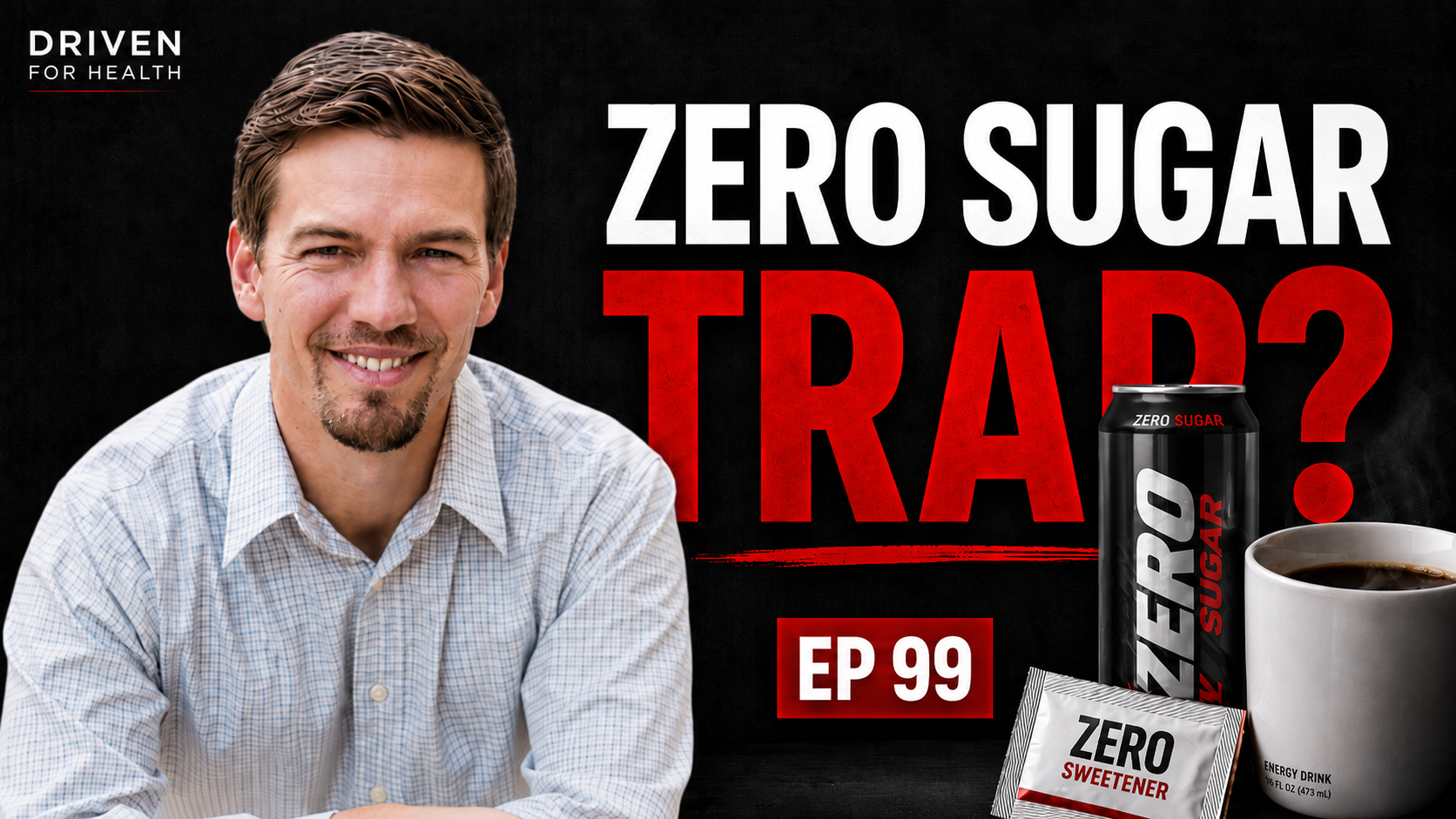
Listen To Episode 99
Coach Brian breaks down the full research, study by study, in Episode 99 of Driven For Health: Artificial Sweeteners Safe or Not for Men? I Reviewed the Research So You Don't Have To.
Common Questions About Artificial Sweeteners
Are artificial sweeteners safe to use?
Occasional use of approved artificial sweeteners is considered safe for most adults within FDA daily limits. The bigger question for men over 40 isn't single-day safety. It's what years of daily use may do to gut health, blood sugar regulation, and cardiovascular risk, which is where longer-term research raises more caution.
Do artificial sweeteners cause cancer?
Current evidence in humans does not support a link between artificial sweeteners and cancer. The animal studies sometimes cited used doses far beyond anything a person would realistically consume, which limits how relevant they are to human risk.
Can artificial sweeteners affect blood sugar even with zero calories?
Yes. Several studies have found that sweeteners like saccharin, sucralose, and aspartame can affect blood sugar regulation by disrupting gut bacteria, independent of calorie content. That happens through a gut health pathway rather than a direct sugar mechanism, which is why zero sugar doesn't guarantee zero impact on glucose response.
What is the FDA's daily limit for aspartame?
The FDA sets the limit at 50 milligrams per kilogram of body weight. For a 180-pound man, that works out to roughly 18 to 19 cans of diet soda a day, a level almost nobody actually reaches.
Do artificial sweeteners disrupt gut bacteria?
Research published in the journal Nature found that saccharin, sucralose, and aspartame can reduce butyrate-producing bacteria in the gut. Butyrate supports insulin sensitivity, so lower levels are tied to more insulin resistance over time.
How fast can cutting artificial sweeteners change my numbers?
Some men tracking a continuous glucose monitor have seen their morning fasting glucose drop 10 to 15 points within two weeks of cutting artificial sweeteners, with nothing else changed.
Are stevia and monk fruit better alternatives?
Generally, yes. Stevia and monk fruit show less disruption to gut bacteria and blood sugar response compared to synthetic sweeteners like sucralose and aspartame in current research. Check the ingredient list, since some stevia and monk fruit products are blended with fillers like erythritol.
Should I switch from regular soda to diet soda?
For most men drinking regular soda daily, switching to a diet version is a reasonable short-term step that can meaningfully cut sugar and calorie intake. From there, the goal is reducing overall reliance on sweetened drinks over time, not treating the diet version as a permanent, unlimited substitute.
Ready to Get Your Numbers Back in a Healthy Range?
If you've got lab work you don't fully understand, or you're not sure whether small daily choices like this one are moving your numbers, a private lab review is the fastest way to find out. Bring your blood panel and walk away with a clear plan for your situation.
Book Your Private Lab Review Call
The Call To Rise is a 100-day Fat Loss Transformation Experience for driven men ready to rebuild their body, their energy, and their confidence. Through strength training, personalized nutrition, and real accountability, most men lose 20 plus pounds and improve chronic issues like high blood pressure, high cholesterol, or type 2 diabetes along the way. Learn more at thecalltorise.com.

CEO l Head Body Tranformer
Brian Parana is a men’s health coach with 23+ years of experience helping busy professionals improve their body, energy, and day-to-day habits while still leading at work and at home. His coaching is built around practical nutrition, training, sleep, and accountability, with a plan tailored to the person in front of him.
Over the years, Brian has helped thousands of clients through his work as a personal trainer, CrossFit gym owner, and online coach. He has also coached an Olympic silver medalist, a 2-time Olympian, and a CrossFit World Champion.
Brian is the host of the Driven For Health Podcast, where he shares real-world strategies for men who want to feel strong again and stay consistent without making health a second job.
He’s also the creator of The Call To Rise, a 100-day fat loss experience for driven men who want to drop 20–30 pounds, boost energy, and rebuild confidence through strength training, personalized nutrition, and high-accountability coaching. Many men join because their blood pressure, cholesterol, or blood sugar is heading the wrong direction, and they want a clear plan that fits real life.
Brian is married to his high school sweetheart, Amber, and they have four kids. Their family has traveled to all 50 states and 4 continents, with a goal to reach all seven.

What To Order At Dessert Restaurants For Fat Loss


 YouTube