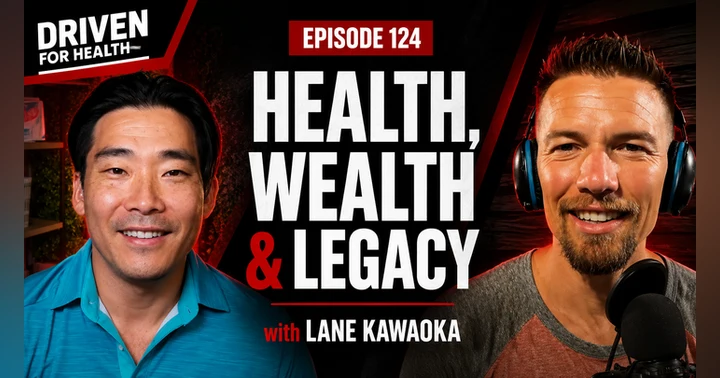
How to Build Wealth and Stay Healthy Enough to Enjoy It with Lane Kawaoka - 124

Lane Kawaoka crossed one million dollars in net worth in 2015. He tells Coach Brian what changed once money stopped being the goal. Lane is the author of The Wealth Elevator. They talk about how health and wealth and legacy connect for busy men. They also cover how walking and food and sleep support better decisions with money.


 YouTube
 Lane Kawaoka crossed one million dollars in net worth back in 2015. He tells Coach Brian what changed once the money stopped being the goal.
(Do you know your net worth but not your last blood pressure reading? See what building health looks like at www.thecalltorise.com)
In this episode of Driven For Health, Coach Brian sits down with Lane Kawaoka, author of The Wealth Elevator, to talk about health, wealth, freedom, and legacy. Lane shares how busy professionals, business owners, entrepreneurs, and driven men can start thinking differently about money, passive income, real estate, taxes, and long-term wealth.
This conversation connects money and men’s health in a real way. If your business is growing but your energy, fitness, nutrition, stress management, or work-life balance are falling apart, the cost catches up. Better health supports better focus, better productivity, better business performance, and better decisions with money.
Brian and Lane also talk about CrossFit, walking, food, sleep, entrepreneurship, online business, financial independence, and what it takes to build wealth without losing yourself in the process.
This conversation is for education and perspective only. Talk with your own financial, legal, tax, and medical professionals before making decisions for your health or wealth.
Main Topics:
- How Lane Kawaoka explains The Wealth Elevator
- The connection between men’s health, wealth, and legacy
- How fitness, CrossFit, walking, food, and sleep support better performance
- Why passive income and real estate can change how men think about money
- The difference between working for income and building assets
- Why stress management matters when building wealth or running a business
- The role of taxes, private investments, and financial strategy for high-income earners
- What legacy means when you think about your family, kids, health, and long-term freedom
Learn more about Lane here
https://thewealthelevator.com/
The Call To Rise is a 100-day fat loss challenge for driven men ready to take their body back. It combines strength training, personalized nutrition and real accountability. Most men drop 20 to 30 pounds and rebuild the confidence that comes with it.
This program also works if you are dealing with high blood pressure, high cholesterol or Type 2 diabetes. It was built for those men too. Many men see those numbers move in the right direction alongside their weight loss.
Inside the program you also join a Brotherhood of men doing the same work. Together you build a body you're proud of and start leading like the man you already are at work.
This is your wake-up call to rise. Learn more and apply at www.thecalltorise.com
Want help applying this to your own health, weight, energy, or lab numbers?
Coach Brian Parana offers Health Hot Seat coaching segments for men who want a clear next step with nutrition, fitness, weight loss, blood pressure, cholesterol, A1C, or daily consistency.
Learn more about The Call To Rise, a 100-day coaching program for driven men over 40 who want to lose weight, improve their health, and rebuild confidence:
To connect with Coach Brian:
brian@brianparana.com
Disclaimer: This podcast is for education and coaching support only. It is not medical advice. Always work with your physician before changing medication, treatment, or medical care.
Most men spend the first half of their life chasing income. It's logical, right? Then they hit about 40 and 50 and start asking harder questions. What is all this work actually building? A bigger paycheck can help, sure, but it doesn't automatically give a man freedom. Freedom comes when his money, wealth, time, his health, and family are moving in the right direction.
Legacy is the same way. It is built through assets you create and the health you have to protect it long term and the example to your family that sees you every day as well. Today I am joined by Lane Kawa, author of the wealth elevator. Lane helps busy professionals understand where they are financially and how to build wealth with more strategy, less stress, and a clearer path toward freedom.
He is a real estate expert as well. That gives you a strong setup for what's happening here on our conversation. Welcome, Lane, to our conversation here. >> Yeah, thanks for having me. Aloha, everybody. >> Yes. Aloha. Right. Exactly. Because he's from Hawaii. I've been to Aahu. I loved the place and I want to go back for sure. Let's start off the conversation.
We can certainly talk about Hawaii here, but what is one powerful takeaway you want everyone listening in to have? >> Yeah, I mean, this one's going to go out to the guys over 1 million net worth. I mean, those are accredited investors. You know, we're going to talk about, you know, how the wealthy invests, what they do for taxes and, you know, things that I learned when I kind of passed that pedestal back in 2015.
>> Right. It's a big accomplishment to have seven figures of wealth in there. And a lot of guys listening in can attune to that. And we do want to focus on why taking care of yourself along that route is super important so that you can keep it and not spending on healthcare, someone wiping your butt, something.
So let's start off talking about some of exercise and such. And you're a CrossFit fan. You like walking. You take care of yourself because obviously it's important. So let's jump in. Yeah. Oh, what do I do for fitness? Um, you know, for me it's got it's got to be quick, right? So, that's why I kind of picked CrossFit.
I think I've been doing it since 2010, 2012, somewhere in there. Um, you know, I was in college, I was always that, you know, do two hours in the gym and and that type of stuff, but it kind of gets old and, >> you know, when you actually like, you know, I was I was an engineer back in the day and life was pretty busy and then kind of doing the second job on the side of investing.
um you don't have very much time to just bro out at the gym all day long. So you >> I think that's where the CrossFit came in, you know? I mean, now I'm in my 40s, so it's a little bit different now, but um >> yeah, you know, I like the intensity. Like I like a lot of the um the whole grit, >> the idea of chippers, right? You kind of just chip away at things.
It's very synonymous with investing and wealth building. >> Right. Right. And especially with CrossFit, I used to own two CrossFit gyms. I had the fortune of taking a personal training client, Betsy Fin Finley, at the age of 60 to the CrossFit games. We went three times. She won, got second and eighth. And it is a discipline.
You get a lot of discipline. You work through a lot of hard, a lot of challenge. And life is going to have lots of challenges for you. So, by choosing to do hard in the gym, whether you do CrossFit or or you do bro splits or any of that stuff, by choosing to take care of yourself and and lifting weights and and all that stuff, it helps separate you, especially when times get tough because they will at some point.
The grass isn't always green, especially in ownership, and there are going to be ways that you need to be able to to manage for sure. So, [snorts] uh, you're you're busy taking care of yourself. Uh, how do we do with food and and all that other stuff around? You you were swigging some water here a little bit ago.
>> Yeah. I mean, I I I got off coffee recently. You I just drink tea and then um, you know, I used to do the keto stuff a decade ago. I love my bread and rice and sushi too much. So, you know, I'm a little bit moderate there. I probably partake a little bit too much in, you know, good good food, steak houses, Michelin stars.
Um, you know, that's probably what I spend my money on these days. So, but, you know, I I guess I kind of balance that with, you know, being a little bit more rigorous with sleeping and diet or exercise, right? Where I let the diet kind of kind of go a little bit. >> Right. Right. Well, if you're moving plenty and you're taking care of yourself and you're more selective of when you actually eat these more indulgent foods and you don't just binge out on it, then it's it's fine.
Moderation, balance, flexibility definitely work, especially uh we just went out last night and my wife and I were celebrating our 20th anniversary and she also she's a travel adviser by her own profession and and business. She sends people on bucket list trips and she sold out her women's only trip and we wanted to celebrate that and so we went to a nice fine restaurant and had was Italian because she's going to Puya.
So I had some pasta and and enjoyed it >> and yeah it was fine. >> Yeah. I mean everybody's got to celebrate somehow, right? I mean food and Italian food. I mean I try and save from noodles but >> it's a lot better than uh cocaine and other other harder things, right? Like it's [laughter] a lot better for your health.
Even a little sugar here or there. >> Right. Right. Right. Exactly. Exactly. Now, what around taking care of yourself transfers over into your investment strategies or even the wealth elevator itself and we can even start there like what the wealth elevator is and why you came up with that concept in the first place. >> Yeah.
I mean maybe kind of going back in my story. I I kind of graduated college, became an engineer, and my parents always taught me to go to school, study hard, invest in the 401k, buy a house to live in. >> I very quickly bought a rental property and, you know, just saved up my money and bought another one. 20% down payments. >> 2015, I had 11 of these rental properties.
But all in this time, you know, I was still on what I call the first floor of the wealth elevator. And, you know, I'll discuss what the the wealth elevator. The wealth element is basically this construct of there's different levels to the wealth building journey, >> right? >> I think most books out there written by like Susie Orman, Dave Ramsey, these kind of guys.
They're mainly for folks under $100,000 net worth, make less than 50 grand a year. You know, that's kind of in the basement level of the wealth elevator. But in my 20s, I had a good engineering job, was able to save my money and buy assets like rental properties or if you know if you like in, you know, just standard um S&P 500, you know, that's that's great, right? I think you're going to get killed with taxes with that stuff eventually, which you can talk more about that later on, but this is kind of that first floor of the wealth of building um journey,
right? When you're under $1 million net worth, >> right? Um, >> yeah, saving in a 401k, doing the S&P 500. Those are the the typical avenues for wealth that you're told to do. >> Yeah. >> And I call that and I I'll say that here because you guys get the joke, right? That's the standard American diet, the SAD diet, right? The And so that's the sa standard American investing diet, right? >> Yeah. Yeah. Yeah. Yeah. Definitely.
I I would agree with that. And we we all know what the standard American diet has done to us. [laughter] So, >> all right. And so, you get into rental properties and why was that the first thing for you to start acquiring assets? >> Well, I think like a dummy, I just listen to what everybody says and everybody said, well, like really wealthy people have real estate and and the numbers make sense, right? like on a rental property, $100,000 home out in the Midwest, you know, 100 goes to repairs, 100 goes to, you know, some
capex issues, $100 goes your property manager, and like $400 or $500 goes to your mortgage and your insurance and taxes. And if you buy right, you know, you can produce maybe a couple hundred bucks of passive cash flow every single year. Now, that doesn't include the tax benefits that the fact that the tenants paying down your mortgage for you, the equity build up there, and then the leverage appreciation, right? And that was kind of where very early on I was like, well, why would I want to put my money in the 401k,
like I'm making way more money doing this. And I wasn't even that good at it, right? I didn't I didn't back then I didn't even know all these like rules, the 50% rule, you know? I didn't you know, people are looking for like a spreadsheet to underwrite properties. they can go to the website and check. But, you know, I I I didn't know any of that, right? And I was just buying these properties cookie cutter style, not doing any flip fixer flipping or any nonsense like that and just working my day job and just buying more and more
properties and um and it was working and my net worth was going up and I was like, well, why doesn't everybody do that? Right. But I wasn't around accredited investors or, you know, real estate investors back then. >> Right. Right. So it was the first avenue and maybe an easy avenue to get in to the fold in a sense of starting to acquire wealth assets that and ownership that actually produces income for you and and a little bit more on the passive side so that you know you have your day job but then that as well happens. When
was the shift that you left the day job that you finally like I'm done being an engineer here. I'm just going all in on the investing. Yeah, I mean it it was all this time I was working my engineering job and you know I had 11 rentals in 2015 that was producing maybe a few thousand dollars of passive cash flow a month.
Um which is great, right? Not going to complain. But that was um you know most of my clients need about like $10 to $20,000 of passive income a month. So >> I you know do the math you know I'm no dummy. I'm an engineer. I can do the math. I would have needed like 30 to 50 properties >> and the headache on that is just massive and the legal liability on that is just massive especially >> for wealthy people and this is I just kind of luckily met a lot of other purely passive investors during this time that had the same pedigree probably
were a lot older than me at the time but they were they had a lot of rental properties too and they were selling them and going into syndications and private placements into larger deals where they could just go passive. and not be the managing member and the person on the hook for lawsuits and the one getting the debt in their own name.
They could just join on many many of these types of deals. So, I was like, "All right, this makes a lot of sense, right?" I mean, there there's a thing or two about, you know, getting in these types of rooms and this is why we're big on community and that's how you get deal flow on on this private investment side.
But this is where I I quickly realized that the wealthy did things very very differently than buying rental properties or what normal people will do out there. And I realized like, wow, I should probably turn this into a job after investing in maybe about 15 deals. >> You know, usually put about 50 grand or so in into them, you know? So, and I was selling the single family homes off, right, too, at the same time, >> right? And a lot of the people I had access to because I didn't have a network. You know, my parents weren't
accredit investors. Didn't even have rental properties by the way. But a lot of people I invested just some of the deals just didn't do well. And I was like, well, let me just do this myself. [laughter] >> So that was kind of where we started to syndicate, you know, smaller apartment buildings, you know, the older ones, a little bit rougher ones.
And >> that's where we got kind of traction heading into 2018, 2019. And then 2020 went over $1 billion of deals and then that's kind of where we kind of followed their momentum and I think yeah I quit 2018 my engineering job to do this full-time. >> Okay. Okay. >> But I I would say you know that's my story but like I think what we try to get for all our folks is >> you know just try and get involved in this world and but for the most part your highest and best use may be just working at your day job or your business. Awesome. Well, that's why they
call passive investing for a reason. So that when you're ready to go full investor mode, you know, when your net worth is over 4 mil, then you can you know where to put it. But when you're under $4 million net worth or on the first and second floor of the wealth elevator, by the way, that's the the range is there.
Um, you know, you got to make money. You got to trade time for money. You got to do a thing. And >> that's a hard place to be. But, you know, for everybody who made their wealth, right? I mean we consider our group a bunch of founders right the first generation multimmillionaire in their family there's always this this concentrated you know whether it takes five years some people takes them a little bit longer 20 years but there's this point where you're just saving and grinding and investing and it just turnurning and then one day you wake up
you're at four.5 million net worth 5 million net worth and you could just put it into T bills if you wanted and get $25,000 of passive cash flow every month but you know that's That's kind of the the idea, right? The wealth elevator is like you're trying to you go from each floor, there's a different mindset and strategy at each floor >> from from investment and tax strategy and you kind of just follow the blueprint, right? Like I mean these are all the things that I experience share through my wealth building journey,
>> right? So let's start with the basement. So we have the basement first floor and it goes up from there. Let's let's define the wealth elevator so everyone knows where they're even at in this what floor they're on. >> Yeah. Yeah. I think I mean I I'm big on like you know understanding who you are. I mean there's a lot of like social media tips, financial tips out there especially, but >> Oh yeah.
>> at what point in the journey does it make sense? So >> you know we we kind of talked about the first floor. So that's when you're under a million dollars net worth, but you're making some money. When you go over a million dollars, you're you're I mean, you're technically called a credit investor, net worth a million dollars or greater, or you make over $200,000 a year.
Now, this is important because now it unlocks a lot of private deal flow that you could invest in. And um you know I'll mention this is a big concept that I kind of realized luckily early on that you know when you invest in the stock market or you know Wall Street products right the financial planner stuff you're investing in the same investments but through the secondary market sloppy seconds the retail market >> right right >> um you know like what we try to do like when I was buying rental properties I was the guy right you don't get no closer to the source of the deal than
that, right? Or when you invest in a syndication, right, you personally know the operator who's running that deal, right? The general partner, and you're part of the passive investor, the LP capital stack. Um, and it's about the name of the game is about cutting out the middleman. And that's been frustrating for me, >> you know, like a lot of people just blindly put their money in their 401k and they just get killed with fees.
Well, Wall Street takes all the profits and you take all the risks. I mean, how else do these guys make all this money and have these big corporate salaries and big buildings? You know, they're not doing it because they they're nice guys, that's for sure. But welcome to the investment industrial complex.
Um, you know, this is >> like supplements, right? Like you I don't I think that this, but like you can just buy the same supplements on book supplements. Is that where all the bros get it from? >> Yeah. Yeah. >> Um, that's what I do. Uh, it's right over there. or my my creatine is like half off of whatever the the other creatine that has all the fancy shiny package to it.
>> Yeah. >> Yeah. We probably shouldn't say what companies there are, right? But um >> but yeah, I mean that's I mean I'm going to say we're like I know there's a health podcast. We're not saying that those are good, right? But >> Right. >> Um it's just an illustration of like how everything works out there in life, right? like right >> you have the original source and if you're able to get close to the original source you're able to get a better deal >> um but that said the dangers of this like in investing or anything else you
have to make sure you're buying good stuff right like whether it's peptides or investments right and that's I think that's where you pair with getting to know um other people that invest alongside with you um that's why we do a lot of community investor events for our credit investors only and um you know so that's I've always been big on personally knowing the the deal operators or operating the deals ourselves, >> right? You build that no- like and trust and then there's a familiarity and then there's group risk that everyone's
willing to take because of the relationships that you have and the opportunity that there is because you're talking about it and you're assessing it and you're going through is this a good deal or not and is are we all going to do this or not? >> Yeah. Yeah. Or is this guy run off of my money? Right.
I think is the thing that everybody's thinking especially on this rung of investments and that's right >> you know you are getting off the beaten path >> and I've been burned I've been burned many many times but you know I'm I'm still here doing kind of the same stuff right today um and >> I I was lucky enough to start with real estate where you can kind of underwrite the deals and it's physical tangible and you know lately I've been branching out to more private equity angel investments less less brickandmortar kind of things investments But um you know what I
realized is this is the way the wealthy invests. Right. >> Right. >> They're they're not definitely not doing a 60/40 uh you know allocation which by the way I'm not a certified financial planner so I'm not allowed to talk about asset allocation mix. So don't listen to me on that stuff. But >> right yeah I always have to say this is not medical advice.
>> Talk to your doctor. Right. Talk to your financial planner or whoever you trust with money uh and investments first and foremost. Um, but Lane is offering his experience around what he has gone through and what he finds to be best and and his group and experience. >> And when we're talking about experience too, in my experience, most of the the people I work with change their CPAs because a lot of those CPAs don't know what the heck they're doing in terms of investing and they do taxes.
They do the forms, >> right? >> But they don't know anything about tax strategy, >> right? And if they knew the power of real estate and passive losses, bonus depreciation, they'd probably be doing it, too. And then therefore, they wouldn't be counting beans and doing this the taxes, >> right? >> Every April and >> Yeah. Right.
>> October, stressing themselves out, right? Like, >> right. Yep. That that is very much the the routine of a typical CPA. So not leveraging tax laws and opportunity to be able to maximize outcomes for themselves and for their clients. >> Yeah. But but a lot of good CPAs, the ones that get it, they see it firsthand from their clients.
Holy crap, look what this guy has. >> And look how his passive losses is knocking out his passive income and how his like he barely pays any taxes legally. maybe I should do emulate some of this, right? Like um just like you know some people are like oh the rich don't pay any taxes, right? They really should be asking like well how can I emulate some of that too legally of course right? Um, >> of course, >> but this is what I was doing like in around 2016.
I was interact I was going from the first floor to the second floor of the wealth elevator and I was interacting with a lot of accredited investors and I was kind of just slinging down all these these best practices like investing in alternative investments such as real estate that happen to kick off all these great tax benefits to then cut your tax bill drastically and then also run it through an infinite banking life insurance plan that's that's um created a special way um that we're not going to get into that that's a kind of a rabbit hole doesn't
move the needles was too much as the taxes especially for the high income earners over $400,000 AGI. But um you know this this what I realized it was kind of simple and it and it kind of frustrated me that like the average person out there is is able to implement these strategies pretty easily but boy is it different than everything that we're taught out there.
>> Right. Right. You go back to even say on the nutrition side, if if we would just properly teach people that how to read a nutrition label properly and how to have better balanced meals and avoid junk food, then we wouldn't be in a national epidemic of obesity. Yeah. >> And all the results of it.
And it's not hard. >> Or the same thing with financial and and saving or and investing in your money. If we could all teach that better in our youth, then we wouldn't have such credit card debt. [laughter] >> Yeah. But it's not as simple as like, you know, hey, eat eat less calories than you consume, dummy. >> Or just like, oh, spend less money than you make.
>> Yeah. Save more than you you spend, right? >> Yeah. Like I mean that's great for the people in the basement level, the wealth elevator, you know, who are trying to get out of debt, >> right? But when you are wealthy like it's like a lot of it is the access to the investments, the people um and like you know unfortunately you can't just stay on your computer and just click buttons, right? You got to kind of get out there and meet people >> and um you know access the you know the the public or the the second the primary
market is what they call it, right? Direct access which is known as the private markets. Nice. Now when someone accomplishes specific financial goals and stability around those, what is the say let's go with the accredited investor like what is that step of okay I have active income from my job and I'm creating passive income.
How do we get to that accredited investor level for someone listening in? >> Yeah. I mean, there's no test, right? It's kind of like you're pregnant or not. If you got a million dollar net worth or $200,000 in income or greater, congratulations. You're in a credit investor. You're on the second floor of the wealth elevator.
Um that, you know, the next the next big milestone is is and it's it kind of ranges for most people. Well, I I would say like $4 to5 million as a general rule of thumb in terms of net worth because at that point then you're able to just invest in really lowrisk low return stuff like T bills and just generate a return where you're able to live the rest of your life infinitely.
>> Um and you know that's the point where you have enough net worth where the critical mass la you know you're able to launch to outer space and break gravity at that point >> right >> or what people known as financial independence at that stage. Um, you know, we the the reason kind of what we do what we do is that we try and teach people how to, you know, you get to that point, you stop trading time for money, right? Whether you run a run a business or you're just a W2 employee, you're trading time for money and you may make
a lot of money and that's great, right? But what you want to get to is hit your crit. You gota you got to put in a lot of work and effort to get to that point where you get critical mass and now you're not trading time for money, but you're allocating your money so it works harder for you.
You know, I mean, you get to that point and you just want to buy T bills. Awesome. Great. Right. I actually think that's a pretty nice idea. But the idea is like, you know, now you talked about legacy, right? Like what do I want? Do I want this to grow to eight figures and above? I want my kids to kind of learn how to do this >> and be capital allocators instead of just worker bees that trade time for money.
>> You know, I'm not going to get too I mean, we talk a lot about, you know, legacy building, what to do, what to how to teach the kids, how to, you know, you know, teach them about wealth building and and legacy, but I think that's where, you know, it's different for everybody, right? I think that what I try to do and focus mainly on is getting people to that that point >> that point. Yeah.
So then they have they have a lot of opportunity at that point and they can be able to pass it on to generations to come, which is important because everybody wants to take care of their family >> typically. >> Yeah. Yeah. Yeah. But I mean I I would argue that if you give each kid more than $2 million each, you know, you had two kids, you four million net worth, then any more would be a little overkill and you might make things worse.
But um the very least you know I think you you work a gold and try and get the financial independence. So now that you can change the lifestyle from working to actually enjoying and doing things for a reason and building adding value to the world, >> right? >> But the idea is like quick how quickly can you get there? >> Um if you get there by the time you're 80, you know, I know you got some fit guys out there, but you know it's kind of too >> Yeah.
You're end of the rope no matter what which way you look. Yeah. >> Right. But you [snorts] know if if you spend a decade or two in you know steadily increasing your net worth it's not unheard to get there before your 40s. That's for sure. I in fact most of our clients sort of like I think we were talking earlier like median age 47 you know >> right >> people who come to our events you know typically in their 50s.
>> Um part of it is you need time. You need time on your side especially if you've done it the wrong way the standard way. Um >> right. But yeah, this um I think what what gets them is like they understand like you know you're investing directly in the deals as opposed to kind of going through the normal channels.
Now with someone listening in that's hearing these things and they're not at say accredited investor level. What do how do you start speaking into their their mind or their ideas to shift them from what what they have been doing to get them to see the opportunity that is in front of them that's available to everyone like where's how do you do that what's their income level that's >> well let's say let's say they are clearing like six figures 100k and but they obviously want to go up to over 200 >> yeah I mean that was me in my 20s right?
Like I I was kind of but I was able to save 20 30 grand per year and then you know I used that to buy one rental property and then I wasn't only saving 20 30 grand because each rental property increased my passive income a little bit right so you know by the time I had 11 rental properties I was making an extra 60,000 a year so maybe I was netting 30 saving 30 but with my p my investments I was >> plus 60 so plus 90 right so now I was able ble to buy three rental properties there, right? And that's I I just say
that as like, you know, maybe that's motivating, right? Cuz like this is the hard part. It's a hockey stick >> in the beginning. It's like watching grass grow. I mean, it's even harder when you're under 100 thou. The the basement level of the wealth of is the hardest place, >> right? >> Especially when you don't make too much, >> right? >> Um you know, most of my clients are able to save at least 20 grand, 20, 30 grand per year from their paycheck.
But if you're not there yet, you know, that's fine. You know, just it's going to take you a little bit more longer. And but you know get on that escalator, buy buy assets, buy real estate and then that you know every year that monthly savings amount will go up. Yeah. What about investing in skills to be able to then grow your income through that manner of um now for me it's like sales and marketing and uh the better I'm at as say a marketer then the more opportunities are going to come my way.
How would you talk about that in this aspect so that you level up your abilities and see these things uh all of a sudden because of the exposure that that you're putting yourself through? >> Yeah. I mean, I would say half of my clients are like W2 guys where, you know, they're going to make what they're going to make, right? If they kiss enough butt and pass enough, you know, do what their boss wants, their their salary should grow, right? Definitely outpace inflation, right? if they get some promotions here or there,
>> right? >> But, you know, the guys like you're you're saying, right? Like, does it make sense for me to I mean, obviously the business owners are going to say, you know, heck no, I'm not going to go to college. That's a waste of money. And I would probably agree with that at that point, right? >> My 16-year-old is really struggling right now.
He's like, why am I going to go to college? AI will just give me the answers. And I'm like, well, I mean, you're not wrong. [laughter] >> Yeah. So, so the business owners out there, yeah, you know, if you pay if you spend $20,000 to take a a training course and that increase incre improves your close rate by 10% that leads to an extra $100,000 a year. That's a 5x ROI.
That's obviously a lot more than what you get in real estate or any other investment out there other than some crazy risky altcoin. You know, you probably lose your money doing that, too. But um you know another thing would be business owners and I talk to them all the time right like you know maybe you know before you passively invest where you know you may only you know I don't think you're going to be able to like get more than 30 40% a year right like but that's easy if like you know if you get an employee they should easily
or they better make a high ROI for you so you should do that there first. >> Yes. Um, so yeah, I for entrepreneurs out there, especially under the $1 million revenue mark a year, it probably makes more sense to invest in yourself as they say. But that's why what a lot of investors will do is they'll, you know, a lot of investors come to us after they've sold, right? They've sold their company for like five mil plus, >> right? >> And then they parlay that into plus they don't have they're not liquidity rich, right? They're still equity rich, cash
poor. But that I think that's what's required, right? That's what's required to build something from scratch is to start always be investing in the business. Now, there's an interesting art to like titrating up to like, you know, you don't want to wait till you're $5 million net worth to start passively investing.
>> No. >> Yet, you don't want to passively invest when you're like half a million dollars net worth as a business entrepreneur because you be you should be investing in your company, >> right? >> But I don't know when that starts, right? That's that's different for everybody, right? >> You know, >> to what degree do you start taking risk on these other opportunities to then continue to grow your overall wealth >> in a sense? And that is >> right.
>> Yeah. Obviously, it's for each individual person to decide. >> Yeah. >> And in that of of how much risk they're willing to take and accept. And ultimately, you and I both know that that's the name of the game. You got to pay to play. And there's risk in anything. There's risk in just you staying a W2 employee.
You might not have a job tomorrow. >> Yeah. >> Because AI is going to replace you or whatever. So, there's risk in that, too. And I'd rather much rather take the risk of growing a business of putting in the the sweat equity in the beginning to then get that hockey stick like a fact and impact.
Uh that's even what say like this this podcast started. I didn't even want to do podcasts and then I realized I need to do podcasts and you know this is episode uh 124. So uh and under a year so I've been putting in a little bit of work and it's starting to to to hug a stick in a sense. >> Yeah. You see it. >> Yeah.
But every situation is different like you know I have clients like dentists and doctors and they've got like the entrepreneur bug right because they always see how cool we are. [laughter] We're not we're not we're just um you know I on a side note like you know you and I kind of are the you know we deal with the kind of the same people in terms of the marketing world right like all these marketers they want to sell us some newest hacker tactic for 20 grand >> right >> you know most times it's like 5% effective right like it works 5% of the time right [laughter]
>> yes you know I I have definitely bought into courses and programs and just been underwhelmed and lackluster. It's like, "Oh, >> yeah." >> So, as I got behind the curtain, I'm like, >> "Yeah, >> this is what I'm bought into. This isn't quite what I thought." [laughter] >> But we I mean, we, you know, we definitely toot our horn when it works.
And we meet a lot of people who also buy those silly programs too along the way. So, there is some envy from th those guys, right? Like, I want to be an entrepreneur. Woo! Work for myself. Um although most entrepreneurs are just you know trading time for money and you know they they don't really they own a business that controls them but >> right >> you know that's why but I tell the doctors and dentists like dude you make >> $600,000 a year $800,000 you don't want to come to this side of the you know the grass is not greener on
this side just you're doing fine just do what you're doing maybe do like some like tax mitigation strategies that people in this world will do um you know which I certainly think is huge huge for people who make over $400,000 um to cut a huge portion of their income. >> And you know that's I think you know you just keep keep being a doctor right for the next half a decade and you're there >> right. Yeah.
You you will be above the the one mill and in no time and >> as long as you don't spend it on fancy cars and big houses. >> Right. Right. and too many fine dining experiences, then you'll you'll you'll get there and and be okay. And and that's an okay way to go do it because there well there's again there's risk either way.
But uh if if you have that security and that type of a position then going to say entrepreneur world is uh it could be a bit more risk than you're used to because you're used to just going in and doing the thing and not having to to think about a thousand other things that could or couldn't happen along the way too. >> Yeah.
Yeah. But, you know, most times, you know, out there in the wild, like, you know, the the entrepreneur clients, especially the newer ones, right, that we're talking about, a lot of times they're more apt to just invest in boring investments that might gain them five to 10%. Right. Whereas I have to push them and I have to say, "Don't do that, dude.
Like, go and hire another two employees with that money instead." >> Right. >> Right. Like, so they're a little bit more on the conservative side. They'd rather have, you know, a, you know, a bird in hand than a chance at five of them, you know, by being an entrepreneur and spending it on that crazy marketing guy with the $25,000 strategy.
>> Right. Right. >> Yep. >> And I'm sorry if there's, you know, you're the guy, the marketing guy who runs a great business. I'm sure you're great at sales and marketing, but uh I don't want to offend you that, you know, you I'm sure your $25,000 uh product works. [laughter] >> Yes. Yes. works for you, right? Yeah.
>> Right. Just make sure that you're selling it with ethical intentions and results and and uh Yeah, >> for sure. Now as as we climb up the elevator, you are exposing yourself to new opportunities, new people, new networks, new way of thinking that can then grow the opportunities that you have essentially is what we're talking about.
Which then certainly amplifies the risk as you've been burned in the past. I've been burned in different business ventures and such, but the overall outcome is that the the each hand that you're playing card that you're dealt in playing those is to leverage to be able to get to the next level. Where does this wealth elevator end? Or does it? >> Yeah, I mean, I think I I mean, it doesn't really end, but I think when you get past the third floor, it definitely gets easier in a couple of ways.
first, you know, you're not working with low-life operators, right? Like I mean, when when you first started your business and even with me, like I don't know if you partnered with anybody, but like you just have like fake it till you make it people and people >> I had a guy that was the business guy and I was the the personal trainer coach guy and he he definitely leveraged me.
>> Yeah. I was at the gym 247 all the time doing all the things and just was happy that I was a gym owner. But man, that that those two years really taught me something >> quite a bit. But just I mean I'm not saying that this is true, but like I'm just saying for like for your business because you've gotten it to a respectable level and you know people and you know other people that know other people, you could probably vet like if you wanted to partner with uh >> you know somebody total left field like a women's um
>> health coach or whatever, right? Like >> you have access to better deal partners and operators, >> right? So that makes it a lot easier and it's actually made us our job a lot easier to find good deals because you know our network knows good people and we can also cross reference and verify. Um, and then the other thing is like, you know, in the beginning, the hard part is, you know, when I was first starting, I, you know, I had a million dollars.
>> You know, if you start doing out $50,000 per project, you know, your money doesn't go very far, right? Yeah, you're diversified in, you know, dozen or a couple dozen deals, but that's not diversification, >> right? >> Um, you know, I have, you know, I think I had like just under 100 K1s this year, right? I mean, not saying that that's diversification or any gold standard, but you know, if any one or two or five deals go bad, right? You still have the greater hole, right? So, you're diversified and more solid that way. Um,
but this these are the kind of things that you try and teach the next generation about, right? Diversification. you still need to take risks um with a portion of your portfolio and but maybe also play the barbell effect where you have an an a heavier weight on like the life insurance side that's super low risk low return or T bills for that matter right um you know I think that's that's where the wealth elevator goes on the higher levels and you know originally like I mean I had no concept of this before but
then >> when we were buying all these apartments these are the the cats who would be buying from right [laughter] and then and then it' be interesting. >> They're elevating up. They're going on their own wealth elevator and they're happy to >> put you. All right. Hey, you went my first floor level.
I'm going to the second or third floor. >> Bye-bye. >> Well, we we would be buying from generational wealthy families, right? That had, you know, dozens and dozen apartments. And, you know, we you know, one case like we were working with the patriarch, right? But he he was on his deathbed like trying to unload his assets and his kids like for example like in that one the kids only wanted the sexy properties in Miami probably to show off to their friends, >> right? >> They didn't want the boring blue collared assets which we wanted in
Alabama, right? That had a great opportunity in them, >> right? >> And so I I saw it firsthand. You know, who am I to say their net worth was like a hund00 million dollars, right? And they owned a freaking island out there in Alabama. But that that this is kind of where I got insight into that world and started to you know build some friendships in that realm.
Um >> but you know I I think I speak more for the the first generation multi-millionaires right the founders right you know not the person who inherited millions of dollars >> right >> but the one who you know you know yeah I mean at least for me like you know my parents sent me to college they they set me up good but um you know didn't have more than a million too certainly didn't have more than $2 million right but if the idea is you take that and you grow with it and that's at least what I want for my kids >> right Right. Yeah. And what what defines
legacy for you as as you are uh going up your own elevator? How do you see the exchange to your generation of kids? And how how are you going to pass this on to them? >> Oh, I have opinions. And and they've changed over the the years. >> Of course, they should change, right? Just like anything there, it's going to evolve with experience, time, and and everything else that happens.
>> Yeah. So, you know, at one time I was like, you know, let's give them as much money as we can. And like I said, you know, the the $2 million more per person is my current belief. >> Um I I'm not a big fan of just giving them the money. I believe that they should ask for it and apply for it for whatever investment or business they want.
Yeah, I definitely agree with that one. >> I definitely believe in like entrepreneurship is the best u form of personal development because it humbles you. >> You know, most founders who created their wealth, they're usually pretty humble people and they realize how lucky >> they were >> um to get to that point. So >> yeah, you know, I I I I think it's three things and um I I was talking about this on my my last podcast that I had that um I could never put my finger on it, you know, to answer your question, but it like what do I what kind of kids do I
want to raise in this world? Like the first one is I want them to be um have autonomy, right? So that means >> they have some sort of impact into their own well-being. So, like that may even mean like, well, for every million dollars that the trust gives you, you have to earn a million dollars, right? Something as silly as that.
Like that kind of reinforces autonomy in a strange way as opposed to them, >> right? Right. >> I'm just, you know, driving around my my Mercedes G Wagon. Um, >> so this this kind of create puts them into the cycle of they're they're a contributing value to the world. The the next thing is now they need some competence in something.
And I think this comes first. It's them building skill sets. Unfortunately, rich kids never have to grind or earn any grit in anything. That's a part. >> They never put in the Malcolm Gladwell 10,000 hours to get good at anything. And therefore, a lot of wealthy second, third generation beyond kids have low self-esteem deep down, >> right? >> They just they're just known as like the the the douchy rich kid who just pays for everybody's drinks. this.
>> Um, >> yeah, we all know who that person is, right, in our friend group. And >> and hopefully they don't know who they are, but most of them they're not idiots. They know they know that they're that person. >> They they understand self value. >> Yeah. Um, the last one is just, you know, being a part of like community or like I I always thought like, hey, make it better for the family.
But I think, you know, some people like some of investors don't have kids. So I think this like comes into like either church or community making the world better place and you know that part of the autonomy or add values back to your community there. But >> you know to me those those are the three things that I think >> I don't know what I'm going to have young kids so I don't know what I'm going to do but I think those are the three goals like or KPIs.
>> Yeah that that's great. I I really like putting the kids to work in a sense of the entrepreneurship, getting them to get into the weeds of being becoming competent in some area that they're interested in, adding value back into the world. Yeah. >> And that's that's super important because they have to learn >> to to struggle, to strive, to be humbled, to have success, and be able to foster the skills and the development that that you went through and like I've went through to be able to acquire ultimately long-term wealth to be able
to add more value, which is the underlying take here if you've been hearing is we have to add value to the world people no matter which way we look at it and acquiring wealth allows you to more freely be able to add more value in a positive way. >> Yeah. I mean look I don't want to spoil children but my thought process on this has changed quite drastically over the years.
Um, if you would have found me 5 years ago, I was all about, hey, let's engineer a trust where they get x amount when they're 25, x amount 35, 35 is an important number, and then, you know, rest later. And, you know, they got to take drug tests to achieve this, they've got to apply for this funding. Um, all these rules and like kind of overengineering.
And I think this came from a place of like, you know, ego, right? I think most founders want to feel like they can come up through the grave and control everybody after their death. >> But lately, I've been, you know, reflecting on, you know, I just want them to be happy, right? Like I just want them to be a contributor to society as we mentioned have some confidence in their skill sets not just because they're rich and everything was given to them and then have some sense of connection to community ohana and be a positive net to the world and whether
that they're like a highowered important doctor in one respect versus someone who who is known as a a good human being and always helping out and a teacher and I don't really care right who am I to say Right. I mean, maybe I'll still buy them each a house so they can live >> for free and not have to worry about that.
Not, you know, I think that's the difference between >> an engineer who makes $130,000 who hates their job but just needs a little bit extra money versus somebody who's super content and happy making 65,000. >> Right. Yeah. Totally. And if you say buying a house can offload some of the extra money that they need or Ultimately, it ends up being stress relief so that they can be more content and be happier and express joy in a lot of different ways, especially to the people closest to them and the others that surround them.
That's it's really important. I've I've experienced that level of of wealth, too. So, like, oh, I don't have to worry about my bills. Look, okay, this is good. like I can just operate now and and not have to be under the the the finger of like, oh, here comes a another credit card bill in the mail.
Like this isn't what you want to have to experience to to to struggle in that sense. >> Yeah. >> Right. Yeah. >> Totally. Excellent. This has been great so far. So, we've got the wealth elevator. We are acquiring wealth through real estate, through other opportunities of private equity and getting to know, like, and trust people, network with people, actually not hide behind a keyboard and on the internet.
And that's really important. Now, what is one takeaway that these guys should really think about in their own journey of their wealth elevator? Like what's one last uh nugget that you can bestow upon them to get them to start to say like open their eyes or think differently or plant a seed that starts to fester and grow? Well, like like I said, I think the the things that the wealthy do, alternative investments, tax strategies, infinite banking, it it's nothing that the average Joe still can't implement.
Although it's very counterintuitive that what we're all taught. And then the second thing is you got to know where you're at, right? Self-awareness. Um, if you're broke, probably don't want to listen to me, [laughter] you know, like. But if you're a good accumulator of wealth and you're decent with your budgeting, then it's time to step up to the wealth elevator, grab yourself a book, and then see what floor you're on, and then move from there.
>> Right. Right. And I know you offered some books uh as well to the audience. So, what what can we do to be able to hook them up with a Wealth Elevator book? >> Yeah. Well, I mean, I gave them to you, Brian. So, it's up to you. I mean, you're you're the keeper. You're the keeper of the goodies.
But, um, you know, people go to Amazon, they buy the book, and I think that then you can leave a review. If you leave a review, and you take a screenshot, send it to team atthe wealth elevator.com. We'll hook you up with the free PDF so you can upload it to your AI and ask your art questions. And then, and the MP3, so I'll just read it to you if you're lazy like me.
But, uh, if you're old school and, you know, and you want those, um, you know, maybe just reach out to Brian. Yeah. through email and we'll hook you up with a hard copy. >> Yeah, perfect. And I can get those supplied for you. So, uh, well, excellent. We're gonna have a link in the show notes for Lane's info, his stuff, where he's at, and be able to connect with him.
And if you have some you've got money and you want to elevate your game and start thinking differently, Lane is offering a a pretty good opportunity here. Lane, I haven't had anyone talking about investments and anything like you have on my podcast yet. So, this is a really good opportunity to explore Lane's world and get connected with them to see different ways of thinking and and that's the name of the game anyways in life is just not follow just the old patterns of behaviors that we've done.
There's lots of opportunity out there that you have to seek out and find and be around other people, right? the they always say your net worth is your net worth and that's what Lane has shared with us today. So I want to thank you so much for coming on board here with us and uh and then here we go. >> Yeah.
And and I'll just kind of close this out is >> yeah, >> you know, they it's not too hard to get financial independence. And I think that's where in parallel you got to do the health stuff, right? Like health is wealth as as they say. >> Always, >> you know, people who don't have money. Um I get it. You got to burn both ends of the candle.
But you I think very quickly when you get on the wealth elevator, you start to realize you're on the fast path to perpetual wealth, right? That kind of keeps growing. And then you're like, "Oh, shoot. I better I better try and, you know, live live longer so I can take advantage of this thing, right? So, um, that's why I've always kind of been on the the health bandwagon.
I mean, it also, you know, powers the long hours doing all this stuff, but >> Right. >> Um, but yeah, thanks for having me, Brian. Really appreciate it. >> Yeah. Yeah, definitely. I I second that. I have so many guys that are struggling in their 50s and 60s that start showing up because they were stuck in the business and they never stopped to think about themselves.
They just hustle grinded and and burned the candle at both ends never to to stop refresh themselves. So it it does it does catch up at some point probably sooner than you think. So all right that is it for this episode of Driven. Thank you so much for coming.