
Why You Still Look Like You Never Work Out
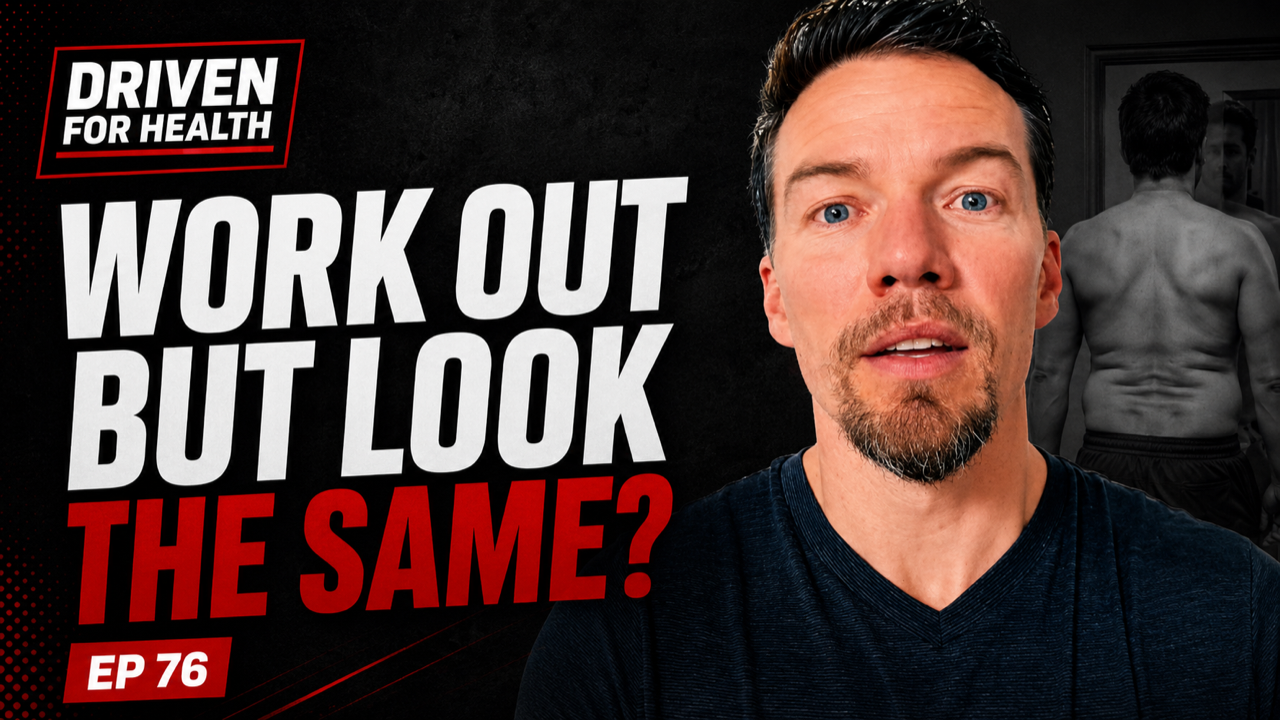
Episode 76 opens in a family group chat with a photo a man does not recognize himself in. Coach Brian names the three gaps that leave a hard-working man looking the same for years and hands over the numbers to test each one. Bring your training log, your weekly cardio minutes and two weeks of food data.
A man can go to the gym four days a week for two years and look the same at the end of it. That happens for three specific reasons. This episode names all three and hands you the numbers to test each one against.
The Morning You Already Know
Alarm at 5:30. You are running on six hours of sleep because work ran late. You skip breakfast and get yourself to the gym by 6:15.
Chest day. Three sets of ten on the bench press. Three sets of ten on the cables. Some curls and some abs. Out the door by 7:15 and at your desk by 8.
You do that four or five days a week. Most men your age do not. You are not hitting the drive-through and you are not drinking soda. You get seven or eight hours of sleep most nights.
Then Saturday comes and the jeans are still tight around the waist. Someone takes a photo at a family thing and your stomach drops when you open it later.
Coach Brian's read on that is direct. If you are working as hard as you think you are and your body is not changing, something in the way you execute is off.
He opens the episode with a client who lived in exactly that spot. An executive at a construction firm with three kids at home and constant travel. He had carried about 50 extra pounds for the better part of five years and had tried a diet here and a program there. Over the time they worked together he dropped the weight, got his labs back into a normal range, and started sleeping through the night. What he named as the real change had nothing to do with the scale. He had stopped telling his wife, his team and himself that he was fine when he was not.
Gap One: Exercising Is Not Training
Imagine a rep on your sales team who is at his desk every day making calls. His numbers have not moved in two years. At what point do you stop blaming the market and start asking what happens on those calls?
Coach Brian asks the same question about your workouts. He describes a man in a hotel gym in Virginia. Headphones in, gym clothes on, looking the part. Chest press machine, three sets of ten. Ab machine, three sets of ten. A few minutes on the elliptical at a pace where he could have read a magazine. He was barely breathing hard when he picked up his water bottle and left.
That man tells people he works out five days a week. He does. The weight on that chest press has not changed since the month he joined the gym. His body finished adapting to that workout years ago and has nothing left to respond to.
Training is a different thing. Training means the load goes up. This week you lift a little more than last week, or you get a rep or two more at the same weight. At the end of a hard set you could not have produced two more reps.
When Coach Brian programs strength work for a client, he runs blocks of six to eight weeks on the same movements. Sets, reps and weight all get tracked. Every week something goes up, because the moment the muscle gets comfortable the progress stops.
Two questions settle whether you are training or exercising. Do you have a structured program with a clear way to track whether you are getting stronger? Do you know what you lifted four weeks ago on your main movements so you can beat it today?
Answer no to either one and that is your first problem.
Gap Two: Your Cardio Is Not What You Think It Is
Most men say they do cardio. Pressed on what that looks like, they describe ten minutes on the treadmill before lifting or a walk on Sunday.
Your heart is a muscle. It gets stronger and more efficient only when you challenge it on a regular basis.
Coach Brian's target in this episode is ten thousand steps every day plus sixty to ninety minutes of dedicated cardio per week. Break the cardio into twenty to thirty minute sessions, two to four times a week. Your heart rate should sit around 130 to 150 beats per minute for the whole session.
Treadmill, bike, rower or stair climber. The machine does not matter. The pace test does. If you could hold a comfortable phone conversation at that pace, you are strolling rather than training your heart.
That work builds your body's ability to burn fat, helps your heart handle stress and helps your blood sugar respond better to food. It also creates a calorie burn across the week that moves the scale over time.
If you train hard four days a week and skip this, a chunk of your result sits unclaimed every week.
Gap Three: You Are Not in a Calorie Deficit
This is the piece men push back on hardest. If your body is not losing weight, you are not eating less than you burn. No supplement or training style changes that.
The number Coach Brian sets in this episode is 500. Eat 500 fewer calories a day than you burn and the scale starts moving.
Run the arithmetic before you set your expectations. A 500 calorie daily gap comes to about a pound of fat across seven days. That is a pace you can hold for months.
Five hundred calories sounds like a lot until you see how fast it disappears. Coach Brian's estimate from years of intake reviews is that eating pretty clean and eating clean run 400 to 600 calories apart on a normal day.
The extra calories are rarely in the meals you sit down for. They sit around the meals. A small bag of trail mix from the office vending machine runs about 200. Two beers on a Friday night while the game is on run about 300. The coffee number depends entirely on what goes into the cup.
Then there is the handful of almonds off the kitchen counter during a call. The two bites left on your son's plate that you finish without thinking. The pour of bourbon at 9:30 while you catch up on email.
None of that registers as eating. That is where the numbers hide.
The Two-Week Read
You would never run your business on guesswork. You look at revenue and expenses every week because a number you stop watching is a problem you cannot see coming.
Coach Brian wants that same logic pointed at your food. Here is the process he gives.
For the next two weeks, log everything you eat. Use MyFitnessPal or Cronometer or whatever app you will open. Change nothing yet. No new plan. Watch and record what is happening.
Step on the scale every morning at the same time and log the number.
At the end of two weeks you hold two facts. What your weight did over fourteen days, and what your average daily calories were.
Then eat about 500 fewer calories a day than that average for the next two weeks. Watch the scale over the following month.
That is Coach Brian's Body Math Formula in practice. I move this much plus I eat this much equals my body responds this way. Your results are not random and the inputs are countable.
What to Do Starting This Week
Three things.
First, find what you lifted four weeks ago on your main lifts and compare it to today. If you cannot find the number or it has not moved, that is problem one and it comes before anything else.
Second, add up your real cardio from last week. Not steps. Time with your heart rate up at 130 to 150. If you cannot reach sixty total minutes across the week, that is your first target and you work up to it.
Third, download a food tracking app and log everything starting tomorrow morning. Two weeks. Every day. Everything.
Then watch four numbers. Step count daily. Weight every morning at the same time. Average calories at the end of each week. Your main lifts, tracked so you can see whether they move or stand still.
When the real numbers are in front of you, you stop arguing with yourself about whether you are doing enough.
What Another Twelve Months Looks Like
You keep training the same way. You keep eating the way you eat. You tell yourself you will lock it in when work slows down or the kids' schedules ease up.
Twelve months from now your son is a year older and your daughter is a year older. The Saturday mornings coaching their games keep coming whether or not your body is ready for them.
Your kids are watching how you handle your own health. Your body right now is telling them something about whether you execute on hard things.
The three gaps are not complicated. Training that never progresses. Not enough real cardio. No honest look at the food numbers. You can start on all three this week without a dramatic overhaul.
Where to Start
If you want the smallest possible first step, take the free Lose 3 lbs in 3 Days guide. It runs on protein-first meals, a daily water target and extra walking, with no calorie restriction and no added workouts.
If you are done guessing and you want a plan built around your actual life, here is the program.
The Call To Rise is a 100-day Fat Loss Challenge designed for driven men ready to get back to a healthy body, boost their energy, and lead as a powerful man.
If you are struggling with some form of chronic illness such as high blood pressure, cholesterol or even Type 2 Diabetes - this program is designed for you too.
Through a proven system of strength training, personalized nutrition, and real accountability, most men lose 20 plus pounds and rebuild the confidence that comes with it and even improve chronic illness issues. It's more than a fitness program, it's a body transformation experience with a Brotherhood of like-minded men committed to showing up, leveling up, and leading in a body they are excited about.
This is your wake-up call to rise.
www.thecalltorise.com
The guarantee is plain. Lose 20 or more pounds in the 100 days or Coach Brian keeps working with you until you do. On episode 53, Andy walks through his own 38 pounds.
Frequently Asked Questions
Why do I still look like I never work out when I go to the gym four days a week?
Coach Brian points to three gaps in episode 76. Your training has no progression, your cardio is too light to count, and you are not in a calorie deficit. Close all three and the body responds.
What is the difference between exercising and training?
Exercising is putting in the time with the same weights week after week until your body has nothing left to adapt to. Training means the load or the reps go up over a block of six to eight weeks so the muscle has to keep responding.
How much cardio do men over 40 need to lose fat?
Coach Brian asks for ten thousand steps every day plus sixty to ninety minutes of dedicated cardio a week. Break that into twenty to thirty minute sessions two to four times a week with your heart rate around 130 to 150 beats per minute.
How big does a calorie deficit need to be to lose fat?
In this episode Coach Brian sets the target at 500 fewer calories a day than you burn. Held across a week that comes to about a pound of fat.
Where are the hidden calories in a normal day?
They sit around the meals rather than in them. A small bag of trail mix runs about 200 and two beers on a Friday night run about 300, and the almonds off the counter and the bourbon at 9:30 rarely register as eating at all.
How long should I track my food before changing anything?
Two weeks with no changes at all. At the end you have your average daily calories and what your weight did, which is enough information to set the next two weeks.
What is the Call To Rise program?
The Call To Rise is a 100-day fat loss challenge for driven men built on strength training, personalized nutrition and real accountability. Most men lose 20 plus pounds, and the guarantee is that Coach Brian keeps working with you until you reach 20.
Where do I start if I am not ready for a coaching program?
Start with the free Lose 3 lbs in 3 Days guide at thecalltorise.com/lose3lbsin3days. It uses protein-first meals, a daily water target and extra walking with no calorie restriction.

CEO l Head Body Tranformer
Brian Parana is a men’s health coach with 23+ years of experience helping busy professionals improve their body, energy, and day-to-day habits while still leading at work and at home. His coaching is built around practical nutrition, training, sleep, and accountability, with a plan tailored to the person in front of him.
Over the years, Brian has helped thousands of clients through his work as a personal trainer, CrossFit gym owner, and online coach. He has also coached an Olympic silver medalist, a 2-time Olympian, and a CrossFit World Champion.
Brian is the host of the Driven For Health Podcast, where he shares real-world strategies for men who want to feel strong again and stay consistent without making health a second job.
He’s also the creator of The Call To Rise, a 100-day fat loss experience for driven men who want to drop 20–30 pounds, boost energy, and rebuild confidence through strength training, personalized nutrition, and high-accountability coaching. Many men join because their blood pressure, cholesterol, or blood sugar is heading the wrong direction, and they want a clear plan that fits real life.
Brian is married to his high school sweetheart, Amber, and they have four kids. Their family has traveled to all 50 states and 4 continents, with a goal to reach all seven.

What To Order At Dessert Restaurants For Fat Loss



 YouTube