Rest Periods and Muscle Growth: What Men Over 40 Need to Know | Strength Pyramid Level 5
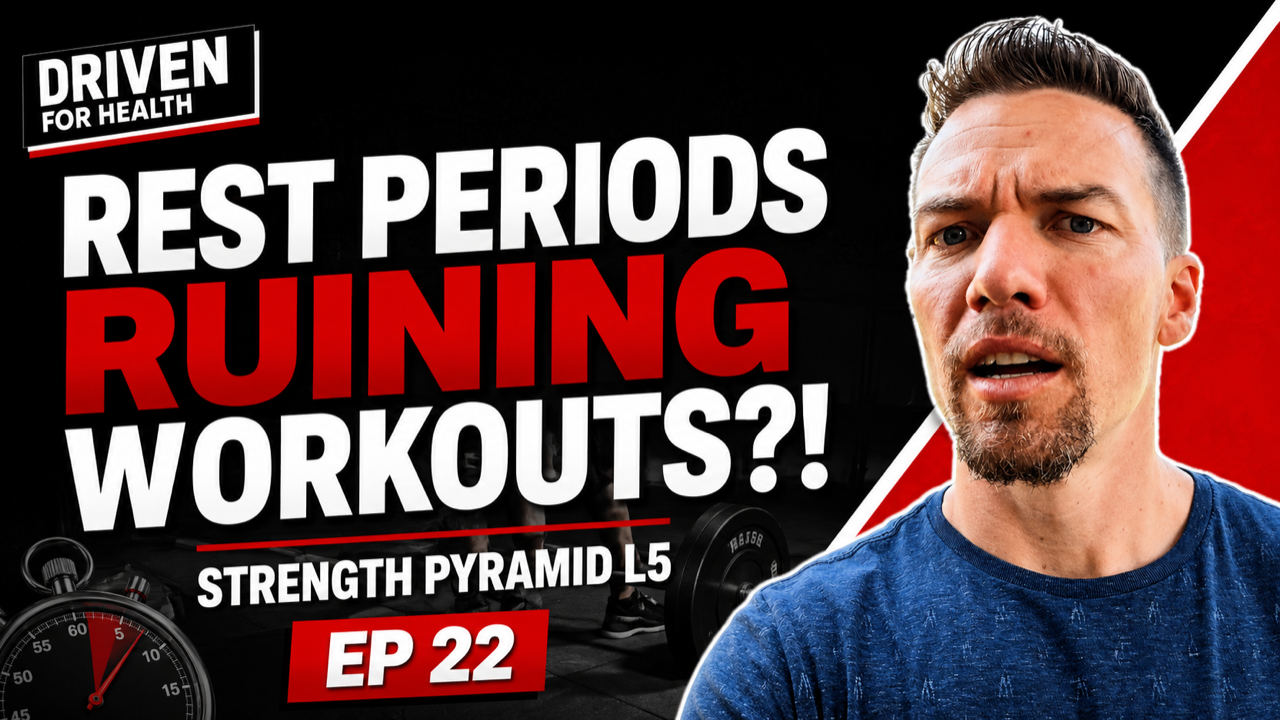
Most men feel guilty sitting between sets. That guilt is costing them strength. Coach Brian breaks down the real research on rest periods and gives you a clear system for knowing when you are ready to lift again.
Summary: Short rest periods do not build more muscle. Research cited in this episode shows that cutting rest too short reduces total training volume and can harm your strength gains. Coach Brian Parana explains how long to rest between sets, how to use antagonist supersets to save time on upper body days, and which lifts should always get full recovery.
The Rest Period Myth That Is Hurting Your Training
Textbooks still tell you to rest 30 to 60 seconds between sets for hypertrophy. Some coaches still teach it today.
The research does not support this recommendation.
That advice came from studies conducted in the 1980s and 1990s. Those studies found a correlation between short rest periods and higher growth hormone levels after certain training protocols. Researchers concluded that shorter rest must produce more muscle growth.
That conclusion missed something important.
Growth hormone rises in response to training stress. It does not cause muscle growth in normal physiological ranges. When researchers studied people injecting high doses of growth hormone, hypertrophy did not increase. So the strategy of cutting rest short to spike growth hormone is built on a faulty premise.
Coach Brian uses a clear analogy in the episode. Ice cream sales and murder rates both climb on hot days. That does not mean ice cream causes crime. The temperature drives both outcomes. The link between short rest and muscle growth follows the same pattern of mistaken correlation.
What Short Rest Does to Your Training
Shorter rest does increase metabolic fatigue. That much is real.
The problem shows up in the next set. You return to the bar before recovering and lift less weight. You get fewer reps. Your total training volume drops.
Total volume is one of the main drivers of muscle growth. Cutting rest short reduces volume. That can set you back on the goal you are chasing.
A review co-authored by researchers Menno Henselmans and Brad Schoenfeld examined the existing evidence on rest periods. Their finding: there is no requirement to shorten rest for hypertrophy. Cutting rest too short can harm the loads you subsequently use and reduce your overall session volume.
The performance-guided approach is simple. If you can match the same weight and reps from your previous set, you are ready to lift. If your numbers drop off quickly, you did not rest long enough. Let the quality of your next set tell you when to go.
For most men, two to three minutes between big compound lifts works well. For accessory work, one to two minutes is typically enough.
When to Work During Your Rest
There is one scenario where doing something in your rest interval makes sense.
Research supports antagonist paired sets (what many lifters call supersets). These pair muscles that oppose each other, not muscles that do the same job. The distinction matters.
Examples of effective pairings: - Bench press with rows - Overhead press with lat pulldowns - Leg extensions with leg curls - Bicep curls with tricep exercises
When you pair opposing groups, the muscle you trained during the first exercise gets active recovery while you train the other side. Studies show performance on the main lift does not drop with this approach. In some cases, you can perform more reps when you return to the first exercise.
The time advantage is real. You stay productive instead of sitting between sets. Upper body sessions that would otherwise run long can be structured much more efficiently.
An upper body session using this approach can look like this:
Start with bench press paired with rows. Complete all sets for both. Then move to chinups paired with overhead press. Complete all sets for both. Finish by pairing biceps and triceps work throughout all remaining sets.
You hit the same volume in less time, with performance staying high.
Listen to the full breakdown here: https://podcast.brianparana.com/rest-periods-are-ruining-your-workouts-strength-pyramid-level-5-22/
The Lifts That Need Full Rest
The antagonist superset approach breaks down with certain movements.
Squats, deadlifts, and heavy lunges should not be paired with another exercise during the rest interval. Any lift requiring full-body stabilization falls in the same category. Research shows that adding work in the rest interval of these movements harms performance on the main lift.
A barbell squat with the bar on your back is a full-body stabilization task. The demand on recovery is fundamentally different from an upper body movement. Accumulated fatigue from a secondary exercise carries directly into the next squat set.
Use antagonist supersets for upper body training. Squats, deadlifts, and similar full-body movements need complete rest. Start each set fresh.
Where Rest Periods Sit in the Strength Pyramid
This episode covers Level 5 of the strength pyramid Coach Brian has been building throughout this series.
The earlier levels set the foundation: - Level 1: Adherence. Consistency beats chasing the perfect plan. - Level 2: Volume, intensity, and frequency. Your total workload and how it relates to muscle growth. - Level 3: Progression strategies. Matched to your training age for efficient gains. - Level 4: Exercise selection. Movements that support both strength and physique goals.
Rest periods sit at Level 5 because they matter, but less than the levels below. Getting them wrong can undermine the more fundamental parts of your training. Getting them right protects your performance and makes your sessions more productive.
What to Take Into Your Next Session
Give your body enough recovery to hit the same weight and reps on your next set. For big compound lifts, two to three minutes is a solid target. For accessory movements, one to two minutes is typically enough.
For upper body sessions, pair opposing muscle groups to save time without losing performance. Press with pull. Bench with rows. Overhead press with pulldowns. Arms together.
For squats and deadlifts, rest fully. These movements demand it.
Related Episodes
- Episode 23 covers exercise tempo, the next level in the strength pyramid.
- Episode 21 shows what structured training combined with the right nutrition system can produce: How John Lost 50 Pounds at 60
Take the Next Step
Direct CTA: Call To Rise
If you want a training and nutrition plan built around a 40-plus body, Call To Rise is Brian's 100-day group coaching program for men 40 to 60. The 12 men who have completed the 100 days averaged 25 or more pounds lost. Andy lost 38 pounds in 100 days (Episode 53). Mike lost 17 pounds and 12% body fat (Episode 113).
The guarantee: lose 20 or more pounds in 100 days, or Brian keeps working with you until you do.
Apply at www.thecalltorise.com.
Health Hot Seat
Have a specific question about your training or fat loss? The Health Hot Seat is a free live group session where Brian answers questions directly. Join the next session at go.brianparana.com/healthhotseat.

CEO l Head Body Tranformer
Brian Parana is a men’s health coach with 23+ years of experience helping busy professionals improve their body, energy, and day-to-day habits while still leading at work and at home. His coaching is built around practical nutrition, training, sleep, and accountability, with a plan tailored to the person in front of him.
Over the years, Brian has helped thousands of clients through his work as a personal trainer, CrossFit gym owner, and online coach. He has also coached an Olympic silver medalist, a 2-time Olympian, and a CrossFit World Champion.
Brian is the host of the Driven For Health Podcast, where he shares real-world strategies for men who want to feel strong again and stay consistent without making health a second job.
He’s also the creator of The Call To Rise, a 100-day fat loss experience for driven men who want to drop 20–30 pounds, boost energy, and rebuild confidence through strength training, personalized nutrition, and high-accountability coaching. Many men join because their blood pressure, cholesterol, or blood sugar is heading the wrong direction, and they want a clear plan that fits real life.
Brian is married to his high school sweetheart, Amber, and they have four kids. Their family has traveled to all 50 states and 4 continents, with a goal to reach all seven.

What To Order At Dessert Restaurants For Fat Loss



 YouTube