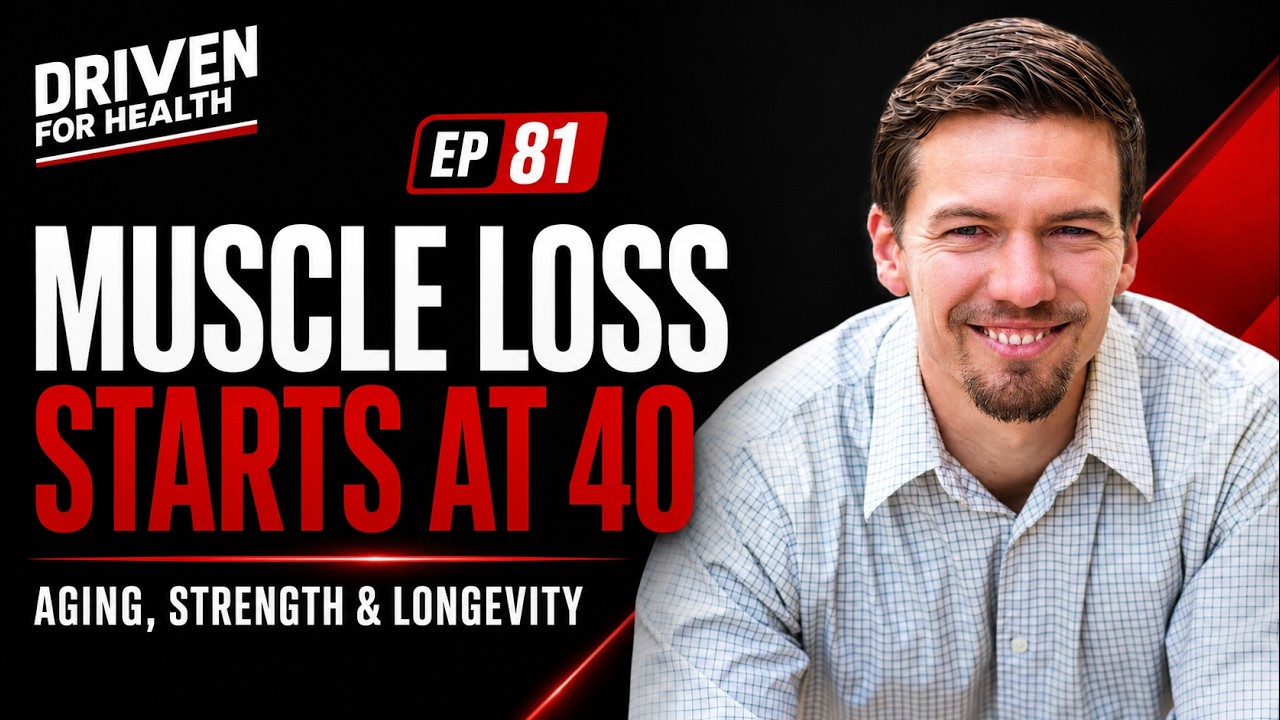
Muscle, Aging and Longevity: What the Science Says for Men Over 40
Sarcopenia is the word for what the scale keeps hiding from you. Coach Brian pulls the numbers on how fast muscle goes after 40 and lays out the protein and training that slow it down. Episode 81 also covers a nursing home study that resets what most men believe is still possible at any age.
You can hold the same body weight for ten years and still feel different in your own body. Softer through the middle. Slower to recover. That is a change in body composition, and Coach Brian Parana built this episode to translate the research on muscle and aging into what a man in his 40s or 50s can act on. Listen to Episode 81 for the full breakdown.
The research comes from the published work of Dr. Brad Schoenfeld and Alan Aragon. Coach Brian is a coach and not a doctor. Nothing here is medical advice.
The Loss You Cannot See on a Scale
Sarcopenia is age-related muscle loss. Starting around age 40 the average person loses roughly half a percent of muscle mass per year. At 50 the rate picks up to one to one and a half percent annually. At 60 it accelerates to around three percent per year.
By the time you reach your 60s, somewhere between 10 and 20 percent of the population already has medically diagnosable sarcopenia. That means measurable weakness and reduced physical function. That is one in five people your age.
A man can hold the same body weight from 40 to 55 and trade muscle for fat the whole way through. Same number on the scale and a different health profile underneath it.
Coach Brian uses a truck engine to make the point. Drop from an eight cylinder to a six cylinder and the truck still rolls down the road while pulling less weight. Skeletal muscle also conducts fuel use across the body, so glucose handling and insulin sensitivity connect back to how much of it you carry.
When Muscle Loss Starts
Most men assume this belongs to old age. The literature shows muscle degradation beginning as early as the early 30s, which lines up almost exactly with the sedentary years that follow college.
Almost nobody gets a DEXA scan along the way, so the trade between muscle and fat never gets measured. People in their 30s and 40s who are sedentary are sometimes biologically older than fit and well-fed people twice their age.
Walking the dog and gardening and taking the stairs all help your day and none of them counteract muscle loss. Resistance training is the tool that does.
The Nursing Home Study
A researcher named Maria Fiatarone went into a nursing home where the average age of the subjects was 90. She had them do leg extensions three days a week for eight weeks.
The average increase in strength was 150 percent. Functional capacity went up 50 percent. Three of the ten subjects were able to walk without the assistance of their cane.
You are not 90 and you have decades ahead of you. At your age the research points to measurable increases in muscle size and real strength gains, plus better insulin sensitivity and blood markers.
Muscle Is an Organ and Not Decoration
Coach Brian describes muscle as a secretory organ. It produces myokines, substances released into the bloodstream that act across multiple systems. Some reduce chronic inflammation and others support insulin sensitivity.
Type one muscle fibers handle endurance. Type two fibers handle strength and power, and type two is what is most at risk as you age. Losing that fiber means losing the ability to produce force quickly, which is what you need when you trip and have to catch yourself.
Roughly 50 percent of people who break a hip at that age never regain their full functional capacity. Six more months of skipped resistance training means more of that fiber gone.
Why the Same Inputs Stop Working
Anabolic resistance is the name for what changes next. As you get older your body becomes less efficient at building muscle from the same inputs. A younger person might build muscle effectively with 20 grams of high-quality protein after training. An older man often needs nearly double that for a similar response.
Coach Brian compares it to a thermostat that has been turned down. The heating system still works and you have to push the dial further.
Resistance training is the primary lever here and it pulls harder than protein does. Muscle scans of people who trained consistently for life often compare favorably at 60 and 70 against sedentary people in their 20s.
What the Research Says About Protein
The standard RDA is 0.8 grams per kilogram of body weight. That is the floor for basic survival and nowhere near what an older man needs to preserve or build muscle.
The research points to 1.6 grams per kilogram as the target for most people who are actively training. For a 200-pound man that lands around 145 grams of protein per day.
1.2 grams per kilogram is the realistic floor once you are training. The range for most men sits between 1.2 and 1.6 grams per kilogram, trending toward 1.6 with consistent training.
In a calorie deficit the number goes up, with some studies putting it closer to 2 grams per kilogram in certain conditions.
Timing matters less than most men expect. Total daily protein is the primary driver, and three quality protein meals a day covers most men.
Coach Brian's coaching standard is 150 to 200 grams a day, then individualized from there. Episode 70 covers getting a real share of that in before lunch.
How to Train for This
The minimum effective dose for healthy aging is two to three days per week of resistance training. About 30 minutes per session. A few sets of multi-joint movements like rows and presses and squats and hinges.
Rep range is the most misunderstood variable. Whether you lift a weight you can move for 6 reps or one you can move for 20 reps, the muscle growth response is close to identical.
Effort is the variable that carries the result. Your last few reps need to be genuinely difficult to complete with good form. When Coach Brian pushes men past their comfort zone, most of them say they have never trained that hard in their life. Most were already training.
Under 60 seconds of rest between sets starts to compromise muscle development and above 90 seconds there is not much added benefit. Anywhere from 90 seconds to two or three minutes works. Short on time? Superset opposing muscle groups like chest and back. Episode 22 goes deeper on rest.
Training to absolute failure on every set is not required, and on heavy squats and deadlifts it raises injury risk. Save the hard pushes toward failure for machine work and isolation exercises.
Moderate cardio is not a threat to muscle for most men. Do your resistance training first in the session.
Recovery and the Three Supplements With Real Support
The most common recovery mistake is not a missing supplement. It is too much volume piling up with not enough rest built in. If you are sore all the time, look at your training load before you look at a label.
Three supplements have meaningful research behind them for men over 40.
- Creatine monohydrate at five grams per day. Roughly 20 to 30 percent of the population are non-responders.
- Omega-3 fatty acids at two to three grams of combined EPA and DHA per day. The research shows improvements in muscle protein synthesis and reductions in inflammation and strength gains in older adults.
- Vitamin D3 at one to two thousand IUs daily. Deficiency is common in older adults and affects musculoskeletal function.
Cold plunging is the one to watch. Cold exposure decreases muscle protein synthesis and reduces muscle development. An occasional plunge will not ruin your progress. Making it a daily practice around your training is a poor trade when muscle and strength are the priorities.
If You Are Taking a GLP-1
These medications suppress appetite, which is how they work. Suppressed appetite often means suppressed protein intake and reduced training capacity. Men on these drugs forget to eat and forget to fuel, and their gym performance drops.
The muscle loss risk on a GLP-1 is real and underappreciated. The drug handles the calorie reduction and you have to protect the muscle. Episode 123 covers this in full.
Your Three Number Scoreboard
- Daily protein grams. Track it every day for two weeks until you know where you stand.
- Resistance training days per week. Not cardio and not walking. Two to three is the minimum.
- Waist circumference once a month, which tells you more about body composition than daily weight does.
Start this week by tracking protein for three days and getting two resistance sessions in.
Cross-episode links
- Episode 18: How Much Should You Lift and How Often
- Episode 70: 5 High-Protein Breakfasts for Busy Men
- Episode 123: Why GLP-1s Are Costing Men Muscle
Call to Action
The free Lose 3 lbs in 3 Days plan is a three day starting point. Get it at thecalltorise.com/lose3lbsin3days.
The Call To Rise is Coach Brian's 100 day program for driven men who want their health at the level their career is already at. Most men lose 20 plus pounds. What is included:
- An individualized meal plan
- An individualized training plan
- Weekly round table calls with the group
- 1:1 calls with Coach Brian
The guarantee is one sentence. Lose 20 or more pounds in the 100 days, or Coach Brian keeps working with you until you do. Apply at thecalltorise.com.
Frequently Asked Questions
What is sarcopenia?
Sarcopenia is age-related muscle loss. Starting around age 40 the average person loses roughly half a percent of muscle mass per year. At 50 that rate picks up to one to one and a half percent annually and at 60 it reaches around three percent.
When does muscle loss start in men?
Earlier than most men expect. The literature shows muscle degradation beginning as early as the early 30s, which lines up with the sedentary years that follow college. Sedentary people in their 30s and 40s are sometimes biologically older than fit people twice their age.
Can you build muscle and strength when you are older?
The research says yes. Maria Fiatarone put nursing home residents with an average age of 90 on leg extensions three days a week for eight weeks. The average increase in strength was 150 percent and three of the ten walked without the assistance of their cane.
How much protein does a man over 40 need?
The research points to 1.6 grams per kilogram of body weight for most people who are training, which is around 145 grams a day for a 200-pound man. 1.2 grams per kilogram is the realistic floor. Coach Brian's coaching standard is 150 to 200 grams a day, then individualized from there.
How many days a week should a man over 40 lift?
Two to three days per week at about 30 minutes per session is the minimum effective dose for healthy aging. Build the session out of multi-joint movements like rows and presses and squats and hinges. Walking the dog and gardening help your day and do not counteract muscle loss.
Does rep range matter for building muscle?
Far less than effort does. Whether you lift a weight you can move for 6 reps or one you can move for 20 reps, the muscle growth response is close to identical. What matters is how close to failure your last few reps land.
Which supplements have real research behind them for men over 40?
Three. Creatine monohydrate at five grams per day, with roughly 20 to 30 percent of the population being non-responders. Omega-3 fatty acids at two to three grams of combined EPA and DHA per day. Vitamin D3 at one to two thousand IUs daily.
How do you protect muscle while taking a GLP-1?
Raise the priority on protein and resistance training rather than lowering it. These drugs suppress appetite, and suppressed appetite often means suppressed protein intake and reduced training capacity. The drug handles the calorie reduction and you protect the muscle.

CEO l Head Body Tranformer
Brian Parana is a men’s health coach with 23+ years of experience helping busy professionals improve their body, energy, and day-to-day habits while still leading at work and at home. His coaching is built around practical nutrition, training, sleep, and accountability, with a plan tailored to the person in front of him.
Over the years, Brian has helped thousands of clients through his work as a personal trainer, CrossFit gym owner, and online coach. He has also coached an Olympic silver medalist, a 2-time Olympian, and a CrossFit World Champion.
Brian is the host of the Driven For Health Podcast, where he shares real-world strategies for men who want to feel strong again and stay consistent without making health a second job.
He’s also the creator of The Call To Rise, a 100-day fat loss experience for driven men who want to drop 20–30 pounds, boost energy, and rebuild confidence through strength training, personalized nutrition, and high-accountability coaching. Many men join because their blood pressure, cholesterol, or blood sugar is heading the wrong direction, and they want a clear plan that fits real life.
Brian is married to his high school sweetheart, Amber, and they have four kids. Their family has traveled to all 50 states and 4 continents, with a goal to reach all seven.

What To Order At Dessert Restaurants For Fat Loss



 YouTube