Vitamins, Minerals, and Water: The Fat-Loss Basics Men Over 40 Skip - 7
You hit your calories and your macros and you still feel drained. Coach Brian covers vitamins and minerals and water, the third level of the Nutrition Pyramid. You learn why food that looks healthy can still leave you short on nutrition. He also shares his own top supplement picks and his hydration tips.


 YouTube
 You can train hard, track your calories, and hit your macros perfectly and still leave results on the table. Coach Brian says vitamins, minerals, and water are the silent drivers most men skip.
(Does your food look macro-friendly but still leave you drained? See what might be missing.)
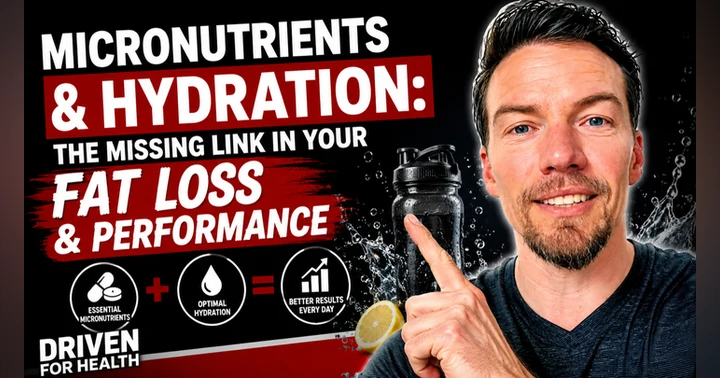
Coach Brian covers the third level of the Nutrition Pyramid, micronutrients and hydration, and why most men in their 40s and 50s unknowingly sabotage progress by eating foods that look healthy but lack real nutrition. He explains the difference between macro and micronutrients, the key vitamins and minerals your body relies on for energy and metabolism, and the electrolytes that actually matter and how to use them. He also shares his own top supplement picks and hydration tips.
By the end you will have a stronger nutrition foundation that makes your training actually work for you.
Main Topics:
- The difference between macronutrients and micronutrients
- Key vitamins and minerals your body relies on for energy and metabolism
- The electrolytes that actually matter and how to use them wisely
- How to build a diet that supports real recovery, not just macros
- Why macro-friendly foods can still leave you undernourished
- Coach Brian's top supplement picks and hydration tips
Join 30 Tips in 30 Days, a free daily email plan with one practical tip to help you eat smarter, move better, and build routines that actually last.
go.brianparana.com/30days
Want help applying this to your own health, weight, energy, or lab numbers?
Coach Brian Parana offers Health Hot Seat coaching segments for men who want a clear next step with nutrition, fitness, weight loss, blood pressure, cholesterol, A1C, or daily consistency.
Learn more about The Call To Rise, a 100-day coaching program for driven men over 40 who want to lose weight, improve their health, and rebuild confidence:
To connect with Coach Brian:
brian@brianparana.com
Disclaimer: This podcast is for education and coaching support only. It is not medical advice. Always work with your physician before changing medication, treatment, or medical care.
- You could be working out, counting calories, and hitting every macro. But if your body is starving for vitamins and minerals because you're eating poor food options, you're leaving your results on the table. Most men don't even realize how much potential they're missing out until it's too late. I'm Will and I kept telling myself there was always a better time to get in shape, to lose the weight, to take my health seriously. I kept putting it off.
- Work, family, life, you know, those daily things. Then one day, I realized it had been almost 20 years since I felt really in shape. I was tired every day around 3. My energy was low during family time and I knew something had to change after I finally caught myself telling my kids I'd get to them later.
- That's when I joined the call to rise 100 day challenge. In just 3 months, I dropped 27 lbs, gained back my energy to show up for my family, and finally have pants fitting. Almost weighing in close to what I was in high school, but with more muscle. I just wish I hadn't waited so long. Welcome back to Driven for Health podcast, episode number seven.
- Pretty cool to have gotten here in less than two weeks. We're here to help you high performing men over 40 take control of your health, energy, confidence, your body, get it back in shape. And I'm Coach Brian Prana. And today we're diving into the third level of the nutrition pyramid for muscle and stacking these levels up.
- In the last two, if you haven't caught up to where I'm at right now, in episode five, we talked about calories. Episode six, we talked about macros, macronutrients, protein, carbs, fats, and today it's on micro nutrients. We've already covered those big pictures of the energy balance, rate of weight loss, which is, you know, losing weight, maintaining weight, gaining muscle.
- Then the macronutrients in episode 6. So, if you didn't get a chance to listen yet, please pause this one and go back to at least episode five for calories and number six for macros. But now it is time to get into the details that can make a huge difference in your health and performance. Today we'll talk about the vitamins, minerals your body actually needs, how to make sure you're getting them, and why something as simple as water intake can impact everything from your workouts to your energy levels.
- By the end of this episode, you'll know exactly how to make your diet work smarter, not harder for your body, for your goals, for your life. Eventually, we'll get to the lifestyle and behavior piece, which is extremely extremely important, but we'll save that for the last episode in this series. Today we're talking about something right in the middle of that pyramid.
- The micronutrients, vitamins, minerals, water intake. Now, I know a lot of people get caught up in the m those macros and the the proteins and carbs and fats. So, this is a chance to zoom in on the smaller stuff. But don't let the name fool you. Micro nutrients are still essential for you. So, let's set the stage.
- Macros verse micros. Big verse small. Pretty simple, right? You need macronutrients in large amounts. Grams is how they're measured. Sometimes hundreds of grams, especially say carbohydrates. If you're a really active male, a good size weight with a lot of muscle mass, you could easily put 200 g of protein, 3 400 carbs, and 100 grams of fat in your day.
- That would fuel your body. But the micronutrients, small, much smaller amounts, milligrams, maybe a couple grams at most in a day. Say sodium is 2,000 milligrams or two grams. That's not a lot. If you salt your food, you most certainly are getting a lot of grams of salt on top of the food processing and the food naturally and also on top of the natural sodium that food has in it as well.
- But just because the numbers are smaller doesn't mean they're less important. Micronutrients fall into two categories. Minerals and vitamins. Minerals are inorganic. They're literally on the periodic table. That thing back in seventh grade you probably learned, maybe sixth grade, depending on what school you went to.
- Yeah, that thing. Vitamins are organic and they come from plants, animals, or synthesized in small amounts by our body. Let's start with minerals first. We have macro minerals which we need for our body in larger amounts. Things like calcium. Most people know this is for bones and teeth.
- But it's also critical for muscle contraction, nerve signaling, blood clotting. If your calcium is low, not only can your bones weaken over time, that would be say osteoporosis, but your muscles may cramp more easily. Who listening in has the middle of the night calf cramp that shoots them right out of bed screaming? It could be calcium.
- Or the next one we have is phosphorus. Works closely with calcium to bind and build strong bones and teeth. It's a key player in energy production. Think ATP. What we're talk about ATP, it's a really fast acting burning. Think you're going to sprint. You're just going to take off. 3 2 1 go.
- And you start running, sprinting. Your body uses ATP. And that is the the ATP is also the energy currency of your cells. Without enough phosphorus, your energy metabolism may suffer. Third on the list, we have potassium, an electrolyte that helps regulate fluid balance, nerve signals, and muscle contractions. It's the anti- cramp mineral, and also helps keep your blood pressure in check.
- Potassium, bananas, bananas, and uh during a run to keep from cramping, right? We've heard that time and again. Sulfur part of some amino acids. It's essential for building proteins. also important for joint health, skin, hair, nails. You don't hear about sulfur much, but it is quietly essential in your diet. Sodium.
- Everyone knows about sodium, right? Another electrolyte that helps us regulate fluid balance, nerve impulses, and muscle contractions. It often gets a bad rap, but without enough of it, right? Because everyone say don't eat too much sodium, that's what we're referring to there. But without it, especially if you're sweating a lot, you could experience fatigue, dizziness, poor performance.
- My son did a marathon last weekend. It's been one week and what, three, four hours since he finished the Akran Marathon. and a time of 3:32 at 16. I was blown away at his speed and endurance and the way he looked and his just his go- get him attitude. But we talked about having sodium throughout the race and having electrolyte drink beforehand and making sure that he was eating afterwards and even during the race for sure.
- You have to eat if you're going that long. You absolutely have to eat something. Next up is chlorine or chloride. It works handinhand with sodium to maintain fluid balance, proper pH in the body. It's also part of stomach acid which is obviously helpful for digestion. Now, magnesium involved in over 300 biochemical reactions in the body. That's a lot.
- That's why you hear about magnesium supplements and all muscle relaxation. People use magnesium to help sleep, nerve function, energy production, bone health, you name it, it's probably doing something for you. And low magnesium equals muscle cramps, poor sleep, even mood issues. So, we will see magnesium recommended as a sleep aid to help with getting you sleep, keeping you asleep.
- Now, you notice that those are just a few electrolytes that tie into water intake, and that's important to make sure we're drinking, and they are trace minerals, which we need in smaller amounts, and they're just as important. So, these are some of the smaller ones. Iron, iron carries oxygen to the blood via hemoglobin, right? It helps translate that.
- So our tour to France cyclists would do all sorts of stuff with hemoglobin to help blood oxygen transportation so they could produce high power outputs for a long time. It'll help you keep you from you feeling fatigued, weak, your workouts will suffer if you don't have enough iron. If you're anemic, right, we've heard that term before.
- You might need to take an iron supplement or eat more red meat and a variety of other heem and non-heem type iron foods. Cobalt most important part of vitamin B12. Supports red blood cells and nerve health. Copper helps with forming red blood cells. Supports your immune system. Aids in iron absorption. Helps with energy. Zinc for immune function.
- Right? We always I remember back in the day my mom if I was had a sniffly nose we'd had zinc tablets and I would take some that was always the thing. Right now we take emergency in our house right now. It also helps with wound healing and hormone production. Testosterone as an example for our guys.
- Manganesees supports bone health function and formation. energy, metabolism, antioxidants, iodine, rounding out the last two. So, iodine is for thyroid hormone production and regulates metabolism. Low iodine can lead to sluggish metabolism and fatigue. Now, iodine will be usually paired up with sodium and salt to help keep people healthy that way and not have issues with it.
- selenium and antioxidants healthier around oxidative stress there. There's plenty more, but those are the ones that you probably heard as well. Now, we're going to jump into the vitamins and kind of go through theirs, what their roles are. Vitamin A supports vision and cell growth, immune function.
- Vitamin D helps your body absorb calcium and phosphorus, which is again going back to the bones. This is the sunshine vitamin because your body produces it when exposed to sunlight. And if you're not in sunlight, then you need to take a vitamin D K2 supplement. Vitamin E, a powerful antioxidant that helps protect cells from damage.
- It helps with the immune system as well. Has a role in skin and eye care. And you'll see vitamin E inside lotions, vitamin K, blood clotting, and bone health. And if you didn't have vitamin K, enough of it, your body can't effectively use calcium for bones, which then can cause more problems with say osteoporosis.
- And now we have water soluble vitamins here. And those were fat soluble ones. These are water soluble. We have vitamin B1, B2, B3, B5, B6, B7, B9, B12, vitamin C. Okay, I'm not going to go into too much detail of the B vitamins, but they help with eyes, skin, nails, helps with energy production, helps your body convert food into energy, helps with your DNA repair, brain health. There's a lot of things.
- And then vitamin C is a when you're sick, you always get more vitamin C. It's a powerhouse for the immune function in your body. That helps quite a bit. Now before we wrap up with vitamins mineral section here in this micronutrients talk we're going to go over things that we don't think about every day which is food fortification fortified foods in say cereals and different things that our companies put into our food.
- Now fortifying food is basically when vitamins and minerals are added to the foods and that don't have them naturally and uh you know don't have enough to meet daily needs if if you're not eating healthy. This is perfectation just everyone. Some little history here, just did some research, but iodine was added to table salt in the 1920s to prevent goer, which is a swelling of the thyroid that was pretty popular back then.
- It was common and it's one of the first and most successful examples of how pairing the iodine with sodium allowed for uh the humans in general to have less issues. Some examples of fortified food are breakfast cereals, milk, salt, orange juice, margarine all to be examples of that. Now, they do really help fill nutritional gaps, especially if our modern diet isn't doing it or soil depletion could be hard to find some of those micronutrients or you're just not getting whole foods and everything's in a box or a package.
- Now, one thing to note is bioavailability is the body's ability to absorb vitamins and minerals from fortified foods is different from whole foods. Okay, that's super important. Whole foods usually come with fiber, antioxidants, and other compounds that support absorption and overall health for your body, your hair, your skin, your nails, digestion, energy, all these things.
- So, when you think of fortified foods, it's a safety net. It just covers our bases in a sense. It's not a replacement for fruits, vegetables, lean proteins, for other nutrient-dense food. We can't skip that. We've talked about the cart before the horse thing. This is the horse is the real whole foods. The cart is supplemental to the micronutrients of fortified options there.
- Now, the key takeaway is even if your macros are perfect, if your micro nutrients are off, say low sodium, your performance is going to suffer and you're not going to recover as well or fast either. So, we've covered a couple bases on vitamins, minerals. Hopefully, made it through there. It's not the most exciting thing, but certainly have to cover in our hierarchy of our nutrition pyramid.
- But let's talk of some supplements that can fill the gaps, especially if you're super busy, you're running around, you are eating this, that or the other, and we want to make sure that we can have some supplements, supplemental as an insurance policy to make sure that the body gets what it needs. First and foremost, we've got multivitamin.
- The good old Moles vitamins been around for a long time. This thing covers all the micronutrient gaps that you might miss in the diet alone, especially say water soluble vitamins like the B complex or the vitamin C things that we just went over. You take it. A minimum dose is one that covers at least 100% of your daily value.
- And with these, what happens is you actually will pee them out if you get too much. You don't really have to worry about o overdoing, especially water soluble vitamins. Some recommended brands that you'll see across the internet would be Thor. Basic nutrients two a day. It's a high quality bioavailability. That's important too.
- And then clean ingredients. That's what they are known for, right? A very healthy supplement that is backed. Now, another one would be Adam's men's multivitamin. It's affordable. It covers all your bases. We can find these things on Amazon for sure, or just on the internet. And if you needed to, you could always run down to GNC and get the good old Mega Man or a men's one a day just to cover your bases. Now, another one, electrolytes.
- Really easy to add. We've seen a huge influx of things like element, drip drop, liquid IV to name some more popular ones on the market. And these things support hydration, helps with your nerves function, your muscles function, right? Low electrolytes. Say you've ran a long time, and now you're depleted and you can't run anymore.
- Your muscles don't want to work, especially if you're sweating a lot or it's super hot. Today we had a cross country meet for my second son. It was warm out there. My daughter had two soccer games. First one was just fine. And the second one, the heat, the sun was out and it was warm.
- I went from pants and a jacket this morning to shorts and a t-shirt. And that's what you get in fall weather in Ohio. Now, some of the supplements, they help maintain potassium, magnesium, sodium, chloride levels. Now we want minimum doses are going to be about sodium about 500 to,000 milligrams during intense exercise.
- Think an hour straight going hard for the higher end of that. Potassium 200 to 400 milligrams per serving. Mines and magnesium. Magnesium about 200 to 400 as well. And again, we can find these in stores everywhere or online. For these recommended brands could be nun, nu, a sports tablet. You just pop it into the water, it dissolves. Very convenient.
- You can take them anywhere. You could do the element that is LM NT or the liquid IV, but I quite honestly those are over a dollar a stick these days for one serving, which is isn't unreasonable per se, but if you look at emergency, it has so many more vitamins and minerals, especially way more than Gatorade.
- I wouldn't do Gatorade. There's a reason why Gatorade was so popular because it had sugar in it. It had those carbohydrates and those Gators would be drinking Gatorade early on in their football games and then the second half they had more energy because of the carbohydrates. Not necessarily. There's just not that much potassium and sodium inside that beverage.
- It's going to be driven more by the sugar in it itself. how we make sure our diet has what it needs. How do we do that? Well, here's where I want to talk a little bit about the mindset. Something that you've may or may not know. Things called if if it's your macros or flexible dieting. I think I shared once before in one of the episodes earlier about flexible diet.
- It's probably the first one to be honest. first episode. I really enjoy flexible dieting. That approach makes so much sense. And flexible dieting has been great because it allows people to enjoy their food while hitting their macronutrient targets. But here's the catch. Sometimes people use it as an excuse to eat anything to hit their macros.
- Pop-Tarts, candy, highly processed foods that might help them hit their numbers, but they're missing some of the micronutrient density foods. On the flip side, you've got the old school bodybuilders who eat only chicken, broccoli, and rice. They're highly restrictive and definitely can be micronutrient deficient as well. So, what's the solution here? Well, we want to shift from exclusive to inclusive thinking.
- And you want to include foods rich with micro nutrients, vitamins, minerals, vegetables, leafy greens, nuts, seeds, starchy carbs without cutting out all the foods that you enjoy. And that's where the balance is. I'm huge proponent of balance, moderation, flexibility into my life. And I use that to help coach other people figure out how to put flexible dieting approach into their life.
- Let's look at breaking some of these things down. Say getting some fruit and vegetables. Love getting at least one, two, three pieces of fruit in a day. Having vegetables. If your calorie intake is, say, you know, 1,200 to 2,000, I'm going to have you eat ideally a lot of fibrous carbs as vegetables. Think of salad toppers, cucumbers, tomatoes, peppers, onions, cauliflower, carrots, those type of things.
- I'm going to have you try and eat two, three, well, probably more like 3, four, five cups at a meal at least three times. Have one, two, three pieces of fruit. If you're at 2,000 to 3,000, then you have a lot more calories available. And then we're going to have to start eating more starchy carbs and fats.
- And if you're super duper active, then at 3,000 plus calories, you're going to have to eat a lot more starchy carbs and fats. I'm watching my 16-year-old Levi mow down food like crazy. I mean, he is just a a garbage pit these days. Uh he eats potatoes straight up. Just just he'll eat five in a day. They're about baseball size roughly, maybe plus or minus, but those are the average size of them.
- Now, is this low carb or not? And ideally, we're sticking to volumetrics. Those choices, volumetrics is how much volume of food can I eat for low calories. Things like berries, they give you so much more fruit for the amount of volume of calories and carbohydrates. And the benefit take away from berries, especially blueberries, blackberries, raspberries, they're super high in fiber.
- Six grams or so, seven grams in a cup. That's even better than strawberries that say two or three in a cup. They're so good. They they keep you full. They're low calorie. They have all those rich colors in them that give you micronutrients that you want for your body. And you'll be more likely you'll eat more. and then you'll be able to stay within your macros.
- But let's move into so water. So you have electrolytes and micronutrients, but let's talk about some water. Hydration is always got to be part of taking better care of yourself. And this is the level of the pyramid that it's at. And we can count all your fluids. It doesn't have to necessarily be exclusive to just water, but we do want to have a lot of water.
- And sorry, alcohol can count toward your water intake. Now, a rough guideline, 2/3 of your body weight in pounds in fluid ounces. Example being if you weigh 210 lbs, that's about 140 fluid ounces per day. I'm a big fan of doing men over 100 ounces for real simple or we have even a gallon. If you are sweating and doing high intensity exercise, then you might need more than a gallon.
- That's for sure. All right. Now, you should be going to the bathroom three, four, five times a day. And your urine should be clear most of the time, if not all the time. We don't need to be going to the bathroom nine times a day. Certainly, if you pace out 100 ounces across 16 hours with 8 hours sleep, that's only 6 ounces of fluid per hour.
- That will not send you to the bathroom all the time. But humans don't drink just little sips all day long. They usually skip hours and then they have to gulp it down. That ends up being big challenge. then it definitely will keep you up at night and you will feel that quite a bit. Now even if this is something so important about hydration is even if even if you just lost 2% of your water from your body weight that could definitely cause some significant performance issues.
- Hydration does matter. a nun or a element or a liquid IV if you're doing something hard and just make sure you're drinking adequate amounts of water along the way. Wrapping up our level three of the nutrition pyramid is going to be minerals with whether they're macro or trace minerals.
- We went through two different types vitamins fat soluble and water soluble. We've got the diet mindset whether we're we don't really want to always do just if it I fym if it fits your macros and just eating pot-arts to just hit your targets. We do want to have whole foods. We don't have to just exclusively eat whole foods. we can find a balance and that's the undertone of what I always coach people through fruit and vegetables and cups per day based on say the amount of calorie ranges there but again I'm always going to tell you to eat three four cups of
- vegetables at a meal that will keep you full and manage calories super duper easy and water intake we just went through that if you get this right on top of dialing in macros you've got a huge portion of your nutrition dialed in. Now, the the micronutrients may be small, but they have a big impact in how you feel, how you move, and how your body operates on under the hood, so to speak.
- I'd like to share that this episode is brought to you by the call to rise 100 day fat loss challenge. The program is designed specifically for busy, high performing men, fathers, husbands, dads, guys that just are ready to take their bodies back, boost their energies, and step into the peak confidence of themselves.
- They don't want the belly. They don't want their suits not bidding. If you've been telling yourself there's always a better time to get in shape, the truth is the best time is now. Tomorrow is always tomorrow. Today, do something to improve yourself. Over the next 100 days, we'll guide you through a proven system of strength training, even more importantly, nutrition, personalized nutritional approach, and radical accountability to do the things you know you need to do.
- This will help you get 20 plus to 30 pounds of in the next 100 days. Get your confidence back, get your nutrition dialed in, and get it to work in the every day of your life. Easy stepby-step direction led by yours truly to get the results that you want. That's it. You want to look better, feel better, this is it.
- Visit the calterrise.com to get started and finally take control of your health today. Well, there goes the end of the micronutrients and level three. Let's go into our fast five portion. I really enjoy doing this one. And it's just fun to get to dive into some really quick rapid fire questions and answers or get to know me a little bit better.
- Some of these are today I have in front of me or some get to know me a little bit better. Question number one, what's the one habit you wish you started 10 years ago? Well, you're listening to it. I wish I would have started a podcast sooner. I would run and listen to him and never even had a thought in my mind that I would have one one day.
- As I continue in my career, I realized, hm, this is really good way to speak my truth and help a lot of people quickly. And that's why I'm here. So, I hope you get tons of value out of this. I've done seven in about 10 days. So, I've been rapid fire to get this thing launched up and create a lot of momentum. I hope you enjoy.
- Number two, if you could give one piece of health advice to your younger self, what would it be? Just put in the work, younger Brian, even if you don't want to that day. That could be something as simple as exercising or just studying back in my high school days or playing my clarinet. I was I played the licorice stick.
- That's how I met my wife actually back in sixth grade band on Fridays at Elllet High School. So, uh, play the clarinet a little bit better. Put in the work. That's a huge piece of advice that then leverages your health, especially getting to the gym or going out on a run or doing something like that. What's number question number three is, what's your go-to quick energy boost during a long day? I posted this on my Instagram in the last week. I really enjoy this combo.
- It's a low-fat cottage cheese with oats, berries, protein powders, chia seeds. I whip it together with splash of oat milk. Tastes amazing. Super fast, high protein, very filling for say four, five, six hours if I needed it, too. And that within five minutes, I'm almost done with it. Super fast. Question number four.
- What's your guilty pleasure that you actually enjoy in moderation? Well, I won't lie. I do like craft beer and the darker the better. Stouts, porters, the ones that have really rich taste to them. I really enjoy those. Now, I don't really drink a lot. I will have them socially and I will have them. There's my alarm. I have so many alarms.
- When you have four kids, you just always have alarms going off so you remember to do things. All right, now back to the beer. I enjoy beer. I will drink it socially. I'll have one, maybe two. I don't really I don't like getting drunk in a sense because there's always repercussions on the back end. And they say alcohol is borrowing tomorrow's happiness because tomorrow you might wake up and not feel well.
- Question number five. What's the one result you notice first when you're consistent with your training and nutrition? I'm not going to lie, inner confidence is the first thing I noticed. There's a little bit more abdominal definition. I just feel like I stand taller. And that look, that feel in my body gives me energy.
- I can just really just Oh, if I lose an extra percent body fat, oh my gosh, the the increase of energy is incremental. It's that's that's it. All right, guys. That's a wrap to today's dive into micronutrients, water, how to make your diet work smarter for your body, and ultimately your goals. Remember, it's not just about hitting your macros.
- If it fits your macros, it's about making sure that your body actually gets the vitamins, the minerals, hydration that it needs to perform to the demands that you put on it to recover and feel that unstoppable body. A lot of you haven't felt that way in a long time. If you want to get a little more actional tips that level you up with your health, your energy, your fat loss, I have a 30 tips in 30 days email sequence.
- For the next 30 days, you'll get specific scienceback tips to help you make progress and stay consistent. They're super easy to implement. They're not complicated. I am here to make things as easy as possible for every person I ever work with. So, 30 tips in 30 days. Even if you only did 50% of them, you'll be so much better off that way.
- Look in the show notes for that link and subscribe. Love to see you and take you through that journey there. And of course, if you are ready to take action and get your body back, guys, the calltorise.com. I post regularly, people making progress every single day in my stories, on my posts. It's legit. I'll be actually having some interviews in the future episodes as well, sharing real guys stories on their progress.
- Over and out. Off we go. Thank you much.