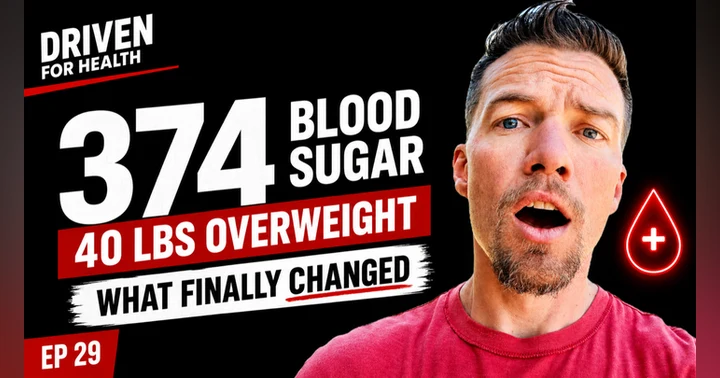
374 Blood Sugar and 40 lbs Overweight: How He Turned It Around at 40+ - 29
Brian Nase was waking up five or six times a night with a thirst he could not quench. A blood sugar reading of 374 led to a Type 2 diabetes diagnosis. Coach Brian talks with him about the warning signs most men brush off. You will also hear why his first approach backfired and how he eats now.


 YouTube
 Brian Nase was waking up five to six times a night with unquenchable thirst. A blood sugar reading of 374 turned one late-night bathroom trip into a full wake-up call.
(Have you brushed off warning signs as just getting older? See what Brian's body was actually telling him.)
Coach Brian sits down with Brian Nase, a former restaurant operator who spent 30 plus years working long hours before a Type 2 diabetes diagnosis changed everything. Brian shares the early warning signs most men shrug off, how he dropped nearly 40 pounds in 90 days and got off medication, and why his first approach actually backfired. He explains the 90/10 whole-foods rule that lets him enjoy holidays with family without losing control, and how a 10-hour eating window helps his body recover instead of staying in constant feed mode.
By the end you will know the early signs to watch for and a real approach to reversing them before they become a crisis.
Main Topics:
- The early warning signs of diabetes most men shrug off as just aging
- How Brian dropped nearly 40 pounds in 90 days and got off medication
- Why his first approach to fixing it backfired
- The 90/10 whole-foods rule for enjoying holidays without losing control
- How a 10-hour eating window helps the body recover
- Why his diagnosis led him to start a coaching business with his son
Brian Nase is a NASM Certified Personal Trainer and Nutrition Coach who reversed his own Type 2 diabetes and now runs a father-son training business, Time Tension PT.
Connect with Brian on Instagram, Facebook, and TikTok: Time Tension PT
Want help applying this to your own health, weight, energy, or lab numbers?
Coach Brian Parana offers Health Hot Seat coaching segments for men who want a clear next step with nutrition, fitness, weight loss, blood pressure, cholesterol, A1C, or daily consistency.
Learn more about The Call To Rise, a 100-day coaching program for driven men over 40 who want to lose weight, improve their health, and rebuild confidence:
To connect with Coach Brian:
brian@brianparana.com
Disclaimer: This podcast is for education and coaching support only. It is not medical advice. Always work with your physician before changing medication, treatment, or medical care.
- You you don't have to be a slave to medication. We all should be managing our health like we all have diabetes. >> It is reversible people through nutrition, through an active healthy lifestyle. >> My A1C was 117. Again, what normal between five and six is where they like to see it.
- He said, "Okay, here's what we're going to do. We're going to put you on metformin. That is, you know, the most typical drug that they give you for diabetes." Then he wanted to put me on leinipil, which is the high blood pressure medication because that was also a part of the the equation. He wanted to do statin drugs. I refused those.
- And if God's going to take me now, then good. That's what the deal was. I'm not taking the statins. I'm like, so if you want to be my doctor, you're going to respect that wish. And he's like, all right, no problem. He said, listen, take these medications, then uh try and lose some weight. That was it. That was the whole >> Hello everyone today.
- Welcome to Driven for Health. I'm Coach Brian Piranha. On today's episode, I have a colleague. This is a must listen. Gentlemen, you do not need to have a serious chronic illness wake you up. But for Brian, unfortunately, it did. It's been actually a blessing in disguise because of some of the changes that he has made since his diagnosis.
- We'll certainly jump into it. We are often told that as we age, metabolism slows down. and pills pile up. If you have that pill box next to your bed of with a MTW T Monday, Tuesday, whatnot, you're doing life wrong. We should not be doing that. Brian, my guest, is living proof that you can change your life. He went from waking up five times a day, not just feeling like he was old man bladder at 80, but he literally ended up unfortunately getting diagnosed with type two diabetes, which caused a big intervention into his life. His whole
- family jumped in and it's actually been a family affair. We'll dive in. He gained his life back. He's launched a new career and at age 56, he feels younger than ever. We're going to go through this fantastic story of his the the call to the adventure of the diagnosis to the victory of losing weight initially to having unforeseen issues and challenges come up through to now he is in some of his best life.
- Brian, welcome to the show. Let's start off. What is the big impact that the last couple years have had on your life and where you're what's led you to where you're at right now? >> Well, Brian, thank you for for having me. I appreciate it and I'm looking at I'm looking forward to really telling the story.
- The one thing that I think I want to say to everybody and start off with is that you you don't have to be a slave to medication. Uh I'm not advocating that you don't listen to your doctor or take the medication, right? That's super super important. But for the last really 8 to nine years uh with having managed diabetes uh type 2 diabetes with no medication still still not on it still not on the blood pressure medications. Yeah.
- Those are things that >> it really took a a change though. >> It's funny. I say this all the time. You've heard the saying, well once you have diabetes, you can't get rid of it. Well, that's kind of true because you really do have to manage it. But I say to people all the time, the truth is we all should be managing our health.
- Like we all have diabetes. >> Yes. >> That'll make more sense later on when I when I talk about different things. So I think that's super super super important. >> Totally totally totally. I've dealt with I've been doing this for 23 years. I've had my share fair share of pre-diabetic type 1 type two diabetics I've worked with.
- It is reversible people through nutrition, through an active healthy lifestyle, through understanding the mechanics of the food that you put in, the environmental factors that are in your everyday life, stress, how you treat yourself, and how you treat your schedule. Let's jump in. Take us back to we obviously we talked a little bit before this, but take us back to where you just kept waking up and you were super thirsty.
- Did you have any idea what was going on or were you just ignoring the signs and the symptoms or what? >> That's a perfect uh intro to this cuz um I wasn't ignoring anything. I had no idea what was going on. My wife intervened. You need to go to the doctor. Okay. Um I I I'm not a big doctor guy. I don't like to go. So most people don't. Okay.
- I go She gave me this little list of all the questions I was supposed to ask, right? All right. So, I go to the doctor. This is the first time I've been in this doctor's office. Of course, I'm filling out the paperwork like normal. I'm sitting there and I'm waiting and waiting. About 30 minutes later, the nurse comes out with a cup and she's like, "We'd like for you to do, you know, your analysis.
- " I'm like, "Well, that's a little strange for my first visit, but okay, I did it." >> Then I'm waiting a little bit longer. Then finally, I'm admitted into the waiting room. I'm in there for 40 minutes and now I'm getting now I'm getting mad because I'm going this guy doesn't respect my time as much as he respects his.
- I'm thinking this is the last time I'm gonna see this doctor. >> So lo and behold he walks into the room and he's like hey Brian how are you but I'm fine. Said listen I'm here because my wife sent me I got this list I got supposed to ask questions. He looks me square in the eyes and he goes put the list away.
- He goes you got bigger problems. >> What do you mean? And he goes, "Based on your urine alone, you're pre-diabetic or full-blown diabetic." >> Unfortunately, then >> further testing, then they did the blood work that my blood sugar was 374. >> What's normal? Just so everyone knows what's a normal range. >> That's between 80 and maybe 90.
- >> 110. If you're at 150, you just ate >> to give perspective for people. >> Yeah. So my A1C was 117. Again, what normal between five and six is where they like to see it. >> Yep. Soon as you get six people, then you are definitely classified as a pre-diabetic or even type 2 diabetic. And it's something to really take seriously.
- And unfortunately, 11 is very high. It's not the highest I've heard. I've heard 15 A1C. >> Oh my lord. >> And 400 plus blood sugar levels. Holy moly. Right. Uh, real quick before we keep moving, what were some of the initial signs, symptoms just so that if someone's listening in and they are actually experiencing these things, it's a warning sign, not just, oh, I'm old and I just wake up, haha, go to the bathroom.
- What are some of the the situation where you're say your your your height, your body weight, your the the all those things that are signs that there is bigger problems? >> Yes. Number one, the weight. you mentioned that that's super important. I was about 40 pounds overweight >> and this is the key, Brian. This is really important that I was carrying that weight >> easily for 20 years.
- >> Okay, >> so this is a key proponent. It's really important to understand. Yeah, this doesn't happen overnight. It's not one of those things where all of a sudden you wake up diabetic. That that that's not it. It takes uh I say it all the time. It takes practice to get to get there. >> It's marathon in a sense because it's not going to happen overnight.
- And as you're constantly training our body to respond in a certain way >> and and diet to do diabetes was the way you were training it unfortunately. >> That's that's yeah for sure. So some of the other symptoms was that frequent urination throughout the night that was just miserable. I couldn't sleep. And then the worst part of it, believe it or not, was the unquenchable thirst.
- >> I can't I can't even describe it to you. No matter what you do, if you drink something, you usually can say, "Okay, well, I'm better now. I'm good." >> Right? >> It was awful. It was like I wasn't drinking anything. >> That was [clears throat] probably the worst part. >> That piece of it is probably So, that's a big warning sign there, too.
- >> I was tired, feeling fatigued all the time. Those are pretty much if you if you're feeling those things and you're out there listening right now, it's time to go to the doctor, >> right? Get your >> Don't waste another minute. fact sometimes also rapid weight loss is a sign of diabetes too because you just don't know what's happening.
- You're like, "Oh, I'm losing weight." It's not because you change your your lifestyle in a sense, but that is just another factor to pay attention to. If you are listening in and there are sudden changes that happen and occur that way, you should go see the doctor. And we'll just throw that tagline in. We're not medical professionals and you should consult a doctor about your own personal health and needs around that.
- Let's let's have a quick conversation about what what's your wife's name? >> Kelly. >> Kelly. How did Kelly intervene here? Cuz wives definitely can do that, right? >> Yeah. She just knew I was miserable and she's like always on me about going to the doctor. You don't have a choice. You're going. Okay.
- If if you've been married like we are over 30 years, you listen to what you're told sometimes. And those are the things. >> I I'm a 19 in and I have been with my wife. I've known her since I was 11. >> We've been around each other for a long time. And yeah, >> she what she says usually goes cuz she's smarter than me and thinks things through a little bit more than I do.
- >> I understand. >> All right. Now, let's get into some of the So, you back to the doctor's office, right? What were some of the the diagnosis? What was the say medicine prescription that you're going to take away from there? And then the implications of what you felt leaving the doctor's office and how life was going to change from that >> right >> time.
- >> Well, here's the thing. At that time, I was clueless. Clueless. I was scared. I didn't know what was happening. He said, "Okay, here's what we're going to do. We're going to put you on metformin." And that is, you know, the most typical drug that they give you for diabetes. And then he wanted to put me on leinipl, which is the high blood pressure medication because that was also a part of the the equation.
- And he wanted to do statin drugs. I refused those. And I just did because I I'm like, look, this is bad. And if God's going to take me now, then good. Then that's what the deal is. I'm not taking the statin drugs. if you want to be my doctor, you're going to respect that wish. And he's like, "All right, no problem." >> He said, "Listen, take these medications.
- " He goes, "And then uh try and lose some weight, >> right?" >> And that was it. That was the whole that was the whole thing. And like, so now I again, I don't know what I'm doing, >> right? >> As like a former high school and college athlete, well, let me get my bike out. Uh, I'll start riding like crazy. I was doing a 100 miles a week on my bike.
- I said, "Okay, well, I'm going to go ahead and do a strict vegetarian diet." As it turned out, I didn't realize that um it really was more of a vegan diet. I cut out all animal products, all dairy products. >> Gotcha. >> And went crazy. I mean, I literally was neurotic about it within >> real quick though.
- Real quick, we have to acknowledge that >> you've been doing this is is your career now, but people don't always take that action, right? They might find out that they have lung cancer and they keep smoking, >> right? It's literally I've had clients that I've talked to. So wait, you >> wait. So this and this and this doesn't make any sense, right? And naturally, you think that they'd stop.
- So kudos to taking massive action, right? That is a huge >> thing for people to hear and understand is he got diagnosed. He did not accept that as truth and what he wanted life to become or be like actually acknowledging that awareness factor of like I am a type two diabetic. He didn't want to claim that identity.
- So he went in a different way and certainly there are better ways maybe to go about it. He'll continue to share but the point is that he changed. He made a huge effort and made an impact. So continue Brian. Okay. What happened? >> So yeah. So, after about like a about 120 days, I had been to the doctor once before this 100 day period.
- And I had lost about 35 lbs. And the thing about it was the doctor looked at me, he goes, "In my lifetime as a physician," he said, "I've never never ever seen this happen before. My A1C was down to a 5.2. my sugar levels were normalized and my blood pressure was absolutely normal. He's like, I have to take you off the medicine >> because you can't stay on it anymore.
- I'm like, oh, well, that's a that's a good thing. I'm like, so that's great. >> And how much weight did you lose at that point? >> About 35 almost 40 lbs. >> Okay. >> Almost all of it. I went from 230 and I now is hovering around 190 now. >> Okay. On paper, the doctor, everyone's, wow, you're doing so good. >> Correct.
- But it doesn't necessarily sound like it was >> great for you. >> No, because then you you go to work and everyone's praising you and how how awesome you look and it's amazing what you've been able to do. You're feeling pretty good about yourself. I certainly was. >> But then, interestingly enough, let's fast forward two years.
- I said, "It's time. I got to get some life insurance for my family so they could be protected." I knew I put a little couple pounds back on again. The insurance company sent over a nurse practitioner and they took my weight, you know, blood blood the whole deal, right? >> It turns out I end up I ended up being denied >> for the insurance.
- I'm going what >> what happened? Well, I gained about 20 pounds >> because it was I stopped paying attention to, you know, monitoring my blood sugar. All of a sudden, now my A1C was 8.2 again and it was over 200. Yeah. And again, so why did this happen? Well, when it when that happened, this there's got to be another way.
- I still really didn't understand the diabetes. It was almost like I felt it was a thing that happened to me and not a and not I didn't realize it was something I did to myself. So, I went back and I tried to read everything I could possibly think of and find and get my hands on about what is this all about? And I come I came to understand that you know insulin resistance is really the disease and I say that all the time.
- It's like people think that it's high blood sugar. Actually the high blood sugar is the symptom of that underlying problem which is insulin resistance. Right >> from there that's >> Can you define that for people? >> So sure. So insulin resistance is basically when your cells want to actually take glucose out of it out of your bloodstream so that it can use it as energy.
- Well, over time if uh through poor diet, lack of exercise, those cells become damaged. And when that happens, the the actual the insulin that's supposed to allow that to your cell to open up and allow glucose in so it can be used, it doesn't do it effectively anymore. So what happens is now you have elevated elevated blood sugar cuz it can't get in >> and it can't be used that is diabetes that's where the blood sugar >> right >> listen in people he's giving you a very distinct problem understanding that the high blood sugar levels are a symptom of
- your body not being able to absorb and have to constantly release more insulin, which then dulls your receptors and your hormones and gets your body really out of whack and not a good way. >> Exactly. That's why they say the disease never goes away, >> right? >> Because if you don't address that, then that stays that way.
- You have to heal yourself from the inside out. That's where that again the journey began there and understanding that I have to reverse this insulin resistance problem. That's where the resistance training comes in and and actually eating differently so that the body starts going, "Wait, this is good.
- We can use this stuff that we're getting now and we're going to fix this problem." >> You got the insurance denial that woke you up again. And so, what was the shift that happened from that point? It sounds like you chose a different route than you had done in the past to lose weight. >> Yeah. So what I what I because of what I researched I unders started to understand that although cardio activity is really really good for you and we always will say that but it's good for your heart it's good for your lungs it's actually for me it's good for my head
- going out for a walk and riding my bike those are things that make me feel great emotionally so those are all super super great benefits but what I did and the that cardio created such a calorie deficit when I was riding a 100 miles in a and caused the the rapid weight loss. Yeah. It lowered my blood sugar.
- It actually improved my insulin sensitivity because, you know, I probably went from around, I don't know, 2500 to 3,000 calories a day was what I was eating. And then with that shift in the diet and the the riding, I was probably down to like 800 calories. This was a huge shift. That was not a good thing because then all of a sudden now my body's slowing down.
- my my BMR slowed down, metabolism slowing down, and then all of a sudden now here I am gaining weight back again because I figured, well, you know, I didn't even eat a lot. It felt like I didn't go back to my old ways, and I didn't, but I didn't need to. >> So, that was a a big that was like the shift then was to go, how do I how do I eat differently? How do I maintain a certain amount of calories that are good for me and uh can help improve the insulin sensitivity? One of the things was eating more protein and making sure
- that that was a part of what I was doing. So, wow. Okay, maybe animal products have to come back in, right? Because it did. And so, >> protein, >> why do I care about that? Well, we know that the protein helps us build muscle. The the link there is is the more muscle mass you have, the easier it is for your body to actually absorb that glucose into your muscles.
- >> Yep. This is important because it >> in your belly people muscle you eat food carbohydrates blood sugar goes up your body releases insulin and it stores. It's constantly storing and releasing fat and storing releasing carbohydrates. But when you do this right, you use your muscles as a gas tank and it's like gasoline going into the gas tank.
- You take those extra carbohydrates and blood sugars you ate and it gets stored in your muscle to use because you just worked out recently in the last, you know, day or less. And then you're going to move your body some more and you're constantly using the gasoline. And you're never putting too much gas into the system in the first place to overfill the gas tank, which is what obesity is.
- is people are putting too many calories in their body more than man and it's just literally overflowing the you filling up your car and just letting the the gasoline pump run and just shooting gas everywhere. That's that's not it. So what Brian is saying is that you eat, you get stored in muscle and then you can use it for more exercise and then it doesn't get stored on your belly or your butt.
- >> Yeah. It it has that lowering effect of the blood sugar. So when you don't have these huge amounts of insulin, well really sugar and then insulin in your system, the body can start to heal itself over time and that's what actually was starting to happen. So that's an important piece of this puzzle if you are trying to correct this problem >> that that's a big part of it.
- Your diet and exercising properly with some resistance training is a big piece of it. Again, cardio is awesome. I I love it. But at the same time, it's got to be it's got to be a mix of the two or three, I should say. >> Definitely. Definitely. So now you are on to something, right? The you're changed your ways. You've learned.
- Everyone has immediate instant access. We are all living like kings and queens of 500 years ago. You have instant access is what to whatever you want. We just need to use that for our own personal gain or personal health and not just attention seeking and being the consumable product on the other end.
- And that's what a lot of people do. They just scroll and scroll and scroll. But so what's shifted for you in your life now as a result of having the diagnosis in the first place and then I guess lack of better phrase kind of getting slapped again like hey you didn't learn your lesson the first time with the insurance but now it seems like you did.
- So what's transpired as a result of all this? >> Well I can't imagine now living my life any differently. So yeah, obviously it took some time, but the reality is is that I don't want to go through that anymore. It was awful. It was really not it was not a fun experience. Eating the right way, you you learn to to love food again in a different way.
- And it's funny because growing up in an Italian family, I remember it was an insult if you didn't have seconds. It really was. You were insulting your grandmother. This is horrible. I don't want to insult anybody, right? >> But but those are really horrible behaviors. That's not the way I eat anymore.
- I've learned to enjoy the food, all all foods. And that's really really important. Yeah, that's a big shift because it's not doesn't happen overnight. It actually happens pretty quickly, but it doesn't happen overnight. When you start eating a balanced diet, again, a whole foods diet, a really important part of this whole thing.
- That's where the big that's where the big shift is, >> right? That is huge. At the young age of 56, you are now moving in a different direction with your career, with your family. What's come of this challenge that you've had and now you're in some of the best house you've been in the last what 15, 20 years? >> Yeah.
- The biggest change for me is just a career change. As a matter of fact, in July of this year coming up, I will be completely out of the restaurant business. I've started a business, a coaching business, both a personal training and nutrition coaching business with my son Vincent who's a Florida State graduate. Uh, this is like so exciting and and I'll tell you what for me what's super exciting is that when you have children, and I think everyone relates to this, is that you do everything you can to make sure that they're okay and they're healthy and you say, "What can I do?"
- You give them a better life. And so now I'm looking at it, what's the one thing I can do for Vin to help him out? And the truth is it's like my whole life I've worked really hard making money for somebody else, this is it. This is the chance for him to own his own business and become an entrepreneur. And I feel like if if I can do that for him and he he gets it, man, then he has the freedom in his life to do whatever he wants.
- And that that would be like one of my greatest accomplishments. So, I'm excited about this this uh journey with this business with him. >> That's awesome. And that's how we met. We're colleagues through business coaching and growing our businesses. That's one reason why this podcast even exists of an extension of, okay, how can I do more? How can I give more? How can I >> bring really good information, sciencebacked information, and get people to actually do it? Because information is great unless you don't do anything with it. It's it's just in one
- year out the other >> and and that's where this evolution has and you're going to be living some of the best years of your life and experiencing. I have a 16-year-old son, Levi, and I I admire that this is what you're doing with him and he has he's ran a marathon already. He's raced an Olympic distance triathlon and he's a swimmer and he definitely has say the the the endurance and the capacity and the the excitement to pursue what his dad's doing.
- So, I need to keep developing myself and my business and capacity to be able to help bring him in and do what you're doing. And it's a really cool uh role model and and what you guys are doing there now. If we could look at say some of the strategy knowing what you do know now, if you could speak to the diabetic or the 40 lb overweight version of yourself, >> what would you say? What is maybe one or two key things that you would tell them? How could you impact their life? >> Number one, a whole foods uh diet.
- Basically, if it walks the earth, if it grows out of the earth, you eat it. If it doesn't, don't. I use this 9010 rule. The truth of the matter, we got the holidays coming up, Thanksgiving, >> man. Do not deny yourself anything you want on Thanksgiving. Enjoy your family. Enjoy the food.
- Why? Cuz it's one meal out of 365 days in the year. It I promise you, if you're on a weight loss journey, it won't matter. >> It really, really won't. So, that's super important. And you follow that rule. The other thing is too is that you do the resistance training. You got to build the muscle. That is super super important. You don't have to go crazy.
- You don't have to go nuts. You just have to make sure you're consistent with it. So that's another piece of it. And the last part I will tell you and this is the one I work the hardest on is trying to get some sleep. >> Yes. >> Super super important. Right. So se seven to eight hours. I mean it's a ritual for me now.
- I know it sounds crazy but you got you almost I guess the older you get for me. No distractions. Phone gets off. The television's off. You lay there in the dark. I even used one of those silly little pillows on my eyes. Whatever it takes to get there. And the last part of it which helps me improve the insulin sensitivity is this timerestricted eating.
- >> Yeah. >> It's not to me it's not fasting. I know a lot of people say it that way. >> Yeah. Yeah. You and I are going to agree on this for sure. Is we can have some restricted time. A time that you eat and a time that you don't. And it gives great boundaries of when you eat. Go ahead. >> Yeah, cuz fasting to me is like if you if you um stop eating at 5:00 tonight and then don't eat until 5:00 tomorrow night, that's 24-hour fast, >> right? >> Timerestrict eating is if you wake up at 8:00 and you stop eating at 6:00, that's
- timerestricted eating. >> Exactly. >> So, there's a 10-hour window. And so, you we were not designed to eat all day long. >> Just because we have access to it, that doesn't mean it, >> right? >> It's the right thing to do. >> You've got to allow the body and your cells in particular to actually heal. You can't be in a constant state of digestion.
- The body has got to be able to recover and repair. And when you're constantly eating, it doesn't work that way. So, those are the strategies. And really, honestly, that's what you need to do. That's it. >> If you care about that part of it, and you say, I don't want to live like this anymore like it was for me, that's the things you got to do.
- And really, boy, life gets a whole lot better a whole lot quicker. And just even lastly, going back to say the timerestricted eating, I always like to to waiting at least 12 hours from your last meal to your first meal. That even goes back to the 1950s when don't eat after dinner. >> You eat at 6 or 7:00 and then you wake up at 6 or 7 and then you have in quotations breakfast.
- Well, that's a great thing. Having 12 or 14 hours is a very reasonable time to go overnight without food. You don't have to do what the internet says of a 16-hour, eight hour window. For me, I get hungry. I'm gonna overeat on that first meal, which then defeats the whole point because yes, people, you can have a 20hour fast and a 4hour window and still eat too many calories.
- Then not only are you over consuming calories, but you're over consuming carbs and everything and really just stressing your system in that small chunk of time because you haven't eaten anything all day. >> Excellent. Excellent. Well, Brian, this is awesome. It's so happy that you have >> woken up in a sense. Kelly called you out, got you to go.
- She obviously loves you, wants you to be around, and now it's transformed into a business with your son. Where can people find you? Certainly. This will go in the show notes. >> Sure. So, uh, you can go to Time Tension PT in Instagram or Facebook and even Tik Tok. So, that's the easiest place to find me.
- Uh, we'd love to see a follow there and hopefully someday too connect and and help anybody who's listening here today because I'd love to actually share some stuff and and see if we can't get you on the right track. >> Yeah. Awesome. Awesome. Well, thank you so much for changing your life to help encourage others.
- From a 374 blood sugar with going [music] to the bathroom multiple times to being overweight, it was a wakeup call that you needed [music] to change. And the biggest takeaway that people should hear is that you shouldn't wait for those signs to show up. If you are over 20 pounds overweight, you need to take action to start changing that because that develops like as he said training for diabetes in a sense of overeing and sitting and not moving [music] and having high carbs and stuff and if Brian can do it at his age and and anyone can do it and I'm 42 so I'm
- I'm starting to get up there and I want to make sure that I too and all my listeners are in some of the best health that they can be in the next 10, 20, 50, however much longer we can live. Right. Right. >> So, well, thank you for coming on to Driven for Health. I hope that the listener got a lot out of this and excited to have you have everyone listen to the next episode.
- Thanks so much for joining. Off we go. Thanks, Brian.