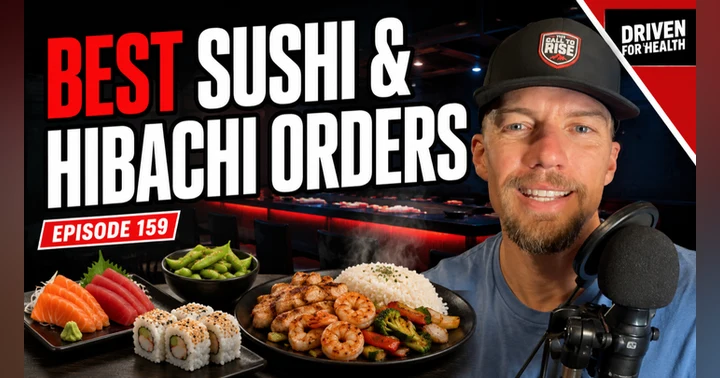
Coach Brian Parana (0:2.860) The crunchy shrimp roll in my eating on the go guide is about 580, maybe 600 calories. The shrimp avocado roll is roughly about 290. You can get these at the same restaurant, a sushi restaurant. We're talking about Japanese cuisine today, and that's important because when we are looking at this, what we'd consider healthy food. Coach Brian Parana (0:31.626) Is then we are really excited about understanding that sushi is healthy and can work really well for you. Now the other aspect of what we're going to be talking about today is hibachi. And hibachi can either way you can still end up over consuming and getting thrown off track, but hibachi might be where more damage gets done. Your order definitely feels healthy. Coach Brian Parana (1:1.068) Because it's not burgers and fries, you automatically think, hey, this is a better choice for me. But again, you can eat too many rolls, maki rolls, for example, that really start to stack calories, and that's how sushi will get you. It's not usually the raw fish that usually ends up being super healthy for you. It ends up being the other stuff, the lots of Coach Brian Parana (1:30.241) Extra calories that come from multiple servings, or we get the crunchy, and we'll talk about it here. But today we're talking about Japanese cuisine. I'm actually pretty excited about this. It's something near and dear to my heart. So driven for health. I'm Coach Brian Parana. This is episode 159 in the What to Order restaurant series. As I said, I love sushi and I eat it. Coach Brian Parana (1:58.603) As much as possible. I've actually used it as rewards for doing things in my business or whatnot. I've used that in other areas of my life. we'll go to sushi restaurants to celebrate birthdays, or my daughter and I will have a dad daughter date as well. And in in this situation, I do end up eating a lot of sushi. When I go to get sushi, this is a Coach Brian Parana (2:27.316) large amount that I will admittedly say that I consume and I enjoy it. And and I'll literally manipulate the rest of the day to make it work. And I would suggest you do too. I think the most I've had is seven, eight rolls in a sitting, but that ends up being about it for the day. I just don't really eat anything else. I think they roll me out of that place too. When I go to Coach Brian Parana (2:56.898) Different restaurants. Sure, I might have some edamame or miso soup, but I end up just going for the sushi itself. And I try not to have a lot of the extra things around it. Let's break this episode into two pieces sushi and hibachi. We'll start with sushi first and then move on to the other one second to help you figure out how to order and make this work for you. Coach Brian Parana (3:25.854) Sushi gets calorically expensive, not because of the fish, it's super lean, vegetables usually on it, it's low fat, unless you get something with cream cheese and avocado. But where it's the count of the rolls. Or if you have fried toppings, creamy sauces, and different things around that meal as to think of appetizers or dumplings or Coach Brian Parana (3:55.779) Different things like that, Rangoon rolls or wontons and such, these things start to add up. Now, sashimi ends up being a big win with just being the fish itself, and that ends up you can get a couple pieces of that and make it work out really well. You can grab an eating on the go guide. You can just go into the show notes and grab it. It's it's go.brianparana.com. Coach Brian Parana (4:25.026) /eatingonthego. I break down Asian cuisine. I break down Chinese cuisine. I break down all sorts of different fast food, fast casual, fine dining on the go at the gas station airport. And that's what we've been doing since episode 145, where we started off with Chipotle. So go grab it now, pause it and just go download it so that you have access to it. It's very in-depth and gives really, really good, actionable, easy things. Coach Brian Parana (4:54.370) Tactics tips for you to understand. All right. The crunchy shrimp roll can again, these are approximations, just to throw that out there. Right? This is an exact because every sushi artist, in a sense, that makes the rolls might make things subtly different with different amount of rice, vegetables, and whatnot. So Coach Brian Parana (5:20.038) The crunchy one, again, probably 500, 600 to 700, depending on what it is. And where an avocado roll can be under 300 calories, about 275 to 300. The Philadelphia roll can go about 350 to 400 calories. A spicy salmon roll, one of my favorites, about 250 calories. The spider roll, and there's so many different names for these things, right? So this is just a general roll. Coach Brian Parana (5:49.507) But that's gonna be about 400. And if you're noting the trend here, typical Maki rolls, the more basic ones are say 300 calories a roll. Whereas the more fancy dancy ones, they're gonna start climbing in calories to 400, 500, or possibly more if it's got a lot of crunchy decorations on it. The California roll is actually gonna come in pretty low around 200. Coach Brian Parana (6:17.782) And this is a good thing because you can e end up eating a couple of those and feel full without adding a lot of it. So let's break this down. A plain roll, something like a cucumber roll or a tuna roll can start 150 to 200. Obviously, a cucumber roll doesn't have much in it, like cucumbers, rice, and the wrap. Whereas the tuna roll can have the meat in it, and that's gonna be a little bit more at at the 200. Coach Brian Parana (6:46.520) So this is your base. So but the moment that tempura gets involved, added to the name, say shrimp tempura roll, and anything with a fried filling, you're gonna add 250 to 300 calories pretty darn fast. So 200 plus 250 is gonna be 450 upwards of 500, and that's how that's gonna work. It's a combination of the batter to make the crispiness. Coach Brian Parana (7:15.662) oil of the frying itself to make it crispy as well. And the other thing that you really have to pay attention to and most people don't is the sauce. It sauce costs calories. It tastes good. It makes say like yum yum sauce. That stuff is crazy high in calories because it tastes so good and they serve it on everything to make sure that you enjoy it. Coach Brian Parana (7:44.141) The cream cheese, a roll built around cream cheese, like Philadelphia roll, can run 120 to 180 calories, and it's gonna end up being a lot of fat, obviously. Then we put the drizzle, the spicy mayo that can add another 30 to 50 calories on top of it, and this is how sushi rolls stack. So the math of a loaded roll, let's break that down. It can start. Coach Brian Parana (8:12.322) 150 to 200 at the base level, the plain version. Add tempura, and we're at automatically at 450. Add cream cheese filling and we're at 550. Drizzle the spicy mayo on top or the eel sauce. That's now we're around 600. Just for that one roll. Eat two. Now we're at 1200. That ends up being a really heavy amount of food. Coach Brian Parana (8:40.142) How about another one? We've heard this one, dynamite roll. Now they they can be a lot of different things than dynamite roll, right? That's it's it's it's it starts off with a bang, right? every single Japanese restaurant will make something a little bit different there. So this is the one that I have found and and most common was imitation crab mixed with mayo, tempura, fried shrimp. Coach Brian Parana (9:10.476) Avocado, cucumber, and it's all rolled up and drizzled with spicy mayo, sweet eel sauce, and then there's fried shrimp inside and with the two sauces outside. And then it's tempured, fried battered. And when we get to the end of this thing, it's hard to ignore that. It tastes pretty darn good. But man, it's gonna be a seven, eight hundred calorie possibly in cost. Coach Brian Parana (9:40.097) A lot of calories, carbs, and fats, not so much protein. Right? Think about this too. Crunchy, crispy usually means fried. Dynamite means filled with creamy substance. And those are how we start to see it broken down, just like any other restaurant menu. Something says crispy on it, it's clearly fried, breaded fried. All right. It's just that's how they define it in the restaurant world. Coach Brian Parana (10:9.142) One more thing worth knowing about ordering raw fish. The FDA says previously frozen fish lowers the parasite risk of what could be in the fish itself. Now, freezing doesn't kill every germ, so cooked seafood ends up being the safest choice and the lowest possible risk of. Coach Brian Parana (10:37.780) stomach issues and whatnot. The other thing to pay attention to is the sushi grade. Doesn't i it's not a term recognized by the federal government that it regulates. Restaurants still have to follow state and local food rules, safety rules, and the label doesn't necessarily it's not made official as a a government grade the same way someone would assume. Another side note Coach Brian Parana (11:7.938) Wasabi in Japan is made from wasabi root. Wasabi in America is generally green horseradish. Just an FYI. Alright, just want to make sure that you're paying attention to that. And a tablespoon of wasabi can be like say 30-ish calories, something like that. Now, before we move into hibachi, one more thing that might top off the Coach Brian Parana (11:36.277) Sushi order is sake. A six-ounce serving of sake is about 230 calories. Alcohol has calories in it, it's usually seven grams per for or seven calories per gram. And that is something that my fitness files are gonna track alcohol, but we have to pay attention to alcohol. I've done a number of alcohol-related Coach Brian Parana (12:2.678) Episodes. I'll probably do another one at a different angle for you guys here at some point. But alcohol, in my belief, isn't necessarily the culprit of you not losing weight. It's usually the choices that you make when alcohol is involved because you just don't make good ones. All right, wrapping up the sushi. So, what are we thinking about? One, two rolls, some sashimi, maybe the miso soup, and some edamame. Coach Brian Parana (12:31.800) That could be a complete meal that can get you 800 calories or less, maybe be pretty filling for long enough and really enjoyable, especially if you eat them with the chopsticks, because yes, that's what you do in Japan. So when in Japan, you eat with chopsticks. If you want a tempered type roll, we just have to pay attention. All right, what is the calorie cost here? It's gonna be five, six hundred calories. And am I eating anything else with it? Coach Brian Parana (13:1.560) So maybe you could offset it with some sashimi, just pieces of fish, to help boost the protein there and keep the fat and carbs down. Moving into hibachi. Let's think of this. Who goes to the hibachi for the show, right? I do. I love that thing. We've got the onion volcano. It's the stacked onion rings that that light up with. Coach Brian Parana (13:29.976) fire because of the steam shooting out of it. And this that's fun. The chef is flipping shrimp tails off the grill and catching in his pocket or his hat. He's twirling around eggs. He's he's squirting things across the table in your mouth. So it's an entertaining piece of a time with you. And and they're trying also toss the chicken for your buddy to catch it. Coach Brian Parana (13:58.667) In in his mouth, right? So this show traces all the way back to a real restaurant, Misono in Kobe, Japan. There's a chef I'm gonna have to pass on his name, Shigeji Fujioka. There we go. Best attempts, right? But he started cooking right in front of the guests back in 1945. Coach Brian Parana (14:26.638) Turning the meal into entertainment in and of itself. And that is the birthplace of the hibachi itself. Rocky Aoki brought the idea to Japan and opened up the first Japanese type restaurant that in in New York City in 1964, Benihana. Right? We know that name, right? Benihana. Coach Brian Parana (14:54.914) helped popularize the whole theatrical style show and made it super popular. And w we have a we have a place near us called Wasabi that has sushi and it has the hibachi girls and we'll occasionally go there for birthdays and such. for a family of six, a hibachi can easily come in at like two hundred and fifty bucks. So for Coach Brian Parana (15:24.706) Getting meat, vegetables, and rice, like that's a a pretty steep price when we can make it obviously a lot lower at home. same thing with the Chinese takeout that I talked about the other day, with it just being like an eighty dollar deal, and they feel bad for me, so they end up giving me a discount when I come in and and bring out two bags of food. So for us, it's a special occasion, but is so much fun and the kids really. Coach Brian Parana (15:54.733) Love it. The show is distracting you from the amount of calories that are going into your rice and onto that hot grill. Butter, oil, everything gets fried. You have dipping sauces like the yum yum sauce. it gets all slathered up into the protein, the vegetables as well. And we're watching the the chef's hands and then. Coach Brian Parana (16:20.792) Ding ding gang dang gang and they're they're going really fast, banging and clanging with their utensils and spatulas and all. And this is how the the chef ended up divvying up the portions of whatever comes out. Now we went recently within the last couple of months, and the amount of rice that they bring out, too, it's like days worth of rice. We end up leaving and Coach Brian Parana (16:47.148) With multiple styrofoam containers for leftovers of just basically rice because they bring so much there. When we are looking to eat what they give us at hibachi, we need that protein first type approach. Chicken, shrimp, fish, tofu. If you're more vegetarian, plant-based, that's all good. And then the vegetables, of course. Coach Brian Parana (17:16.766) And we want to make sure that you try and get as many of the vegetables as possible because they will help to minimize the amount of calories coming from the buttery oiled rice that's going to be put on your plate, too. Now the chef will divvy it up however that they want. And there is the zucchini, onions, peppers, and stuff that we want to maybe say, hey. Coach Brian Parana (17:45.773) Bring it over here to my plate a little bit more, and that can actually benefit you a lot. Here's where we can start to save a little bit of calories here. Instead of doing the fried rice, we do steamed. Not as fun, but inside my guide, the fried rice can run 400 plus calories, and steam rice, a cup of rice is about 200. That is a significant. Coach Brian Parana (18:14.166) cost different in calories and carbs and fats. A 400 calorie serving of fried rice is gonna have probably 60 or 70 carbs in it with 10 to 20 grams of fat. Whereas steamed rice is just going to be 40 carbs and no fat because the oil or butter is where the fat comes from. Coach Brian Parana (18:40.520) As with all Asian cuisines, we do have the sauces like soy sauce. This is going to multiply your sodium on top of everything else that you've already been doing here. We do want to try and get the lower sodium soy sauce. That can be roughly 500 milligrams per tablespoon. So we have to be careful. That's the low sodium. Now the regular sodium can be double that. That's what Coach Brian Parana (19:10.190) That's honestly that's why it's so good. The yum yum sauce is about 150 to 200 calories and about 17 grams of fat for every two tablespoons. So this is think of it like ranch dressing for a Japanese. It's the easiest way to think about it because it is a lot of calories that add up pretty fast for you. And the the chef is going to be pouring that and serving it in on your plate as you go. So we have to Coach Brian Parana (19:40.587) there's a couple ways to go about this. Certainly we could say, hey, no butter, no oil, white rice only, please. We can totally make that request. Or we work around it in the day. We've we just know that there's gonna be a lot of carbs, fats, calories at hibachi. So we need to maybe do a protein shake, piece of fruit, a chicken salad at lunch, and that can hold us over a little bit to get to dinner and not be a [unclear]. Maybe. Coach Brian Parana (20:6.890) move some more so you burn some more calories and you can really enjoy the whole experience of what the hibachi has. And at the very end of this all people, you put the food in your mouth. So please don't overeat. Just take a portion of it, maybe a third to 50% of it, and then take the rest home. This will be your biggest calorie win and you can just eat whatever they serve you and not have to be special ordered Coach Brian Parana (20:35.842) Or anything like that. Coach Brian Parana (20:38.944) Other things here to it's not the a lightened up version. The typical American hibachi order is soup. You have the house salad with ginger dressing, right? It's this maybe a handful of lettuce, iceberg lettuce with this orange dressing on it. Then we have chicken and shrimp that you can pick from, either or you've got generally most of you end up. Coach Brian Parana (21:8.790) being able to get one or maybe both. sometimes steak is in there too, right? Steak, chicken, and shrimp, and then people will get whatever their specific one is that they ordered. We've got hibachi vegetables, the rice, and that's usually it. So add it up, a plate of this stuff is easily gonna cost you one thousand to fifteen hundred calories pretty quick. This is just before the sauce gets added in it. It's just Coach Brian Parana (21:38.509) The way that it's served. So bare warning for you. Some of the best orders that we can do. Let's go to the sushi side with just Japanese cuisine in general. Four pieces of salmon or tuna sashimi. We have a cup of edamame and one California roll-in side. That'll give you about five to six hundred calories and roughly say 50 grams of protein on average. That's a win. That will keep you full long enough. Coach Brian Parana (22:8.074) And check the box. And fiber coming from the edamame. On the hibachi side, we'll go with chicken and the shrimp because they're the lower fat versions. We will go with double vegetable, steamed rice instead of the fried, sauce on the side so you can dip and dab it, and ask for light oil on the grill. That'll come in about 700 calories. And about 50 to 60 grams of protein. So it ends up being Coach Brian Parana (22:36.722) Still a good compromise, and you can just again always moderate how much rice you put in your mouth. These are the best type of orders to have at this type of place. And I definitely want you to enjoy sushi and hibachi. They're so much fun and enjoyable and a unique experience to in comparison to a burger fried joint, right? I much would rather go to sushi place instead of. Coach Brian Parana (23:6.526) Most other places. So it ends up being a really good deal. Now, maybe you have a sushi joint that gives you specials at certain times of the day or different days of the week. Please hit them up. Right? Go in and do it, and that would be excellent as we go. Now, as we wrap up, again, we have a reminder that I have the eating on the go guide. go.brianparana.com/eatingonthego. Coach Brian Parana (23:34.339) You can check this out. It's again has all the things I just covered and more. It has all sorts of different cuisines. Go check it out, download it, use it today at and or at least at the very least at this next weekend or upcoming meal that you're gonna have out, whether it's a client meeting, a meeting out with the family, big entertaining on the weekend, or whatnot. It'll be a lot of fun. If you need help, thecalltorise.com. This is an implementation program to help. Coach Brian Parana (24:3.936) You guys get in shape, cut the belly fat, and start looking and feeling better than you have the last five to ten years. The goal is to lose 20 plus pounds in 100 days. Learn how to eat the right foods at the right times in the right amounts so that you actually fuel fat loss. Today I just talked with one of my guys. He travels, I don't know, he's he's about seven to eight weeks in. He's down 15 pounds already. Coach Brian Parana (24:31.362) While traveling at least three or four times, and then he's putting on a number of different events while he's got two different businesses that he runs, and this is working out for him really well. We found some really go-to meals when he's eating out, and he has very simplified meals when he's eating at home, which is awesome as well, because we don't want to have complexity. Coach Brian Parana (24:55.734) The whole part of what I do as a coach is simplify things and make it easier. So we get a walkaway understanding of a meal plan, a workout routine, a lifestyle that changes your habits, your behaviors for the long term. So check that out at thecalltorise.com. Just like the hat says if you're watching a video. That's it for hibachi sushi Japanese cuisine. And next up, we are going to be doing smoothies, a little Coach Brian Parana (25:25.214) Smoothie King or Robeks or any of that stuff with the green goddess or the the 800-pound gorilla peanut butter power protein shake or something like that. So look forward to that. And if you like the the the series, send me an email and tell me what you're learning, brian@brianparana.com, and even pass this on to a friend. That's it for this episode of Driven for Health. Coach Brian Parana (25:55.256) Train hard, eat smart, and I'll catch you in the next one.



 YouTube