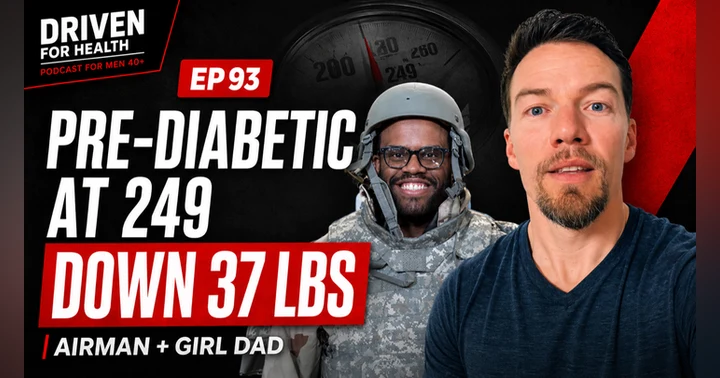
Pre-Diabetic at 249lbs: How an Airman and Girl Dad Lost 37 Pounds - 93
Danny serves in the Air Force and was over the weight standard at 249 pounds. He was at risk of being forced out of the service he loved. Coach Brian talks with Danny about the changes behind his 37 pound loss. He was already training hard in the gym. The fix was simpler meals and a plan for social eating.


 YouTube
 Danny serves in the Air Force and is a girl dad of two. He was over the Air Force weight standard at 249 pounds and risked getting forced out of the service he loved. Four months later he weighed 212 pounds and started training for a ruck marathon.
(Are the numbers on your last physical putting your career or your health at risk? See how men like Danny turn it around at www.thecalltorise.com.)
Coach Brian talks with Danny about the exact changes that took him from 249 to 212 pounds. Danny had already been hitting the gym hard, but his nutrition and mindset were working against him. He explains how he simplified his meals, handled social eating, and pushed through the body image pressure that comes with military standards.
By the end you will know how to build a plan simple enough to survive a busy schedule and strict enough to actually move the scale.
Main Topics:
- Danny drops from 249 to 212 pounds in about four months
- Facing the Air Force weight standard and the risk of getting forced out
- Working out hard in the gym while still carrying the extra weight
- Simplifying nutrition instead of chasing complicated meal plans
- Handling social eating and cultural food pressure
- The body image pressure tied to military and cultural standards
- Training for a ruck marathon as the next goal
- Building identity change that leads to lasting results
The Call To Rise is a 100-day fat loss challenge for driven men ready to take their body back. It combines strength training, personalized nutrition and real accountability. Most men drop 20 to 30 pounds and rebuild the confidence that comes with it.
This program also works if you are dealing with high blood pressure, high cholesterol or Type 2 diabetes. It was built for those men too. Many men see those numbers move in the right direction alongside their weight loss.
Inside the program you also join a Brotherhood of men doing the same work. Together you build a body you're proud of and start leading like the man you already are at work.
This is your wake-up call to rise. Learn more and apply at www.thecalltorise.com
Want help applying this to your own health, weight, energy, or lab numbers?
Coach Brian Parana offers Health Hot Seat coaching segments for men who want a clear next step with nutrition, fitness, weight loss, blood pressure, cholesterol, A1C, or daily consistency.
Learn more about The Call To Rise, a 100-day coaching program for driven men over 40 who want to lose weight, improve their health, and rebuild confidence:
To connect with Coach Brian:
brian@brianparana.com
Disclaimer: This podcast is for education and coaching support only. It is not medical advice. Always work with your physician before changing medication, treatment, or medical care.
- excited to talk with Danny today. This guy's a girl dad of two. He serves in the Air Force. I want to thank you for your service. I appreciate it because you serve. I can just talk to people about health, nutrition, what food they eat. So, I really appreciate that. From there, we've got he realized that he was in an unfortunate circumstance of being overweight and not under the guidelines that he needed to be for the Air Force.
- They're going to gig him out. He decided to take action and change and consequently he got help. He was trying things on his own and wow the help really changed the way he approached his health weight loss journey and getting sustainable amazing results here in the last what fourish months or so 249 to 212 and he's training for a ruck marathon.
- We're going to go into all of these things. This is Danny. He is he's like a hot tamalei. This guy's got so much good energy. I can't wait to talk and you can hear about his motivation. He's just such a driver. This is Driven for Health episode 93. Welcome Danny to the show. So excited to have you. >> Thank you coach.
- I'm like very excited to be here and just to have a conversation. >> Yes, exactly. that the transformation, that's what we're talking about. You and all the energy that you brought into this, all the decisive choices and decisions, the conversations, the hundreds of text messages that we've shared in the last couple of weeks, and the definitive outcome.
- Now for the listeners, the guys listening in, what's one or two takeaways that you would love to share with these guys that they they lock into this undertone of why you were so successful and will be continuously moving forward. >> I would say one of the biggest things is just simplicity with whatever we're doing.
- I personally tend to over complicate things and I overthink things and things like that. When it comes to cooking, I like to do more complex things. I like to meal prep. I like to meal plan and so on and so forth. Prior for me meeting coach, my meal planning and meal prepping that would take hours sometimes. >> Yeah. >> Planning itself will take hours.
- And then me >> you you and Chad GBT, right? You got hanging out trying to make a meal plan for the week and it just wasn't working, was it? >> Oh, it wasn't working because oftent times I would use Chad GBT. I will put the parameters of where I think my calories should be. But Chad GBT will not calculate the right calories and such.
- So that made it very challenging. As I was eating what I thought would be let's say 22 21,800 calories. I was more eating 25 to 27 or even more without me realizing >> and I was >> cycle of what the heck is going on. >> I would say the biggest takeaway that I do right now is just the simplicity when it meal planning and meal prepping.
- >> Yep. Listen into that and we'll we'll go throughout this conversation about some of the simplicity the strategies that we use. So Danny, let's talk about who you are and what do you do? >> Yeah. So my name is Danny Mendoza, as you said. I have two jobs. I'm a civilian worker in AT&T as no phones and I have the privilege of serving in the Air Force reserves as a chaplain's assistant.
- >> That's excellent. and and we talked a lot about about your passion to serve especially with uh other men and in that chaplain type persona and identity and and that's uh where I'm really excited long term for you. But what what's changed? So to paint the picture of where we were a couple months ago when Chad you finally got frustrated with Chad GBT and it wasn't working for you.
- What was what was that situation? paint that picture and let's go from there. >> Yeah, absolutely. It's a great question. I think I'm going to take a moment just to give you the full perspective if I will. One that I've always had is I've always had a lot of energy. I was always into fitness and such.
- So, that necessarily wasn't an issue in terms of going to the gym. I will go six days a week, twice a day. >> Twice a day. Those kind of things were were never an issue. What was the issue was literally the nutrition side of it. The nutrition side of it was my weakness. And I have researched. I have done I'm not a nutritionist or anything like that.
- I am a YouTube connissure and and things like that. >> YouTube University, aren't we all? >> Exactly. So that's where I would get my information and such, but I try to be as informed as possible. Of course, >> that I had in terms of the foundation was I I'm a very driven person. When I set my mind to something, I'm going to do it. Uh I'm all in.
- >> So that's that's all good and dandy. Essentially, I if you will, I was like a Ferrari without the right engine. That's exactly how I needed a GTR. This >> guy's putting diesel fuel in his Ferrari, too. Yes. >> Yeah. It wasn't working. >> No, it wasn't. All right. So, where were we at when we started? Body weight wise, uh, body image wise, clothing wise, things like that.
- >> Yeah. When we first started, I was 249 as you mentioned. In terms of athleticism, I was still athletic and such. However, >> more banged up than mo than times. I was very strong, so strength was never an issue and things. Uh, and I was able to move and whatnot, but in overall it I just felt very yucky, if you will.
- It's hard for me to contemplate it because I never had any major health issues or anything like that, >> right? >> But not yet. >> Yeah, exactly. But I was definitely leading towards that way. I was pre-diabetic during that time. And every time I would eat, I was pre-diabetic, but basically borderline like one step away from being diabetic to the point where every time I would eat, I would need to either take a nap or I would get like really really tired and things just because of the blood sugar and and everything was being affect
- >> the mindset, the mental was also playing a factor too. Yes, confidence and everything was part of me. So that wasn't necessarily an issue. However, it was almost like contradictory, if you will. In one sense, I'm in the gym and I work hard, very hard, but then in the other sense, it didn't look like I went to the gym just simply because of the overweight and the fact that I was fat.
- >> On top of that, there was when it comes to body image and such, we all know that that plays a big mental game. That's a lot of psych psychology behind that. Especially here in America, we're told that men should look like this. And you're not really a man unless you're looking like this.
- And a lot of people have different images of what that means, especially Hollywood and so on and so forth. That also plays a factor. All those things played a factor. And that's where I was. On top of that, like you were mentioning, I had the the the pressure, if you will, of hey, if I don't shape up, I might get out. And I love being in the Air Force.
- I love being a chaplain's assistant. So that was something that were very much bringing anxiety to me. All of those factors is where I was at the time. >> Right. >> Well, and so with say the career path of be being a chaplain and all that, there there's an undertone and meaning to why you even chose that in the first place.
- So there's a huge identity shift that you'd have to do if you got kicked out. And the consequences of that that would span beyond just the what you would think like, oh, he just has to get a new another job. No, it ends up being part of your identity. It's just like, if I can't do this, who is Brian? Because I've literally been doing this for 23 years. This is who I am.
- It's just like, I am a father. I have four kids. Without that identity, who am I? I'm married to my high school sweetheart. If I'm not a husband, who am I? and I get lost very quickly. So, we had that. And how about the impact on your your little ladies? >> Yeah, the same thing. One of the things that I want to leave, I'm sure every man can relate to this is at the end of the day, I want to leave legacy.
- We are all going to die. That's the reality. And I'm not going to sound morbid or anything like that, but that's the reality. And >> end of the road, >> right? Exactly. It depends on what you believe in the afterlife. if you're Christian, if you're not, if you're pagan, and so on and so forth. That's understandable.
- But the reality is is that right now we have one shot, which is where we're at right now. We have to maximize that as much as possible. And one of the things that I wanted to show my daughters is is that when you put your mind to it, you can do anything. Anything is possible. And yes, there's going to be caveats along the road and such.
- And I know that we're going to get into this more as we go along. It wasn't necessarily all smooth and dandy. However, you start to go through even though the storm is there, we still have the map which is, hey, I want to get to this goal. >> It's going to be windy and there are times where we're down, there are times where we're up, but we're still moving towards the goal.
- And at the end of the day, that's the legisl that I want to leave to to them in particular is no matter what you do, no matter what you put your mind to, anything is possible. That's awesome. And then that's your job. That's literally your identity to create those opportunity. One thing that was said a couple episodes ago on the jet fighter pilot with Brad, he said that you as a man right now, your kids are 80% likely to become who you are as an adult rather than who you want them to be. And that's huge.
- They're watching your every movements. are absorbing your energy and the way you talk, your language, the the energy that you have at varying times of the day, how you interact with them, how much time you spend with them, and those are huge and and we need to step up for our children so that they are confident leaders and bold independent people when they get to this age.
- Now, we also talk about the MAP. Just want to paint this picture for guys. Map map, massive action plan. Say we're in LA and we want to get to New York City that we can't just tangent that. Even if you were to get into an airplane, you're still not going to tangent that from one point to the next. There's going to be windy parts to it to avoid different uh weather systems or air turbulence or literal like the mountains or the Rockies or something.
- So there are literal, you know, deviations from the path that we have to adjust. And having a massive action plan, no matter where you are at in that process of going from LA to New York City, you are able to keep heading in the right direction and not just get, you know, a flat tire and then next thing you know, you're you're living in some small town whatever because you you never fix the tire and you can't go forward anymore.
- Like that's that's what happens with people and they get plateaued and they stuck in a rut and they just fall back into old patterns. They don't change. So we've we've understood that where some of the things were in the beginning you you were doing love the gym. This guy is full throttle. I had to hold him back quite a bit and reframe his his uh eagerness to to overex exercise.
- Uh we've talked about the the motivation of why you were doing this in the first place is make sure most importantly that you stay in the air force. That was the immediate thing that got your attention but all the other things just like leaving a legacy. Those are all important. Now what were some of the things that we did along the way that really made a difference to not only get the weight off but to just build the competence, the knowledge, the knowhow, the systems, the processes.
- Like I could keep going on and on, but the rubber meet the road. What did we do, Danny, to get the weight off? >> Okay. Yeah, there's different aspects of it. And I was There's the obviously the physical, the mental, the spiritual. I'm going to put on one point on each of those three. >> Yeah, let's do it. >> First, the physical with your rule.
- And by the way, I am your disciple. Uh, so I definitely repeat what coach says. It's kind of funny. Um, in in the beginning of our journey, you mentioned how to build a plate. You gave me first off, you gave me like a flood of information and I'm like, "Holy smokes, I need to go and check all this.
- " And I was ecstatic because there's more information and such. In one of the informations in one of the PDFs you gave me, it listed out how to build the plate and how to build the plate in four different in four different steps. Step number one is getting your protein, your protein source. Step number two is getting your fibrous carbs.
- Step number three, >> I vegetable. Real quick, i.e. vegetables or fruit for people listening. That's how we define fibrous carbs. >> Go ahead. >> Yeah. Next is the starchy carbs. A starchy carb would be rice, pasta, squash, beans, and so on and so forth. And lastly, it would be your fats. I also discovered fairly quickly that with my digestive system, I need more fibrous carbs versus all the other stuff.
- >> Then I discovered that the best way for me to build a plate would be I would start with a big portion of fibrous carbs and then go down from there. So fibrous let's say we have a circle 2/3 of that plate will be a fibrous carb then one/3 would be one/3 would be a protein and then on the side it would be f uh some uh the starchy carbs >> starchy carbs and maybe some fat >> and then maybe some fat and even then if I do add fat I'm only adding one teaspoon a half a teaspoon or something like that.
- >> Small serving. >> Yeah. You know, to fry my egg or whatever. Very little. >> That's that's the that's the physical portion of it. >> The mental portion of it is I, as you know, coach, I am Dominican and I'm Latino. When it comes to food, especially in the Latino culture, it is very attached to you as identity as you were mentioning earlier.
- One of the things that I know that you and I have talked about in plenty of times is food is very strong in the sense that in the Latino culture, our culture tells us if we go into grandma's house and we leave the plate empty, that means that we are full that we're so hungry and she'll pile on more. And it also teaches us that we cannot say no because that's disrespectful to the cook.
- You don't love grandma if you don't eat all her food. >> Yes. And then on top of that, one of the things as a man is I need to eat a lot because men are supposed to eat a lot because men are the providers and so on and so forth. That is the the tradition. >> Then on top of that, we also have the American side, which I am American. My American side tells me that what's a good diet is going to McDonald's and eating all this processed food and eating all good. Right.
- On top of that, I also like to eat on top of that. It was definitely a recipe for disaster. Now, one of the things that you have taught me is when you're going and you're eating, you want to have your budget like the same way that you do when you go and you have your financial budget. If I only have $100, I cannot spend $150. That's dumb.
- >> That's the same thing here. If I have, in our case, it was 2200 calories. Now the reason why you mentioned 22 for me personally was because one I'm am very active and I am training for a marathon. That is not necessarily that way for everybody and I don't want everybody to take that oh my god I can eat 2200 and lose weight and such.
- That's not what I'm saying. >> Results vary people and approaches vary per individual. >> Yes. Now, in my case, because I am super active and things, that's the that's the amount of calories that I needed in order for me to have the right fuel, so I won't be starving myself and I'm able to keep on going without the soreness.
- >> Now that we have that understanding of, okay, I have 2200 calories, that's great. That means no matter what scenario I'm in, 2200 is 2200. Now there have been days where and you taught me where we have refueling days. We don't call them cheating days. We call them refueling. >> Which means that instead of having 2200 calories for that particular day, I might have 3,000 or even 4,000 calories >> depending on the amount of activity.
- >> And all of that has helped me to reframe my mindset. For example, if I know that I need to go into a party, I want to go into a party. I want to enjoy >> this guy. Social. He loves being around people. He likes party atmospheres. >> Yes. So, because I know I need to I'm going to a party, let's say tonight at 8:00. Okay, that's fantastic.
- And I have 2200 calories. Great. That means that throughout the day, I will eat myself a thousand calories and then pick out, if you will, in the evening. Now, one might say, "Oh my god, 1,000 calories throughout the day. How how you doing that without starving yourself?" That's easy.
- What I'll do is going back to the physical portion of it of building my plate. If I have lots of fibrous carbs, that keeps me full for longer. If I have a big old plate and we you and I have calculated this, if I have five large carrots >> plus chicken, that'll last me six hours easily and I won't be starving or anything like that.
- And those are how we incorporated the physical and then also the mental side of it. Now the last thing that I want to mention is like you like we were mentioning earlier which will be the spiritual the way that we're going to define the spiritual is what you identify as and the shortness of yourself basically similar to where you're saying your identity.
- Now we have mentioned here that in the past my identity was eating a lot of food. My in the past was eating a lot of junk food is eating a lot of bad food and such. Now how is Danny being healthy and how is Danny in an health environment? And that's one thing that I have learned. And now how do I apply all of that is it's very simple.
- If even if I go into a party and I have a large amount of calories to spare, it does not mean that I'm going to go and take out like I used to. No, no, no, no. >> How do I do it is one I am a social eater because I know that I'm a social eater. I need to control myself. >> How do I control myself is I get little portions, very small portions, one of those little bowls, if you will.
- I'll get those bowls and I'll start packing it in. Not not overflowing, but now I know, hey, in this bowl I have this amount of calories. And it not necessarily does it have to be healthy stuff. No. But I know that, hey, in this bowl, I have this. Now, what has also helped too is when we're going, I'll have to take a picture and send it to you.
- >> That gets stop and think, all right, Danny, is this worth the calories? And then that's when I'm like, no, it's not worth the calories because I don't need that joke. And that's that's the biggest takeaway incorporating all three of those aspects putting it all together. That's what you have taught me. >> Yeah.
- And the social aspect is incredibly important to understand. Everyone listening in is going to be social and being social as a human being. Food is love, happiness, excitement, it's sadness, it's joy, it's frustration, it's uh depression. It's all sorts of different meanings behind it. We have to disassociate ourselves with just going places to stuff our mouths with.
- We have to go and look at the other social aspects, the entertainment value, the relationship building, the connections that we have, the enjoyment of that experience. And it doesn't have to be related to how much food I put in my mouth. And as soon as we shift that perspective and that social environment, it becomes a lot easier to manage because some people like, well, I can't.
- No, we we we change the way you see things and the way you the perspective, your mindset is one of the pillars of the call to rise program. How you think about this changes and it makes it easier for you to correspond to change to have that uh this positive situation. So, we're down what 40 pounds or so. You you have crushed it.
- Now, he is doing a Ruck marathon and that's why he has 2,200 calories because we have him doing 16,000 steps a day and what three maybe four workouts with some other things in the week and stretching. Those are some primary movers for for Danny because he's going to actually be doing a race here in the next uh it's about a month out from now.
- >> All right. Which is exciting because you're going to you are very well prepared. probably way more than you would have been doing it on your own, right? >> Oh, absolutely. Absolutely. >> Yeah, definitely. Now, what were some of the biggest challenges that you had getting started in the first place, reaching out or thinking that you actually coming to the point of not just being a man and and asking for help, reaching out for some support or or time or money or any of that? What were some of the challenges you had to manage and
- navigate to make this happen for yourself? One of the challenges that I've had and this is a positive slash negative is I do have a lot of knowledge in fitness. It's not that you're you're talking to uh a newbie or anything like that, >> right? That's where it becomes a challenge because I have done everything that I thought was possible with all the research and things like that and in a large sense I gave up and I didn't make any sense and I'm like I don't know how I'm going to do this and such. In terms of the money, yes, in
- the beginning I can say slightly it was a it was a challenge. Now, to be to be transparent, you weren't necessarily the best um the cheapest. >> However, >> I can't be >> right. Right. If there's something that I've learned when it comes to when it comes to this and such is and especially working in sales is I personally don't use the word cheap, right? I use the word economical.
- >> Yeah. >> And that just has a psychological portion to it. And even then, frankly, you weren't necessarily the most economical. However, I when I was shopping around, I laid >> cuz you said that on the first call. You're like, "Yeah, I'm going to talk to a bunch of people." Like, okay. Yeah, that's fine. >> Exactly.
- Exactly. However, the reason why you gained me as a client is because I laid the parameters very clearly. I said, "Hey, I need to be x amount of weight by x amount of time. This is how much activity I currently do. This is what it is. And most of the people are like, "Oh my god, it's going to be impossible. I don't how are we going to do it? Oh my, we got to start yesterday and all this stuff.
- " And you may and then I said I also told the people, "Hey, I'm also running a marathon. These things I am doing and I just need help." Most people were either telling me that it's that it's mutually exclusive that you can't do both at the same time that you or that it was so impossible that I don't know how we're going to do it.
- And such versus you, you looked at me, you took a moment, you looked at me, and you said something along the lines of, "Yeah, that's a challenge, but if you want to do it, you're going to do it with me." Just like that. And then and then you did use some marketing tactics that definitely worked on me. You were like, "Listen, man.
- I'm going to give you a sale, but you have to do it by tomorrow." So then that definitely helped me to pull it's it's just classic, you know, business, right? in a sense because here's the one thing that I know anyone listening in. If you go to make a decision, you want some change, if you don't take action and say a 24-hour time frame of that choice, you're not going to do it.
- I have I've had thousands thousands of conversations with people and if I if they don't move forward within 24 hours, they do not move at all. thousands of examples of this and that's why it helped to encourage taking progress and momentum. Now, you have crushed it. I've thoroughly enjoyed working with you. We've gone over some of the mechanics of what what we went through and and all and and the reason why nutrition is super important, getting it to match pace with the actual exercise and activity level of whoever it is that I'm working with. finding
- better systems, processes, solutions for you to actually implement it into your day-to-day life and then also keep doing it, right? You are Danny, I would have to agree with this. You are completely confident that you can continue to make progress and maintain it for the duration of your life, right? The rest of your life.
- >> Yep. Exactly. Exactly. >> Absolutely. So, if if we're talking to Danny back at 249 and all the things that were Danny was, what advice would you give him to get that version of Danny to take action now and not wait till Monday or not wait till the New Year's resolution or be reactive like, oh, my job or my insurance is going to increase or whatever if I don't get healthier.
- What would you tell? >> Yeah, that's a fantastic question. First, I would look at myself and tell myself and reaffirm that I am worthy. And I'm going to say this in in third person, you know, you are worthy and you can do it. There's something that in this journey that I have learned and that is whatever you want to spend your time on, if it's worth it, then you're going to you're going to have to either spend money or time.
- And those are the two aspects that are always that we have. Yes, I know that you have knowledge and such, but listen to coach Brian. He knows what he's talking about. He is a psycho like you and he will >> very driven >> to take you to the right direction and on top of that I will tell myself yes I understand you've been through this journey and such you've been through ups and downs one thing that you will establish is you will establish your happy place and you will have a map and you will know what your your goals are going to be very
- clear for 2026. One thing that I wanted to uh piggy back on what you were mentioning in the map, my personal map, I have a bingo card, which I don't have physically on me and I for yeah, forgive me for that, but I have a physical bingo card that I have hanging up in my office and that are all the goals that I want to complete for this year.
- Now, is it realistic for me to say that I'm going to complete every single one? No. That's not realistic. However, it is realistic for me to tell you that the goal is to get all of them, if not as many as possible, right? >> And even if I don't get 100% of it, if I only score bingo, then I've already succeeded.
- And what I have what I have realized is I have everything that I'm doing now is for intention. >> What coach Brian is when you take a moment instead of doing a New Year's resolution because New Year's resolutions is is a lot of crack. where you sit there and instead of doing that, you take a moment and you analyze what do I want this year to look like? Right now, we're in March.
- We're in the middle of March. April is almost here. It feels like time is flying by psycho. >> It is. >> However, what I can tell you is is that so far I have five or six mini little projects going on. And all of these five or six minute little projects, all of them are going towards my goals for my bingo card.
- For example, >> next week I am going to do a fatherdaughter dance. That's a check mark bingo card. I am starting a small business with my daughters. That's a check in the bingo card. I am read >> I am reading Spanish books. That's a check in the bingo card. I am going to complete my ruck which I'm training right now for that's a check.
- >> I'm gonna do skydiving. I'm doing this. But all these things that I had for many years. Oh my god, I'm going to do it and it never got done. Now my driven side would been like, "Oh my god, it's we're in we're in March. Why the hell hasn't none of this all happened?" No, no, no, no.
- What you have taught me is we're focusing on at least one thing at a time. Maybe small little things here and there, >> they are getting worked on, >> but I don't have to be 100% productive every single moment of my life. >> Right. >> So, today is Sunday. Today is a Sunday is a chill day. Yesterday, I wrote nine miles. >> Yes.
- I that went and went to a concert of something that I wanted to do. Today I'm having a chill slashlazy day, which is fine. Later on tonight, I'm going to go do something social. I'm going to go watch the World Baseball Classic because the Dominicans are playing the Americans. So, I'm very excited for that. >> All of these things.
- Now, the guy that I was before would be like, "Danny, how you going to do that? How you going to do all this? Uh how you not going to be productive?" and so on and so forth. It's like slow your roll. It's not that I'm not being productive. That's one thing that you have taught me and my chaplain have taught me and that's this.
- I am very good at going hard. I'm very good at that. >> That that is not a weakness of mine. >> What is a weakness of mine is going soft and the recovery and the focus and so on and so forth. as we're sitting here talking and describing all this, I'm doing laundry. So, it's not like I'm 100% nonproductive, >> right? >> But at the same time, I don't need to be all the time because eventually I'll break.
- And that's something that I would tell myself is it's okay. Yes, go hard, but at the same time, go sw. You need to have that balance. Yeah, that was all part of the the map that we set up for you, that massive action plan. It had the obviously physical things of nutrition, of exercise, but then we also changed the mindset and your identity along the way because of the conversations that we had, the questions that were asked and the things that you said were important to you that we held you accountable to doing.
- Even that bingo card, filling that out was something that you wanted to do and I helped you facilitate that in a way that you're excited. You're living in anticipation and full of energy of the things that are planned out and you're going to have a very productive year, probably one of the more productive years that you've had in the last 5 to 10.
- And it's all as a result of you deciding enough is enough and taking a step to find some support because I'll be honest, everyone that I work with knows what to do, but they're not doing it. And it's simple, but it's not easy. And that's my job to figure out how to make it simple and easy. Danny, you are a rock star. We got the the ruck marathon coming up.
- We got a couple more pounds to take off and then transition you into powerlifting mode and whatever other version and season of this process that we get to. I'm thoroughly looking forward to it. And I want to thank you so much for just giving it your all, being open and honest with me, connecting and and the conversations we had week in and week out.
- I truly appreciate because you're the type of guy that I I want to coach and work with and and enrich their life on many different fronts. Not just the scale number, but how it impacts Danny himself most importantly, but the people that surround him and the impact that he can have in those areas, especially his two little girls, me being a father of four and all that.
- Now, if anyone's listening in is inspired by Danny's story, check out the calltorise.com. be more than happy to have a conversation with you about your situation to see how I might be able to help in the program itself might be able to help. The goal is in a 100 days to lose 20 plus pounds and start getting out of chronic illness if you have that through nutrition, through exercise, through mindset, through changes in your identity while doing it with a brotherhood, other men that are similar to you struggling with similar situations. So check that out at
- thealltorise.com. And I want to thank you and thank the audience for listening in. And that's a wrap for this episode of Driven for Health. Thank you.