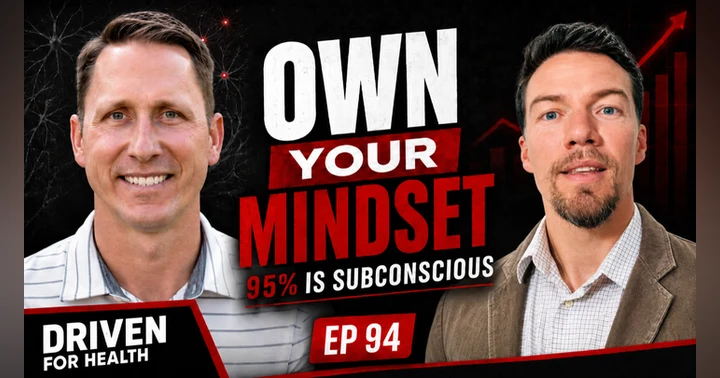
Own Your Mindset: Master Your Health and Business: Rion Westfall - 94

Rion Westfall's son cleared 8 feet in the pole vault after changing what he told himself. Rion is the creator of the Own Your Revenue program. He explains how self talk and routines drive your decisions. You leave knowing how to train your mindset and where to look for hidden growth in your business.


 YouTube
 Rion Westfall's son walked up to the pole vault bar telling himself he would only clear 7 feet again. His dad reminded him that the body cannot tell the difference between a joke and a fact. So the boy and his teammate started repeating we're going to get 8 instead. Both of them cleared 8 feet that night, a personal record for each.
(What are you telling yourself before the moments that matter most? See how Rion's Own Your Revenue process trains that mindset at www.537bd.com.)
Coach Brian sits down with Rion Westfall, creator of the Own Your Revenue program. Rion built his career auditing businesses in 15 countries and now helps owners find the revenue patterns hiding inside their own company. They talk about why 95 percent of your decisions run on autopilot and how training that subconscious changes results in weeks instead of years. Rion also breaks down why disappointment is really just an unmet expectation and shares the exercise that uncovered 73 hours of low value work inside one company.
By the end you will know how to train your mindset the way elite athletes do and where to look first for hidden growth in your own business.
Main Topics:
- Rion's son uses self talk to clear a personal record in pole vaulting
- Why 95 percent of your daily decisions run on autopilot
- The idea that disappointment is really an unmet expectation
- Coaching a retired NFL player through his first year as an entrepreneur
- Why 96 percent of small businesses fail within five years
- The PEPSLIM framework for finding hidden revenue in a business
- A time audit that uncovered 73 hours of low value work inside one company
- Building patterns and routines that remove decision fatigue
If you are a leader who wants real growth with healthy margins, learn more about Own Your Revenue.
https://www.537bd.com
Connect with Rion Westfall on LinkedIn: https://www.linkedin.com/in/rion-westfall-own-your-revenue-business/
Email: rwestfall@537bd.com
About Rion Westfall:
Rion Westfall is a mechanical engineer turned business strategist and the creator of the Own Your Revenue program. He has founded nine companies and audited businesses across 15 countries. His PEPSLIM framework breaks a business into seven core parts to find hidden revenue and protect margins. Learn more about his work at www.537bd.com.
Want help applying this to your own health, weight, energy, or lab numbers?
Coach Brian Parana offers Health Hot Seat coaching segments for men who want a clear next step with nutrition, fitness, weight loss, blood pressure, cholesterol, A1C, or daily consistency.
Learn more about The Call To Rise, a 100-day coaching program for driven men over 40 who want to lose weight, improve their health, and rebuild confidence:
To connect with Coach Brian:
brian@brianparana.com
Disclaimer: This podcast is for education and coaching support only. It is not medical advice. Always work with your physician before changing medication, treatment, or medical care.
- We're diving deep into the critical connection between your business success and your personal well-being, personal health with Ryan Westfall, creator of Own Your Revenue Program. This episode is for careerdriven men that are juggling the real life of the 40s. We've got career, we've got families, we have responsibilities, there's life stress, pressures, and a lot of other things happening in this time frame.
- So, challenges to be expected and we have to overcome it. We'll be talking over some of the concepts about change your own mindset. That's one of the undertones is own your mindset. And Ryan shares powerful insights as to why 95% of your life's decisions are subconscious and how you can actively train your mind for success.
- So, we're going into mindset today, guys. And we'll go through a lot of different things that are relevant to busyness, of life, career, and I hope that you are ready for this ride. Grab a pen and paper. Welcome to Driven for Health, episode 94. Ryan, welcome to the show. >> Awesome, Brian. Thank you so much. It's a it's an awesome pleasure to be here and amongst all all those listening.
- >> Excellent. And let's get to it. If we could say one powerful takeaway that we need the guys to hear and listen into today, what would that be? The one powerful takeaway I would say is, you know, often we can't tell which levers in life are actually going to advance our progress. So being able to tactically hunt the right patterns in our life to find those levers are only going to expedite our progress in, you know, weeks and months as opposed to years of of of grinding.
- Oh, I totally resonate with that. For me, being a health, nutrition, fitness, lifestyle, I'm looking at the main levers of of health. Well, nutrition, right? That's a huge huge one that most people don't know and understand. Soon as we start pulling on it, magic happens all of a sudden. We don't have to do weird diets or GOP wands or get on the peptide train or anything like that.
- We can just make better decisions and be informed about those. But even in say my business, I'm I had one lever I was yanking on super hard for years and it worked out. I'd like it was like a slot machine. I'd pull it and out came money and and now all of a sudden it it just I don't know that the the casino saw I was winning too much and and they changed the the computer program because guys, if you're if you're gambling at casinos, yeah, it's a software like you're you're not going to win, okay? Goodness sakes.
- But so it's changed and I had to find other lovers and I am hunting like crazy to to pull on those things. And so that this all resonates even with life connecting with my poor kids differently as they grow in age. Uh one story and then we'll turn them back over. My wife went with my second son Everett to New York City Friday, Saturday, Sunday or sun Saturday, Sunday, Monday.
- I just picked them up yesterday and I tried to ask my son Everett what they did, what was his favorite part and he couldn't be bothered. He was too busy. I don't know what sitting in the back of the car. this like uh how do I connect with him and he's just being an angsty teenager and and so I am gonna have a little conversation like hey dude did I spent about four hours getting you tuned from the airport and a couple hundred dollars for you to go have a really good time with your mom at the very least you can tell me what did you enjoy most about
- >> what happened >> yeah so you have kids too right >> yep I've got got four kids uh my oldest is actually just graduated last year and he's down in Brazil. Uh he's serving two-year mission down there. And then I've got uh one in high school and one in middle school and one at the end of elementary. So, three boys and one girl.
- >> Yeah, me too. Three boys. My youngest is a girl. And you're you're in the thick of it, too, except you have one out of the house already and my wife's already ready. >> It start it starts to change the mentality. You start thinking differently. >> Yeah, totally. Totally. According to my wife Amber, he's already gone, right? >> He's a sophomore.
- We still got a little more time, but >> not too much. Oh my god. So, mindset was a big undertone of what we're going to be talking about. That was we had a pre-call interview and that was a a strong thing that you can totally bring to the guys listening in. And let's start with family with the mindset there.
- How do we start to find these say hunting patterns of behavior and habits and routines that we can teach our kids to be able to be fruitful? I know say your your daughter, she's a state champ, so she's super driven. Uh so let's jump into some of that with her and then the other kids. >> Absolutely. There's, you know, as parents, just like what you pointed out, we we don't know how the kids are going to be one day to the next, even even sometimes amongst our spouses, right? So, and ourselves, if we're honest with with each other, we're like, "Hey, I
- woke up today and it just it just wasn't hitting right, whatever the case is." >> But there are, you know, patterns are found everywhere. And whether it's personal life, whether it's business life, whether it's family life, relationships, uh yes, my program, as you pointed out, I I call it own your revenue because yes, that's what we do for business, but it's it's about taking control of that revenue.
- And in life, that involves things like own your mindset, own your time, own your relationships, own your you know, there's there you can play, you can keep going on that list, right? And as you're sitting here talking about kids, I mean, again, I' I've got four and they vary. I mean, even though familial wise, you know, with our family aspects, we've got certain things that we like as a family, but, you know, I've got one kid that's my oldest.
- He really loves music and he'll get up and he'll sing and he taught himself to play the guitar and he can sit down in the piano and he can just, you know, hear something and he'll go and he'll start tinkering and all of a sudden he's playing the music and you're just like, >> "Oh, wow. That's awesome." >> And then my third son, he's like, "I don't want anything to do with it.
- " Like, you know, all I want to do is play ball, you know? And so we we have these differences in in these these human beings that are growing up and they're going through all the things they're going through. But uh but I find that yes, the you know the patterns that we allow ourselves to to do as a family. You know, there are certain things that uh that if we do correctly, and you're about health and regularity and and and you know very well that consistency in something is better than inconsistency at everything.
- >> I agree. And so as we are consistent with I know with our family hey yeah we wake up we've got early athletics sometimes the kids have to leave at you know they have to leave at 6:15 you know 6:00 to go to athletics and so we've made a point in our life that hey we get up and we do 15 minutes of family what what we call scripture study right where we're just doing hey we got 15 minutes and we do it and sometimes sometimes that 15 minutes became five because someone didn't get up or something like that.
- >> Oh yeah, the morning routine. >> It's it it's it's life, but but in the end it's it's those patterns that we develop that consistency in life that the kids and the people around us, you know, I mean, we're talking about family in this case, but people around us recognize patterns, right? >> They recognize I mean that that's one thing that is so easy for us to see.
- We can see patterns and we can spot them, but oftentimes we don't hunt for the right ones and identify them or quantify them as to, hey, is this one really moving the needle? Is it having the impact that I want it to have or how can I modify it so that it can have the impact that I want it to have? >> And so, absolutely 100% agree with that.
- >> Oh, yeah. Hunting patterns. I see patterns of course in what I do because when you're a subject matter expert like I am for health and you are for business you you you know the roadway that they need to go and and we'll certainly talk about business here and strategy and and owning the revenue part of a successful business because that is challenging in of it of of itself like I want to provide a service to a certain person and and a product and I need to get it to to to market and all this stuff and and there's a pattern behavior that will
- produce a viable outcome of a successful business. And if you just play that game, you will be successful. But if not, then you're going to go through trials and tribulations a lot more than you need to. Now, uh for you, what's one mindset, hack, story, something that you can talk to? I think of the out of shape Ryan that's 30 lbs overweight and and the the one habit that's helped you with your mindset to keep yourself on track for your specific goals whether it be health whether it be business or or anything
- like that. >> I will use an example that I had last night. So >> right this is fresh this is this is as fresh as it can be. my son, my my third child, uh second son, he's in eighth grade, you know, so he's he's 13 years old. And last year he decided to try pole vaultting, right? I've never pole vaulted.
- I've never been on a track field. Like I played lots of sports, but I've never done that. And so, you know, when you're starting to do that, you're starting to to to rely on that pole and learn the techniques and everything associated with pole vaultting, it's actually really kind of cool. >> But here he is and the last two track meets, yeah, last night was our third track meet of the season.
- And the first two he got seven feet. Good. He cleared it. Seven and 1/2 ft. He cleared it. Eight feet. He didn't hit it the the first track meet. You get three tries at it. He didn't hit at the second track meet. So, so this track meet, our third track meet, he's going into it. He's like, I've got 8 feet. I've got 8 feet.
- >> And he the mindset. >> Yeah. You know, and and admittedly, he woke up today or yesterday and it was windy day. You know, we had probably, you know, 10 15 mph normal winds, which are usually pretty windy when you're trying to, you know, launch your body up in the air. And uh >> he he he literally was thinking, man, I I'm only going to get 76 today.
- I'm only going to get 76. And we've been practicing this thing about mindset and about positivity and how you talk to yourself cuz your your body doesn't know any different, right? Your body doesn't >> energy, right? To >> your body, it it doesn't know if you're telling a joke about yourself or you're being realistic.
- It only hears it and it responds to it, >> right? >> And so% agree. >> Yeah. So sure enough, he started telling himself and there were three three guys on the team and he started telling another kid who's never cleared 8 feet and they started talking positive to each other just, hey, we're going to get eight. We're going to get eight.
- We're going to get eight. Both of them, my son gets up and he clears 8 feet. Personal record. Boom. Everybody's cheering. The other kid gets up, he clears it. >> And luckily enough, his pole ended up hitting it and knocked the bar off, but he was down on the ground. They actually called it a win.
- They they actually gave it to him. Okay. >> And so both of them get 8 ft. And so now they're just excited. Hey, personal record. Personal record. So, but hey, now you got to get up and you got to try 86. >> And so my son gets up and he tries it first time knocks it down. Second time knocks it down. And he he says, "Dad, I just stayed confident.
- " And his third time, his third last try, he clears 86. So a second personal record. So you know, now now he's going to nine feet. You know, I'm at like nine feet. Like okay, that's starting to get up there. >> Yeah. Yeah. And so, but you know, here it is. And and and all of you know, just the energy that comes with how you address yourself, right? There's there's never a there's never a lack for negative energy.
- I I mean, our world is full of it, unfortunately. >> Every day. I mean, all you got to do is pick up a phone and scroll. All you got to do is talk to your neighbor. Someone is going to emit an immense load of negativity. It's going to happen. >> And so the mind the mindset of >> just the positive conversation you have with yourself, >> right? Recognizing being able to recognize frustration, being able to recognize just that negative feeling as you're thinking about something and then just about face, you know, just about face and shift and just start changing the
- conversation. No different than I mean I find myself I will I have these thoughts in my heads and I'm literally talking to myself and my wife always catches me and she's like, "Why do you look upset?" And I'm like, "I'm not upset. I'm just thinking, right? It's just my thinking face. I don't know what to call it.
- It's my thinking. >> And really, it's just me talking to me about >> RTF. Ryan's thinking face. There you go. Just call. It's RTF. >> RTF. I'm sorry, sweetie. RTF, you know. And uh but but yeah, when we when we do have those those thinking faces like understand, hey, that conversation we're having with our brain, just just make it as if you were having a good conversation with somebody else and just guide it. Guide it. Let it flow.
- >> Yes. Totally. When I open up conversations with any person I've ever worked with in the last 15 years, first thing I always have to establish what went well because people will dump on me. And it took me a few times to figure this out early on. I got 45 minutes into this one conversation one time and and I feel like I'm on my heels the whole time, defensive, trying to prove or justify or defend or whatever we were doing.
- But 45 some minutes in they they said I lost three pounds this week. Like where did that not come out in the first minute? Why did you not lead with that? because I'm over here, okay, what are we doing? Like, how's this going? And we're doing just fine for whatever we've talked about for the last 40 minutes. It doesn't even matter. You're down weight.
- We're moving in the right direction. This is great. Next, next time we talk, make sure you preface it in the beginning, the first 30 seconds. Ryan, I did really good this week. >> Big win for the week or the day. Right. >> Great. Right. Now, speaking of that, you you talked and mentioned disappointment is is relative to expectation.
- Let's expand upon it because I have to reset people's expectations all the time and so do you with your coaching and even being a a parent and a husband, right? Expectations. So, let's jump in. Disappointment is relative to expectation. Explain that. You know, I was we had I I discovered this. And when I say discovered meanings I I I learned and internalized it myself, right? Right.
- >> It's a truth that existed. It's just I learned it here a few years ago. >> And and it and it realized to me and it dealt with a family relationship and whatnot. But it's it's a truth that is that is very very I mean it's just like gravity. It's a law. I mean it it happens the case and and as I was looking at one of my family members my the the aspects of this constant weight of disappointment, right? that was being felt by this individual and just continually regardless of what she tried to do and how hard she tried to work and
- all you know all the things that she was doing to do right by this other person. >> It just it it you know and this went on for years. I mean years and years and years >> and driving this person to tears you know years and just over and over and over and over again. And as I pondered more on that and thinking okay why why is this happen? I mean I by trait by study I'm a mechanical engineer I'm business so I'm very just pensive in that regards.
- I'm always looking for, hey, why is this happen root cause analysis, you know, all this other kind of stuff >> and uh like where is this coming from? like you're giving, you know, you're working your tail end off to support and all this stuff and, you know, eventually it becomes almost almost as if they're, you know, people pleasing and just bowing down to this person.
- And then this person uses, you know, negative leverage on them to make them feel and and it's just this continual spiral. And I'm thinking, why is this happening, you know, mentally? Why does this because you're not doing it? And and that's when it dawned on me. It's like this disappointment that you feel is based on unmet expectations.
- >> You have you have expectations for that individual. You expect that individual to act a certain way, to have a certain amount of honor, to have a certain amount of class, to have a certain amount of honesty. Whatever it is, you have an expectation of X. And when that person, right, the disappointment comes is when that expectation is not met.
- What whatever degree, I mean, if we get close to it, we sometimes accept it, but if we're way far from it, that's where that that disappointment really sets in. >> Yeah. And I was actually going through I've got three boys, one girl. And I I always joke but at the same time we our family we are evenly balanced.
- I mean you know one one girl three boys. I mean we're evenly balanced. Right. >> And and my daughter as you mentioned she's u you know she's she's got three state championships in cheer and two state championships in soccer. So she's got five so far. >> And there is ridiculous. >> Yeah. I mean, you know, like like she's got rings for every finger and um but in her world, in the the the female cheer world, which I've never been exposed to until her, you know, growing up in this world, there's drama, right? There's just there there's just there's
- just drama. >> Yeah. Unfortunately, >> unfortunately, but having learned that lesson about the connection between expectations and disappointments because same thing would happen. She would come home and be disappointed and upset about this and a disappointed, you know, it's just just that constant drama that's affecting you and usually it's almost always negative, right? It's hardly ever positive in that regard.
- >> Yeah, unfortunately. >> And and so, hey, how do we change that? Well, we can't control other people. >> Nope. >> But we can control our own behaviors. >> Yes. >> And what we do and what expectations we set with individuals, that's a behavior of ours, right? And so when we learn to control that behavior, we're talking about levers.
- When we when we pull the lever of expectation, if someone is constantly not meeting a certain level of expectation, just like my son's example, hey, we're just going to lower the bar until they can get over it, right? >> Right. Until they can get over it, and then we'll work from there. Then we'll change our behaviors to make it become more.
- But that relationship, that fundamental truth is is I mean, it applies to our personal families. it applies to our employees and our teams, our business associates, our friends, >> whatever it is. That's that's a fun >> it's a fundamental principle. And I have I have found as >> as I have monitored my expectations, especially those were that were constantly being, you know, disappointed by because they weren't being met.
- >> As I monitored and adjust those, >> I became happier. >> Yes. >> Right. not not not only the other individual, but I became happier because it simplified my life. It it relieved a lot of that mental real estate that I was consumed with on just, you know, the energy consumed with dealing with those disappointments all the time.
- And when I can adjust that, my gosh, it just became happier. It becomes simpler. And and life just life is a lot easier when you live that way. I I would agree the the expectations need to be in proper alignment with the efforts and also the inputs that you're receiving because we're receiving so many inputs in our world on top of just the marketing and everyone trying to get our attention.
- But it's just like wow we have to have the right expectation. That's something that I always will talk about is you don't want to be met your 40s or 50s don't want to be met with unmet expectations. You're like, "Wow, I was going to be a millionaire. I was going to rule the world and do this and whatever and have x amount in my bank account and and driving this car and be living in this house and and those are external expectations that we can put for the American dream.
- And then you can be really disappointed if those aren't or have happened regardless of however grand and great your life it could be and and you just walk around sad and then but then that affects and impacts all the other relationships in your life your your spouse your partner your kids your your co-workers or employees or whatnot because you're walking around like I don't have this nice car or whatever and it's it doesn't even matter sometimes it's just like they all do the same thing.
- Four wheels and they get you places. But whatever, >> you know, com comparison and usually you you usually we we feel that way because we're comparing, right? We're but but comparison is the thief of joy. >> And and you know, we we get get over yourself. Stop comparing yourself to other people or other you know, the things that they have.
- >> And uh you know, I go back to that that old movie, It's a Wonderful Life, right? when little Jimmy or whatever comes up and he he's telling his dad, he says, "Did you see the neighbor's new car?" And he's like, "What? Is our car not good enough?" You know, just it just let it let it go. Let it go. >> Right. Right.
- >> You can't take it with you. >> Right. So, let's let's take this expectation and shift it toward business now. And you had a really good story that you shared with me and love to to bring it back up. someone at a very high level that that has a lot of expectations and how they were hot to try to just go launch and you had to slow things down because of mindset, because of expectations and and all that.
- So, let's let's jump into that story. >> Yeah, I've got uh one of my clients, he's uh retire just retired from the NFL. uh spent five years in the NFL and the the the day we started that I started quote coaching him was literally the day after he submitted his retirement resignation letter, right? And in in those realms, anybody that's played athletics, I mean, I was football and baseball and college and all this other stuff, but once you get to a certain point and especially when you get into the like that's your that's your entire life. You
- >> that's your identity. Oh, an NFL football player. Everyone knows that. you know, I I have a lifestyle that I've lived where I've maintained, you know, 6,000 calories every day and I'm, you know, force eating and just, you know, just just to maintain my 275 pounds and this and, you know, just all the things and all and and literally right now, boom, it's done.
- >> It It's not important anymore. The whole training and it's a just a hard shift. And it's not like you can just pick up and just, hey, well, I'm gonna wait, I can't go to the next team. Like, I'm I'm I'm done, >> right? >> And this unless I'm playing in the backyard with my kids, >> you know. Exactly.
- And and in his case, his kids are, you know, two and one. And so there's there's there's not a whole lot there to throw with. >> Nope. But but but part of that was okay. Well, I'm gonna I'm I'm going to do the business idea that I thought, you know, that I I've been thinking of for the last couple years. Okay, great. But you've never done it.
- >> You've never been an entrepreneur. You've never done those things. >> You're an elite athlete, but in this domain, you're amateur. >> Yeah, completely. And so, you know, I wrote down a question in preparation for this, and we'll we'll probably touch on it on a few times, but the question I wrote was, would you compete, you know, whether this is a professional league, whether this was in the Olympics, wherever it is, would you compete without a coach? >> Not at that level.
- I doubt that anyone honestly would say, "Yeah, I I I'd go and compete without a coach." Like, okay, maybe maybe Wreck League when you're, you know, when you're nine, >> weekend warrior, >> you know, weekend warrior, you know, something like that. High school, college, professional, definitely you would never ever ever entertain going into a competitive atmosphere without a coach.
- >> Right. And I asked myself the same question. Why do we do that in business? Why as entrepreneurs, so many just go into entrepreneurship without a coach, >> right? >> Without a mentor, without someone to at least provide some form of guidance. >> Guidance. Yeah. >> You know, hey, >> spent a couple zeros on coaching over the years. Quite a couple.
- And and and the thing is I mean did they not expedite? >> They did. >> Yeah. Some were better than others. >> Abs. Absolutely. >> And one more recent one was more of a a learning in a sense than the outcomes that I was expecting. Right. We think of uh say business coach this monetary aspect to the back end.
- And there was a lot of learning a lot of backend. you I was I didn't send an email for 10 years and I've sent thousands of emails over the last 18 months. So that's a big difference. This podcast there wasn't a podcast. There wasn't even a thought of a podcast and now I'm almost Yeah, we're we're we're getting close to 100 now.
- So it was a huge learning and my expectations were challenged quite a bit because of what I thought the outcome was going to be and what the outcome actually was. And there's other things that happened there, but ultimately I learned a lot, >> you know, and and and as a I've been a couple months now.
- I mean, that was at the beginning of this year, so it was only a couple months ago that this um retired player has has started working with me. And before we can jump into, hey, here's the business and here's how you, you know, here's how you set it up and here's how you do this and these are the things you need to evaluate and all the before we start getting into that aspect, there had to be that mindset shift from going, hey, you're you were doing this, now you're going >> NFL elite.
- >> I I always go back up. >> Exactly. I had um to to point one out. Uh, and since we're talking about sports, I I played baseball and um I remember as I was growing up, I went into the Dodgers organization and and one of those was I was sitting there and and at bat one coach came up to me. I don't even know who he was.
- And but when you're at a certain level, you just there there's people watching all the time, right? I mean, they're all scouts all over the place and coach, you know, they're always watching, >> right? >> And he comes up to me and he looks at me and he says, "Radio deviation." Huh? What? You're talking to me? You know, like what the heck is radial deviation? Like I have no idea what you're talking about.
- and and he start and he starts to explain it to me and and it's for hitters and when when you're at bat, you know, basically if you're taking your wrist, if you >> right, if you radiate or, you know, deviate your wrist, take your thumb and kind of take it back to your bicep, what that's going to do is it's going to generate as you pull through the swing, it's going to generate a bat speed, you know, where the head of the bat is traveling at a faster speed than you otherwise would and bat speed in baseball is a good thing because it's going to make the ball go farther and
- harder, right? >> And but something that I mean I'd played baseball since I could ever remember being able to run or walk. I mean that that's just how it was. But I'd never heard of this, you know, never been taught to me. All the coaches I've had and everything, all the leagues I've played in, no one had ever told me that.
- And so the value of certain coaches at certain points in your life is invaluable to the rate of success. You know, we talk about business and we talk about if you do look at the statistics, you know that SMBs in the SMB world, 96% of them fell. >> Yeah. >> Within within five years, >> right? Which is significant.
- I I if you know a hundred only four of them on average is going to be around >> within five years of when they started. That is horrible. >> Yeah. like like when would you when would you ever accept a 4% success rate >> baseball you know >> and and so very similarly yeah as we look at our lives like hey uh what coaches do is they allow us to expedite what you would learn in three years of quote school of hard knocks that three years can be two months right And there's why wouldn't you? Oh, I had to pay for it.
- >> You had to pay to expedite something from 3 years to two months. Okay, great. How can I do that more? Right. I mean, >> yes, usually that's the outcome that we're looking for. >> Yeah. And so, so yeah, my my my comment on in regards to that is Yeah. would you compete without a coach? Would you go to battle in business without a coach? Well, if you do, you just you're you're you're you're jeopardizing time >> risk >> and your rate of return, right? I mean, will you be successful? Yeah.
- There's a 4% statistic probability that you will, but you're also going to lose on a ton of time. >> Yeah. >> And and you'll know it. You'll know it when you sit down with a coach. You'll know, hey, dang, I I didn't know that. I didn't know this. And you're changing within days, within weeks, >> right? you know, your mindset and your actions and things like that.
- And um I know that that'll lead into our 95%, you know, subconscious stuff. I know what that's where you're going, but yes, that that would be how I would answer that. >> Yeah, definitely. I I actually score is a mentor group in in America and actually reached out and I had someone reply yesterday to to me to try a different approach.
- So instead of having a fitness business coach type thing which I've had a couple now and I see I can see the patterns of behavior now. I couldn't a year ago but now I see okay these are the things that we have to do. Okay and they all take talk the same language and the same approaches basically. It's like all right let's look at it a different way.
- How do I manage my business and my life and my time differently and going from someone else that has successfully navigated through business in a different field and look at it through a marketing and PR and branding lens. And so that'll be interesting. First call is on Friday to to talk with with Lori and see what we can do together as a a shift in uh competing because that's what I'm doing.
- I'm competing against every other guy that is a coach that wants to get six-pack for someone or whatever. So, it's like, all right, what's my advantage? What's my leverage? And and so, let's let's go into that 95% rule for for everyone listening. What's the the subconscious decisions 95% and why it's necessary to be successful here? You have to understand the a little bit of the backstory here.
- So okay, >> one of the and not one the most acclaimed book on quote success is written by Napoleon Hill and it is called Think and Grow Rich. >> Most people most people have heard of it >> but they've read portions of it. It's it's not the easiest read, but you'll learn about the Fords and the Rockefellers and the, you know, all these other different people as as he spent decades studying them and behaviors and everything.
- I've always admired the fact that the first word in the title of that book is think. And so when you understand that his whole aspect is thought, right? It's not grow rich and think, it's think and grow rich. And there's a gentleman, his name is John Mitchell. I I I use his some of his work in my own to help this with this aspect of mindset.
- And John Mitchell, he's down currently down at the uh University of Texas and he has a program called Think It, Be It. >> Yeah. and he wrote a book called The Missing Secret, which is a play off of Think and Grow Rich because Napoleon Hill, he did all these studies and he wrote about the power of that thought, but never really gave how do you control that thought or how do you develop that thought? And John took that and kind of studied more and went, you know, now that we're, I don't know, however many years past the time that Napoleon wrote his stuff and
- science has proven a lot of things since then. And part of that is the 95% rule. And the 95% what it is is 95% of all the decisions you make in your life are subconscious. When you woke up this morning, >> did you think about grabbing your toothbrush and brushing your teeth? Did you think about whether it was the right leg or the left leg that went first into your pants? Did you think about you? You You don't >> real quick though, you need to make sure that you don't fall into the trap of sock, shoe, sock, shoe. That's Yeah.
- Your your day is way off then. Okay. randomly that came up on a a card that my daughter and I were playing the other day and it just references just a bunch of funny things. But yes, don't do that. Sock, socks, you shoe. Be normal people. >> Sorry, I had to put that one. >> But but no, that I mean, you're spot on.
- We do so much subconsciously that, you know, as we're doing those tasks, as we're as our body is making those decisions, >> usually our conscious is thinking about something else, right? It's, you know, we eat and we do, you know, we do all these things. Just so much subconscious. I didn't realize, me personally, I didn't realize that it was that much.
- Like I I I knew that subconscious was responsible for certain things, but I would have never >> answered saying, "Yeah, it's responsible for 95%." And so I think of it as, okay, let's just go, since we've been on this athletic run, if our body is made up of a bunch of these muscles, but one muscle was responsible for 95% of all of our movement and strength and everything.
- What would you do for that muscle? You would train it. You would stretch it. You would take care of it. You would ice it when it needs ice. You would heat it when it needs heat. You would tend to that muscle. Why? Because it's responsible for 95% of your motion and agility and everything else like that. >> Right? So similarly if our subconscious is responsible for 95% of our actions and we know that thought comes before action.
- Well, how do you then modify slash train your subconscious? And that's the whole premise of it is okay, how do we start doing this? And one thing that I've learned in doing this cuz once I started doing it myself, I started seeing effects literally within the first couple weeks. You go back to habits, right? How long does it take to create a habit? Well, 21 days or you know what? We all know these things, >> right? >> But we always throw this out there.
- Habits can happen immediately. They don't have to be 21 days. And that's a fallacy that a lot of people fall into. the the the worst classic example I do. You've been smoking for 20 years, going to the the lung doctor to say you have cancer. You have three choices. Just smoke it out.
- Just play the game of I'm going to start counting how many days I'm a non-smoker and then start smoking or quit cold turkey. And that's a new habit and behavior. So, you have the power just listening people listening. You have the power to change immediately. You don't have to have this. You don't have to give yourself 21 days for anything.
- You can change right now. And that's the the process of thinking and and then changing behavior. 100%. You can't get to day to 21 if you don't hit day one. Right. So making making those changes and and the the crux of this is understanding in order to train our subconscious is very trusting. And when I say trusting, if you think about it, we use this term brain, we use this team term brainwash, right? When you're told to look at a certain color, like, you know, if you tell your brain, hey, I'm going to look around the room, I want you to look around the room and
- find all the red things, >> right? And if if you look around the room, >> red real quick. >> There's red >> up there in the >> up in the I see that >> the ceiling, there's a couple red ones. >> And what what what indefinitely happens? You look around and that kind of maroon one, you're going to start calling red.
- and that one, you know, the these ones that are that are not quite red, but they're close to red, you're just going to start calling them red because >> you're telling yourself that those are red, >> right? >> Very similarly, our subconscious does the same. We we started this segment off with about, you know, the power of positivity, right? >> When we're telling ourselves how these things goes and professional athletes, I love the parallel between entrepreneurship and professional athletes. when when when you look at
- true professional athletes, u you know the I like football, so I'm just going to go uh retiree Tom Brady, right? You know, Tom Brady would go out to the field hours before the game >> and sometimes he'd just sit there. He'd just sit on the bench and he's looking out at the field, got a little headphones on and he is just thinking, what's he doing? He's playing the game in his mind. He's studied the tapes.
- He knows this. Well, this person does this, then I do this. This person does that, then I do this. This is how I beat this. This is how I beat that. That's how I react to here. They're they're visualizing this in their head. What they're really doing >> is a form of training their subconscious, >> right? Because because when you snap that ball and you've only got three seconds before that 327 pounder is on top of you, >> you your conscious needs help from the subconscious.
- You know, it needs that reaction stuff. But if you train it and and very similarly, that's that's the concept behind this. And and John has a a great uh he's call he calls it the 12minute routine where literally you read through you're training your subconscious about various aspects of your life and you read through these and we re-evaluate them every you know 3 months every quarter and as we do this I have noticed myself I've started change I start thinking differently and you know that's the whole premise is think and grow think and grow thought before
- growth. It always starts with a thought. A behavior always starts with a thought. A habit always starts with a thought. So, how you're training your thought is absolutely critical to whether or not you're going to be moderately successful, not successful at all, ultra successful in whatever endeavor you're going to do.
- I mean, it it it played enough of an impact on me that I turned to my wife and I said, "You're going to do this." And she said, "What is it?" and she started doing it and she started seeing the benefits and then I took it to my daughter, same one and we started doing it right before her, you know, national competition and it helps.
- It >> it has an effect on us if we learn how to own our mindset. >> Yeah. And it goes back to some of the hunting patterns that we talked about. These are patterns behavior. Professionals and elites study, they prepare, they refine, they review, they go through these things to eliminate challenges and unforeseen circumstances and situations and allow put themselves in the best position to allow as much success as they can handle.
- Decision fatigue isn't an issue. Then if you have patterns of behavior, I in episode 61, I I had an episode where I talked literally beating decision fatigue when it comes to eating without thinking. So you can adjust these patterns, behaviors around being an active, healthy adult and and keeping your body weight the same consistently, plus or minus a couple pounds.
- But that it's gonna people, your weight's going to fluctuate up and down. The five pound weight range is a great weight range for you to stay in and be comfortable. And if it gets to the high end, then we need to knock it off, so to speak, get back to the habits, behaviors. But thinking about food should not or or anything that we're talking about should not be full of lots of extra decisions or lots of extra steps.
- And these are again going back to habits that are we see success on a regular basis from from doing these things. And you're right 95% everything comes from our brain and we think and then we act. And sometimes when we act and then think it doesn't we need to put our foot in our mouth a couple times. What if we do it that way? >> Not a good situation there.
- So, how one more story of success going into the actual own your revenue piece of of you working with someone that you've been able to transcend from decide that I want to compete and yes, you do need a coach and then a mentor, someone to help guide you and keep you on the path because shiny object syndrome and attention and all this stuff is a significant challenge these days, especially with AI.
- it is moving at lightning speed and you can't even keep up and a lot of I I read something where a lot of major teams are struggling to just keep up with the rate of change. So they are settling into behavior patterns and and waiting a certain amount of time to then change things up again. Because if you're constantly changing, you're just in this rough storm of of the the waves just toss you left and right.
- And that's it's what it feels like the tech industry and the AI and everything is doing. So uh let's go over story of owning your revenue that you've had with someone who's really been successful and and showcase some of your your capacities. Absolutely. So, I built the own your revenue. That's what I call it. That's the title of it.
- Own your revenue. And the premise of it is in business, it's hard to tell which levers are going to get a 2x, 3x, 5x growth with proper margins. I'm going to emphasize that with proper margins. And so what ends up happening is you scale, but you end up scaling more chaos than profit. >> And so the own your revenue process is designed to tactically hunt the revenue patterns that will pull the right lever so that you add 7 8 figure growth in the next 6 to 12 months while maintaining those margins or increasing them as
- well. because those margins are go beyond just monetarily but there's a lot of time a lot of stress a lot of impact in your personal relationships that I just want to call out that so somebody listening might not be thinking about they just think the monetary of like I spend this much and I make this much no you do want that to work but you spend this much and you have a fruitful life in its entirety as well >> I I I use the term revenue one because yes it's business focused but re revenue is the blood to a business. So if we
- think of our blood inside of our bodies it's more than just a red liquid right there's so many different nutrients and what goes on with cells and regeneration and you know there's so many different aspects and the bone marrows and the this and the oxygens and the there's so many different things that affect the blood but we got to call it something.
- So in this case, you know, >> substance is, >> you know, >> own your revenue is yes, everything that's combined. And you know, we've already talked about one, which is the mindset, right? >> But really, as I traveled the world, I worked in 15 different countries doing audits and evaluations on businesses. That's how I got good at this is because I would go in whether it's four days or four weeks I would be spending evaluating an auditing business >> all day right every nook and cranny every stone unturned and uncovered
- >> regardless of the you know the skill levels the country I was in their education levels it didn't matter we were hunting I was hunting what ultimately at the time I didn't really know it but yes I was hunting for the patterns I was hunting for the right levers So that's why I developed this program. That's why I built the app.
- That's why I'm building the things that I have because as entrepreneurs, again, it's hard to tell which levers are going to have the 2x, 3x, 5x with proper margin effect on our business. So being able to quantify it, being able to pull it out, being able to see it on a dashboard and say like, "Oh, holy cow, you know, this has that effect and this has that effect.
- Oh, I've divided my company now into these seven categories. I call it pepslim. People, equipment, process, strategy, leadership, inventory, money. >> Now that I'm starting to see my business, I talked about that radial deviation. And I had no clue what it was until somebody came and told me what it was. Right. >> Right. >> When someone comes to you, when a coach comes to you and tells you things that you don't know, >> that's a good thing.
- You know that >> that means you have permission to improve. You have permission to grow and expand. Without it, you're just going to be kind of riding that wave. So, absolutely that that's why I developed this process. And so one of the things as you were talking about one of the examples and I have a gentleman I help anywhere from you know the solopreneurs as as we mentioned with the with the retired NFL guy.
- I've got companies that are 150 employees or so before before they go up to that quote corporate level, >> right? and they've got a VP for everything that they want you, >> right? >> But in this in this case, this u this particular owner about a hundred employees, they do about $40 million. They've been around for 25 years.
- And we were having this conversation and he had a couple of banger years where just the luck and everything was hitting right and then there's been a couple of years of struggle, right? Margins haven't been there. In fact, they've been, >> you know, negative. >> The marketplace shifted and I'm I'm experiencing growth, growing pains myself.
- >> And and how do you address that? How do you figure that? Well, what was working then isn't working now, but there's no real clear way to see, right? There's no real clear way to see. I love videos, especially with athletes, because you can take a video and say, "Oh, hey, look.
- You see this play? You see where you did this? Where you did this?" It's like you shouldn't do that, you should do this. Video has been wonderful. In essence, that's what kind of the owner revenue is designed as. Here's your video of yourself. Let's look at this. Let's look at that. Let's look at this. Let's go on the hunt.
- I'm going to ask very poant questions. They might be uncomfortable. In fact, they will be uncomfortable. So, >> yeah. Yeah. Yeah. That's where growth happens. >> Let's get over it because we know that's where the growth is going to happen. So, yeah. You want to retire in three, four years and you want to sell the business. Great.
- you can't sell it now because of these reasons. Okay, let's fix them. >> You'll get way less than you want from it if you sell it now. >> And and and and to that point, if if you've got the right coach on board to help you, they're going they're going to help you do those things. And so, one of the exercises that I do with the leadership team inside of business is I do have a look at their time, right? you know, and and I'm not a I'm not a time Nazi per se, like I'm not going to go through it just hey, every little tiny bit, but it is a critical factor as to
- what you're doing. And so we popped up >> one of the things that I asked him in the very beginning, I said, all right, if I were to hire you, >> let's just say I want you this afternoon for two hours, what would you charge me for those two hours? immaterial what we're going to talk about. You're the CEO. You're the subject matter expert.
- Whatever it is, I'm gonna hire you for two hours. What would you charge me? Well, 500 bucks an hour. Okay, great. No problem. Okay. 1,000 bucks. Boom. >> It doesn't matter because I know we talked about I know where we're going. So, everyone listening in like to turn it up a little bit right now. Ryan really points things out here real good.
- And and so so I I I've got this little worksheet that, you know, I've developed and we start going down it and we say, "Okay, you say you're worth 500 bucks an hour. Great. No problem. No argument. Uh what do you do, you know, on an average week?" And so we go through and this is the activity that you do. You're you do estimating and well, what do you do when you're estimating? Well, I'm drafting up proposals and all this other kind of stuff. Okay. Well, that's one activity.
- How much do you do? Well, I spend 10 hours a week doing that. Okay, great. And then, you know, we just go down the list. And, you know, by the time we get to the bottom, almost every time with founders, with leadership teams, I'm usually knocking on the door of anywhere from 60 to 70 hours a week usually. >> Sometimes I'll get mid to high 50s, but it's never 40.
- Like I >> Right. >> I don't see that. Right. >> I don't work 40. I don't think I feel like I'm always working. >> And that's, you know, that's that's that's the thing. So, as as we sit here and then what I do after that is I will then pop up and say, "All right, if you let's just pretend you're going to go away and you have to hire somebody to do that first line, that estimating line.
- If you were to hire somebody to do it, how much would you pay per hour for someone to do that?" And oh, well, that'd be worth $40 an hour or $60, you know, whatever it is. And we just go down the line. All the items are the things that they do. and we we extrapolate that. >> And then so in this particular case uh we had I want to say it was 73 hours that this gentleman works on average.
- I mean each week just varies uh but on average work 73 hours a week. Okay. Well, it's a 247 operation. They're always going. They're always on. So you know it's not a 9-to-f5 typical. And so as I ran the calculations, I just added up all the sums of what he would pay someone else to do those jobs, right? Just added those up and said, "Okay, $71 and boom, if you pay all that money time, hey, you're working for $127 an hour.
- " And he just froze. And he's sitting there looking at it and he's like, "This is the point. I I actually love this point because most of the time if you picture the old cartoons where they would have that green color face where the guy's just wanting to vomit like like this this is that kind of realization like >> you totally walk them down and reveal it to him, right? >> I I I I charge I would charge out $500 an hour. That's my value.
- That's where I should be. But yet I'm working for $127 an hour. >> Oh gosh. You know, right? And so that's one realization. And then I go, okay, in a ideal world, how much time would you want to spend on estimating? You're spending 10. How much would you want to spend? Oh, I'd want to spend five. I only want to be reviewing it, not writing them. Okay, great.
- You know, and you just go down the list. This is what you're doing. What would you want that to be? And we just go down it. One thing that almost always is the case is I get down to the bottom. very few. In fact, I'm trying to remember if I've had a single one, maybe one entrepreneur that has told me one of their line item activities is think big or think like a CEO or, you know, uh plan the future of the company, you know, whatever it is, anything to that tone.
- I've never had anyone tell me that's what they do. Even though it's their responsibility, it's their company. They're the only ones that can do that. >> No one has told me out of all the 71 hours and 65 hours and 68 and 63. >> No, no one has said that's what I do in my business. >> I find that very intriguing as a pattern, right? the more and more businesses I work with, >> that's not something that they're doing.
- And and I said, "Hey, if you were to do this, what would be the value of it?" And he's like, "I don't know." I said, "Well, you charge out $500 an hour. Surely it'd be worth more." And so I usually end up putting a thousand plus, right? Because it's it's infinite worth and only the CEO can do that.
- Only the founder, only the the the lead guy can do that. But we get down to the point and and and we take those those visions, what he envisions his time being for each of those activities, and voila, he pops up and there's 53 hours a week. I said, "So, you just saved yourself 21 hours a week." I said, "How's that going to make your wife feel? How's that going to make your daughter feel? How's that going to make you feel?" I mean >> yeah but that's a day that's literally a day of driving back >> life >> really I and and so you you you start thinking differently and and to his
- credit he has made monu I mean this was I don't know I think we did our first one back in October um and I reevaluate this time to say hey we we recognized it we wanted to make the shift are we actually making the shift right >> and so Sure enough, he's he's going through I call it add A add automate, delegate, delete.
- Right? So, let's go through this. Can we automate any of this? Yes, do it. Can we delete delegate it? Yes, delegate it. Can we delete it? Yes, delete it. Right? >> And and has a strong fear that that's exactly what's going to happen with Lori. She's like, "Hey, you're doing too much." >> I know I am. I know I am. I'm doing everything.
- >> Yep. And so when when you start to own things, which there's a big word that be accountable, right? >> Be accountable for your revenue. Be accountable for your mindset. Be accountable for your relationship. Be accountable for your time. >> Be accountable to yourself, for the things that you have control over.
- >> Right. >> Yep. And as you do that, as you start driving towards those things, then it's inevitable the results will follow. The the people will follow. You know, one of the things I think we talked a little bit or maybe it was another podcast, we talked a little bit about the difference between a leader and a manager, right? >> Yeah. Yeah.
- >> Leaders, you you can't push a rope. You can't do it. So you can only pull people to where you're wanting them to go. You can only bring them by pulling them, not pushing them. >> So yeah, pushing never works. Ask your kids. >> Ask your wife. >> Show them, right? You know, show them by your example.
- Show them by what you're doing. Show them by letting them. And when you do those things, when you when you develop those types of habits and routines and things within your business, you start to create a revenue culture. That's what I call it. You start to develop a revenue culture where everybody is accountable for the success of the business, for maintaining.
- Hey, just like our blood, if you're the lungs, your job is to get oxygen to the blood. >> Yep. Well, if you're the stomach, you're, you know, your livers and, you know, there's different aspects of our body that are responsible to support the blood in different ways. Our our businesses are no different. Our people, our teams, they all have different ways that they support the revenue.
- Some of them on the top line, some of them on the bottom line. Meaning, hey, how do you product, you know, how do you produce, how do you fulfill the work and your expenses? And there there's so many different ways. But being able to look at holistically your company to own your revenue to build that revenue culture is I mean that's why we see the success we do in six to 12 months and not 3 to four years >> right pulling yourself toward the future of the the experience that you want to have. I have that with the call to rise
- guys. Any person I've ever worked with that is successful already knows what to do. they're just not doing it. And then we have to find these patterns of behaviors, shift them into something that is actually productive with their time, their energy around what they eat, how they move their bodies, how they fit it into the busyiness of their every day.
- Even I talk a ton about time management or stress management because those things take away from and challenge the overall outcome. And when I look back at my pretty good track record, I episode 60, I had three guys 30 pounds, 30 lbs, 38 lbs in 100 days. They lost 98 pounds between the three of them and it was up accountability and it was just following through on doing the things that they needed to do to be in their best healthiest self.
- So it's this resonates significantly with me and with the people who are listening in. >> We we we talk about that number. I have a fear. I mean my my hope is hey when I saw that 96% number where 4% only survive. I'm like how do we make 4% 5%. Right. Right. I'm not trying to save all of them but if I can save one let's do one. Right.
- And >> John Mitchell, the guy we were talking about, this mind, his study shows 2%. He says only 2%, even if you know all this stuff about subconscious and how to train it and all this kind of stuff. He says only 2% will actually do something about it. >> Right. >> And so me personally, I have this fear. I'm like, well, if only 2% are willing to change your stuff, then is 4% ever going to become 5%? I don't know.
- But there's somebody here, like you said, there's somebody listening that's saying, "All right, how do I become that 2%. I I want to be that 2% or that 4% in business. I want to make sure that I have this success and and move on." And absolutely 100% agreed. >> Yep. This is so good. So proper expectations 95% of your subconscious is doing the the heavy lifting of everything and we need to make sure that we are paying attention to those around us.
- The are the way that we do think and the the lens that we view it from. A positive, optimistic, opportunity seeking approach is going to be the ultimate outcome that's going to move you in the direction in the first place to creating the outcomes that you want and understanding the patterns of behaviors not only in who is successful, but then in your own patterns behavior.
- Do you get up and do you think this way or do you take these actions or do you do this stuff in your brain? Do you have time that allows yourself just to think and you're not just distracting by scrolling or checking your email a thousand times or or whatever? And and these are things that develop success across the board.
- Sure, we want success in business, but you need to be successful as a person in a wholehearted way. And that's one of the reasons why I brought Ryan on because he jumped into mindset like we haven't really spoken tons on mindset. I've done a little bit of course, but to the degree in depth that we did today is just fantastic.
- So, I hope that a lot of people listening in have enjoyed this conversation. And with that, Ryan, where do we find you? What what goodies do we have to share with our listeners? >> Absolutely. We've got a goodie that we're in the process of launching, but uh there will be a free trial coming for we're in the process of building it right now, so it's almost ready to launch.
- Uh hopefully by the time this episode releases it's available, but uh but really a a free trial if you will into the owner your revenue dashboard for your business. So uh to step into that um my company 537BD or business development, you can go to the website 537bd.com and that's where you all the links and everything are in there as well as of course on LinkedIn.
- You can find me on LinkedIn. Uh my calendar's there. So, it's really not that hard. Like I said, would you compete without a coach? Uh, are you going to play the game of entrepreneurship without a mentor? I mean, my calendar is right there. It takes 3 seconds. >> Yeah, it wasn't hard to get a hold of you, right? >> To click that button and to say, "Hey, yeah, tell me more.
- " You know, let's let's let's have that conversation how I can do instead of three years, let's do it the next six to 12 months. Great. Let's do it. >> Right. >> That's excellent. and and hopefully you've heard that he's has a sheer amount of expertise here to be able to back it up and leverage this. So, you can check him out in those places in the show notes. They will be there.
- The biggest takeaway today for me is the mindset of looking through the lens of positivity of understanding that the way that you think ultimately shapes the experience that we are having. And when we have proper expectations to align with the experiences that we are having, then life can be really fulfilling and really happy and really exciting and you're not walking around sad and disappointed.
- Right now, it's a cloudy day out, but the sun is still outside cuz it is bright or you wouldn't be able to see my face because I'm in my barn now. And I understand that there's clouds, but that doesn't mean that the sun's out and I should think differently or otherwise cuz that would not be that that doesn't that doesn't work for me.
- I want the sun is shining. That's the type of lens I like to view life through. So, >> thank you so much for listening in, Ryan. Thanks so much for your time today, dropping gold nuggets every which way. I hope people took notes and can take away this this this mindset shift that we talked own your mindset to ultimately own your revenue.
- Well, thank you so much everyone and off we go. All right.