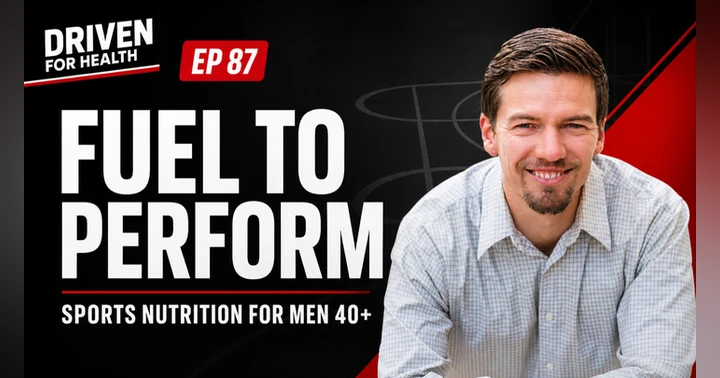
How to Maximize Performance: Sports Nutrition Tips for Men Over 40 - 87
You eat the same way whether you lift weights or play a hard match. Chris Nicol of Rocket Athlete reaches for gummy bears during play and protein afterward. He tells Coach Brian how to time electrolytes and sugar and protein around your training. You learn what to eat before and during and after activity.


 YouTube
 Chris Nickel of Rocket Athlete reaches for gummy bears mid match instead of a sports drink. Fast digesting sugar keeps him moving during play, and protein rebuilds him afterward. That simple split is the backbone of his entire performance nutrition system.
(Are you fueling your workouts the same way whether you are lifting or sprinting through a match? See how timing your intake changes everything at www.thecalltorise.com.)
Coach Brian sits down with Chris Nickel of Rocket Athlete to break down sports nutrition for men over 40. They cover how to time electrolytes, glucose, and protein around your training instead of guessing. Chris shares simple food options like gummy bears, deli sandwiches, and Greek yogurt that fuel real performance without overcomplicating things.
By the end you will know exactly what to eat before, during, and after activity to perform better and recover faster.
Main Topics:
- Chris Nickel's approach to fueling squash and racket sports
- Why gummy bears and hard candy work better than heavy food during play
- Timing electrolytes around your workout instead of just drinking water
- Understanding sodium and potassium in your electrolyte choices
- Simple protein options like deli sandwiches, protein shakes, and Greek yogurt
- Why fast digesting sugar matters during high intensity bouts
- Building a pre and post workout routine that actually works
- How sports nutrition principles apply to any weekend activity
The Call To Rise is a 100-day fat loss challenge for driven men ready to take their body back. It combines strength training, personalized nutrition and real accountability. Most men drop 20 to 30 pounds and rebuild the confidence that comes with it.
This program also works if you are dealing with high blood pressure, high cholesterol or Type 2 diabetes. It was built for those men too. Many men see those numbers move in the right direction alongside their weight loss.
Inside the program you also join a Brotherhood of men doing the same work. Together you build a body you're proud of and start leading like the man you already are at work.
This is your wake-up call to rise. Learn more and apply at www.thecalltorise.com
Want help applying this to your own health, weight, energy, or lab numbers?
Coach Brian Parana offers Health Hot Seat coaching segments for men who want a clear next step with nutrition, fitness, weight loss, blood pressure, cholesterol, A1C, or daily consistency.
Learn more about The Call To Rise, a 100-day coaching program for driven men over 40 who want to lose weight, improve their health, and rebuild confidence:
To connect with Coach Brian:
brian@brianparana.com
Disclaimer: This podcast is for education and coaching support only. It is not medical advice. Always work with your physician before changing medication, treatment, or medical care.
- Today I'll be sharing some sciencebacked strategies to fuel your sport game weekend warrior activity. Boost energy and enhance recovery from macronutrients to micronutrients and timing of meals. Get ready to transform performance wherever you're at on the court, in the field, out on the road.
- In this episode of Driven for Health, episode 87, I sat down with Chris Nickel of Rocket Athlete, and he was we had a sports nutrition conversation the other day, and I wanted to share it with you because I have an action-packed full strategy around a lot of different nutritional habits, specifically with exercise and performance.
- Of course, we're speaking about squash specifically, but ultimately when you think about it and you step back, the 30,000 foot view, all of this stuff ends up being the exact same. Doesn't matter what performance you are, this matters. Welcome to this episode and I hope you enjoy. Take notes. Good evening, folks.
- Good evening and welcome to the an episode of the Racket Athlete Podcast, Racket Sports Performance. We have on today coach Brian Pirana who works with men age 35 plus looking for weight loss, energy that levels that are looking to be much better and lifestyle changes. Welcome to the show, Brian. >> Yes, Chris, thanks so much for having me.
- Yeah, that's exactly it. We have to get these guys in shape and get them in health and make them to be their younger version of themselves. Then sometimes they show up in their 40s. >> Absolutely. We can resonate with that, right? >> Yeah. Yeah. We both have four kids and it's self-employed and absolutely >> rat race most states.
- >> It's a it's a balancing act, but it's it's always on the go, right? >> Always on the go. Today we're going to chat about with Brian uh specifically for squash nutrition. So Brian obviously has good experience in uh you you working with some athletes at the moment as well, Brian? Is that right? >> Definitely.
- Definitely. I have had Olympic athletes all the way down to coaching my kids little league soccer where they they run at two and a half then three, four years old. They just move as a blob chasing the football, the soccer ball. So, yes, I've had a lot of athletes throughout my time. Endurance, uh, racket sports, uh, baseball, you name it, I've I've dabbled.
- Nice. So, let's start with this one, right? Who is Brian Piranha? What is your story? What's your background? What do you What do you do that makes you unique? And also in your coaching, how have you got experience from that? Yeah. Hello. I wasn't so good of a basketball player. I just couldn't quite figure out how to catch a ball or something. Yeah.
- But so I ran and and running in high school turned into running in college and it became a really strong passion and I wanted to do well. I woke up and trained before school. I ran extra after practice. I did the work. We ran over summer. Things like that. And that allowed me to start to really develop this athlete inside into the 20s.
- I ended up doing marathons. I I graduated up to marathons and then into I own CrossFit gyms. Uh now the point at which I entered in some racket sports was when I worked at the YMCA. This was one of my first career uh I said jobs and but it also launched my career when I was in there. I I worked in let's say senior year high school and I was the maintenance guy.
- I'm folding towels. I'm sweeping the vacuum and and and cleaning. But they had racket ball courts that I was able to go up and play. is on level is on level three and [clears throat] they had probably six or seven courts and they were a very active league and I fell in love with raetball because and they play handball too but raetball is just so much fun because you have the ball on this tight little box and you're just banging and moving and it's really fast.
- Uh I I tried tennis and all and you know how tennis goes. If you're not good, the ball never goes where it's supposed to, right? Keep it in the lines, Brian. Right. But raetball was a lot of fun and and I guess leading through that being into my profession. Sure, I I was a personal trainer. I own gyms, but the last decade, I've spent a significant amount of time with nutrition.
- And being an athlete myself, I was always interested in sports nutrition as well. how to properly fuel my body, how to recover, what type of food should I be eating before, during, or after long training workouts, because that is important. If you're an athlete, regardless of what sport you choose, it matters.
- It really can set the tone and the pace and the difference between you being say the first one on the team to get picked to you being the last one because all the guys want you on the team because you always push and you go and you're it's like your first, second, third game, not you know when you get done playing a number of games you Yeah. you're toast.
- Legs are heavy. You're tired. >> Things like that. [clears throat] So that that was that's some of the origins of Brian and how it's it's it's came to be with sport nutrition performance. >> Nice. So that sounds like you've had a good lot of experience. You've had various things going on in the fitness and nutrition and the sports.
- >> Yeah. >> Nutrition and also playing sport as well, right? So >> let's focus down to squash nutrition now, Brian. Okay. So >> yeah, >> let's look at the what are the foundations to you for squash nutrition. >> Yeah, first and foremost, we have to understand your activity level. Not just on the court, but in the course of the day.
- [snorts] Are you doing strength training? Are you walking or are you sitting at a desk? Are you do you have a family or not? All these things have to be considered because your overall total energy expenditure is important to know and understand because if you are very active then you need to make sure that you fuel that activity with the proper amount of calories.
- Most guys don't understand even how many calories they are eating let alone how much they're supposed to eat. So we have to address calories. We have to become a calorie aware. And then once we start doing that and start understanding nutrition, then we have our three macronutrients. Protein is to build and recover your body. Carbs are for energy.
- And then fat is for hormonal balance. Well, we only need so much protein. Carbs vary based on the amount of activity you do. instead of like today you missed the squash session and tomorrow you're doing two hours. Well, by default you need this much more carbohydrates to eat and fuel and recover.
- And then we again we only need so much fat based on whatever you're doing or however it looks in in the day in terms of total calorie expenditure. Now going into so we have those things we go back into the actual calories. It could be a huge range. If you sit at a sedentary job and you play squash an hour a day or something or a couple times a week, then you might only need 2,000 calories.
- But if you're in there playing 90 minutes multiple times a week and you're on your feet and you're hitting 10,000 steps and you work out, might need even 3,000 calories a day. And then that ends up breaking down into how much protein, carbs, and fats. Now, the average man and woman are are going to need adequate amounts of protein and and that for men are going to range somewhere between 150 to 200 grams per pound is going to be generally what that falls in with most guys averaging say 160 to 175 plus or minus again based on weight as well. then and women are going
- to fall between a 100 is a minimum for the ladies, but even 130 or 140 grams of protein in a day. And why? Because we're breaking muscle down. And then we have to rebuild it. And then we'll talk quickly about the fat. There's only certain amount of fat that we need. And fat isn't a lot of food. It might surprise you when you start adding it up.
- Where where did all this fat come from? It's what so many clients say when they start paying so much more attention. And if we were to say macros, we might as well be specific. Women somewhere around 50 to 70 grams in a day. And then gentlemen are going to be anywhere from 60 to 80 to 100 grams depending again upon the amount of calories they eat.
- And then lastly, and we'll turn it back over, is the carbohydrates. Those can vary quite a bit and they often are the remainder of calories in the amount of calories that you're eating. So think of a a good ratio could be about 40% of your calories coming from carbohydrates and 30% coming from protein and fat as well to get you to 100.
- So the carbs can range anywhere from 150 to female to 300 plus for guys that are really moving a lot. There's some some pretty good specifics there, boy. Yeah. >> Yeah, of course. [snorts] So, one thing I want to ask you haven't mentioned there is micronutrients. What's your views on that for squash nutrition? >> Yeah, definitely. Definitely.
- Now, micronutrients are vitamins and minerals and what we have with those. If we're having a balanced diet, lots of colors, then okay, we're we're usually good. Taking a a men's or woman's one a day, we're good. we don't have to think too hard or or work too hard to to to do that.
- Now, if we were to think about say the performance aspect of it, having more electrolytes on top of a a men's one a day or a women's one a day, that makes a lot of sense. And specifically around your training itself, do we need Gatorade? The story goes the the Florida Gator in the third and fourth quarters of the football game could outperform their competitors and hence Gatorade was born.
- Well, if you look at a nutrition label for Gatorade, there actually isn't a lot of electrolytes. Sodium and potassium are there, but it's not an absorbent amount that you would think. There's sugar. >> Gatorade is using sugar. not necessarily the best source for a say an electrolyte replacement for Gatorade.
- >> Using things like glucose and sugar are important in the timing of when you use them, especially around a high performance and intensity squash session or any other racket session because there's a lot of bouts of intensity for a certain amount of duration, right? A lot of sessions will last, you know, if you're going to go train, you're going to do an hour and 90 minutes worth of time. And having glucose makes sense.
- We can talk about that later. But as far as getting an actual supplement for your electrolytes, there are plenty on the market that you can find. You just want to make sure you're paying attention to the potassium and the sodium that is in it. And then you want to time it around your workouts before, during, and after, especially depending on how much you sweat.
- Right. So, would you say they're all important before, during, and after, or would you, if someone was beginning to start using electrolytes, where would they start? Would they start taking it before, after, or during? >> If they're starting, I would do a men's multivitamin and call it a day. That's fine. Okay.
- Now, if they have a higher level of advancement or a degree of seriousness around the sport, then yeah, we're definitely going to have some higher sodium tablets before and even during even to the point of I've had athletes do caffeine tablets as well. like 50 or 100 milligrams before and even in the first part to give that little extra edge and energy which then helps with the say the perceived exertion of how hard you can go for how long in the session which is important because oftent times a lot of it comes down to the actual what you
- think in your head to be able to allow you to push harder for yourself. >> Yeah. Yep. Yeah. So, what eating suggestions can you give uh squash players who are out and about all the time traveling for the matches if they're on a serious sort of competitions or just beginning even beginners and up to advanced players as well.
- How what could you suggest they do for their eating routines out and about and traveling? >> Yeah, definitely. Well, first and foremost, you have to plan. You have to be aware of where your food's even coming. Oftent times you're out and about and you end up just find yourself in the local pub and you're getting some fish and chips or something like that.
- That's that's not going to help you in your training. High amounts of carbs and fats in that type of way isn't going to be ideal. firstly is look around and see what type of food and meal options there are. Whether it is a restaurant, a sit-down restaurant versus a fast casual place that you can grab food and go from there.
- Then we have to think about, okay, does the hotel offer food for a continental breakfast in a sense? If so, then we can leverage that. we'd want to go with starting off with some carbohydrates and some proteins. The easiest way to do that is the proteins would be usually eggs or yogurt. And anytime I'm talking to guys, we're looking for about 40 50 grams of protein in a meal.
- And women are more around say 30 or so grams plus or minus a little bit. So we can get that from yogurt or eggs. And then we'd want to have a carbohydrate. Oatmeal could be a good one to in that situation. And a lot of hotels will have oatmeals to allow you to be able to enjoy that. And that would be a really solid start in the day.
- If you're if you're not doing that, then you need to go out and find at the very least say a high protein sandwich, breakfast sandwich of sorts that has some egg, that has some Canadian bacon, that has a lowfat protein source on it because you don't want a bunch of sausage sitting in your stomach when you're trying to play the game.
- That's not it doesn't go so well through the the digestion pipe, so to speak. So this would be good starting points in your day there, >> right? >> Going going into say launch, we need to look at typically a lot will just be an easy deli sandwich with some some high protein lunch meat on it. Have some fruit and some vegetables, say like carrot sticks, really easy to go piece an of an apple.
- and then you have a sandwich that has a lot of protein on it. That could be a really easy portable way. And at the very least, you can go to a local super market or a grocery store to be able to find something like that or find the the components that make that up and then then you're pretty good for lunch.
- Now, as we go into the actual training itself, dinner is it will be a little bit here in a moment, but as we go into the training itself, we're looking for carbohydrates, simple carbohydrates. Think granola bars, think uh bananas, fruits. Um we're going to have uh crackers. We can find certain supplement type things that have glucose in them.
- One favorite thing especially for say a squash player is have honey. Just have honey around your workouts. You you put a squirt in your mouth and then that'll get that'll keep you pretty alive and wiry for 20 minutes and then in about 20 30 minutes you do it again and that'll carry you into the second half of the hour and keeping your energy levels up because the glucose, the sugar is what's important in that situation to be able to have and enjoy, but then also keep those the engine moving and not just end up with hitting the wall because you have no more gas in the
- tank. >> Yeah. Yeah, absolutely. [clears throat] Um, yeah. So, that's a good point actually. Let's move on to let's take what you've spoken about there and look at timing for squash performance for the nutrition. Right. So, >> right. >> How would you take that with your timing in regards to the whole day and also to the training? >> Yeah.
- Now, in actual performance, when are meets typically, Chris? Are they gonna be in the morning? Probably, right? Uh, we have a weekend, right? >> Yeah. So, like competitions, I mean, what level you're at? It depends. Can we take a typical weekend competition, three days, couple of matches one day, couple of matches next day, couple matches the next day.
- So potentially you have two matches in a day >> and then one could be at 9:00, one could be at 12 and then you have the rest of the day >> after that. So >> perfect. Perfect. So with that general type of of outline of the schedule, you're going to start off with that strong breakfast. It's going to be heavy on the carbs and some of the eggs in a sense.
- That will give you a lot of energy, say four or five, 600 calories for sure. And that will be a very strong start. you grab some fruit to carry with you to be able to have at a later time. As far as timing goes, most people do pretty well eating one, two, three hours before a competition, a match, and that is a good time frame so it doesn't sit too heavy in the stomach.
- Plus, it'll give your muscles and your blood sugars and everything to have adequate amounts of time to do what it needs to with that food. When we get into the actual match itself, then we're looking for the that's when you get the honey, the the sugar, the glucose, the even candy, hard candies or gummy bears, things like that be really good sources of energy in those highintensity bouts because you could have say a couple gummy bears and those will be a lot of sugar and carbohydrates in a good way to propel your workout and not sit heavy in the
- stomach, which is what you want. Something that is fast, easily digestible, and it could be granola bars or graham crackers or peanut butter and jelly sandwich even could be a really good food source before. As we go to the second half afterwards or in between, then that's when we want to get some protein.
- So, it could be that deli sandwich, could be a protein shake, a protein bar with some fruit could be really good options as well. Uh, if you have access or around say a refrigerator, we could look at things like a Greek yogurt or something like that to to be able to make it just different of a a protein source and a meat-based protein.
- But you would want to have some protein in between those matches because >> recovery and balance of food. And then going into the second one, then we can again repeat the strategy of having some more grab and go carbohydrates because you don't you don't need anything heavy. But again, going back to a granola bar could be a really easy opportunity to have before the second match.
- And then you have an actual proper lunch at say two o'clock after you're done with your match and the competition and then a proper dinner with a protein, a vegetable, some starchy carbs, and >> yeah, >> the calories can vary depending on obviously how many that you've eaten in a day.
- But we get to the the last meal, it could be 500 to,000 calories, and that's fine. >> Yeah. Yeah. So I [clears throat] think for for a sport like squash as well, I mean carbs is very very important to put into the meals as well because >> Yep. >> I find as well like when I'm coaching sometimes people are scared of carbs. But actually, but actually if you if you if you time it right, if you whether it's beginner squash player or or a performance squash player, you time it right, you you eat the the right amount for yourself, what your body needs, it's not an issue, right,
- Brian? >> Correct. Correct. You need a certain amount of calories in your body to perform at the level that you want with the amount of exercise and activity that you're doing. that a certain percentage of those are going to fall into the proteins, the carbs, and fats. That's what make up calories and make up the food meat.
- So, the it's it's not too it's pretty often that you're going to find even especially on the higher output days, you might have 50 or even 60% of your calories coming from carbohydrates. >> And that's okay. >> It's okay. It's it's fine. fruit, vegetable, probably not so much vegetables on those days, unless you're in a non-competitive time, say dinner.
- Yeah. >> But the other times of days, there's gonna be starchy carbs, simple carbs, sugars, breads, cereals, things that can sit lighter in the stomach a little bit and process pretzels, snacks like that. Yeah. So, let's move on to the final question for today's podcast. What one valuable tip could you take could you give to a squash player today that they could start using now today and nutrition plan for the love.
- Think through the nutrition part aspect of it because you're going to spend so much time in the exercise, the actual performance, right? You're you're you're in the zone and you're you're doing all the things and you're all pumped up. It's like the Rocky montages. You got the music going and you're spending so much time on that, but you so many people don't spend any time on the actual food >> and nutrition and that's where the challenges come. That's the problem.
- That's where things are a big issue. So you have to think okay about how many calories do I need about how many carbs should I take with me? What access to food do I have before, during or after this event? How far away is it? Am I in a hotel for the night or the weekend? Or am I able to come home? There's a lot of these factors that I will work through.
- Literally, I'll just ask questions to my athletes. Okay, let's break down the event in its entirety. Where is it? When is it? When are you competing? When do you warm up? When are you cooling down? When do we need to have food at certain times? And when we go to that in depth, then you actually understand the importance of of the the food and the plan that needs to be executed because you can be all as motivated as you want, but if you run out of gas and in the middle of the the match, you you're just you're done. You're gonna get beat.
- >> Yeah. Exactly. So think about your lifestyle. We need to think about nutrition more in your lifestyle wherever you're going. Right. >> Right. [clears throat] Exactly. Exactly. >> So have you got any final words today, Brian, before this podcast finishes today? >> Yeah. Final word is that to the degree at which you educate yourself around the exercise, the training, the drills, the equipment, all those fun aspects of squash is to the degree at which you need to spend for nutrition of learning and understanding what is in the food that
- you eat and how does it impact your body because I promise you you will you will perform significantly better and outlast your competitor because they didn't think anything about nutrition or food or plan around that at all. 99% of athletes just do the exercise piece and they don't do the others.
- So, there you go. >> Thank you for coming on today, Brian. It's been a pleasure interviewing you. Also been on LinkedIn live >> as well as the podcast today. So, it's great been having having you on the show. This is another episode of the Rocket Athlete Podcast, Rocket Sports Performance. Have a great day, folks. Thanks for tuning in to the round table.
- I hope that you enjoy these. I will keep recording them and throwing them up as episodes here and there throughout the Driven for Health podcast. I think it's really important that guys hear real guys talk about some of the challenges and situations you might find yourself in.
- very similar ones to obviously learn, take into real life and implement, but also be inspired to do bigger and better things for yourself, especially around your health and those closest to you. That's it for this episode. Catch you in the next one.