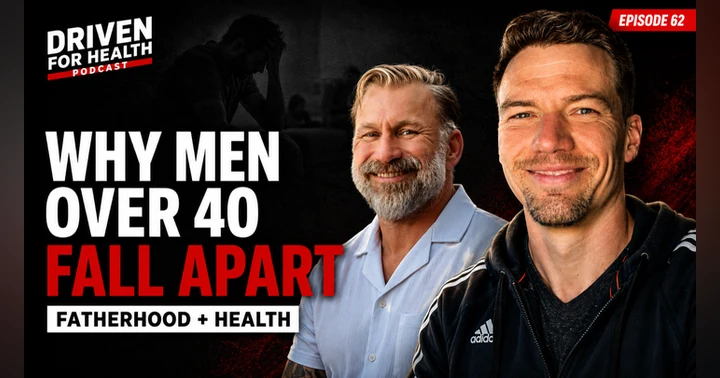
Fatherhood, Health, and Why Men Over 40 Fall Apart - 62
You still picture yourself as the athlete you were at 25 and your body tells you otherwise. Coach Brian draws on 23 years of coaching to explain five pillars of lasting health. They are identity and movement and fuel and mindset and brotherhood. You learn where to start rebuilding yours.


 YouTube
 Many men in their 40s still see themselves as the athlete they were at 25. Their body has other plans, and that gap between self-image and reality is where a lot of men get stuck.
(Do you still picture yourself the way you looked years ago? See what closes that gap for good.)
Coach Brian draws on 23 years of coaching, including work with Olympic athletes, to break down five pillars of lasting health: identity, movement, fuel, mindset, and brotherhood. He explains time chunking as a way to fit training into a packed schedule, why peer groups keep men consistent, and how to update your self-image so it matches where you are now instead of where you used to be. He also covers how stress, loneliness, and aging quietly erode a man's health if left unaddressed.
By the end you will know the five pillars that hold up lasting health and where to start rebuilding yours.
Main Topics:
- The five pillars of lasting health: identity, movement, fuel, mindset, and brotherhood
- Time chunking to fit training into a packed schedule
- Why peer groups and brotherhood keep men consistent
- Updating your self-image to match who you are now
- How stress and loneliness quietly erode a man's health
- Real client stories of men who rebuilt their strength after 40
The Call To Rise is a 100-day fat loss challenge for driven men ready to take their body back. It combines strength training, personalized nutrition and real accountability. Most men drop 20 to 30 pounds and rebuild the confidence that comes with it.
This program also works if you are dealing with high blood pressure, high cholesterol or Type 2 diabetes. It was built for those men too. Many men see those numbers move in the right direction alongside their weight loss.
Inside the program you also join a Brotherhood of men doing the same work. Together you build a body you're proud of and start leading like the man you already are at work.
This is your wake-up call to rise. Learn more and apply at www.thecalltorise.com
Want help applying this to your own health, weight, energy, or lab numbers?
Coach Brian Parana offers Health Hot Seat coaching segments for men who want a clear next step with nutrition, fitness, weight loss, blood pressure, cholesterol, A1C, or daily consistency.
Learn more about The Call To Rise, a 100-day coaching program for driven men over 40 who want to lose weight, improve their health, and rebuild confidence:
To connect with Coach Brian:
brian@brianparana.com
Disclaimer: This podcast is for education and coaching support only. It is not medical advice. Always work with your physician before changing medication, treatment, or medical care.
- Welcome to Driven for Health, episode 62. Really excited to share this interview that I had with George Dutra of the Rogue Dad Podcast. We're going to jump right into it. We talk about fatherhood, fitness, nutrition, life, the challenges that men have in their 40s. We're both in our 40s and how we are overcoming those. Jump in.
- Here we go. >> What's going on everybody? Welcome to another episode of the Rogue Dad Podcast. I'm your host, George, and today we have a guest. Brian Piranha is a men's health coach, 23 years, father of four, and host of the Driven for Health podcast. And I sat with him today. We had a podcast at Super Bowl Sunday.
- So, you know, things are serious when two dudes get together and work during sports. But we had a good conversation and I hope that you guys like it and I hope maybe you can learn a little something about how to be driven and how to make those changes in your life that gets you to be a little more focused, get you to be a little more of the person that you want to be because that's his goal is to help men and women.
- And he's dealt with everybody from your average Joe to your Olympians. So without any further ado, here is my conversation with Brian Piranha, men's health coach. Yeah, thanks so much for having me. You you reached out the other day and this whole vibe of what you do and have and are doing on your podcast totally caught my attention.
- Who's Brian? Who's he not? It feels like so life coach is a really good uh title, but I play nutritionist, fitness guy, getting people. >> Say I feel like that doesn't really give you enough justice, life coach. And I hate to say this because it's going to sound kind of mean, but I feel like life coach is kind of every chick is a life coach now.
- It seems like at the gym, you know what I mean? I feel like you do so much more and you're so much more qualified than the life coaches I know, which is why I was like, I don't think that's a good enough title for you to be honest. >> No, unfortunately not. I'm still trying to figure out my way in the social media world of exactly what to call myself because I feel like a Swiss Army knife to be honest.
- I've just had I've been doing this for 23 years and I started off with exercise then got nutrition and just to sheer volume of clients literally thousands of people and I 100,000 hours of talking to people or more and text messages and everything. I have experience a lot with a lot of people and help them move from I guess it's the gap.
- So people are here and they want to get to here and I help them close that gap and the easiest next best step that's easiest way to to talk about what I do. So, first and foremost, usually a lot of people come to me because of weight loss or actually I'm literally just got off the phone with Kendra Harrison, a Tokyo women's 100 meter silver medalist for America and she's my client right now and pretty wild, pretty thrilled to have her.
- >> She's she's from Tokyo and she's >> No, no, that's she got a silver medal at the Tokyo Games. >> At the Tokyo Games. Oh. Oh, yeah. Yeah. Yeah. >> Yep. So I have that and I have people who are trying not to die of cancer >> all in between. It's pretty wild and the challenges that they have in their life and how do we overcome them? >> That's the say the where the magic secret sauce of where Brian comes into play, right? >> Is over these things one step at a time.
- So, um, just because I I'm personally interested in stories like this because of my involvement with fitness during my life and just all that stuff, I can really relate to >> anything on the fitness spectrum. It's kind of like if you play guitar, it doesn't matter if you play flamingo or hard rock, >> they look at each other is like, "Oh, that guy's a guitar player, too.
- " >> Yes. >> So, >> let's jam >> on a personal level. Yeah. Like, what was your first sport? How did you get into fitness? Were you overweight and overcame something and now you're stronger? Were you always an athlete? You know what I mean? There's so many roads that could get you to where you are, >> right? Always an athlete, always took care of myself.
- I was started off with baseball way back in UE leagues. I I was afraid of the ball. The ball would come down from the pitcher. >> I just didn't want to get hit. So, I just I did that for a couple years and was like, "This is definitely not my sport." I love basketball. I shot thousands of shots in my backyard at my my mom's house and but I wasn't good on the team.
- Couldn't seem to catch a ball. My Dan, I'm actually going to see him tonight. Today's Super Bowl Sunday. We're going to hang out with he's got four kids. I have four kids. We met in middle school, but he invited me out to the track the track team and he was running cross country and said, "Dude, you got to run track with me.
- " I said, "All right, dude. Let's go." And since then, track, cross country, and high school really dominated. I always love referencing Rocky. The training montages. Oh man. >> Especially the snow. >> Come on. >> Get me so juiced. And I just love training. I I would love to be a professional athlete, but that's not where my life took me.
- But I I ended up running a serious amount coming in high school, out of high school, got into marathons, ultramarathons. I ran Boston, probably ran about a 12 different marathons. My best being a 256 at Marine Corps. >> Actually, my my 16-year-old son challenged me to run a marathon this year, September.
- I have, let me see, I have it on my my computer. 229 days. I have a countdown. Did you see that high school kid that just broke the mile record? >> No, I have not. >> Dude, it's like three minutes and something seconds, dude. It's insane. >> A high school kid. >> That is wild. >> Yeah, >> I had a really good training a friend. He's still a friend.
- Leo Cormaker was his name. And he was just a really really good athlete and he pulled me along in that that bubble of just pursuing excellence and and working hard, >> right? All right. So, that's just I'm 43 now. >> 43. Okay. Um, and you another thing you do is you have the Driven for Health podcast. >> Yes. Yeah, definitely.
- So, outside of being an athlete myself and all, this is what I do for a living is help people improve their health, their quality of life, improve their lifestyle, and the Driven for Health podcast is an extension of that. I'm I'm currently getting ready to release episode 62 since late September. So, I've been on just a just a recording and pub publishing >> spree lately trying to get those things out into the world.
- >> I notic in um like the information packet you sent me and I listen to a few of your podcasts. Uh >> great. Thank you. >> identity around being healthy. Yes. >> Like can what do you mean by that? Like what do can you break that down a little bit? Yeah, every person has an identity at which they think and see themselves as, right? I still see myself as the 20-year-old runner.
- I've done other things. I own CrossFit gym and I've I've done a lot of other strength training and different things. So, I'm not just a runner, per se. Triathlons I did for quite a while, but I see myself as an athlete and I'm starting to be challenged in that. I take care of myself. I've been in the five pound weight range for two decades.
- So, nutrition, exercise, lifestyle, all this stuff is easy to me. Well, it should be. It's what I do. But I'm seeing the age starting to play a factor. It's like, oh, my cal is strained for a week or now my glute is sore and doesn't let me run or something. I'm like, >> so, so this identity of I see myself as an athlete and now my body isn't allowing me to do that.
- So, there's friction internally about that. And when I meet people, say you're 20 pounds overweight or your A1C is high and your doctor's trying to call you a diabetic or you are super successful in certain areas of your life, say business owners. I' I've got guys making millions in a year and they they're on high blood pressure medication.
- They're they can't even see the tip of their toes because their bellies in the way. Man, that's always >> that has always because I have friends that have no financial worries whatsoever. None. Their kids don't. They don't. They're probably their grandkids won't. They don't have to worry about anything financial.
- And it's always trips me out when I see them unhealthy because I will go broke buying supplements or trying to eat right. And it doesn't even I could I would one of the reasons I would love to be rich is so I could have all of the nutritional stuff and you know everything I need to be healthy. All the the light therapy, the cryotherapy, the you know >> massage right now weekly massage please.
- Yes. >> I couldn't I couldn't imagine having an abundance of money like that and being unhealthy. That always blows me away. >> I I make a good living but I can't retire yet. And I have four kids, too. >> And that they're expensive. My oldest is 16, three boys and a girl. Youngest is 10. My last my daughter.
- >> And yeah, they keep they keep draining my bank account. >> But I bet it's being drained because you're spending money on them living healthy. You know what I mean? Like I I bet the money you have is going towards health rather than material things. Not that material things are bad, but if you're if you have all the material things, you should be healthy.
- I totally agree. I see this map behind me and one reason why it's cold now. I usually have an outdoor studio in my barn, but it's outside and it's like 20° outside, so I'm not going out there. Same here. But >> one thing that we do here is my wife and I, we really share our lives with our kids and experience driven.
- My daughter has slept in >> all 49 states. She Idaho got away from us. We have not slept in Idaho, but we've we've literally spent at least one night in every state and then we're working on all seven continents. We we're going to go to South America, Machu Picchu in April. So, a lot of my money and is going toward experience for my kids with that, their afterchool curricular activities and and their arts and performance and all this stuff.
- That's where all of it goes. So, I'm financially stable, but not ready to retire anytime soon. One of the things uh about the um identity being around healthy that I uh the reason why that caught my attention was because I noticed that you worked with like Olympic athletes and elite athletes just as well as you know men and women other >> and I've always just being in gyms myself and knowing fighters more than anything um always like once you become that and that's your identity It's so hard not to be that anymore. It's so not It's so hard
- to be like, man, okay, so I I'm not as fast in the ring as I used to be. I'm not I can't get up as much as I used to be. So then your identity kind of changes to coach >> or right teacher. And that's a weird thing even for me who doesn't have any professional fighting anything, just been in the gyms and has trained with fighters and trained fighters and everything.
- [snorts] I still have this thing of where like I still want to get in a spar. I haven't realized to myself that I shouldn't be in the in their spine as far as I do. You know what I mean? Or did >> it really faster than me? >> It does. My both of my older two are faster than me running. And it's sad. And I I don't know if I'll be able to catch back up.
- >> Yeah. And that's such a weird thing, right? Like >> it is it it is a weird thing that I I just I trip out on I'm more and more and more the older I get and the less I'm able to do in the gym. And it's >> horrible. Even though I bet you and I are better than or not better but just more >> better stronger or more functional >> 80% of the country, you know what I mean? It's still our bar is a little higher.
- Um >> yeah, >> let's say for example deadlift. I don't even know how much I deadlift anymore. I used to deadlift over my heaviest was a 415 and I I definitely don't deadlift over 300 anymore. I just go I'd much rather have a bunch of plates on it and do reps and sets and just make sure my back doesn't hurt the next day.
- >> Right. So that >> and that's just part of life. That's part of transitioning and and and having different goals with four kids in school and and a heavy need of parenting that I need to be hands-on in. I have to I can't just go all into sports. When I was 20, the hardest question I had was, "How far am I going to run today?" Right >> now, it's like, "Do I even have time to work out today?" And that's what I feel for a lot of guys and that's where I've really shifted quite a bit in the in the recent last year or three and and
- towards working with men to get them to own their identity and get back to that leader, that person, that alpha in a sense of who they are and what they do best so that they can be around for their family so that they can be there for themselves. they can be there for their partner, their spouse, the kids, the their work, whether they own the business or their co-orker, whatever.
- We need guys showing up and and and not having this this internal friction of I wake up and I feel like lack of better term [ __ ] about myself and then that precedes everything else that happens in the day. So how do you do that >> with identity is usually I meet people at a point a turning point they say I have to change enough is enough that right I'm working with people that are action takers and are fed up with the point >> so as long as they have to water >> yeah oh yeah totally I mean you can lead a horse to water but you can't make it
- Right. Okay. So, that's the general analogy, but you can get the horse to drink if you know and understand how to do that. Do you do you know how to get a horse to drink? Question is for you. Do you know how to get the horse to drink the water? >> Uh, work it out and make it thirsty. >> Exactly. Right. You you can work it out.
- You can salt the oats that it eats right before you take it. So, that is thing when you get there. So yes, there has to be some sort of a a preliminary situation that shows up >> now. Yeah, catalyst. So that's what the Driven for Health podcast is. That's why I'm guesting here. That's why I post on my socials every day or multiple times a day.
- That's why I'm sending out emails every day. That's why I'm doing all these things is to salt the wound in a sense to agitate someone enough to say, "Okay, enough is enough and I have to do something about it." And I trust Brian to be able to help me create the newer identity of of who I was in the past and I'm not aligning with right now.
- And we do that through simple conversation. >> George, what is it that you want? What would you love to see yourself create and manifest in the next 3 to 5 years? Simple questions like that allow us to be able to start to facilitate. Okay, we have a map, map, a massive action plan, and we can go from one side of the the map to the other side of the map and actually be able to >> maneuver that regardless of the traffic jams, the detours, the the road stop, pit stops, the things are going to happen in life.
- >> Yeah. It's a massive action plan. And so, everyone needs a map for their life. And if they don't have a map, what do you think they're doing? They're just driving around aimlessly. >> Aimlessly, right? They're doing circles. They're doing loops like, "Oh, I want to go here.
- " Everyone has goals and dreams and aspirations. I want to go here, but I don't know how to get there. It's because you're following a bad map and you're doing circles. And we can do that through finding a peer group, >> whether it's a coach, a mentor, other people that are driven. you can get into a meetup or other small group communities that are have other people, right? I think Tony Robbins always says if if you're the smartest person in the room, you're in the wrong room.
- You need to go find [laughter] another room to learn and grow in. And so that can that can be part of it. And then you have to start to rearrange your life around ways to be able to make it easier for you to be able to create the opportunities for yourself. For example, for us fitness, it's a part of our everyday life.
- We have access to a gym. We set time in our day to schedule it out. We go in, we do check the box, and we generally enjoy it to some degree. Some days you're really excited. Other days you're like, I'd rather not be doing this. And that's just a human experience, but we still check that box.
- So far you get you found a way >> to get fitness done to take care of yourselves whether it is lifting deadlifts and and and doing a CrossFit workout or just going for a simple run around the the block and and and all in between. >> So you said something in there, man, that uh has really been kind of on my radar lately and I'm really appreciative to introducing me to Mike Hugh.
- Uh, I talked to him the other day and uh, >> wonderful. >> Yeah. Yeah. We got a podcast next month scheduled for next month. And uh, >> one of the reasons, one of the things that you said, which is why I'm glad I'm talking to Mike, is I just moved out here from California. My whole life I lived in California.
- I had my two buddies, you know what I mean? My friends out there that I was close with, I talked to all the time. And now that I'm out here, it it took a while. It really did. It took about a year, a year and a half or so. But, you know, this is the first time I'm like saying this out loud, but I'm starting to get lonely.
- And for you to say, you know, men need their peer groups. I'm starting to feel that to where I had my two buddies where it was like one of the days of the week I knew we were going to hang out. Two of the days, like maybe on the weekend or whatever, I was going to get my time with my buddies and just get it all out.
- Yep. >> Go to work, come back next week. You know what I mean? Like I didn't realize how important it is for dudes to have friends >> because another thing is I think the older you get it it's kind of harder to make friends. >> Um >> totally. >> So we have a common connection a couple of them right.
- So we have we like fitness we've got we're girl dads. We have podcasts. So those are three immediate connection points that you and I can bond and start to grow relationship, but we don't have proximity, which is a challenge. So if we were to maintain a relationship outside of this podcast, then we would have to >> work harder at it, plan it out, and and figure out ways to create that connection without the proximity.
- And so even going back to your your other two friends, you've got this thing, and you guys could still go to the gym together. you're just staring at each other through FaceTime [laughter] or whatever and working out. But honestly, that's how I meet with my guys, Dan, Chris, and Andy. Those are my three amigos, I always call them. We I run with Andy.
- I lift weights with Chris and Dan or sometimes together. I connected those guys together. So now in the last, say about six, seven, eight months that they've been working out with me in my barn, they're they've grown a good relationship. They're not going to hang out outside of that because they both have four kids.
- I have four kids, so we're super busy. But hey, let's work out together and we will chat and we'll just be nonsense and act like 10 year olds or whatever and just have a great time. Blow off theme, vent, laugh. >> Chris and I, we watch movies while we work out. We we were we're [snorts] currently uh the heck are we watching? We watch Predator.
- We're watching uh Running Man, a bunch of Arnold Schwarzenegger things. We watch all Trrons like we're just watching stuff and and working out together. But it's it's more connection as well uh of growing that relationship. So it's so important and I myself I have those three guys to do that with but I too am finding myself that I am lonely.
- I it's it'solation [snorts] especially being an entrepreneur. I should either be I have time for this or that. I don't have time for both. >> Yeah. That's kind of what I was leading to, which what you said again is like finding the map. And I was going to say it's like I'm getting lonely or I'm starting to notice the loss of connection with my guy friendss and the the good and the bad is that I think because of it is because of taking on a balance of okay, I got the podcast, I got body buds, I got my daughter, I got
- my wife, I got work, I got standup, I got guitar, I got, you know, I write a little bit. all these things that I want to put time to and like going out and making new friends and hey, what's your name? So, I was going to say that I rely heavily on the gym community because I I know they're going to be there.
- I know there's going to be certain people when I go hit the bag. I know there's going to be certain people there in this area. And it's it's it's weird because I don't really know them outside of the gym, but it's kind of filling the void. So, it's just a balanced thing, man. Like, do you have any advice on balancing like everything? >> Life is not balanced.
- And if you want to have work life balanced, good luck. I don't I don't actually know how to do that. And I think that [laughter] if people are selling that, I don't I don't think they actually have a busy life because I've got a lot I've got a very high level of demand on pulling on me at every single >> So, do you put like a whole day aside? So, do you put like whole days aside or like >> Well, certainly we could say go back to Tony Robbins time chunk.
- We can have blocks of time that we are doing certain activities that make sense because as soon as you move forward in one activity, you want to have enough time and energy to express yourself, however it is. Because if you have a short enough time, say guitar, oh well shoot, you just you just got done warming up and then you got to jump.
- you didn't even get to play any riffs or or start to develop the skill because you didn't allow say a hour or two hour block of time before you're getting interrupted. And so time chunking is obviously super important if you could do it, but you have to be strategic around those times that you do it.
- And then here's the other thing I think is that when you schedule time with people, you should make sure that there's a con a positive connection around fun, enjoyment, experience around whether it's with people or even say the guitar. Well, I played guitar in in college and I wish that I would have found some connection with someone who knew what they were doing rather than me just playing riffs off the internet because I didn't continue because everything else pulled me away from that because it I wasn't good or I didn't get good enough
- fast enough in a sense to be competent in it without fumbling around. Well, especially with something like music where it's just it's fun by yourself, but when you do it with one other person, no matter what the instrument is, it's always so much more fun, man. >> It's always so much more fun. >> Same thing with working out.
- Same with everything can be done better with someone that you connect with. I think that's a another thing that we're exploring here is is that the opportunities that arise from your network, the connection points of the people around you and then how deep you can go with them and the time that you have is important, >> right? >> Yeah.
- It's just kind of dawning on me too like I think one of the reasons why your friends are your friends is like my buddies back home, they know all my dirty secrets. You know what I mean? Like they helped create most of them. If you want to know the truth, [laughter] >> they were there for most of them. >> And that's the connection point, right? >> So, it's kind of hard being like, "Hey, I'm this flawed dude.
- Will you be my friend?" Because I got all kinds of weird stuff that I've already done that these people know about and it's like I I don't know. So, that for me that's kind of a a I don't know, a speed bump over meeting new people is, you know, >> definitely. I'm I'm a flawed dude. I I did some things in my past that, you know, weren't cool, you know, and it's just a weird thing trying to tell all those stories again, you know.
- >> Yeah. Yeah. We we all are flawed. Some of those stories don't need told >> to express some of the some of the wounds that you do have, right? We've all done things that we would take back like, "Hey, if I could rewind time, I would definitely change this." But then guess what? something else would have happened instead that was negative.
- And that's just the life experience. But also, it depends on how much of a level that you identify with that being a negative experience rather than just being an experience. And I suppose that if it were to be defined as negative, one, you would have to identify it as negative first and foremost, but then it'd have to be hurtful or negative to other people around you.
- And if that was the case, then we could definitely all identify that as being a negative experience, and maybe you shouldn't do that again. >> [laughter] >> Right, right, right. >> But you won it, right? >> No, for sure. For sure. >> I know. Um, so one of the things I wanted to talk to you about too is, uh, so a lot of the times I'm parenting, I find my brain going into coaching mode.
- Like I find my brain, you know what I mean? Charge. >> So, okay. So, I was going to ask you like coaching and parenting, like how are they different or are they They're not really I would say all my clients and my children. >> Yeah. >> It goes back to identity in that reference. I am the leader, right? In that frame of reference.
- Say you were my client. I am your mentor. I am in the authority position and authority positions speak, coach, guide when done properly, right? not yell dis like >> they they motivate they encourage they aspire they create going back to say Kendra Kenny my Olympic athlete she is in a far superior position but in our domain I said Kenny she our last call she's like it's okay I'm really goal driven I need specifics I need exactly what do I need to do and I said I already told you everything that I need you to do I'm not giving you specific
- numbers because you don't even know how much food you're eating Kenny, you are a world ath the elite athlete in the top percentage. She's broken world records. She's that good. But you're an amateur at nutrition. I'm the authority here. We're following my playbook, right? So, but if I got out on the track, I mean, shoot, you three seconds in, I'm already dusted, right? She's already crushed me.
- So, um, but yeah, going back to that that authoritative or that leadership position, I definitely identify that in so many areas of my life and sometimes I try and do it with my wife and it never works out. She's like, I'm not your client, buddy. >> Yeah, I hear that. >> Well, my my kid, we we made a bargain.
- Levi's my oldest and he is he's a spitting image of his dad. Literally, kid ran a marathon at age 16. He's done a triathon. He's locked in to try to get to states for swimming. He's got blonde hair and I I found pictures of myself when I was 16, 17 and I had blonde hair and I was working out and I had pictures with me flexing without my shirt on and I was like, "Dude, look, you're exactly like your father.
- " But there's this phrase that we did just literally yesterday the bargain was is uh you choose your actions but you don't choose the consequences. And I think that's a very that's that's life, right? And I I I [clears throat] find people their actions they have chosen have gotten them to be 20 30 50 80 pounds overweight. They're diabetic.
- They have high blood pressure. They have cholesterol. They have their health. They can't walk up the stairs without breathing heavy. Right? Those are often times where I find people in that. So the actions that they chose got them to this consequence of of poor health and they don't like it. And if you don't change this, you will die earlier.
- So this action consequence played on my son. He uh what did he do? He ruffled some feathers in the house then he knows he shouldn't and but he did it anyways and he was he was hangry probably. He just didn't have enough food after swim practice and he was just shortfused tempered. Come out to eat with us and something transpired and he caused a sequence of events.
- I said, "Hey, that that 10 that that three minutes of effort that you did cost me 48 hours of of my own pain as a result of it." And he wanted to use the car, which he was told he wasn't allowed because of the the incident. It wasn't anything major. He was just wrestling his brother at an inappropriate time.
- That's ultimately what it was. They they just they shouldn't be wrestling whatever at dinner time. But so he he lost privilege with the car, but he wanted to go see his girlfriend. And I said, "Hey, you you did this. It caused me a certain amount of pain and you've apologized to your mom, but you really haven't done anything for me in a sense.
- I'm glad that you're cleaning the house and you're stepping up and trying to be more mature and all this, but if you want to go to your girlfriend's tonight, we need to make a we need to negotiate something." The negotiation was all day Saturday. So he can go Friday night to his girlfriend's house for about two to three hours.
- All day Saturday, he has to keep his phone time on his phone under 60 minutes, which is hard for teenagers these days, right? And it was just a it was just a conversation. He wanted to say raise the level or the intensity of the conversation. Like, oh yeah. I'm like, no, no, no, no. It's just this is it. You did this thing.
- I experienced this as a result of it. I didn't like that. And then now this is the consequence to your action. You don't get to choose it. Do you want to go to your girlfriends? If so, you're going to spend less than 60 minutes on your phone or it's going to continue into the next day. That's the consequence.
- And so it just ends up being in in that situation, it's more of a there's there's a negotiation of a positive and a a uh an experience where he he had to consolidate something or he had to give up something. Whereas in in say health, fitness, nutrition or taking care of yourself. Okay, we have to get away from this food that is literally trying to kill you.
- And how do we get how do we replace it with an experience that you are excited about that you enjoy that you can see yourself choosing that over that chocolate or whatever >> in the in the future and that's part of the the the the leadership role that you end up having. So, if you could get every man listening to Driven for Health podcast to adopt one mind shift, one mindset shift, what would that be? The one mindset shift.
- Talk about episode 15. I go over the parameters of even what I do or why I do it. Episode one is about why I'm even doing the whole the whole thing in of itself. Episode 15 outlines some of these core principles of what I stand for, changing your identity, moving your body, the that I call it the the call is your identity, the forge is your exercise and movement.
- The fuel is your nutrition. The code is your mindset. And the fifth one is the brotherhood. Those are the five pillars. That's the community. That's being around like-minded individuals that are moving in a direction away from poor health into better health. And so that one I would do that if if we wanted to learn some other things.
- Episode five starts off with nutrition pyramid that helps you get in the right frame of reference around actually learning what nutrition is, how it impacts. And then lastly is is uh maybe episode 60. This is where three guys graduated my call to rise program, 100 day fat loss challenge. They lost 98 pounds between the three guys. Mike Hugh being one of them.
- He lost 30 pounds. His stories there. Lucas and Andy, they lost a combined 98 pounds because they started to change their identity. They had a point at which they were fed up with where they were. They sought help. They found me and then we changed them from their health first and then it it rolls out into a lot of other areas of life because if you're not taking care of yourself, >> how in the world are you going to take care of anyone else around you? You're not.
- You're going to do a shitty job at it at the very best. >> No, I uh I wholeheartly agree with that. That's so funny. I was I mean I I don't know if I've ever said it, but I was going to therapy uh last week and we were talking about fitness and stuff and I was saying how I was saying how if I see somebody who is completely overweight like I'm talking like morbidly obese >> 30 300 you know like crazy morbidly obese there is nothing that person is going to say to me that I'm going to take serious.
- You can't tell >> agreed. Unfortunately, >> there there is I'm not going to believe you you talk about health. I'm not going to believe you talk about nutrition. I'm not going to believe you talk about how far you walk today. I'm not going to believe you talk like anything until you can make the changes for that.
- Like it >> right. >> It's just you have to have yourself account. And I get that there's depression. And I get that there's, you know, uh there's science there. I mean, hereditary things, you know what I mean? I get all those things, but you know what's good for depression? Working out. You know what's good for uh addictions? Working out.
- You know what's good for health? Working like all of these things that got you to where you are can be solved with this thing. So it it's just >> and and going to that unfortunately we then see it go out in other areas of of their life. And probably the biggest reason why I do what I do is seeing the bo the person's confidence just start oozing out of them and and all the things that they start doing and how they express themselves so much better, so much more clearly, so much with more the map. They understand where they're
- going. there's an actual real destination now because they're taking care of themselves. Because if someone's 300 lb and they're trying to sell me something that a guy that's 200 lb and looking sharp and and all and they had literally the same words, the same presentation, the same whatever, I'm going with the other guy, the the guy that take that looks like he takes care of himself just because we're human.
- where at that first that blink of an eye, that first gut connection with someone, you we all judge. It's just it's a it's a hack of being human, especially in our modern society. But even going back in old times, you were you're always looking around fight or flight or who's here as a a friend or a foe in a sense.
- Am I gonna team up with this person or are they going to try and kill me? Right? is so I'm taking the one that I believe or from visually that's going to be more protective [snorts] of me or or more aligned with me or any of that stuff then >> so what is something that someone can do like in the next 24 hours like what is what is a change that they can make to kind of kickstart if they don't if they can't afford a Brian you know what I mean or they don't have a Brian in their area or something like what's something
- somebody could do >> they do they need to get out there is someone in their let's go for a walk fear >> they got they just have to do some effort to go find someone because there's a lot of positive people out there that want to motivate and help people >> but the a simple question we got to go with questions because that's it's not an action there's like a thousand actions that they could take but the simple question is what is the next best step for me to do to move myself forward toward my goals >> what's the next best thing for me to do.
- That's the question that then triggers. Okay, example, someone had their their aunt die. Remember this years ago down in Florida, they had their aunt die and they were about ready to inhale the convenience store, right? All the chips and the food and junk because they were sad. >> I just asked them that question and then I paused and I let them think.
- said your aunt didn't die and want you to gorge yourself on ultrarocessed high calorie garbage that's going to make you unhealthier, more sad, more helpless feeling, more sick feeling. That's not why they passed away and their intentions for you. And they're not even here anymore, unfortunately, to have any influence.
- So, what's the next best thing? That person chose to just go to bed early. Rather than unwind, binge, crash behavior, they went to bed and they got sleep and they were able to wake up a little bit more capable of handling the challenges that stood in their way now with that person passing away in their life because there's a hole now and humans need to figure figure that out.
- There's time for grief, but grief doesn't mean that you gained 5 pounds or 10 pounds because you couldn't control yourself with food. >> Yeah. So, because this is a primarily parenting um thing, I want to ask this is something I ask most people is what do you think your parents did right and what do you think they did wrong? >> Parents were right in a lot of different ways. Right.
- >> Okay. My parents are divorced when I was about 10 or 11, somewhere around there. Uh I don't speak to either of them. [laughter] >> Interesting. >> There's for the last basically 10 years I haven't really been a part of my life. Um they taught me things. There's positive memories of the experiences of what they've done for me.
- Um, but their ability to continue to grow with me as I became an adult was they just couldn't. And we can see that in their actions and behaviors that then led me to distance myself from them. >> Um, >> I can relate to that a lot. >> For example, my dad, >> yeah, my dad literally moved out of state and we never had a conversation about it.
- >> He never told me. I heard from other people that he left the state. I'm like, "Oh, he used to live 25 minutes from you. Now he lives four states south. >> Okay. >> All right. I I've seen my dad once. I've seen both my parents basically once or twice in the last 10 years. Um my dad sounds three times.
- He's taught me how to treat my wife, how to treat my kids, how to you treat myself, different things like that. So they've had some positive impacts on me from sometimes a negative experience. Again, I had I grew up feeling loved, taken care of, so I don't have to like say parent trauma. I'm sure we all do, right? Because humans unintentionally hurt other humans regardless.
- >> No, I see what you're saying. >> I don't have I don't have parent trauma where like >> f my dad or something like that. He just he literally grew away from me and made no attempts to to to grow with me as I I I age into adulthood. I literally thought he'd be at my house helping me put this floor down.
- Like I literally did this whole floor. I ripped the carpet up and I laid down some vinyl flooring. I thought he might participate in that, but nope. Not even in the same state. And this is something that I will do for my kids. I will be in their lives and participating with them. >> Right. Right. Um, yeah, that's kind of my my story, too, is my parents didn't have we didn't have a good relationship.
- So, me being a good dad, I think, is an answer to that. Like, I just want to >> make sure I do the opposite for my kids. So, one thing that I kind of have a problem with navigating is I want to teach my because I have a daughter. So, I want to teach her to be healthy, but not for the reasons of aesthetics or not because of how she looks, but because of, you know, it uh it's just a healthier way to live and you're treating your body right.
- But most of the times, uh, especially for women, I think, fitness is always kind of equated to your attractiveness. You know what I mean? It's kind of one and the same. You work out because it's very rare that you hear somebody say, "Because I want to be healthier." It's always because I want to look different >> till they're 50, [laughter] right? >> When I was a trainer, a lot of the women that I would train, it was always, "Hey, I got a wedding coming up.
- I want to fit in my wedding dress. Uh, I got a 10-year reunion coming up. I want to fit in my old jeans. Uh, can you help me get rid of this flab under my arm? It's never, hey, I want to be able to carry groceries from my driveway to my house without taking a break. It's never I want to be able to walk up a flight of stairs without getting tired.
- It's always some type of vanity reason. And I was guilty of that. I'm not trying to act like that doesn't matter to me. I like looking good just like everybody else. But when I'm trying to teach my daughter fitness, I just I don't know. And I'm not trying to sexualize working out or attractiveness or working out or nothing like that, but >> like the videos you see that I show her of people working out or Instagram reel of a workout or a handstand, these people are always just like it's so it's so sexualized. Everything working out is
- just so sexualized. So it's And you have I was I'm asking cuz your daughters are like teenagers, right? >> She's 10. So she's getting there. >> 10. Oh, okay. Oh, your boys are teenagers. >> Yeah. Yeah. The three older boys and then she's there. Yep. >> Yeah. I mean, even for boys, you know what I mean? Like it >> totally.
- >> You know, so I just I don't know. Is there you got any tips because you got four kids. You got any tips on just how to get them into fitness without it? >> Right. For me, I'm going to lead by example. Always doing fitness. Invite them to participate. >> Do fun activities that move their bodies that allow them to express themselves without actually say lifting weights or something.
- And that's the the basics of it. And then put them in activities that allow them to say everyone's done soccer in my family, uh, swimming, all sorts of different like activities, sporting type stuff to expose them to different opportunities to find what they do enjoy, >> right? Sports >> now. Yeah. Sports. So, the oldest one, he's a swimmer and we've ran together.
- He's ran a marathon, done triathlon. And my second one, he's a swimmer and a runner. So, I've ran with him. They both worked out this last year. And some of it was just patience. I just had to wait until they were ready. My third son, Maxwell, he is he's not very athletic at all in a sense.
- He doesn't enjoy competition. He would swim, but he hated to swim meets. he would just would refuse go basically. >> But if it was just activity then we could get him to do that. Now I am trying to get him to work out with me before the Super Bowl tonight because I want to work out and I do better as you said with body doubling with having someone else there.
- And so even if he's out there with me doing his workout that we gave we I gave his he's got a full body workout that has a silly name to it and he goes out and does three or four rounds and and we watch a movie together and that works for him to be able to do that because if it was just we're going to listen to music or we got to do whatever the sets and reps and all this then it becomes not it but I had to wait for him to be 12 to decide hey I want to work out can you give me a workout routine and then my daughter. She enjoys
- moving but she's not at the exercise. She will go out and play with exercise but there's no actual say formal >> just being active. >> Right. So let's go kick the ball around. >> Right. For sure. >> Let's go walk >> because it's tough otherwise if you can't force someone because then they won't do it >> right. Yeah.
- We I I we try to I try to do yoga or I try to get out here when I'm doing push-ups and stuff. I I I hold pads for her on teacher boxing and stuff. >> Good. >> Yeah. >> Yeah. I I mean, it's just a thing because I really want her to be into it, but it's hard when you're so into it because kids tend to gravitate away from their parents, not towards their parents when they're younger.
- You know what I mean? So, a lot of the times I feel like I'm forcing her. And I guess that's more what I was trying to say is like how do you get them into something they don't really want to go get into even though, you know, it's good for them. And another thing too I think is really something to be thought of because you're kind of like me [snorts] where there's like a natural inclination to compete when you're working out with somebody like oh I'm going to do it my dad but we are at such a high level like we go to the gym all the time like for your parents say oh I
- want to be like my dad but man even that might be really hard uh to do you know what I mean and like I'm just trying to place realistic I guess goals on her. So, I always try to try start small, you know, >> right? >> Uh, >> hey, >> let's let's hit the gloves. Let's go do some whatever. Let's let's go on a hike.
- Let's I think if you're just constantly keeping her active, that in and of itself will be a really good thing to do. uh allowing her to choose the sport, allowing her to find relationships that produce positive experiences in those sports and activities will then further facilitate it.
- You you can't force them to do a sport that they dislike, >> of course. >> Does your wife work out? >> Uh she takes care of herself. We she [snorts] we walk together more so than she's not much of a a worker outer. I've known my wife since I was 11. So I >> Yeah. High school sweethearts, right? >> Yeah. High school sweetheart.
- So she ran in high school and stuff, but you know, we we found that uh best way for us spend time together is walking our dog and going on hikes and family hikes and stuff and she loves exploring this whole world. If I was I made a Facebook post the other day of or no, it was a client a client messaged me.
- He said something about wanting to It was like, "Hey, I'm not going to go walk five miles, but oh, there's this viral bakery that's just happens to be two and a half miles away from my house. Let's go walk to get the thing, the the viral viral bakery food, and I'll I'll happily walk there and do five miles." Right? So, that's kind of what I have to do with her.
- if Hey, we're going to go to uh over the summer we went to uh Mount Etna in Sicily. Let's go hike up the mount the the volcano. She's all game, ready to go. But like, hey, let's go walk around the block. Like, that's that's dumb. No, thank you. >> Well, you think we covered a lot? >> Covered a lot. Uhhuh. Do you want to uh throw anything else out there and any other uh stats or anything? Where'd you go to college? >> I went to University of Akran.
- >> That's where I fell in love with doing sport, exercise, activity as my career. I went into college and it's like what am I going to do? I just I'm going to do general studies have a business or an engineer focus. Well, then I stepped into this one room, this building that had all the exercise classes in it, and they had this this display that had all these different exercise related jobs.
- Yes, I could do any of those the rest of my life. Signed me up. The next day, I was into the college of education and started the the career path back in 2002. >> And since then, that's what I've been doing is exercise, nutrition. I and and lifestyle. And I've developed a lot of experience and can help people from from my kids kids age all the way my oldest client was 83 years young.
- >> Nice. So >> what's your favorite part about being a coach? >> She can't keep weight on. >> My favorite part is >> Yeah. So that lady that that experience she couldn't keep her weight on. She's 83 pounds and about 83 she's 83 years old and about 83 pounds about five foot. So she was she kept losing weight.
- She loved to work out and go to the gym multiple classes in a row, but she wasn't eating enough calories to keep it on. She So her friend introduced me us together and [clears throat] she said, "Maybe I should stop going to exercise." I'm like, "No, no, no, no, no, no, no. We're not stop moving.
- We are not going to move because once you stop it, it's it's not it's all downhill." >> Especially at that age. >> That would be one thing in life. Yeah, that'd be one thing like just keep moving forward. move your body because we are meant to move and as soon as you stop moving, you will all those things that are chasing you will catch up to you real quick, [laughter] >> right? >> We ended up I had to basically add 500 plus calories a day for her to slowly start gaining weight again.
- >> Wow. >> And for someone that's 5' 83 lbs, we got her up to 90 lbs. But it took a couple weeks and it took hundreds and hundreds. She basically had to add one and a half to two more meals in a day worth of food volume of starchy carbs, healthy fats, and and different things because >> you didn't recommend high calorie drinks like >> shakes and stuff.
- >> We only want to we only want to lean on shakes and stuff so much anyways. And she was mainly vegetarian. >> That makes a big difference. So, in my goal that I know and understand nutrition very well, my job is to help create a lifestyle that this person can continue on after I'm done. >> If she didn't have eggs beforehand and then I introduced them and and then it worked, but she >> So, being a vegetarian >> So, being a vegetarian, how did I mean that must have been >> protein, >> huge meals though? >> Uh, yeah, lots of stuff. Is that what
- you get from legumes or something? Beans, >> soy, some dairy product. Yeah, there's a lot of She did have shakes like a protein shake and stuff. She did enjoy it, but that wasn't the main focus was, hey, how much >> protein can we get in you today? The main focus was how do we actual nutrition? How do we add more calories to your plate and bump up the portions of the foods that you enjoy and doing it in a sustainable way that you can maintain the rest of your life so that you can go to four exercise classes in a
- row if you want, but you're not going to be at a deficit in which you are now 82 or 81 pounds because that's not good. >> You don't want to lose weight. Like that's >> dying. by foot. >> Wow. >> Yeah. If if someone's at 80 and they're losing weight, that's a sign of death coming. >> No, for sure. >> Fact. >> For sure.
- >> So, yeah. Like I asked, what's your favorite part of being I think we'll end it with that. What's your favorite part about being a coach, Ron? >> Favorite part is the impact that I have on people's lives. A positive, energetic, inspirational outlet that gives them confidence to go be more them. That's the best part.
- I've had so many people, what I would call a home run hit in a sense of, yeah, they showed up to me to lose weight. Drake is a good example. Drake showed up because of he's 39. >> Yeah, right. But Drake, he's episode is Drake. He is uh episode I want to say 61. >> Would you do an episode per client? I no I have I I label my episodes as numbers so then I can draw onto them.
- So it's episode Where's Drake? Episode 50. There we go. Episode 50. >> No, but I'm saying like do you talk about >> each case like like we have this subject on this podcast and or is he a guest on that podcast or >> No, it it was an interview that we done a testimony. Oh, >> so he was on episode 50. Here's a testimonial video talking about how he lost over 60 pounds.
- And then since that recording, he lost an additional >> 30 and he lost almost 100 pounds with through our work as a result. But >> that's actually a really good idea. >> 29 years >> having a client on the podcast talk about their experience. That that's a pretty good idea. >> Yeah, it's a coaching call. So I have a test client testimonials on as episodes.
- I have live coaching calls as episodes. Uh, >> nice >> IQ and I we had a a I did a podcast recording a podcast with him and then he gave me the the audio and video to it and then I just ran it as episode 43 on the podcast and well then I can say hey you want to hear Mike's story go to episode 43 and listen to it.
- I think you might resonate with the things that we did. And this would be someone who is unsure of themselves. They have to have a lot of weight that they need to lose. They don't want to track every ounce of food that they eat. They don't want to be disrupted. They have young kids. That's the type of person that Mike will is.
- And so then I can send them to that and say, "Hey, Mike is very much like you. Listen to this episode and let me know what you think." Yeah. No, that's >> So then they listen and they can hear the interaction and all that stuff. So, back to Drake. He did. He He had raging high blood pressure. Like, you're a walking heart attack. High blood pressure.
- >> Yeah. High blood pressure. Like 180 over 100 or something crazy. And his doctor's like, "You need to get on medicine ASAP and lose weight ASAP." And he said, "Whoa, I don't want to do medicine. Can I do it naturally?" So then Drake found me through the internet and the universe.
- We connected us together and then we started troubleshooting problem solving. This guy had a crazy high stress job. You would think on paper it looked the dream job, 250k a year. He managed architectural assets in this firm in Nashville that had 1 billion whatever. He had to sign papers that said he was responsible for all the money because a $100,000 and a billion is like a penny to a hundred, right? It could just get lost.
- And all of a sudden, you barely realize that, okay, we have $999.99. Um, >> it's not that big of a deal, but yeah, we still need that one cent there to make a hundred dollars or whatever. And so it's super high stress. He's 270 pounds, 280 pounds, and he need to lose it. So, we were able to find ways that allowed him to do that.
- And this guy was single. He lived alone. He drove a Shelby GT Mustang. This is one of my favorite stories. He's And then we start thinking about all this change that he's doing in his life and does it align with his identity of who he is as a person and we change the mindset around who he is as what he thinks about himself and the processes that he goes through in the day.
- He's he was talking about his car, his sweet car. Who wouldn't want a Shelby GT Mustang, right? Still hot riding around like get all the chicks or whatever. No, that's not the case. Just like, yeah, I go in to get an oil change like 200 bucks. I want to get a get new tires. It's going to cost $1,500.
- It's just like the maintenance of that type of a car, right? And I said, "What car do you actually want then, Drake?" said, "I'm an F-150 guy." Within a week, the dude sold his GT Shelby Mustang and got an F-150. And then he he got it about three years old and then had money to be able to soup it up and get it all custom and all.
- And he just he was the way he described his truck and how happy he was to be driving in a F-150 was ecstatic. And but that was just one of so many things that got this guy down to under 200 lb. If Drake text me or called me, I would answer the phone right now and we could pick up a call like, "Hey dude, what you doing? How you doing? What's going on?" And and it was that the connection, that personal connection and helping inspire someone to do bigger things that they were doing.
- >> What's the correlation between the car and the truck and losing weight? I I think I missed something there. correlation is that because he was on a path to better health, he had friction around his identity, right? Hey, I'm living this way. It's not doing I'm making all this money. I'm not happy.
- I have this really all this money from this job. I'm not happy. I have this car. I'm not happy. I I go to the doctor and they tell me that I'm going to die of a heart attack if I don't change. I'm not happy. >> Okay? So he's not happy in this expression of life that he is living. He finds help. We work together. We change his identity.
- The way he thinks, the way he perceives, the way he does things, the way he he even moved. He quit his job. He quit his 250k job to go do something else. Why? because it was more in line with his identity to be a fit, healthy, active person that drove an F-150 that did this for a living, for a career, and attracted this type of a partner that he actually he called me before he was getting married.
- He we facetimed for a while. I was like, "Dude, this is awesome, man. I'm so happy, so proud, so blessed that we were able to work together and create this much impact." So, that's the connection. He was living this sad life. on paper looks amazing but sad expression of life that he was lonely and unhealthy and then we were able to change it to a new identity of he living an active healthy lifestyle doing a career path >> having a car everything was so much more in alignment with him being expressing himself as Drake
- >> right >> he was wearing a mask he was showing up as a fake false self >> as a F1 >> Makes sense F1 truck and a Mustang body. >> Yeah, exactly. Right. Well, not no not really because that one would think in their brain of a a Mustang body being healthy, fit, right? A a beach muscle guy driving around in a Mustang.
- So, he was he looked good on paper sat >> on the inside. >> I was thinking the F1's probably a little more expensive with all the accessories on that. That's a nice truck. Yeah, he got a couple year old, like three or four years old, so it was already depreciated. It was in good shape, good miles.
- He got a he found a really good deal and then he souped it up with some of the extra cash he had left over from his really expensive Mustang. >> Do you have any shout outs you want to give? Like say hi to anybody like I don't know. I always ask everybody like, "Hey, uh, because you know, sometimes on their own podcast, they talk about a certain thing.
- " So, maybe you want to thank your wife, maybe you want to thank your kids, maybe you want to thank, you know, your client, I don't, you know what I mean? Whatever it may be, I just always give people a shot. >> Certainly. I I I want to shout out my family, of course, right? They're super important. They're the reason why I do these things.
- That's why I'm recording this with you at 2 in the afternoon on a Sunday. >> Hey, and it should be known It should be known that it's two guys working on Super Bowl Sunday. This ain't just any Sunday. >> On Super Bowl Sunday. >> This is Super Bowl Sunday. I >> I always joke with people. I as much as I am into health fitness, I could I have no idea about football.
- I enjoy it the the one or two games I ever see in a year, but I usually am going to the Super Bowl to hang out with my good friend and watch the halftime show, which is got a lot of drama around it this year. >> It does this year. It does. It does. But let's go to the shout out. The shout out is for the guy that's still listening to this show.
- >> That's the shout out. The guy has enough interest to stick around to get to the end or girl. Yeah, a guy or girl. I work with them all, but uh that they have been captivated by the conversation that we have that they're curious that they're they want better for themselves and they they're looking for opportunities in the world.
- [snorts] Whether they do anything with you or I is irrelevant, but that the fact that they are still here listening, thinking, processing, how do I elevate myself? Because the world is an oyster and you have endless opportunities to be able to express yourself in the way that you want for you that lives your best, best life, best self version and you are adding value to the world.
- That's the ultimate way to live and express yourself in this life is adding value to this world, not taking from it and giving to others and leaving them in a better place than when you found them. And that's that's what I do. And so that's the shout out to the person still listening that is striving to be better. >> I like that.
- >> You have to just keep going. You got to find a way. Hey, you got to look at different avenues and opportunities, learn skills, grow your abilities and talents to be able to keep up with inflation, keep up with demand, keep up with AI, whatever that that this fast-paced world is living. >> Yeah, I agree with that 100%.
- Um, cool, man. Well, do you want to give a little bit of information about where people get a hold of you or if they're interested in your services or anything? We'll put everything in the, you know, in the show notes, but if you just want to give a little quick email or whatever. >> Yeah, definitely.
- Well, you can catch me on my socials at Coach Brian Piranha. I have a men's program, The Call to Rise. It's a 100 day fat loss challenge. I help men lose weight, get in better health, manage chronic illness, and it's generally guys 40 or older that are dealing with some of the things that we talked about, the loneliness, the isolation, the unhealthiness that's ultimately going to kill them earlier than they want to.
- Hey, I'm so happy you're crushing it in your bank account, stacking bills, but you're going to die young and it's not going to matter. It's going to be irrelevant. >> That's real. >> So that that's not it. So, so it's a 100 day ballast challenge. I've had a significant amount of success and episode 60 of Driven for health podcast will explain just three of the guys I've worked with in the program and how they had massive success in their health, their weight loss and progress.
- So there's that dri the calltorise.com and driven foralth podcast you can find on all the podcast directory directories Apple Spotify um last month I released one every other day and I plan to do the same this month as well. So, there's crazy amounts of good content and information that's being released there around taking better care of yourself as a man and leveling up and staying healthy and being good for the people around you.
- >> What was your favorite state? >> My favorite state uh I mean Hawaii. [laughter] I mean, come on. So, a couple things. One, so >> we've done all of them. The most memorable was Hawaii. Beautiful Northshore swimming with sea turtles. Epic. So nice. The sunset on Northshore, wild swimming with sea turtle.
- Just that is burned into my brain. Florida is probably our most visited. Orlando, my father-in-law lives there in Clear Water area, so we spent a significant amount of time with her kids there hitting the beach and having a lot of family fun there. And if I were to do one that wasn't like touristy or epic there, I'm going to go with Yellowstone was just epic in and of itself because it's there's so much happening there in the the environment, the terrain, the the expression of of of Earth, >> dude. The scenery in that area is crazy.
- >> Yeah, >> it's beautiful. >> Totally. All right, man. Cool, dude. Well, uh, I appreciate you stopping by and, uh, >> Driven for Health podcast. >> Give it a listen to Brian. Thanks for hanging out with me on Super Bowl Sunday, man. >> Yeah, buddy. Thanks for having me. >> All right, you guys.
- Don't be afraid to go rogue with your parents, and I'll see you guys next week. Later. I hope that you really enjoyed our conversation, learned a lot about myself, George, and just what being a man in their 40s looks and feels like these days. I hope that you go search out the Rogue Dad podcast on Spotify. I'll leave a link in the show notes to do so.
- And if you have a show that you listen to regularly, would I'd love to get introduced to other people that are doing this and have really good, unique, strong conversations about what it's like as a man in their 40s. Thank you so much for joining us and on to the next episode.