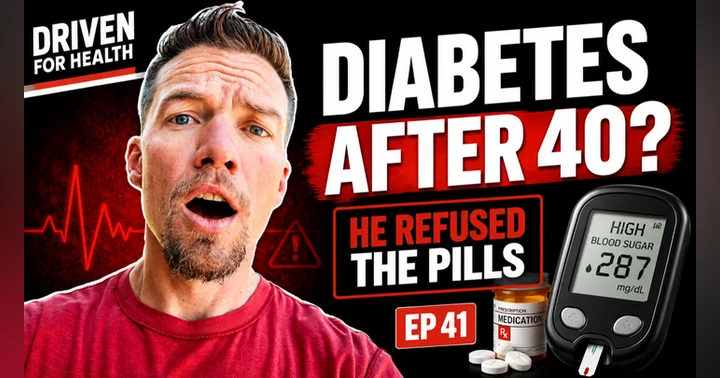
Diagnosed With Diabetes After 40: Why He Refused to Just Take the Pills - 41
You walk out of a routine checkup with a diabetes diagnosis and a plan that is only more pills. Cliff Beach heard type 2 diabetes and high blood pressure and high cholesterol on the same day. He tells Coach Brian what he changed in his food and movement. You learn the warning signs men ignore until their labs get worse.


 YouTube
 Cliff Beach walked into a routine doctor visit and walked out with type 2 diabetes, high blood pressure, and high cholesterol on the same day. The plan he was handed was more medication and no clear next step.
(Have you ever been handed a diagnosis with no real plan attached? See what Cliff did instead of just accepting it.)
Coach Brian sits down with Cliff Beach to break down what Cliff calls the Hollywood Shuffle, the grind lifestyle that feels normal until your body pushes back. Cliff explains the warning signs most men ignore until their labs get worse, why managing it with pills alone leaves men stuck, and the nutrition and movement changes that helped him lose 50 pounds in five months. He also talks about sobriety, stress coping, and how tracking and simple structure created lasting consistency.
By the end you will know how one man turned a diagnosis into a wake-up call instead of a life sentence.
Main Topics:
- The Hollywood Shuffle and why it quietly wrecks a man's health
- Warning signs most men ignore until their labs get worse
- Why managing it with pills alone leaves men stuck
- The nutrition and movement changes behind a 50 pound loss in five months
- How tracking and simple structure build long-term consistency
- How more energy and mental clarity change how you show up at work
Connect with Cliff Beach at his blog, sidehustleflow.net. His books include Side Hustle and Flow and Shape Up, with a new book, The Daily Grind, releasing in February.
Want help applying this to your own health, weight, energy, or lab numbers?
Coach Brian Parana offers Health Hot Seat coaching segments for men who want a clear next step with nutrition, fitness, weight loss, blood pressure, cholesterol, A1C, or daily consistency.
Learn more about The Call To Rise, a 100-day coaching program for driven men over 40 who want to lose weight, improve their health, and rebuild confidence:
To connect with Coach Brian:
brian@brianparana.com
Disclaimer: This podcast is for education and coaching support only. It is not medical advice. Always work with your physician before changing medication, treatment, or medical care.
- Coach Brian coming back at you Driven for Health podcast. This is the show for men over 40 that are working out or maybe they're not and they just realize that in this phase of life it's crazy busy and their body and their health have taken a backseat because of life, family, kids, all those things. That's where we're bringing on Cliff Beach today.
- This is going to be a live interview. I hope that you enjoy it. Cliff Cliff has lived the the grind that most guys do, right? The early go go go late nights. He was a musician and still is. We'll talk about that. But some of the the lifestyle that goes along with that, we call it the Hollywood hustle and the Hollywood Shuffle.
- Now, with that, these symptoms caused some poor health to start showing up. And Cliff realized, hey, I'm overweight. I cannot keep living this way. made a dramatic change in his life from reversing some major chronic illnesses. Yes, you can reverse diabetes people to stopping drinking and just prioritizing some really bigger things in his life.
- This is a real story about a real person that chose to take a different direction. Result has been compounded in his life now from his his being a musician to his career to his relationships and all that. Cliff, welcome to the show. So happy to have you. Let's open up with a powerful statement. What's one thing that you want the listeners to take away from our conversation? >> Thank you, Coach Brian.
- Uh the powerful statement is you have to pick and choose your own heart, right? Being fat is hard, being skinny is hard, but at the end of the day, you have to choose which path you want to take because ultimately life doesn't get any easier. You just have to get better. constant and never- ending improvement. >> Oh my goodness, I am in that stage of life myself. Four kids.
- My wife and I are both self-employed. My wife actually has two businesses and she's a travel agent and sending people on bucket list trips and does some other things, but this is what I do. Oh my gosh, the dayto-day responsibility stack and life. If if I don't have skill sets, then I quickly fall behind and get caught up into the shuffle of not taking care of myself as well.
- We had a pre conversation here and talking about the Hollywood Shuffle, the lifestyle that you lived early on that created not great habits, behaviors. What? Describe that. What's What's the Hollywood Shuffle? >> The Hollywood Shuffle or the Hollywood hustle. you can do it wherever you are. So, it's not just to to LA, but LA being one of the most expensive cities and being a musician or creative there >> and seeing the the inflation of >> the cost the cost of everything is going up, but the wages are not going up to the level of the cost is that you end up
- wearing many many hats, which is great because you learn a lot of things, skills, relationships, all sorts of just networking and opportunities, but you're still hustling. fun. >> Yeah. And the thing is is that you forget even though you expand and want to do more, you're not a robot. You're a human being.
- You have to power down at some point or your body will scream and yell at you at some point when it was whispering at first for you to pay attention. So through this whole process of doing the shuffle, you're doing whatever you have to do to make ends meet. It's great because you're taking control of your life, right? You're saying, "I'm going to happen to life.
- life is not going to happen to me. But it's but it's still hard. It's still difficult. So, one is figuring out how do I create the ecosystem and and build all that and have the sustainability and enough income and enough gigs to be able to do that, especially being self-employed. And for the musician, the hustle is knowing that you are self-employed.
- It's not just about being great at your art. It's about being great at your business. It's about you, Inc., you're a company. You have >> your personal brand, >> you know, how you look and how you uh portray yourself to the world and how you show up in social media and people are are tracking you. People are looking to see you do well.
- They're looking to pull you down. >> So, the the the hustle is you're all the things all the time. But being everything everywhere all at once. There's a great movie in Hollywood, but it's not a great life because the chaos just becomes you're you're not going to be able to keep up with ever growing demand.
- Like at some point you just >> you as one person can't scale, right? So you have to figure out like how do I scale my skills? How do I become like a robot? Well, you have to start doing things that are recorded and on demand and content that people can pull down so that you can have passive income. They can find you while you're asleep.
- Someone can find your music. That kind of thing. >> So, it was just kind of >> speaking right to our audience. These guys that listen in, they are busy. They have families. They are in their own phase of life. I find that 40s and 50s are their own battlegrounds in a sense where you have to stand tall.
- You have to have energy because as Cliff was just saying, there's an undertone of energy exchange with any type of transaction with humans. You either win, you get a plus one, or you lose and you get a minus one. That person will see it in your posture, in your body, in your the language you use, how you come across, which is so important.
- So you were a musician, an entertainer, late night. Let's let's go back there a little bit. What were some of the lifestyle, the habits, routines that you got caught up in at that point in time? >> Yeah. Well, musicians, most of them, I wouldn't say are the poster childs of health. Many of them end up unfortunately dying early from a a myriad of things.
- one, not all musicians have access to to health care all the time, but um yeah, having late nights, being up late where a lot of us are night owls and you're doing a lot of things. I mean, we when we get into the zone, we can laser focus and be working all the time. Like we want we want to be working. We flow, right? You need that energy that that flow like state >> and that's what you're seeking to get to that state of uh even the great teen spirit nirvana flowike state right to to have some really really good bangers out
- there and make your music elevate you. >> Yeah. So you think that when you sleep or power down or rest or stop to pause then someone's going to eclipse you, right? So you're like, I have to keep going. I have to be going. You think you're building up this like Energizer buddy.
- So like in your 20s, it's like almost when you're in your teens, like you're still rapidly changing and growing and like evolving where like you have this excess energy to burn off. So you can you can eat a whole sleeve of Oreos and you don't get fat because [laughter] you're you're not at that point, right? So you don't So then you you build all these great habits from childhood and teens and in your 20s and you think >> I'll live forever.
- I won't have any help there. Nothing will happen to me. Um I can go go. I'll take on more >> when you fall down because life's going to knock you down. You bounce. >> Yeah. >> But when you get older and you fall down, you're like, "Ow, that hurt." Slowly get up and you don't realize that that is coming. You always say it or hear it.
- Even me and gonna be 43 here in about a week or two two weeks that my calves when I go run don't want to cooperate like they want I can't just go wake up and run anymore. I probably should warm up and foam roll my calves before I go run. >> Yeah, that is definitely the thing. Whenever I see kids running around, I think to myself, you know, God has a sense of humor because like, why did you give them all the energy and their full heads of hair and and luscious locks and highlights? It's like they they should be old Benjamin Buttons exhausted.
- >> Then when I'm 40 and I need it, that's when I should be >> my the best. But >> hopefully you figure out a way to start aging aging backwards. Uh but ideally it's like you know the music life you're eating late because you're up late and then you're eating whatever is around and you're eating what you can get which isn't usually the best quality food because you're usually not thinking that way for a lot of us heavy drinking you're out you're getting paid in alcohol >> party right that's the energy in the environment usually that you're in.
- >> Yeah. And also certain musicians depending on your like are you extroverted, are you introverted, are you inverted, whatever it's like your social battery burns out. So then more more alcohol and drugs or whatever it is like coping mechanisms. Right now let's let's take a quick time out here. >> Cliff was a musician but not necessarily everyone listening in is a musician.
- It doesn't matter. it the the career path of someone in their 20s of doing jobs and and starting to create that going into an actual career and then getting responsibilities and promotions and people under them and all this this this mount. So it's the same difference of where I don't have a lunch today. I don't know what to do.
- Or I'm going to go to this office meeting lunchon to meet with a client and I'm just going to eat whatever's there cuz this is fun. Or an after work experience. Oh, work's buying. Let's have some fun here. These are all related to any industry, any job that you fall into these bad patterns of behaviors, eating habits, drinking, whatever your coping mechanism is.
- for for the love. We see it so much now is screens on screens on screens. Everyone's staring at a screen all day long. And the the the other S in our world, the sun, and nobody sees it anymore. >> Yeah, you can tell that from the lack of vitamin D that people have and just also how the seasonal effective disorder and other things of not getting enough sunlight and and stuff like that and working in an office.
- I mean, yeah, being that sedentary lifestyle, not moving enough affects us. Uh, we don't notice that as we get older, but it's like a you've been so comfortable in a way um that that is damaging you. You know, people in the blue zones and stuff you study, they get older and and their bodies are still working properly. They're out gardening and climbing steps and doing stuff.
- >> It's just a natural thing. We have to create centers for gyms and stuff to be fit now because we just aren't as active as we were, you know, hundreds of years ago. >> But uh but yeah, no matter what the type of job it is, it's like you >> nothing happens all at once. So all the creeping up that's happening in the background, you're not going to notice.
- You're not going to notice that you're starting to get an hour or two less of sleep or a few ounces less of water or you're compromising the protein. Exactly. Yeah. Well, that's it's like it's like boiling a frog. You can't do it all at once because that's how you it then like overtakes you that eventually now you're correct.
- >> Now, what was the timeline of that say crescendo toward poor health where you finally realize, oh my gosh, you know, what was that timeline? >> It was creeping up like in my 30s. I started to slightly feel it and I, you know, you yo-yo. So, you start to make some changes. You have some good months. You say, "Okay, I'm get to the gym.
- I'm going to get a trainer. I'm going to get a nutritionist. I'm going to like tackle it. I did many cycles of like let's do selfish diet, let's do >> you're trying to figure out I want to do something. >> Yeah. Yeah. Yeah. So you're doing all these things and then but you're realizing it for years I didn't realize that diet the way that humans use it is like the antithesis of what diet is in the scientific community that diet for animals is like what they would naturally eat and gravitate to.
- It's not the junk and food science that we've created. >> Yep. >> The thing is is that you have to as an adult, you have to push back on everything that you were sold. Everything you have to assume was a lie. And now you have to go search for the truth. You have to retach yourselves. Like we all grew up on the food pyramid.
- Now we know it was a myth, right? That it was lobbyed and people paid for that. >> It's like let's jump into the word diet itself. When we say the word diet, people think South Beach. They think Mediterranean. They think Atkins keto paleo, the paleo diet in a sense. To me, we're any person I've ever worked with, we're using sciencebacked information around nutrition to implement the foods and the choices and the portions into the diet, the foods that you eat to then get the look, the feel, the body that you want to live in with the energy and
- the anticipation and excitement of what your life should look like. You want to be able to keep up. That's a big tricky thing, right? We've been sold that diet is this diet culture, this I have to withstand this or not do that or restrict or just not eat or whatever to to lose weight in a sense. >> Yeah, you're correct.
- I mean, it's not it's not a short-term solution is what was pitched to us. It's a lifestyle. It's like this is what you're going to be eating for life. So, you need to pick something and adapt and adjust and improve on that something that you can live with. For instance, like if you go on a diet and they're like, "Okay, this is the sardine diet.
- " Well, if you don't like sardines, that's that's not a great diet for you. Also, like one food all the time, no matter what it is, even a great thing, will have lack of benefits at a certain point. You'll get too used to it. >> Chicken, broccoli, and rice is only going to provide the micronutrient of chicken, broccoli, and rice.
- Then, you might be deficient at some point in other ones because of lack of variety or color. >> And they Yeah. You're not even Yeah. And you're not even getting into like the microbiome that you need like 40 different >> varieties of things to to help your gut and then that your gut is the the second brain.
- It's important to be able to focus on a lot of things that are healing the gut. You might not know that you have leaky gut or or deficiencies and in certain things and how that affects your energy and and the and the >> right >> not only are you overworked by the abuse of just what you would normally think of as abuse, but it's the abuse you don't see is that you in the background, you know, your your your gut and not fixing that for for 20 years is going to have a lot of different things than if you're like, "Okay, let me start working on
- it." Again, the word abuse, let's define it. We think of a physical abuse or something. There's a lot of different abuses out there, but that's the the first common one that most people physical abuse, but you are abusing your body every day by choosing this poor ultrarocessed food over this whole food as an example.
- It's just a one micro decision or one influence from a billion-dollar industry that is marketing to you to eat this ultrarocessed very tasty food sciencebacked fun little package container of food thing if it is even food right it's edible it's calories but should we label it food I don't know but that that is a it's a a distinction there that that clip is is saying now what were some of the health issues so it took a couple years what What were the health issues that started showing up? Say where you were at when you graduated high school
- to body weight wise and some of the the poor health conditions that you accumulated doing these not great choices in the Hollywood Shuffle. >> Yeah. I mean, they started showing up in my well originally like in my teens, but it was like they were much easier to control and fix. If I made sudden diet changes, I would see pretty quick results.
- By my 30s, I started to see the taper and slow down. Mid30s, I would say, is when I had like fatty liver, and I wasn't sure what that was. They were like, "Okay, just avoid fatty foods." I'm like, "Okay." And then period, no fried foods. >> Yeah. And I was like, "Okay, fine." Then, uh, and then a few years after that, I really wasn't feeling well.
- And I hadn't been for like a physical in a couple of years until like maybe six years ago. Um, I got diagnosed with diabetes, type two diabetes, high blood pressure, high cholesterol, and they're like, we're just going to put you on these pills so that you can manage it. It just was then on the journey of like, okay, I don't I don't want to be on medication forever.
- Eventually, it just was like more medication, more medication, and the cycle of like, okay, I'm gonna have to do something about it. like I wasn't getting the right advice to be able to actually reverse anything. I was like managing it which meant like I was just living with it like live with it basically. >> I didn't want that.
- Not not only because it's like not living your best life but eventually like I could just foresee that just more problems were going to start stacking like it was starting the medicine. It's like you ever read that book if you give a mouse a cookie like as a kid? Yeah, we have it in my house still. Yeah. So it was like that.
- It was like, well, if I give you this pill, then this pill causes this. Like years ago, when my mom was a kid, she would have these headaches. They gave her a pill, but the that pill gave her a stomach ache, and that stomach ache gave her like she could had to go to the bathroom. Like it was like that's what happened.
- It was like the pills started affecting the other organs. >> One pill creates another pill. >> Yeah. But I was like, but this organ wasn't nothing was wrong with that before we started taking the pills. And they were like, no, it's not the pills. It's just the progression. And I was like, I don't believe that. So, um, [laughter] so yeah.
- So, I basically left that doctor and got a nutritionist and went on this journey of I was like, I want to lose 50 pounds in five months. Put a plan together. >> So, let's go back to the actual peak of the despair in a sense. If you're if you be kind enough to share the body weight, the the number of pills you're on, how you felt, like really step back into that.
- I know you probably don't want to, but just think back to that because people listening are in that state and this is how they get woken up by I I can say it's on blue and face but having you on saying the same things. Well, Cliff said this and it really resonated and then I needed to change. So, if you could step back into that just for like a half a second and explain that situation and and and how you felt when you woke up or the all those things.
- Well, I felt I felt pretty gross. I tell people my check liver light was on. But basically, I went uh yeah, I got on the scale about 22 225. That was the biggest I had been. And I'm 5'8. And so, uh a pretty small frame. And so, uh I think my A1C was at a seven. >> Yep. >> And just so people know, 5.5 is when you get categories into pre-diabetes.
- And then so seven is on the lower end of being a type two diabetic, but you definitely are wearing that label now as a confirmed type two diabetic. I've had people as high as 15. If you're floating around here with a A1C of above 6, seven, or definitely eight, you need help. Now, do not put it off. If you have morning blood sugar levels, if you even check them when you do have diabetes and they're above 200 in the morning, you 110 is normal.
- But if they're consistently above 200, you need help. Now, just want to call that out there to the the people that, oh, it's only a seven. No, no, no. He's describing he's a diabetic. And that's the the takeaway we want to just like label here for a second. and he's like, I don't I don't want to wear that label the rest of my life or take medicine to that's associated with it.
- >> Yeah. But yeah, so it's like I had all these numbers which were great. At least I knew like okay the benchmark and what we could do, but they they weren't explaining like greatly how >> diet and nutrition affects you and what to do. Yeah. Like you need like they would always say like you need to lose weight. I was like and how.
- >> Right. Right. And I want to throw in a little caveat here. Our health care system is designed on triage in a sense. If Cliff comes in and he's exhibiting these issues in his health, I can give this pill to then solve it tomorrow. High blood pressure, get this pill. It goes down.
- High cholesterol, here's this pill. It normalizes, right? If I have high blood sugars, insulin issues, metformin or similar, it gets normalized and then you can go back into say a in quotations healthier state of being as where you were before you went to the doctor. And yeah, the doctor knows that you should be doing a lifestyle change, but they only see you for 15 minutes per their office and the number of people they have to see and the insurance that they have to bill and blah blah blah because of our health care system is set up that way. But
- Cliff gets it. And so many people that I talk to leave the doctor's office with the blanket, you should lose weight and cut out carbs and sugars. And yes, we we all know that's the way, but that's not how you actually change. That should be the wakeup call to go find help and and a path, not just Google the internet forever.
- And and that's exactly what Cliff did. He sought out help from a professional and then was able to start grasping what are the issues, the concept, the things that I need to do to start providing solutions to me every day. So you walk out of the the doctor's office and then what was the next step that you decided to say the line in the sand moment? >> Yeah.
- So the line in the sand moment was when I I started on three different pills and then with the metformin got more pills added. So they add another two sent out to five and then I had to take a six pill which I don't even know what it did to be honest at this point and but it caused it caused a reaction not like an allergic reaction but it caused like the same reaction if I started taking there's contraindications on medicines against each other or it's a simple if you're taking certain meds you can't eat grapefruit because there's a very big interaction that you don't
- want to experience. Yeah, as an example. And yeah, that's true. Yeah. So, you know, we couldn't know what it was. We just knew, okay, this isn't going to work. And then it was kind of like pitch, well, you need this pill. I was like, well, I can't take that one because it's affecting the other ones and I can't not take the other ones.
- I'm just going to have to figure out how can I just get off all pills. That was my goal. And I and I had a lot. I still keep them even though I don't take them, but I keep the bottles. So, I look at them and I'm like, remember when you used to take all those pills? Right. >> Um and so um yeah, the crazy thing is that you know, so with the insurance that I had at the time was with that doctor, I had nutritional counseling as a part of the insurance, but they never referred me to anybody.
- I had to I just looked it up, said this is in my network. Let me do it. But but I was like, I could have gone to that nutritionist like years before because I was with that doctor for a couple years. And I kept saying every time, I'd like to get off medicine. They're like, you need to lose weight. I'm like, "How?" And then nothing happened.
- So, I think, you know, you have to become your own advocate. Unfortunately, it's your body. Yes. You live with it. >> And it's like that. I had a I had a friend that took her dog to the vet and they had a paw problem and they were like, "Well, we could just cut it off." I was like, "Because that's not your foot.
- That's how you feel because it's not you." So, the doctor will never be you to care with an empathy. I don't want my foot cut off from diabetes. Let's do something together about it. They never presented me with that. It's genetics and your genes and your ethnicity. They just weren't going to do anything. >> I think that we're maybe a little bit sure there is some nature in this, but it's very much more nurture in our environment in our society.
- You could have said the nature burst nurture situation maybe the 90s or something. Oh, you have genetics of diabetes or heart conditions or cardiovascular disease. Yeah, those still run true to this day, right? You can go get your your DNA tested and you might have some traits that can lean you toward that. But the nurture side of this is significant in the impact and the acceleration of you experiencing those things can happen through the what you put in your body, how much you move, how much water you drink, basic things,
- how much sleep you get to and and just getting to some of those basic things can make a big resolve the issues. So, you you took some action. You found a professional, which is key. If your check liver light on or check engine light in is on in your car, you're not going to YouTube it and figure out how to do it.
- Maybe you need to figure out how to change the air filter. Yeah, that's pretty easy, right? You don't need to pay the the oil change place an extra, you know, $15 upcharge just to push the the inside thing and slide it in and out, right? You can do that yourself. But when we have a a large number of weights and a number of chronic illness or medications associated with that, you do need professional help with someone who does this for a living.
- >> And also just the accountability, knowing that I had to show up and go over everything with this person and knowing I'm a truthful person, like >> I I'll I'll do it because I don't I don't want to show up and be like, I didn't do it. This didn't happen. >> Yeah. And it's to your own it's to your own detriment, you know, too.
- It's like you you're going to be better by doing it. Most people can be self-managed to a point, but it's nice to have an advocate, someone in your corner, someone who can just tell you this is working, that working, tweak, um, or this is working, keep doing that. But, I mean, with doctors or whoever you're talking to, it's about like more of a holistic approach.
- So, it's like when you go in there, they be like, "Okay, we see these happening. We see your A1C. they see your cholesterol and chocolate fats, whatever it is. But um how much fast food do you eat, >> right? >> Like how how many drinks actually do you have in a week? Cuz sometimes they're like, "Oh, I have I have two a day." It's like two a day, two an hour, you know, like so like you have to be realistic.
- And so then from there, it's also with choosing your hard. Is it difficult to give up alcohol and be out with people at a gig and everybody's drinking and you're the odd man out? No, not now, but in the be but in the beginning it's huge huge, right? And some of it's the social circles that you hang out in. Uh the relationship you have with those people.
- I I see this all the time is people start changing and all of a sudden they create friction in their life. We don't have to do that. You don't have to lose your friend group. You just communicate to them differently and you have a different lens in which you're viewing the world through of a healthier lens in a sense. And you going out and drinking three beers or five beers in a night is not acceptable anymore because it doesn't work for you.
- It doesn't take you towards your health goals. It takes you away. And humans in general are self-preserving and we want to live as long as we can and as healthy as we can, but in that one moment of time and experience, we don't see that. We don't experience that that glimpse of, hey, you're three deep. You are pushing toward five if you're not careful.
- Oh yeah, let's not forget the 1,200 calories you're going to have in the burgers and beer alongside because it just sounds good. And now you're 2,000 plus calories in at that one experience going in way the wrong direction. >> Yeah, there's safety issues and other issues. It's not about judgment and it's again you get to choose and pick what you decide to do but for me it's like you gain a lot of clarity the mental clarity focus stamina because you don't realize especially with alcohol because of depressant like
- >> yes >> there's there's a lot of stuff that you don't get done like productivity wise because it's it it slows you down. >> I get tired if I drink I get tired. It's I I'll I'll I'll get that little buzz in a sense, but then I get tired and it's like yeah, my my enthusiasm and excitement or productivity definitely takes a dive and it's just not as productive.
- I'll do I'll drink socially, but I usually don't drink much at all week to week, dayto day. >> And yeah, >> it has a lot to do with identity, too. Like people identify you with that. Same with same with illnesses. When people take it on as an identity, then it makes it harder to get out of it, right? So, if they're like, "Well, that oh, you know, I oh, you know, I'm just not feeling well.
- That's just my diabetes or whatever." >> You'll just die from that because you're you'll never let it go because now you don't you don't know who you are without it. And the same way when I gave up alcohol, people like people like you're so fun and you do that. It's like, but it's like, but I'm fun before. I was like, >> I was like, how? I was like, I was a fun kid.
- Like I I had years of not drinking before. I was like it can be done. We've all proven that 21 years it can be done. >> Yep. >> But it's again I you really you really have to be um the four agreement says you have to be impeccable with your words, your verbiage and how you speak about everything. It will show the trajectory.
- And you have been a coach a long time. I've coached people in different arenas. And what I've learned is like there was a guy and he talked about all these couples and he could watch a video and be like he could tell if you were going to get divorced. Like he just could tell like from how you spoke. And in the same way I can tell talking to a person if they're ready, if they're serious, if they're going to follow through.
- >> Oh yeah. >> By by the words they used. Anytime like like someone was like, >> "I'll see you sometime." I was like, "We're not scheduling this because you're you're not going to you're not gonna show up." I can already tell you've built a out >> and I'm like, "When you're serious, >> there's a trap door somewhere that you're going to sneak out." Yep.
- >> Yeah. And so when you're serious about it, because that's the thing. Every time I do something that's like people would say an aggressive plan, I like I do that because you're either in or you're out. I was just telling a woman the other day, I was like, "Is there a way to be half pregnant?" She was like, "What are you talking I was like, "You can be it.
- You either are or you aren't." That's how things work. And she's like, "I totally get it." I was like, "Yeah, you have to be full in hokeyp pokey wholeself in other work." >> I I use that term waffling. You you just waffle back and forth. You actually don't make any progress at all for an intermittent amount of time because you feel good of taking action and then you start to coast.
- This is just a human, it's human biology. Oh, I'm getting really successful now. Then we take off the edge of just paying a little extra attention or doing the thing a little better and all of a sudden you're you're coasting and you slow down as a result and then you get motivated and you just really don't change and and you do have to have some guidance parameters and say accountability.
- You probably heard this so many times. I know what to do. I'm not doing it. And as you coach people and I've coached people, all you got to do is get them to trust their word. If do the things you say you're going to do so that you trust yourself and in those moment of time when you need that absolute trust from you yourself and not someone else, that's when it's important because you could have the best, you know, world-class team behind you.
- But if you're not going to trust yourself in that moment of time of following through on that thing that you said you're going to do, then it doesn't matter the expertise that you have behind or whoever there. It's really important is just is we have to have very frameworks or patterns or routines, habits, and humans just do better when they have parameters to live by, more structure.
- Everybody wants to be willy-nilly with their time, but what happens after retirement? If someone's not organized in structure, they die quickly. Unfortunately, they they all their life savings go out the door because they're in poor health and they don't actually get to experience it because of the lack of structure and and just being social or whatever.
- >> Yeah. I mean, it's definitely it's hard because there's a lot to navigate. There's a lot of moving parts. a lot of pieces. But yeah, I mean having a plan, setting goals, when that goal is done, setting another one. I think the main thing I always explain to people in terms of perseverance or what they call true grit, it's doing it when you no longer feel like doing it anymore because you're going to you're going to plateau.
- You're going to have great success and then not so much success. You're gonna have days where you don't want to go to the gym and you don't want to eat those foods and you don't want to go do your steps when it's raining outside, but you have to. You made a commitment to yourself. You know, like if your kid is stuck at the park and you're going to go pick them up, like, do you want to go out in the rain? No.
- But you made a commitment. They're depending on you. But your inner kid inside of you is depending on you to make this. It reminds me of a gentleman I worked with, Bill, and he was so timetight in his schedule because of he owned a business. He had lots of outstanding responsibilities to clients. He was in finance, so he managed a lot of money.
- There's a [snorts] lot of pressure there. He would get up, he'd be looking at the the markets and going to work and talking to clients, looking at the markets, and then he would go home. But when he decided to change, he he would be he was so sedendary during the day that he actually had to set a large chunk of time in the evening and his personal time to then move his body for 90 plus minutes straight through.
- Not hard. or he didn't have to do crazy intense workout, but he'd have to go on a a walk, a hike or or or a bike or something for 90 straight minutes because his daytoday life was so sedendary and he didn't realize it until the point of which he got called out and I said, "Hey, can you move 10,000 steps?" It's actually one of my things.
- I call it the million step challenge and 10k steps over 100 days is 1 million steps. And some people never believe that they can move that. But if we have a plan and organize and and time and we we make intentions, then you can actually accomplish that. It was just a big thing that a lot of people do and they don't realize that their normal patterns of behavior are so sedentary or so counterproductive to taking care of their own health, you you might need a a third eye or someone peeking over your shoulder in a
- sense to to get you out of your own way and unblock you. >> Yeah. What were some of the Go ahead. >> It's a re it's a reframing too for this person. >> Oh yes. >> So it's like you know it's like well he had he was so busy that he had to carve out like his personal time. It's like well great it's your personal time.
- Well what else would you do better than that for your body and there screen? >> Yeah. It's like well if you're if you're looking at the markets you can tell >> this is a good thing to buy or not. If you're looking at you and your health would you buy that? Exactly. Get out there and do the steps. do the right even that whether say you're in a relationship right even if you're in a committed relationship you still want the other person to buy into you and you want to be a marketable asset that they have and that they leverage you don't
- want to become the person that they are the caretaker for that's not a good relationship at all when it comes all said and done and this gentleman was in his 60s when we we finally snapped him out of it and made some pretty dramatic changes just by restructuring his day. Nothing hard, just getting more walking, more water, more movement, more focused nutrition.
- When you were going down with say the the nutrition help and all, what were some of the food changes, the the daily patterns, behaviors that shifted most for you that were had made the biggest influence on getting down 50 pounds? Yeah, I mean I was doing intermittent fasting and that really helped uh for people with diabetes.
- What intermittent fasting does is it like having that longer window of not eating allows your body to like absorb more of the excess because it's not focusing on digestion as much. People don't realize that digestion is really difficult for the body. That's why in fight or flight you stop digesting. And so you don't realize those autonomic responses take a lot of energy.
- And so yeah, it was like that and then figuring out like focusing on more protein and fiber and whole foods and cooking foods more than eating out. >> Yep. >> But mostly yeah, I did my 10,000 steps every day. So I got to the million and I would do much more than that. People were like, "How many steps have you done like in one day?" I was like, "I don't know, 35,000.
- " They're like, "That's crazy." I was like, "I walked for like 12 hours." But it's like I take them all my calls. I started moving it cuz Me too. Yeah. Walk and talk. >> Yeah. And I And I noticed I get better ideas than doing that. But it's like hydration and then sleep. People don't realize that like if you don't sleep, you gain weight.
- So like if you if you only like I would sleep like 5 hours a night. And when you do that over time, one people say like you have a sleep debt and like you don't like you can never repay that. Like well I haven't slept so let me let me sleep for like sleep on the weekend. No, it doesn't it doesn't work like that. >> Yeah.
- And so then and also you won't like you look at your client it's like well he got to 60 he didn't become that in right the last year he had been that way for years it's a neglect and so >> yeah it was just focusing on uh the tracking the accountability I I've been tracking everything I've eaten with a calorie deficit so I did have that um I've been tracking that >> almost 900 days straight as a street >> and that but knowing doing that like you you I would say in theory for the most part you could you can eat whatever you want at the calorie deficit but what
- you'll learn is how to budget them. >> Yeah. Yeah. Exactly. >> So if you go if you go to In-N-Out or wherever Cheesecake Factory you blow it you're like well I just stopped eating. That was the >> commit for the day. I I myself have been in that place. I did the Elvis pancakes at 11 a.m.
- and it was two dinner platter size pancakes with all the toppings, the butter, the syrup, bacon, peanut butter, banana, and yeah, that that was basically the only thing I ate in the whole day. Said, "All right, I guess I spent my budget here." It was very good, but I remember this from easily 12 to 15 years ago is when I did it, and I still recall that experience.
- I enjoyed it, but I stopped eating the rest of the day because that was the consequence of what it is. Now, I just want to point out Cliff used tools. He found a professional. He leveraged a so whether we call intermittent fasting or not, there's a time in the day that he ate and a time in the day that he didn't. So, he had basic structure around, oh, it's 900 p.m. I'm hungry.
- You're not eating because you don't eat after 9 all of a sudden, right? That becomes the play. Now, I eat right before I go to bed. That doesn't matter because my time window shifted. I don't usually eat before 10 or 11 o'clock. actually ate right before we got on this at 10:30ish, 10:40 in the morning and my last meal was 11:00.
- So, it timing of the day doesn't necessarily matter, but he's he's setting up boundaries. He used tracking as a tool to help identify what is in the food he's eating, the proper portions of those foods, the combinations of the foods, understanding calories as the most important. If you go back to episode five, I talk about calories.
- Episode six, I talk about the macronutrients and how to understand what protein, carbs, and fats and how they work together and and then we get into say the lifestyles episode 11 that I dive into that. So, you can go back to listen to those to get a little bit deeper into specifically what might be a good option for you.
- But just saying Cliff found guidelines, found rules, found boundaries that he could commit to. I love saying this and you would hear this in episode 30, Brianisms. What we do in two weeks, we do in two months, we do in two years because that's how you create a lifestyle that you can continue on and not burn out.
- And that's some of the undertone of what we experienced in the Hollywood Shuffle phase of our conversation. And a lot of people are still trying to do their own Hollywood Shuffle in their 40s with juggling all the things. And and we both understand that. That's why we're talking to create some inspiration connection with people listening.
- You have a choice. I think that's one of the very first things Cliff said is you have a choice to decide what's your hard living life in a healthy way or living life in an unhealthy way. Either way, it's a direction and it's going to be its own challenges. It's just as hard to be healthy as it is to be 50 pounds overweight.
- That's that's a really different hard in terms of time, energy, money, right? Even if he has great insurance, there's still a significant amount of costs on time or on his insurance bill. Right now, he's already in the next bracket up. Oh, this guy gets charged more because he has six medications uh under him. So, it it affects his bottom line is the the money in his pocket.
- If he's already hustling because he lives in LA, why would you want to make it even harder on yourself in a sense because of a poor lifestyle and poor day-to-day choices? So, what's the payoff, Cliff? So, you you took action. You you had poor health and it finally slapped you in the face. A doctor's visit. It was just like bam, less change. You got help.
- You use tools. What's been the payoff to tell people what by taking care of yourself? What are the bigger things that now you can spend your time, your energy, your passions on as a result of living in a hard [snorts] in quotations better health situation than you were? >> Well, I mean, I definitely was able to unexpand my business not only in uh my work.
- I work in corporate digital marketing, but in music in a variety of areas. I've been on TV as a houseband leader and then going on to be on radio and and a bunch of stuff. But the main thing is that I have the energy and you've already cultivated so much discipline in so many areas that spilling that over to the others. It's like you exponentially start to make more.
- Plus people, it signals to people that you're a serious person. Like at work, everyone saw that I lost the weight. They they're like, "Wow, that person really can focus and be dedicated to something and and encourage them to see it." Not because I was like, "You should do this." But it was like immediately once people saw that transformation, people were like, "What did you do? What did you do? What did you do?" >> And that's but leading by example, but also like if you're doing the right things and it and you're showing up to life and and that's being pushed out
- there, people will talk to you. They will ask you naturally like I you don't have to go advertise that. They will know because they'll see it. They they saw you before and they know after. And yes, the benefits of like how you look. So marketing, pictures that we took after, publicity stuff, everything looked great because it was just like a different person.
- Um, and and as like as you get older, unfortunately, marketability for a musician, it's like you you market how you look. So like by looking younger, like people are like, "Oh, you're in your 40s. We would never know." It's like, "Yeah, that's nice. It's a compliment, but what it means is that you can go into other arenas.
- like I can go and perform with people who are 20 and it just all works out >> because they're like, "Oh, that >> I don't want to I don't want to show up as the old man." Old in terms of seasoned and and great at what I do, but not old in terms of like the decrepit and wheeling me in there. >> The set starts at 10:00.
- Cliff, you ready? It's like, "Oh, that's past my bedtime. I can't do this." >> Yeah. Exactly. But it's like also just like when I said you clear up your thoughts, you get so many better ideas. I can't prove why, but it's like your your body now can it's freed up to be able to think bigger and >> you're not thinking about what you only have so much bandwidth.
- You're not thinking about what am I eating today or how do I feel? I feel so tired right now at 1 2 3:00 or in the afternoon, but maybe even 9:00 in the morning. Wow, I just woke up and I'm exhausted already from and I don't want to think. I don't want to do because of it. Yeah. >> And your attitude and your temperament changes too.
- It's like you have the energy to withstand what's coming at you without taking it on. So it's like dealing with people and other things. It's like you have more capacity to listen. Like you don't have this overwhelming feeling as much because you've taken it. Especially once I started doing like a lot of Tai Chi and Chiang and stuff in the morning.
- I'd wake up at 8:00 a.m. and start my day at 9:00. Having that hour for myself carved out and then doing my steps and everything else. And also kind of having a plan kind of pre-planned in place, it took a lot of that thinking. That's why Steve Jobs always wore the same shirt and pants because he didn't want >> decision fatigue.
- >> Yeah, decision fatigue. Some of the key components that Cliff is talking about resonates with the underlying protocol that I use is MFP movement. Movement is energy, food choice, and portion control. That's all that Cliff did. He just found it in an organized package and some accountability to make sure he did the things he knew he needed to do in the first place and a longer term sustainable way.
- I think that's what both Cliff and I are saying here. in direct alignment of find a path not a diet but a pathway of sustainable lifestyle that actually gives bears the fruit of the effort which you've seen I've seen when people get more productive and are more successful your credibility your your energy your magnetic personality starts to shine and opportunities come your Definitely.
- And it's like Zig Ziggler when he was making his first book see at the top he was like I have to lose 40 pounds because he was like people are going to poke me in the stomach that lard belly and be like do you believe what you're saying? Like you want us to live our best life. Are you doing that? And that was something I thought about too as I got into the self-help space and other stuff.
- I was like, people are not going to believe that you believe we can all live our best lives and have energy and vitality and happen to life if if you're not showing that outwardly. And so, um, you know, but it's a journey, >> right? >> It doesn't mean that you're going to get it perfect all the time. And the same way with 12 steps or soy, it's like if you fall off, you just get back on.
- I don't know why we created this all or nothing like, well, I either do everything right or I do nothing. It's like, well, that's not going to be a great life. It's like you're you're going to eat the wrong thing at some point. But by having that trackability, you can now go back and look at it and say, "Oh, that's what I ate.
- Then I didn't feel that well that day. I'm going to do something different." Because whenever I was doing different types of journaling, you would always be like, "What am I grateful for?" And like, "What would I like to change tomorrow, right? Because there's always something that can be improved, of course." >> Um, but ultimately, it's not about >> it's not about the right thing or the wrong thing, but it is about choice.
- And what I mean by that is that you choose your hard and most people will say, "Well, then I just won't choose." Then you've chosen by default. Either way, you have to make a choice. So if you don't make the choice to do the right thing, then you've already inadvertently made the choice to do the wrong thing. And and I will also say when I was in business school at Pepperdine, we had this guy who created he had committed a white collar crime and now he was like rehabilitating by uh telling people about like ethics. And basically he was
- like the the time and the place and the choice to be an ethical person is years before the ethical dilemma comes in front of you. By the time that happens, you're already going to do the wrong thing. And the same way with food and with exercise, you have to make the right choice. way before you know the days are. You have to know waking up.
- I'm gonna put the running shoes on and get out there because then if you don't Mel Robin said 5-second rule 5 4 3 2 1. If you're not shoes on out the door, you'll find 95 reasons not to do it. >> Uhhuh. >> You need one compelling reason to do it because you matter. And putting the mask on yourself before anybody else, it prevents you from being that liability that we talked about that now you're not going to be able to help your family.
- And we know ultimately the men that are in this space, you're here for the reason to be better, to be the provider and help your family and all those things are great and this is going to give you the tools to be able to do it. >> Yeah. Oh my gosh, that is amazing. He said it very well. I hope that you are listening.
- You can rewind it actually if you need to hear that played back. Now, Cliff, uh, let's wrap it up. But you just gave a a really good reason of why they should do the thing, which is take better care of themselves. Now, how do we find you? What What are the things that you're doing right now so people can learn a bit more about who Cliff Beach is? >> Awesome.
- Well, everyone can go find me on my blog, scihustleandflow.net. We do five articles every week for free. Hopefully that'll get you to go check out one of my books. I have side hustle and flow, which was the first one. Shape up, which tells you all about the health journey. And now in February, we'll be releasing the daily grind, which is little bite-size chunks of prompts that will help you move the needle forward.
- 365, because I believe it's a daily choice. You wake up every day and decide to reaffirm that choice. Um, but ultimately, it's it's micro changes, you know? It's like when you do all these things, don't try to do all the things at once. It's like it's like I became sober then I worked [clears throat] on you know diet then fitness like I didn't stack it.
- If I did them all together I probably would have failed. So it's like try to slowly build the habits and then from those habits it creates a snowball and momentum but just keep doing it. Keep keep doing it. Keep moving forward and uh you know you're not going to die on a diet. I know that it's in the word but ultimately like >> you will not starve.
- You know, when I cut the 1500 calories, I did not starve. And I and I want people to be clear. If you feel like you're starving, that's just your body saying like, I've been addicted to sugar. Yeah. >> Right. And that's the thing. You can get up. You can become so sober from alcohol or drugs. And there are programs for that.
- >> But you need to be sober from sugar, white sugar, table sugar, you know, whatever it is. It doesn't mean you never have it. It just means true moderation. And and that's because most of us are addicted to to sugar and and and because we learned it for the not I would say the fault basically of our parents.
- You learn that like when you're crying at here's a cookie. Now you feel better. And you don't know now but you've created a trajectory in that person. It's like when I feel bad I'll grab this. It's like no when I feel bad I'll go walk. I'll feel bad I'll go work out. I'll feel bad I'll go I'll read or listen to a podcast.
- There are ways to cope and other things. And like I said, it's not a judgment thing. It's just an awareness. Having the self-awareness that something needs to change. And then when you listen to the inner voice inside you that's whispering, that's quiet and drowned out, it will tell you what you need to do. And with that, Cliff has said it very well.
- You need to listen to yourself to be able to get past all the crazy busyiness, all the attention seeking that everyone is doing, trying to grab your eyeballs, your bandwidth, your capacity to do anything, any self of type of selfthought and to take care of yourself because if you're not taking care of yourself, someone else is influencing you to make other decisions and you need to be in control of yourself.
- Now, if our conversation hit home, then the takeaway is that Cliff didn't get lucky. He was intentional, purposeful, and he had a huge reason why to get out of the situation that it was in. He outsourced the initial load of getting healthier by finding a professional. He got away from the prescription. He got away from the poor health situ or the labels of that being a diabetic.
- Nobody wants to walk around being labeled that way. And he found a path that created sustainable long-term success. And everyone's path is subtly different. I've worked with thousands of people over the last 23 years doing this. And everyone, we're all doing the same thing. We're focusing on movement, food choice, and portion control, but we have to do it in a way that blends with your lifestyle.
- This creates a long-term successful cascade of opportunity for you and confidence in your career, in your relationships closest to you. This is the pattern I see all the time. And that's why I focus on men's health because you are the leader of your household. You are the person in control, the one that everyone is looking toward.
- And for me, I have four kids, my wife. I have to stand tall. I have to stand proud. I have to be able to take a deep breath in and be able to make a good choice in the moments of challenge or disruption or just crazy of having four kids. Now, if you want to learn more about Cliff, I'll have his sidehustleflow.net that and all his links in the show notes.
- His book shape up to hear his and and read his inspirational story here. The daily grind will be dropping here so you can get on his email list to be able to do that. Now, lastly, if you found this episode valuable, leave a fivestar review. Cliff and I would love to see that. I'll share the impact that Cliff had on you of making a decision to change for the better. All right.
- Well, this is today's episode of Driven for Health. I hope that you enjoy some more of these guest interviews. I'm going to be bringing on a lot more as we go. This is episode 41. And thank you so much. We'll catch you in episode 42.