Here's Why You Sleep Worse If You're Over 40
You go to bed tired and you wake up tired. You check the number on your watch and it says 6 hours and 42 minutes, and something inside you already feels like you failed before the day starts...
That is the trap. And if you have been stuck in it for a while, the number on your wrist is not the main problem. Your relationship with sleep is.
I have been coaching people for over 23 years. Sleep comes up constantly. Energy crashes, brain fog, weight that won't budge, mood swings at 6 p.m. when the family is trying to talk to you.
Almost every one of those conversations eventually circles back to sleep. And the single biggest pattern I see is not that men are sleeping too few hours. It is that they are carrying a set of beliefs and behaviors around sleep that are making the whole situation harder than it needs to be.
The 8-hour target has become the measuring stick for almost every conversation about sleep health. Coaches ask about it. Doctors ask about it. Trackers grade you on it. And the problem is not that sleep duration doesn't matter. It does. The problem is that when you reduce the entire picture of sleep health down to one number, you miss everything else that actually drives how you feel.
The Number Is Not the Problem. The Obsession With the Number Is.
Think about how most men treat sleep. They lie down, check the time, calculate how many hours they have left, try to force themselves to fall asleep, fail, get frustrated, check the clock again. They wake up short of their target and spend the first part of the morning mentally penalizing themselves for it.
That cycle has a name. It is performance anxiety around sleep. And it is one of the more common reasons men stay stuck in poor sleep patterns long-term.
Sleep is different from most health behaviors. With nutrition and training, a certain degree of effort and intentionality is required. You push through when you don't feel like it. You make the choice even when the choice is hard. Sleep does not work that way. Sleep requires a kind of surrender that effort actually works against. The harder you try to force it, the more your brain resists it.
When you treat sleep like a metric to conquer, you set yourself up for a stress response at the exact moment your body needs the opposite.
What Actually Matters Beyond Duration
Duration is one pillar of sleep health. But it is not the only one, and in many situations it is not even the most important one. Quality and depth of sleep, regularity of your sleep schedule, and continuity across the night all play a significant role in how restorative your sleep actually is.
Here is a practical example. Six and a half hours of solid, deep, uninterrupted sleep can leave you more recovered and clear-headed than eight hours of light, fragmented, anxious time in bed. The watch score might look better on the eight-hour night. How you actually feel might be better after six and a half.
This does not mean less sleep is the goal. It means the quality of the time you are asleep matters at least as much as the amount. And chasing duration without addressing quality means you may be spending more time in bed while getting less actual recovery.
There are two categories of sleep that drive most of the restoration happening in your body and brain. Non-REM sleep, particularly in its deeper stages, is where your body does most of its physical repair. Cardiovascular regulation, growth hormone release, tissue recovery, and the clearing of metabolic waste from your brain all occur here. REM sleep, the phase associated with dreaming, is where your brain processes emotional load, consolidates memory, and manages the kind of stress that builds up across a busy day. Both categories matter. And both require a nervous system calm enough to actually cycle through them.
If you are lying awake for 40 minutes before falling asleep, or waking at 2 a.m. with your mind running, no sleep hygiene checklist is going to solve that. Something else is driving it.
The Three-Stage Pattern That Keeps Men Stuck
Sleep struggles tend to follow a pattern. There are baseline factors that make some men more prone to sleep difficulty, things like a naturally higher stress response or a tendency toward anxious thinking. These are not permanent sentences. They just mean the behavioral side of sleep needs a bit more attention.
Then there are what you could call trigger factors. Travel, a new work deadline, a sick kid, a rough stretch at home. These disrupt sleep for days or even weeks and that is completely normal. That is just life. The problem is not the disruption. The problem is what happens after.
For a lot of men, one bad stretch turns into a belief:I am just a bad sleeper.That belief gets reinforced every night. And then something called conditioned arousal sets in. Your brain starts to associate the bedroom with being awake. With being frustrated. With failing at something you are supposed to do automatically.
The analogy that stuck with me is this: imagine getting food poisoning at a restaurant. Then being convinced to go back and getting it again. Now, just hearing the name of that restaurant makes your stomach turn. You have not even eaten there yet. The association alone is enough to trigger the response.
That is what happens with your bedroom when the third stage of sleep struggle takes hold. You can be exhausted on the couch. The second your head hits the pillow, you are wide awake. That is not a nutrition problem or a supplement deficiency. It is a learned behavioral pattern. And no tracker upgrade or new melatonin product is going to undo it.
The Data vs. Drama Question
Sleep trackers are not useless. Awareness has value. Seeing how things like your water intake timing, your evening stress level, or your consistency of bed times affect your sleep can give you useful feedback over time.
But there is a question worth asking yourself honestly: when you look at your sleep score in the morning, is it data or is it drama?
It is the same question that comes up with the scale when someone is trying to lose weight. Some people look at a number, note it, and move forward. Others spiral. They let the number set the emotional tone for the entire day.
With sleep trackers, there is an additional layer of complexity. Most consumer devices are reasonably accurate at distinguishing between being awake and asleep, and somewhat accurate at detecting REM versus non-REM sleep broadly. Where they fall short is in accurately distinguishing the specific stages of non-REM sleep, particularly those deeper stages where much of the physical recovery happens. They are estimating based on movement and heart rate. The gold standard for that level of precision requires brain wave monitoring in a clinical setting.
This means you may be carrying stress and anxiety about a deep sleep number that is itself an approximation. The algorithm behind your score is proprietary. A 68 on one device is not the same as a 68 on another. What matters more is the trend over time for the same device, and more importantly, how you actually feel.
A More Useful Way to Track Sleep
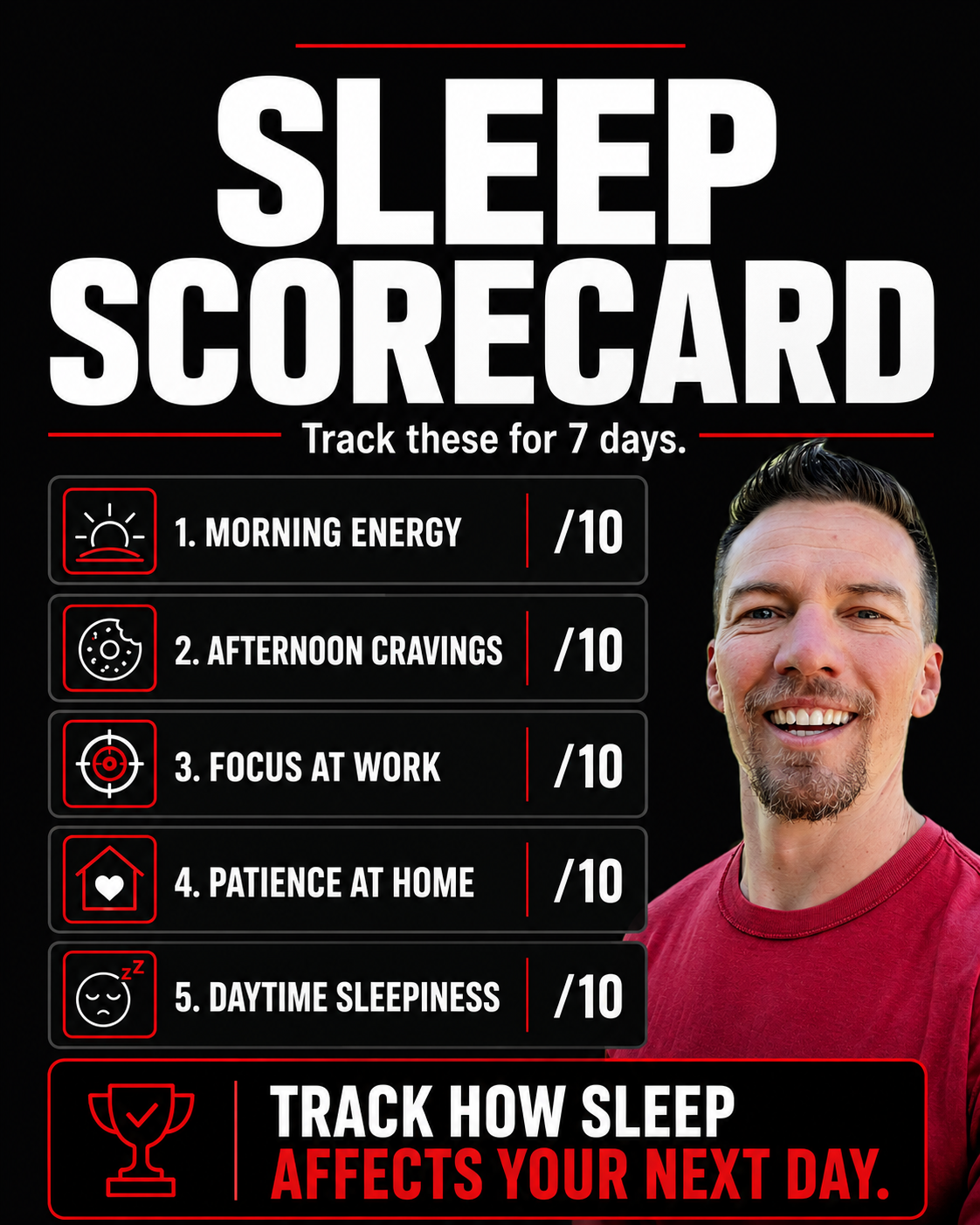
If the number is creating more stress than insight, put it aside for now. Instead, pick three to five things in your daily life that you know are affected by your sleep quality. Energy levels across the day. Mood in the evening. Focus during work. How reactive you are when you walk through the door after a hard day.
Track those. If your energy goes from a 4 to a 6 or 7 consistently over a few weeks, that is real progress. That matters in your actual life. A sleep score shifting from 62 to 74 on an arbitrary scale does not change how you show up at the dinner table or in a high-stakes meeting.
If you want a more structured picture of your patterns without the built-in anxiety of a score, a sleep diary can be genuinely useful. A simple one-page log where you note when you went to sleep, when you woke up, whether you were awake during the night, and what was on your mind. Patterns show up quickly. You may find that your late fluid intake is waking you up three times a night. You may find that your bed time on weekdays versus weekends is wildly inconsistent. These are fixable behaviors.
The Sleep Reset: A Three-Part Behavioral Framework
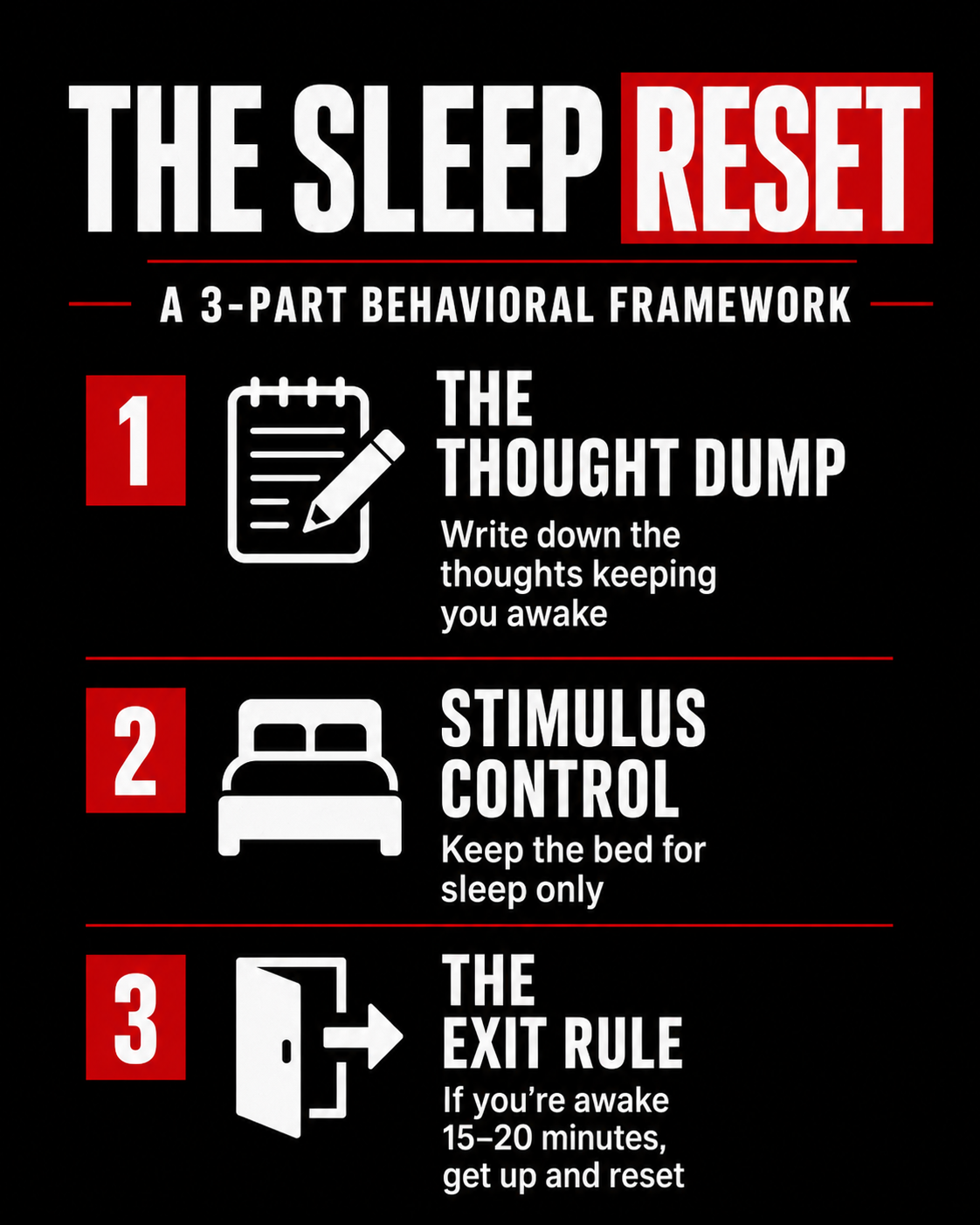
This is not an elaborate protocol. It is three behavioral shifts that address the root cause for most men whose sleep has been struggling chronically.
1. The Thought Dump
Write out every negative belief you carry about yourself as a sleeper. All of it. "I'm just a bad sleeper." "I've never slept well." "I can't function without 8 hours." "My dad was the same way, so I probably always will be." Get it out of your head and onto paper.
Then put those beliefs on trial. Is there any real evidence that these statements are accurate? Is there any evidence, even small, that contradicts them? Most of the time, men are far worse at accurately estimating their own sleep than they think. Rewriting those beliefs and saying them out loud is not performance nonsense. It is behavioral change. The association in your brain between sleep and failure needs to be interrupted at the thought level first.
2. Stimulus Control
Your bed and bedroom should be for sleep only. Not screens. Not work. Not long conversations or the phone scroll that runs to midnight. From a set point in the evening, your bedroom is your bedroom. The brain is associative. Every time you spend wakeful, stimulated time in your bed, you are strengthening the signal that bed equals being awake.
Also worth noting: do not get into bed unless you are actually sleepy. Not tired in a vague way, but genuinely ready to fall asleep. Rushing yourself to bed because you are calculating how many hours remain before your alarm is the exact behavior that creates the problem. You sit there awake, building the wrong association.
3. The Exit Rule
If you are unable to fall asleep or you wake in the night and cannot get back to sleep within 15 to 20 minutes, get out of bed. Go to a low-light area. Read something calm. Do a word puzzle. Whatever is low-stimulation and doesn't involve a screen. When you feel genuinely sleepy again, go back.
This feels counterintuitive. But it directly breaks the conditioned arousal loop. You are not rewarding your brain for lying awake in bed. You are training it to associate bed with being asleep, not being frustrated. Most men do not need to do this indefinitely. It is a temporary intervention that resets the behavioral pattern.
One Night of Bad Sleep Is Not a Crisis
If you have one bad night, or even two, the right response is to do nothing differently. Do not overcaffeinate to compensate. Do not try to nap your way out of it. Do not start a new supplement protocol. Just get back to your normal routine.
One bad night of sleep is like one missed workout or one off-plan meal. It is not going to derail you. What derails you is the cascade of overcorrection that follows. The anxiety, the extra coffee, the early bedtime that puts you in bed before you are actually sleepy, the checking of the clock. One bad night becomes a bad week becomes a month and suddenly you have a chronic problem that started as a normal off night.
The standard for sleep success is not perfection. It is how you respond when sleep inevitably falls short during a demanding season of life. Because the demanding seasons are going to keep coming.
Listen to the Related Episode
Listen to the related Driven For Health Podcast episode here:
https://podcast.brianparana.com/why-men-over-40-sleep-worse-than-they-think-with-nick-lambe-110/
Ready to Put a Real Structure Around Your Health?
Sleep is one part of a larger picture. If your energy, weight, and how you feel day to day have been moving in the wrong direction, it is rarely just one thing. It is usually a combination of sleep, nutrition, movement, and accountability that needs to come together in a plan that fits your actual life.
If you are a man over 40 and you want a structured plan for fat loss, energy, labs, and accountability, apply for The Call To Rise. It is a 100-day coaching program built around the daily habits that actually move the needle.
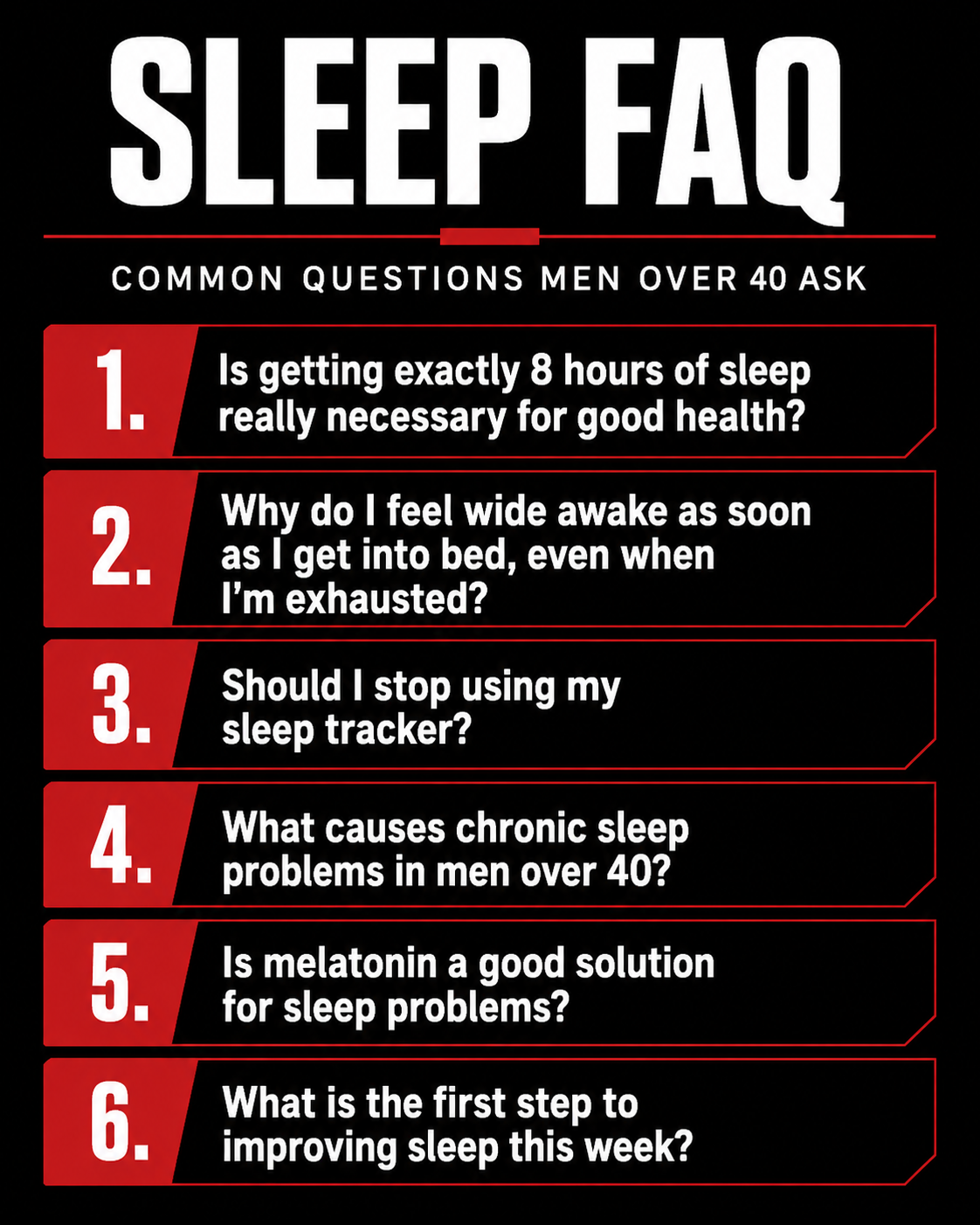
Common Questions From This Episode
Is getting exactly 8 hours of sleep really necessary for good health?
Eight hours is often cited as the standard, but sleep needs vary by individual. More importantly, the quality, depth, and consistency of sleep matter as much as the total time. Six and a half hours of solid, uninterrupted sleep can be more restorative than eight fragmented hours in bed. If you are waking up feeling rested and functioning well through the day, your sleep is likely adequate for you, regardless of what the clock says.
Why do I feel wide awake as soon as I get into bed, even when I'm exhausted?
This is called conditioned arousal. If you have spent enough time in bed unable to sleep, your brain can learn to associate your bedroom with being awake rather than asleep. It is a behavioral pattern, not a permanent condition. Stimulus control strategies, such as only going to bed when genuinely sleepy and getting up if you can't sleep for 15-20 minutes, help break that association over time.
Should I stop using my sleep tracker?
Not necessarily. Sleep trackers can provide useful awareness of patterns and trends over time, especially for a person who handles data well without it increasing anxiety. The key question is whether seeing your score creates useful insight or creates stress. If it is adding to the problem, putting it aside temporarily and using subjective markers like energy, mood, and focus is a legitimate and often more practical approach.
What causes chronic sleep problems in men over 40?
Chronic sleep difficulties often develop through a combination of predisposing factors like baseline anxiety, trigger events like stress or schedule changes, and then perpetuating factors like negative beliefs about being "a bad sleeper" and the learned behavioral association between the bed and being awake. Addressing the behavioral and mindset layer is often the most important part of the work, and it is the part that supplements and trackers cannot fix.
Is melatonin a good solution for sleep problems?
Melatonin has specific use cases, including adjusting to time zone changes or occasional short-term sleep disruption. However, if the root of your sleep struggle is behavioral, a negative relationship with sleep, or conditioned arousal, melatonin is not going to resolve the underlying cause. Relying on a supplement as the baseline coping mechanism, to the point where forgetting it while traveling causes panic, is a sign that the behavioral work matters more than the product.
What is the first step to improving sleep this week?
Do a thought dump. Write down every negative belief you carry about yourself as a sleeper. Then ask whether those beliefs are actually supported by evidence. Restructuring your self-perception around sleep is the foundational behavioral shift. It is where the cycle either continues or starts to break.
What is the exit rule for sleep?
If you can't fall asleep, or you wake up and can't get back to sleep within 15 to 20 minutes, get out of bed. Go to a low-light space and do something calm and screen-free until you feel sleepy again. This breaks the association between your bed and being awake.
What should you do after one bad night of sleep?
Nothing different. Do not overcaffeinate, nap it away, or start a new supplement. Just return to your normal routine. One bad night only becomes a real problem if you react to it with a cascade of overcorrections.
Want more from this episode? Read Why Trying To Sleep 8 Hours A Night Is Making You Worse At It on the Driven For Health blog.

CEO l Head Body Tranformer
Brian Parana is a men’s health coach with 23+ years of experience helping busy professionals improve their body, energy, and day-to-day habits while still leading at work and at home. His coaching is built around practical nutrition, training, sleep, and accountability, with a plan tailored to the person in front of him.
Over the years, Brian has helped thousands of clients through his work as a personal trainer, CrossFit gym owner, and online coach. He has also coached an Olympic silver medalist, a 2-time Olympian, and a CrossFit World Champion.
Brian is the host of the Driven For Health Podcast, where he shares real-world strategies for men who want to feel strong again and stay consistent without making health a second job.
He’s also the creator of The Call To Rise, a 100-day fat loss experience for driven men who want to drop 20–30 pounds, boost energy, and rebuild confidence through strength training, personalized nutrition, and high-accountability coaching. Many men join because their blood pressure, cholesterol, or blood sugar is heading the wrong direction, and they want a clear plan that fits real life.
Brian is married to his high school sweetheart, Amber, and they have four kids. Their family has traveled to all 50 states and 4 continents, with a goal to reach all seven.

What To Order At Dessert Restaurants For Fat Loss



 YouTube