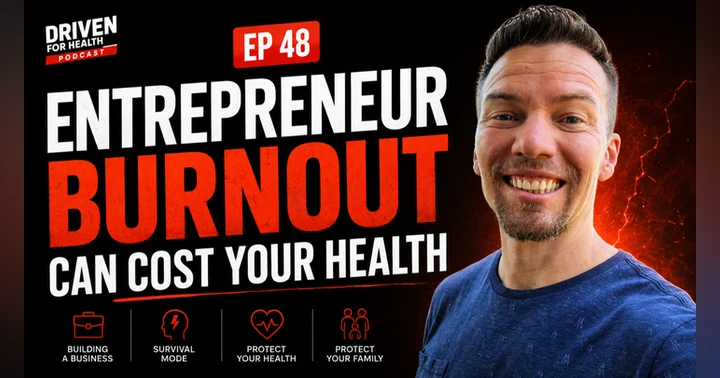
What Entrepreneurship Taught Me About Burnout and Health - 48
Coach Brian ran his first gym on four to five hours of sleep a night for two years. On the Sh!t Creek Survivors podcast he talks about burnout and emotional eating. He explains the middle gear mentality. You leave with daily standards and pattern interrupts for the next time stress pushes you to extremes.


 YouTube
 Coach Brian once ran his first gym on four to five hours of sleep a night for two years straight. That season strained his marriage and taught him a lesson most men ignore until it costs them.
(Does your default under pressure go straight to extreme? Here is what to do instead.)
Coach Brian joins the Sh!t Creek Survivors podcast to talk about survivor mode done right, not panic mode, not a crash diet, but the kind that helps you get stable and rebuild. They cover PTSD, addiction, stress, and emotional eating, and why most men keep starting over every January. Brian shares his own story of burnout from his early gym days and breaks down the middle gear mentality, a way to keep moving without swinging between all or nothing.
By the end you will have simple daily standards and pattern interrupts you can use the next time stress pushes you toward extremes.
Main Topics:
- Why the all or nothing approach keeps failing you
- The middle gear mentality and how to use it to actually change
- Simple daily standards for movement, nutrition, water, and sleep
- Pattern interrupts for late night eating and stress habits
- Why awareness comes before change, and why perfect is a trap
- Brian's own story of burnout from his early gym years
Ready to build momentum instead of starting over? Learn more about The Call To Rise, a 100-day fat loss challenge for men who want structure, accountability, and real results.
www.thecalltorise.com
Want help applying this to your own health, weight, energy, or lab numbers?
Coach Brian Parana offers Health Hot Seat coaching segments for men who want a clear next step with nutrition, fitness, weight loss, blood pressure, cholesterol, A1C, or daily consistency.
Learn more about The Call To Rise, a 100-day coaching program for driven men over 40 who want to lose weight, improve their health, and rebuild confidence:
To connect with Coach Brian:
brian@brianparana.com
Disclaimer: This podcast is for education and coaching support only. It is not medical advice. Always work with your physician before changing medication, treatment, or medical care.
- There was a two-year stretch when I was getting up at 4 in the morning, coaching all day, answering emails until midnight, and then sleeping on the gym mats between classes. My wife was pregnant with my second son, Everett, and Levi was 15 months old. My business was growing rapidly, and I thought the level of stress was just part of being an entrepreneur.
- What I didn't realize was how close that season came to breaking my health and even my marriage. That's a story I share in today's episode. Welcome to Driven for Health. I'm Coach Brian Prana and this is episode 48. In today's [music] episode, I was a guest actually in a conversation with Shitz Creek Survivors and I wanted to share it with you.
- It centers around something a lot of men misunderstand is survival mode. Sometimes in the life that you're living seasons, there might be survival mode and white knuckling to get something done and it could cost you your health and a lot more. Maybe you resonate with that. In this conversation, we talk about real survivor mode.
- What it looks like, how it impacts your life, your day, your family, relationships, your career, and the kind of help to you get in a better place, rebuild your life, to refocus on what's important, to regain strength and control of your day-to-day, and make sure you again take care of your health. In this episode, we talk about PTSD, addiction, stress, identity.
- Welcome back to Sh Creek Survivors, the podcast where we share stories of resilience, tools for resilience, and the hope that those stories provide. If you're heading into the new year thinking, "All right, it's time I get my life back together." You're in the right place. Today, we're talking about activating survivor mode.
- Not the panic white knuckle kind, but the kind that gets you fit, sober, mentally strong, and moving forward without burning yourself out. We're joined by coach Brian Piranha, and this conversation goes everywhere from sobriety, PTSD, fitness, happiness, relationships, and why chasing extremes usually breaks us instead of building us.
- So, if you're just getting started, if you're trying to stand back up after a fall, or if all you got in you right now is a willingness to listen, let's go. Survivor mode. Activate it. So, you you might know that uh I'm a former police officer. I was injured in the line of duty. I was actually shot in the face 10 years ago.
- And um that sent me down a path through PTSD, >> alcohol, alcohol abuse, and I ended up in a fiveweek coma uh at the year anniversary is when the coma started. And uh during that process and prior to this moment, which I'm about to discuss, I was totally toxic. I wanted to leave this earth. I I had lost faith in anything spiritually.
- I had lost faith in mankind, you know, like all kinds of stuff. like it's basically like I had a divorce with my police department if you will because it was just like heartbreaking and you know you can't really and and I ended up losing my job over it and all that kind of stuff. But >> right, >> long story short, I'm I'm totally toxic.
- I want to die and uh somewhere in this near-death or somewhere in this coma, I had a near-death experience and I actually crossed over and I got to hold my grandma's hand in heaven for a brief period of time. Uh and and heaven is a place where um pain doesn't exist mentally, physically, spiritually. That's the biggest thing I could take away from it. It was all love.
- >> So when I woke up to my wife slapping me in the face 5 weeks into the coma because that's how long you need you here. >> Exactly. Be because they were literally saying >> this is when you have to make a decision. Yes, he has double pneumonia. he's getting healthier, but if he goes past 5 weeks on a ventilator, his brain will actually get lazy and forget how to breathe since we're forcing him oxygen.
- So, she actually chose to pull me off of it, slap me for eight hours, made me breathe, made me breathe. I wasn't too happy to be back all of a sudden cuz now all the pain was back right now. Now, now I'm in a hospital bed. I'm in pain. I'm on a deal, you know. >> Yeah. And I'm going through all this. But it kind of uh pushed me to work on myself a little bit because now I kind of had an idea there might be something on the other side and that sort of scared me enough, you know.
- >> And the first thing I had to do is I had to get sober and that was one of the hardest things for me. Uh I had a lot of ego in my way. I had a lot of personal pride in my way. I had a lot of I'm not like you in my way and uh but I ended up going to AA being the guy in the back of the room with the hat down and everything like that.
- >> I'm in Ohio so AA is just down the road for me. >> Exactly. Yeah. You're the hub. Um >> so yeah, and so I'm going to these meetings and I'm hearing these grown men, whether they're doctors or homeless people, telling stories that I would never tell in public, but they really resonated with me.
- I was like, "Oh my gosh, I I've thought that way. I've felt that way before." Right? >> And I learned through that process that AA isn't just not about drinking. It's about actually kind of like reconciling and coming to terms with where you're at, what you need to do to move forward, creating a plan, you know, having non-negotiables like you've talked about before.
- Um, and just kind of like pushing forward on it moment by moment, day by day, hour by hour thing. And what's crazy is I just on the 21st of November celebrated nine years of being sober. >> So it's it's it's been quite a path and I had to do a I've done more personal growth in the last nine years than I probably did in my entire life prior to that, you know, and it was based out of necessity, desperation, >> and eventually wanting to help other people.
- So Dennis was my patrol partner in special operations and >> actually I actually started a little bit more in the military first. >> Yeah. >> Then I became a police officer down in Dallas and then I went to the military again. Went to Iraq, came back from Iraq, went to the department that I worked with CAN >> and uh of course 30 years of law enforcement, military, I've got a lot of PTSD stories as well.
- Not quite shot in the face, but uh we all have our own [ __ ] creeks, >> right? and uh we reconnected and uh kind of thought that this would be a cool idea to just kind of keep each other accountable, >> right? >> Uh he's made a lot more pro personal growth in nine years. Uh I've only been making some personal growth in the last two years probably.
- >> Okay. >> So, I'm a little bit behind the power curve on on on this, but uh >> yeah, >> we thought this would be a good idea to keep each other accountable and if we have guests on and share some tools of uh resilience, some tools for the toolbox with other people, you never know.
- If it helps one person, it could be worth it. So, >> right. Right. Uh, fast forward now, we've gotten what 40 something episodes in. >> Nice. >> 50 50 >> 50 episodes in. Over 200,000 views total. >> Awesome. >> Uh, and we are ranked >> 158th in the self-help category of podcast in Finland. [laughter] >> Yes. Yes. >> Random little snack.
- I mean, one person in Finland probably watched it and that's what got us there. But who knows? It's still a cool little thing to see. >> That is awesome. Yeah. I started my podcast journey in September 23rd. I recorded my 30th episode yesterday >> and just rolling with it and starting to get guests on and such.
- And I I got this Spotted Piper Creators highlight reel and they're like, "Oh, you're top 10%." I'm like, "Wow, how did I make it there so fast?" >> Nice. >> But uh yeah, it's funny to see someone in Czechlovakia or whatever. It's It's funny to see that. [laughter] >> Yeah, that is that is super funny. One of the reasons I actually wanted to speak with you personally is because when I was getting back on my feet, I actually got up to about 300 lb. Okay.
- >> And I had played uh you know, athletics and college lacrosse and you know, all these kind of things. So, I was super depressed about that and I thought that >> right >> your identity. >> There's a >> Yeah. So, there was a couple things. One was like I felt like ashamed of what had become of myself.
- But the other thing was like I thought once I got back to fitness, I'd be fixed. >> But it's actually just it's kind of like a mechanism to sort of get things going in your whole life. You know what I mean? If you can build a routine in the gym, you can kind of build a routine in life or consistency and and that sort of stuff.
- So we have Coach Brian Piranha just like the fish on today. and and Brian, if you would introduce yourself and and tell us where you come from and what you do. >> Yeah, Akan, Ohio native. Was hanging out with LeBron James back in his high school days. Not actually, but we were we're about the same age. Too bad we're not buddies, right? But yeah, uh Akan, Ohio.
- Actually married my high school sweetheart. I've known her since I was 11. I'm 42 now. uh we've just we're great friends and had a great relationship. She actually gave me the note that note that junior going into senior year, the note said, "Check this box if or check that box if you want to be a friend or or move forward." And I I checked the friend box.
- [laughter] >> But then by the end of the summer, my my best friend Dan actually dared me $5. Spent me $5. I wanted to ask her out at band camp. And I I was like, "I'm not giving you $5, man. I like her." So I did. And here we are. We're four kids deep. You have 16 to 10, three boys and a girl. My oldest is driving now.
- For you parents out there, you understand that, right? Big milestone or like, wait, how do I have two kids in high school now? What is going on? Uh, we live a very busy life. Of course, just juggling the kids, giving them lots of opportunity in school. There's an endless, you know, after school programs or they're in school activities, art, theater, we have swimming, we have soccer, and the list goes on from there.
- But give them tons of opportunity to just thrive and find their thing and and just be bold, confident, independent little humans. Hopefully when they're in their 20s that they are thriving and trying to get their feet planted in life. And and we travel a lot. We've actually traveled all 50 states. We've slept in 49. Idaho got away from us.
- My wife is a travel advisor and she she plans those bucket list trips, but you don't wait till you're you're 50, 60, or 70 or something to do them. Do them now. And so she helps families and people get out and and go explore and live an adventurous life and and go explore and do some of these things.
- So we've done that. We're going to work on all seven continents, too. That's Brian. Personally and professionally, I've been in the health, fitness, nutrition industry since 2002. So, it's been like 23 years. Started off teaching phenomenal abdominal in the local YMCA. From there, I got an exercise nutrition degree and it's just unfolded.
- When you look back, it's just this this rug in a sense that unrolls. So, group exercise, wow, I get paid to work out. this is great to becoming a personal trainer to owning two CrossFit gyms. Actually coached one of my personal training clients who crossfit world champion Betsy Finley at the age of 60. She she could deadlift 250 lbs, do 100 lb press overhead, rope climb, all these things.
- But the coolest part was she could just go get lost on a three-hour hike and just not care in the world where most 60-year-olds are. Well, I walked around the block. There there's my exercise for the day. Let me go get back to my regularly scheduled program. And finally, that's led me so about 10 years online coaching, nutrition, health, fitness, and and now I land with working with men 40, 50s, 60s or so, younger, too. But the call to rise.
- It's a 100 day fat loss challenge to help men get 20 pounds off. learn sciencebacked nutrition, fitness, fit it into a lifestyle because everyone's busy and I'm certainly busy, too. But we can have healthy, happy lives by doing simple things strategically in your everyday. And that's where I I break it down for for guys to be truly successful beyond fat diets or the GLP1s or any of that that the the old hat things that people do and nutrition.
- So there there's a quick rundown of Brian. >> Very cool. >> You're you're probably very busy seeing it's January and everybody's kind of getting their life back together and trying to figure out, you know, what the plan is. >> New Year's resolutions have begun. Yes. Right. >> Yeah. And I'm waiting your right in your wheelhouse.
- I'm in my 50s and I need to lose about 20 pounds. So maybe I need to listen to this a little bit better. [laughter] >> I will I will be bringing some heat today. [laughter] >> Uh >> oh. So Brian, tell us um you know the name of our show is [ __ ] Creek Survivors. So if you'd be willing to share a moment in life where you you really found yourself sort of stuck, overwhelmed, whatever it may have been, and what that situation kind of looked like for you. Yeah, definitely.
- The the one that comes to mind is I opened my first gym and it was supposed to be slated for around this time, December, January, February in 2010, 2011, right at that intersection. Well, >> we were already a couple K deep in the process of getting things going. And it came to this, well, we need to do it now or not.
- And all of a sudden in October, at the end of October, we ended up doing it in 2010. We opened it and my wife was pregnant with our second and had about a month to go. So, eight months pregnant and going into the holiday season. And that was really interesting. Um, I I took some some steps to progress myself there.
- uh partnered with someone actively trying to grow myself, my business, be able to make money and wealth creation through owning a business. >> It backfired in a sense. >> Okay. >> Uh the the partnership just unfortunately was not good. Uh sure, we made money, but I didn't really see a lot of that. And but what I did see was a lot of the gym.
- I would get up at four o'clock, be there at 5, leave there around 11, come back at three to fourish and teach more classes, and be done around nine, and then go home and get home by 10ish and answer emails or whatever till midnight and wake up at 4. And that was about a 2year time frame that I did that. And most of the time I was sleeping four to five hours.
- I was uh if I if I found 10 to 15 minutes in my time of the day, I was can I take a nap? Can I lay my head down? I would I'd sleep in the back of the gym after the six o'clock class because there'd be at least an hour before someone might walk in the door at 8 to check the gym out. And I would just lay my head on an admat on the gym mat with a a t-shirt over my head to take a nap.
- But the >> the that was I guess it's just part of what you do if you have a business or if you need to make things happen. That's sometimes that's just what you have to do to make it happen. But by the time we had 300 members that really didn't need to be the way I had to live and I didn't have to just self-sacrifice for the business in a sense to make a a a good living from that not feel like it was just minimum wage.
- So with with no sure we hired a coach or two, but it still didn't take some of the the that heavy in-person presence and it strained my relationship with my wife, with my family, with my friends. I remember in the first two months or so, I we were on a date and we went to Outback Steakhouse. I could barely keep my eyes open.
- And then we went to Toys R Us to go shopping for diapers and and whatnot. And I was I almost fell asleep two or three times walking in the store while pushing the cart cuz I was just that wiped out. So call that a wonderful day for my wife, right? She was like, "Wow, this is >> wow. What what have I gotten myself into?" Right? But uh she she there came to a point where the the guy just really pressured quite a bit and there was just a lot of stress and and one day he says hey come into the office and okay and he hands me this paper.
- It was basically a paper to sign off my ownership to him and I'll just be an employee because I can't handle it anymore. I can't deal with the pressure the the work or the the things that need done. Again, this is like two years deep of me showing up every single day whether I was sick or not, whether I wanted to or not or any of that stuff.
- And I we had to go to a Christmas party and I just drugged my feet and I ended up taking a paper and we left to go to the to the place whatever was next and I called a lawyer and did not show up. So, [laughter] so that was a two-year crucible of stress, of pressure, of strain on myself, on my relationships. I was threatening bankruptcy.
- There's a lot of things that were going on in that that time frame. So, >> yeah. >> Well, how dark how dark did you get like mentally? uh give up like >> I no I was not to that point but I was I was definitely down. I didn't have a lot of of of say battery. There's nothing no energy in the tank.
- I was just depleted from just no sleep and and just being pressured. And the guy was the partner was very front-facing in a sense of and in public or in person he was fine like oh yeah not a big deal if I missed a phone call in the middle of the day when I was technically off of work and taking that that break that two three hour break in the middle of the day from coaching and being at the gym.
- If I didn't pick that phone up I would get angry text messages. Why don't you pick it up? Come to find out, the guy's bankrolling his his chiropractor, his his massages in the middle of day when he was supposed to be there. And I come, dude, just spending like thousands of dollars in the last year or two on on these things when you're supposed to be at the gym doing work.
- Like, what is this? So, >> right. So there ended up as soon as I saw the the actual like the monetary the the charges of the credit cards and different things like what is going on here? So uh but it was it was pretty low time. I I remember there was a a guy that came onto the staff and he was he was bullying me just easiest way to put it.
- It wasn't say physical harm, but there was a just so much put on me from that guy too that I would come into the gym listening to Ludacris and just at full blast and and and just with the the most angry of songs trying to pump myself up to go in there. You don't you don't know me like that. Just like all this anger and that's just not who I am.
- And it it really shifted some of it was really put put a lot on me. >> Yeah. >> It's it's a very sickening feeling when you actually realize you've been taken advantage of. >> Oh yeah. Yeah. And my wife was trying to call it out for a long time, but I didn't want to see it because I needed to make this work because I I basically cleared out my 401k to make this happen.
- I quit. I burned the bridge in a sense on on making this the thing that worked. And we had in two years we almost made made it to a million dollars cash collected. We had 300 members in the gym. We were making 50k months. I I should have been doing just fine. Like wow, we're thriving over here. Uh, no. The gym closed within a few months of me leaving though because soon as I I was the buffer of the guy and soon as I left and everyone saw and got a taste of what I had been putting up with for two years.
- >> So, you were actually able to separate yourself physically and financially from this guy before the gym closed? >> No. No. I actually had to get cashed out. I I ended up writing it to agreement to get something out of the gym because I had everything wrapped up in it. >> Yeah. Yeah. >> Yeah. >> I was waiting for the payoff and we were we were we should 50k months in my brain means more than a $5,000 take-home check in a month, right? Wouldn't that make sense? especially when you only have the only overhead you have is the the gym
- space basically cuz you've already purchased all the equipment and everything else taken care of. >> So, it's just like why why are we only getting this much and I'm over here stressing about paying off my car like I might have to do bankruptcy and so like it didn't make sense. >> Right. Right. >> So, it was tough.
- >> And so, yeah. So, what was that that final thing that you had to do to kind of the trigger to kind of walk away from that? Was there something in particular you had to do like face the guy or was there >> Yeah, it was >> Yeah, it was a lawyer, you said. >> Yeah, it was the lawyer is he he pulled out a piece of paper and said, "Hey, sign everything over and just be an employee.
- " You guys know how that would have went, right? >> Like, thank you. Bye-bye. [clears throat] So, uh, so I ended up getting a bulldog for a lawyer. She was just would not put up with this crap and which, which helped. And I I got some cash and some equipment and different things to get planted and started again. >> And then you were out. >> Yeah.
- Then I was out. Yeah. That took about, you know, two, three month process to get fully out and get the money and all, but yeah, it was >> that's what it was. But I didn't show up to that place anymore. >> Yeah. >> Yeah. >> Got the stealing relief happened when you finally got the FJ and the and the back. >> Yeah.
- Yeah. Yeah. But unfortunately, I kept running into the guy after the fact, too. He he'd just show up at not not It was just by proximity. we lived in the same area and it just be randomly run into the guy. It's like, "Oh my lord, this is too much." >> I think it's good to know that the a coach has been through something. You know what I mean? It's, you know, he's got life experience and stuff like that.
- So, I am sure that you've transitioned like all these >> moments of of learning and stuff like that into things you've helped >> other people with. Anyway, long story long story short, >> what was maybe a uh a lesson you learned through that situation or a paddle that you picked up, something you used to get yourself out of it? >> Uh lean into my wife.
- She was the she was the boat, the paddle, everything. and she was just incredibly helpful in >> being able to just build me back up and give me the confidence, the esteem, the the energy to to go out and and do something with myself after that. even to the point of where we're at now. This this I'm in my barn gym here at my house, but she recognized that we needed to move from where we were to somewhere where I had a capacity to be able to produce an income.
- And I would have people come over to this this barn gym and work out with me. And that ended up >> becoming one of our next steps. We moved, relocated. um training at my house in my backyard which alleviated a lot of pressure, a lot of overhead, a lot of other options that were out there. And then that allowed me to have the space and capacity to shift online as well.
- >> And a lot of right >> where I'm at now I would totally attribute back to her is she just was there for me despite just basically not treating her very well in that process, right? because [clears throat] I was dealing with so much on a a negative sense that I I didn't necessarily I wasn't purposely taking out on her.
- But if you you bumped up because you only have 24 hours in a day and if you're spending all of it >> in one area then you're you're not balancing out that time in the right manner. And so yeah, it makes sense, >> right? >> Imagine if she hadn't though, man. That would have been >> She could have left me [laughter] that that's for sure.
- She could have said this is you you you know what any number of different reasons could just you >> and I both know what it's like having a a very strong confident woman behind us and backing us and helping us through all of our journeys too. So kudos to you to having that as also. So >> yeah, >> I'll say that. >> What a what a great answer.
- What a great like to the point >> search search your heart [clears throat] you know my wife helped me because that's exactly how it happened with me. I she helped me when I didn't want to help myself. I was like, "Why are you even still with me?" You know what I mean? Like, >> just what are you doing? She's just like, >> "Yeah.
- " And she's like, "For better or worse." And I'm like, >> you [laughter] got groaning. >> You're like, "Thank God." >> And it also speaks to that individuals when they're in a time of crisis, there's two things. One is you needed help >> and your wife was there to help you. >> Yep. And two, this is a really good opportunity to mention that when someone's going through a highly stressful situation, they make their circle really small, right? Because you can't trust as many people, >> right? >> And then accidentally what happens is when the person who's trying to help you
- comes close, sometimes you accidentally bite them. And I've been guilty of that because it's like suddenly I'm funneling everything that's going on in my life towards this one situation where there's a a fork in the in the spoon where the spoons go. You know what I mean? Like it's it's like totally out of proportion.
- >> And you come back to it later, you're like, I'm so sorry. That's, you know, that had nothing to do with you. And you have to kind of >> eat uh eat crow or whatever it is. And then uh you know and and somehow >> man do they teach you how to love in those moments right >> because >> I think another big step in that exact same moment is recognize it in yourself.
- >> Recognize finding that spot where you're like oh man I am messing up. I am out of balance with my time with my wife or how I'm reacting about the fork in the spoon drawer. >> I need to get back into a balanced spot. And it's grateful that they were there to help keep giving that support. But if you don't recognize the problem yourself, you're just going to be out of balance.
- >> Right. Right. I'm [clears throat] even juggling with that now, just being self-employed, having the landscape, the the the marketplace evolve and shift and change. I have to make appropriate adjustments, too. in my line of health, nutrition, fitness, self-care, and we've got GOP ones. There's AI and and those two in and of themselves are huge disruptors in terms of what like I've done and have been accustomed to in terms of being able to generate leads and opportunities for my business and to help people grow. And this this year has
- been a little bit tough in terms of finding those opportunities and creating new connections. That's why I'm even on this podcast and started podcasting guesting back in March. I've been on about 65 70ish podcast and I started my own podcast Driven for Health as [clears throat] a result of looking to speak my experience, my truth, connect with people and expose myself to more opportunities out there.
- And it's been a lot of time, a lot of energy, a lot of focus on these things. You guys know just even so we have the our conversation, but then you have the background editing and and then the the or even getting finding the person to talk to the conversation, the background editing, publishing, making sure it works and it sounds good.
- And that's one podcast is potentially three to four to five hours depending on how much editing and processing and and different things that go into it. It's a lot of time that you can't spend with your your loved one in a sense. >> And so I'm dealing with that right now as as the marketplace has been shifting and finding my my feet.
- But >> but if you want to help people the way you like helping people, you have to put in some of that time, too. So, >> of course. Right. All right. I have to introduce people to me. >> And it builds up resiliency, right? That's some of the undertone of the show is is being resilient through whatever. Life is always going to throw us curve balls and you have to be ready for change. Life is always change.
- Even I love to bring this up. [clears throat] We haven't moved, right? You guys have been sat there. I'm standing here. We haven't moved location at all. But since the beginning of our conversation, what almost 40 minutes ago uh with the pre-roll, the earth has been spinning, right? We are quite a bit farther away from our first initial conversation point and life is moving and you have to be ready for that.
- You have to be agile, lean and be adjustable to what life is and and that's a a sense of resiliency that that you can build upon and show up for yourself and for others >> and community talking to each other. We we're expressing ideas and getting things out of our heads makes it more real. makes it become something. >> Yeah. >> Um >> it it helps us, it helps you, it helps somebody listening.
- >> Yep. And I'm so guilty of this one thing. I thought life was supposed to be perfect. [laughter] >> You know what I mean? Like I I thought life like the goal of life was to be happy. You know what I mean? And and it's supposed to be happy all the time. And once you get there, you kind of like >> quarantine it and hold on to it really tight and don't let it change.
- and you know it's exactly the right thing but that is not the way that life works. So it's like it's waves. We keep hearing that with all our guests. It's like you get to the low of the wave and then you get to the high and you get to the low is all part of it. >> Um the the the journey, not the destination, right? The destination is happiness, but >> you experience happiness through the process of the ups and downs.
- and you understand what that is and you can relate to it and it it's tangible all of a sudden and the way you feel, the way you touch, the way you experience what's around you because of the adversity that you've gone through. And let's be honest, guys, we're living like kings these days, right? 500 years ago, you have more privilege, more access, more ability to do whatever you want than kings 500 years ago had, right? And and Our ancestors 100 years ago didn't have a hot shower like we do.
- >> Exactly. Right. A hot shower. Even technology, right? This is only we only connected because we have this thing that we hold in our hand this this rectangle that we can communicate quickly, easily and and >> it's it's wild. But also that creates its own challenges of growth and adaptation and change.
- And we see that in ter in all sorts of different situations. And in my line of work, I see it in poor health, right? weight gain, bad blood panels, cholesterol, blood pressure, triglycerides, potential heart attacks, strokes, diabetes, all these things start showing because of this say privileged life and this convenience life.
- But we're also more disconnected from than any others in history and stuff. And and our level of happiness has to be way up here off the screen because of dopamine, because of attention, because of instant gratification. Whereas our ancestors, they found happiness here. >> Just taking a stroll out in the in the woods >> brought happiness.
- And we have to be careful. But with my kids, they've they my daughter at 10 has literally traveled the world basically. And my oldest at 16, he is a dopamine junkie. And I said, "Dude, you're really going to have to buckle down on you. You can't scroll 10 seconds at a time. You will you will lose 10 years of your life just doing this 10 seconds at a time.
- Uh you you have to find what happiness is. You have to ground yourself in and being happy when you're bored too cuz he'll oh this isn't stimulating enough and he'll want to go find something else to do. No, we just need to sit in this right now and appreciate the calm, the relax and and the chill and and find the the happiness that that sits here in this moment.
- Hit that reset button. >> Yeah. >> Find a way to get away from the stuff. That's But there again, you have to recognize it. So your 16-year-old has to recognize it. >> Yes. >> He's gonna have to try it. He's going have to put the phone down for like a whole day one time, >> right? >> And and figure out how drawing or write or writing words down with a piece of paper and pencil.
- Somehow still going to stimulate some of those dopamine levels in his own way >> and then re and then just kind of regrowth from there and then find a balance with the phone. It can be good things. This instant gratification, but man, it can be bad, too. >> Yep. >> Sounds like he's got a good dad. Keep him going the right way, though.
- >> Yeah, he's got a coach for dad. Lucky him. [laughter] >> That would be awesome. That would be awesome if your dad was your coach. That'd be so cool. >> Uh yeah, you'd think. But also, if that's just all you experience like, wow, stop stop preaching to me or stop whatever, you know? >> Yeah. [laughter] >> I grew up in a in a more of a church environment.
- I'll tell you what, the pastor kids friends were always the wilder one. Oh yeah, yeah, right, right. >> Well, we had a >> slice of rebellion. >> Yeah, we had a pastor's kid on who broke into the church and stole from the church to go get some meth or something like that. So that I mean, yeah, it's pretty [laughter] funny. >> Uh and he's able to talk about it now and and laugh about it.
- That's the only reason I'm able to talk about it. But >> let's kind of get back to >> um how you're helping people. >> Yeah. >> Yeah. Um, especially since we're in January and and one of the things I wanted to mention or ask you about is, >> you know, I've been guilty of it in the past. I'm better at it now, but in January, man, when it comes to physical fitness and getting my physical fitness together, I'm going for a grand slam out of the gates, >> of course.
- >> And and I notice that if I'm like, I'm going to work out six days a week. It's going to start this first week. And what inevitably happens is I set my goal too high. I get to the gym maybe four times and then I chastise myself. I'm already screwing up. I can't believe this is happening.
- So, I'm doing a lot of like emotional kind of roller coaster on myself. >> And >> could you speak to that and how to set maybe like healthy goals compared to just like >> I'm going to eat anything I want until January 1 and then just grand slam everything's going to be fine, right? You know, >> right? There's a term I use quite frequently.
- I haven't necessarily heard it. Maybe I coined it, but nonetheless, it's it's an easy concept to understand. We have that all or nothing. Let's do the Arnold Schwarzenegger eight days a week program and just go and just lose all the weight in two weeks. Well, one to two pounds a week is sustainable. Three is amazing.
- Four or more is out of reach. We're doing something weird in a sense. >> Now, say you have 20 pounds to lose. >> That's theoretically what 10 to 20 weeks worth of effort. And you have to put that in your brain >> from the very get-go. I need to commit to at least 10 to 20 weeks of consistency moving forward. And and the term is middle gear mentality because >> in all areas we can burn out.
- That's something that I'm really >> feathering with right now myself with with business production and content creation and [clears throat] c creating opportunities for myself and and connecting with more people. Right? If I had a hundred people comment on my Instagram post, that's going to that's going to cost me 90 minutes to to just engage with them.
- And that doesn't necessarily mean that that's money-making opportunities right now. But that's 90 minutes that I have to go in and connect and create rapport and connection with these people to potentially get them to be in the Brian bubble to get to know, like, and trust me. And that maybe at some point they might become a client or not, but may or maybe they just listen to my stuff and they change and they have a lot of positive impact from conversation and and my podcast or whatever.
- But then then that's 90 minutes away from my family. So burnout is a thing that I have to manage my time, energy, and efforts there as well. But middle gear mentality, three principles, moderation, balance, flexibility. Those three have to be brought into the process and approach of which you use to change your health.
- [snorts] What I always say to people is the approach we're going to use is a simple phrase. I my 30th episode, I just recorded it the other day and it had [clears throat] a bunch of Brian oneliners, the Brianisms in a sense. And what we do in two weeks, we do in two months, we do in two years. A really simple, easy phrase that you can remember, and I'll say it again if you want to pause this and write it down, but what we do in two weeks, we do in two months, we do in two years.
- We're creating a lifestyle change, a behavior change, a habits, routines, creating systems and processes that allow that thing to be easy. So say the losing 20 pounds has to feel easy. It has to be enjoyable. The food has to taste good. You have to want to be excited on some level about moving your body, whether it's just walking alone, walking with your partner, friend, spouse, your dog, or going to the gym or going to a workout class or any of that stuff.
- But you're going to have to move your body to burn calories and to just be healthy and fit. Go back 500 years ago. You had no problem moving your body. He had a hard time being able to sit down and just rest because if you weren't digging in the dirt, you might not eat tomorrow, right? And and that was a real necessity and again convenient so much.
- So in our modern day that it's hard for people to actually move. I literally have some clients that are so timestrapped and desk jobed that their full days of activity is 2,000 steps. And then they come in and say, "How am I supposed to get 10,000 steps?" And I say, "Well, that's for us to figure out and we're not going to do it in the first week or two.
- " Okay? If it takes us a month to figure it out, cool. Because you have to start creating time and opportunity and and connection with taking that extra activity in your day. Uh I love simple things like walk with your partner, your spouse. They want to talk to you or one of you is the talker, one's the listener.
- and they want to express themselves and say, "I'm the listener in my relationship and my wife wants to talk to me. Might as well walk and talk. Two birds, one stone. Got my steps. I I I was present and engaged with my spouse >> because if I'm not, I'm at home. It's really easy to be distracted by the the the little rectangle in my hand and all the buzzing and dinging that it's doing.
- But I can leave that in the car, put it on silent, and then just walk and be out there with my wife and my dog and get 3,000 steps there and then do some more at another time of the day or whatever. And that creates more connection, which creates a positive connection to an emotion and a feeling toward the act of doing the thing that gets you healthier.
- >> So, middle gear mentality. >> Yeah, middle gear mentality. It's it's hard to it's hard to really I mean instant gratification doesn't really go well with uh middle gear mentality but >> again where you have to you have to readjust [clears throat] it you have to re >> right >> repp [snorts] prioritize it >> the same that's a good way to say it >> my son the dopamine or whatever like instantly it's not going to happen and we have to reconnect with the process of what an active healthy identity of who you are is and I've seen it thousands of
- times where people come in and they don't like themselves. They don't like the way they look, the way they feel, the way they think, uh the opportunities that are in their life, the relationships that are in their life. They do not like it. And their body is an expression of the situations that they are living in.
- If you're 50 pounds overweight, there's probably some un dissatisfaction and unhappiness in your life. And the the I guess the opportunity that I get to have is I have candid conversations with people to actually just start asking questions and ask them why they're doing things and get them to stop and to think about what their actions are and their choices are because they can always change them.
- And that's the one thing is power of choice. If you're listening in here, you always have the choice to make a better decision no matter where you are at in life. And these two gentlemen can attest especially with their background uh in their in their careers and even their personal lives is they can always choose to take this route or that route and this route over here does never leads us to the direction say this route in my world is I'm going to eat junk food.
- I'm gonna just not go to the gym or not take a walk. I'm gonna stay up late watching Netflix. I'm going to instead of drinking water, I'm going to scroll my phone at lunchtime and and disengage from anyone around me, right? >> Those are common common things. Or I'm so mentally exhausted because I've been thinking and sitting all day, but my I feel like my body is exhausted, but it's actually not.
- My body is ready to move but I have to get past this mind block and then but then it keeps me up at light night because my body isn't tired. I haven't worn it down in a sense. My body is say 90% charge where if I moved my body and it was 40% charged by the end of the day, I can fall asleep easy and I don't have to stare at the ceiling or scroll through my phone or just stay up late or not get more sleep for the next day.
- I remember one guy, he said, "Brian, I think you saw my insomnia." I was like, "Oh, yeah. How's that?" 15K a day, man. I I I put my head on the pillow and I am out like a light. Within two to five minutes, I am out. And and and that's something that he wasn't doing. But it's it's so easy. It's free. Go walk your body. It's free. >> Yeah.
- >> And as we've talked about in this podcast a lot, the blueprints are usually pretty simple. It's putting into action. That always takes up more. >> Uhhuh. >> It's more of the challenge. It's harder to do. >> I yesterday I talked to Andy. He's in my my call to rise group 100 day challenge. And he went from 210ish 215ish to he's just under 1980 180 now.
- And he's blown away. His goal by by uh the end of the program was 185 and he's actually realigned it to 175. and he he's dropping he's down like 25 lbs already in in 75 days or so. And he said, "Brian, you hit the nail on the head in the first one. We we have these four components. We've got movement, which 10k a day is a good amount with or without exercise.
- You should work out two to three times a week regardless the rest of your life. You will be a a happy 70 80 year old person if you do right because you'll actually be physically functionally cap capable of taking care of your own body and your your siblings or your your your kids or your spouse trying to ship you off to an assisted living home because you can't wipe your butt, right? [laughter] That's not good.
- >> We got the second one and the one of the most obvious one is nutrition. You have to eat whole foods. We have to have balanced meals. do. Most guys are going to need to be eating 2,000 calories or less. If you're in a calorie deficit to lose weight, you will probably want to be 1,800 or less.
- And that's just the brass tax of it because carrying extra weight is putting more stress and strain on your body. [snorts] But we do that through having three or four balanced meals, protein and vegetable focused first and having a little bit of starch. And if we even say just to be insights for the our our listeners, you take a plate And a quarter of the plate is the protein, a quarter of the plate is a search carb, and half the plate is vegetables or some fruit.
- And that's a very basic model to put a healthy balanced meal that will keep you again going off a simple oneliner. Eat enough food to get you to the next time you're going to eat again, >> right? Yeah. >> And so when dinner comes and you have a full plate full and it's 800,000 calories cuz you're hungry and you're actually tired and just want to check out with food.
- But then at nine o'clock you want to eat again or 10 o'clock you want to eat again because you're technically bored but you haven't moved at all. You don't need food. You don't need calories. You haven't burned calories to be able to have the need to eat at night. [snorts] And that's its own thing. If we want to eat at night, then we find suitable solutions and alternatives that make sense for you to fit food in at that time and not go over the amount of calories that you should be eating in a day. All right. Right.
- >> And so, so there's the nutrition. We have water, 100 ounces for men or more, 80 ounces or more for women. And then we've got sleep. Humans need to sleep, right? We are probably the most restless creatures in the world of all creatures, right? We just can't just lay down and sleep.
- I think some of our our other cultures, non-American cultures, love the siesta. I wish we could bring the siesta into our culture and [clears throat] just have some some chill in the middle of the day because again, you just watch and observe nature and animals sleep. They they sleep a lot. They are well rested and us humans are not.
- And that in and of itself can be an underlying culprit of why you are where you're at with your health, whether it is being overweight or having disease or aches and pains or just just not feeling well. >> Yeah. >> I feel like uh uh some of the eating problems I' I've had and I'm sure other people can relate to it. It feels like it's almost a therapy in itself.
- Like you're you're >> to to feel better, but then you're feeling worse. It's such a weird uh circle. Repeat, repeat, repeat. >> Yep. >> Yep. >> That's exactly what I do. I wake up from my PTSD dreams and I literally run out of the bedroom and I run downstairs to grab something to eat because then I'm using like my senses, you know, like taste, feel, crunch, like all that kind of stuff.
- And it kind of brings me out of that dream, but it's not a healthy habit. >> So, I've had to uh kind of like adjust it >> than some of the older habits. >> You Yeah. So when you get rid of drinking, you know, you crave a lot of sweets because, you know, alcohol is basically sugar. And so you'll notice when you go to AA meetings, there's cakes everywhere and cookies and all that kind of stuff.
- And it's meant to get you over kind of like the craving and all that kind of stuff. But that's the sort of >> it it's funny when you like or at least the way I did it when I was like, "All right, I'm not drinking, but I'm not willing to get rid of everything else." You know, like I'll do this >> and that's baby steps. That's 1% better.
- And that's often times how I coach any one person is I have to take them from here. They want to get to here. And how do we close this gap? And we just do one choice, one decision, one behavior at a time because humans can only manage so much anyways, >> right? >> At one time. >> So you're able to kind of uh in a way make the goals more realistic. Totally.
- So in instead of like coming in in January and being like I'm going to >> flip the table upside down. Yeah. Right. [laughter] >> Flip the table upside down. Clear out the >> supposed to be like this. >> It's not supposed to be like the TV show The Biggest Loser where you just have somebody yelling at you to run on the run.
- >> Right. Yeah. They recently came out with the documentary and it's staggering how many of them have returned to near or close to their original body weight. >> Yeah. And they're angry at the show. >> Yeah. Oh yeah. Yeah. cuz they're bright and wise on lots of different ways, right? Not just their physical body and metabolism, but >> Yeah.
- >> Mhm. >> cuz that one guy was from like Missouri, the the St. Louis guy who did the big weight loss who was on that. I only saw a bit of it cuz my wife was watching the documentary, but I'll watch the rest of it. I thought that was pretty interesting that >> with especially when you go into like a highintensity diet, you know, like >> and then you're working out and it's like on a whole another level.
- As soon as that disappears, >> the game changes. You know what I mean? And so >> basically similar they were very hard on us in basic training and it was not baby steps >> and then once that uh disciplinarian over you is gone it's it's hard to self-discipline sometimes >> right >> some of those guys keep it going but some so yeah it is >> so I like your your your middle gear mentality I like your baby steps >> uh I akin it to like taking a a ladder to get out of a hole.
- You got to step one run at a time. You just go out of the hole. >> Right. >> Um and that goes for life lessons and everything that you're saying too. But >> education and awareness are often the first stop for me with someone. Hey, >> so you wake up, you run down, you put this in your mouth. Do you have any idea how many calories are there? >> You probably would say, I don't know.
- >> And okay, well could just let's just do a quick assessment, a quick tally. And all of a sudden you see that you pile the bowl full of this and some of that on top and then you drink some of this and that and next thing you know you have a thousand calories and now you're made aware of the decision of you going to eat the the reaction of the the dream in a sense to going to [clears throat] eat the food and the consequences of eating the food.
- So we have one issue over here with the dreams that's a challenge and that's just a long road to recovery regardless. >> But then you have this other consequence. This is an action that you chose to do because of this and now we're having this this this waterfall effect where now you're getting fat and overweight and now you're going to have chronic illness that's going to cause everything to get worse.
- And just simply helping people understand, hey, you're eating over a thousand calories at whatever time of day on top of the rest of your calories of your day. Is this a good idea? Or is there another behavior that we can shift to to do? And maybe you need to get up and do 50 push-ups in a row to like, all right, I'm going to wake up, do 50 push-ups, because that's enough that you're not going to be able to do it in one set unless you're strong.
- But most people, it's going to have to take them a little bit of time. But it'll it'll it'll it's a pattern interrupt. It'll cause a buffer of this equals this. But if I put this thing in the middle that make it to more challenging to get the disc, then by the 50th push-up, you have found a different approach, a different avenue, a different way to deal with the challenges of the the dreamlike state to then lessen the the need for the food in a sense.
- and you feel a bit more empowered because you just pumped out 50 push-ups and you are more likely to make a better decision now because you and I decided that hey just for a week or just for two times let's see if we can just put the push-ups in there to to create a different opportunity for you and and then you would agree like oh yeah that makes sense okay I'll try it and then you report back and you're like wow Brian I actually didn't want the food after I got done with my 50th push-up I was actually more empowered to go left instead of right.
- >> Right. >> Yeah, for sure. I also noticed that eating in the middle of the night, I mean, that makes no sense because you're waking up, you're eating as much as much as you can, as fast as you can, and then you're getting back in bed to now try to go to sleep and now you've got all this food in your belly that you're immediately like laying down to process.
- And then I wake up with a stomach ache. I'm like, I don't know why I have a stomach ache. You know what I mean? So now it's affecting my next day, right? And like and I'm chastising myself again. Why did I do it? And then it like just cycles again. >> Cycles. Yep. Yep. Yep. I had one guy >> I think we just saw we got to see Coach Brian in action here.
- He just uh started his process with you subliminally. He just kind of threw it out there and now see try it. I'm gonna make a report back to me. Okay. >> Yes. Yes. Another >> Yeah. Another opportunity. The reason why I said push is because it would make sense. I I would think that would that would be something Cam that you would agree to doing.
- And that's why I threw it out there. I was like, I think if I said this to him, he might be open to receiving that as a potential solution and intermediary to overeing in the middle of the night because we shouldn't be eating in the in the night time anyways, especially after we've gone to sleep. It just we just don't need the calories period.
- Right? It's not a a response. But I had another guy, Roy was his name, and he had this insatiable desire of nighttime food, and he bought yellow caution tape, and he would tape it up every night and then tape it up. And that was a buffer. That was a pattern interrupt because he would have to stop and take that down for him to then go into the kitchen to do the next thing.
- So, it was just enough of a pause in the brain or the circuitry to potentially cause it to rewire. And instead of going right into the kitchen, he said, "Okay, this is not the decision I should be making right now. I'm going to turn around and go back to bed." So, there's there's lots of different ways to do it.
- You would just have to find one approach that made sense for you that would be agreeable for you to say, "Okay, I will do this instead." When when I was eating like a jar of peanut butter a night with a spoon, >> at one point I looked to my wife, I'm like, "You have you have to hide the peanut butter." Yes. >> Like I can't trust myself when we go to bed.
- And there's been certain things like >> I've been on a Twizzler kick. I don't know why, >> but I had a stomach ache the other day from it. I ate like one of those big big bags and just total total gorge. And then like uh she looked at me, she goes, "You want me to hide them?" And I'm like, "No, I can do this. I can do this. I can do this.
- " Like, [laughter] >> right? Right. >> I can make it right now. Something I wanted to >> real quick lastly with that is that you have to find what's important. So, another opportunity or conversation is that do you want to put that on your wife as as at the very simplest of being your mom in a sense to hide the food or to be your partner of like looking out for you.
- But do do you want to put your wife in a situation that you can't control yourself and therefore she has to be your mom to go hide the thing in a sense? And that's just another I've had this conversation with people [laughter] >> like I've had this conversation with people before. James, a veterinarian down in Louisiana.
- The guy would I would he would tell me that he'd do it and I would just send him the the the the gift of the baby slathered in in peanut butter sitting on the table. I just send that gift to him. He's just like, I know, man. I can't help myself. [laughter] It's like, stop buying peanut butter, man. For the love. >> But that's just another again another pattern rep like, okay, >> I do not want to do this to my wife consistently and all the time to have her hide food from me.
- I need to find another course of behavior here to not do that. So, there's there's just a there's just the opportunity to share based on that one single thing. just a couple different ways that you could go about solving it. And they're all different, right? One was a a thought thing, one was a physical barrier, one was, "Okay, I'm going to do this activity first before I go do that.
- " And I wouldn't even tell you, I'd say, "Okay, do the 50 push-ups and then if you're going to go eat, then just go eat." I'm not going to tell you not to eat. >> That's that's not my job. My job is to help you >> find a way to want to stop eating yourself. to say it. It It doesn't sound like you tell them what to do.
- >> No, I educate aware. >> Yeah. >> Yeah. You guide them so they get to make their own decision, which means there's more buy in and commitment because they're not being told what to do, right? They've kind of like come to it on their own. That's how therapy works for me. I walk out and I'm like, I'm a genius. I just figured that out.
- But really my my therapist is like think about this and what would you consider here and what about and she never tells me what to think or what to do. It's kind of just like this coaching therapy. That's really and I I that's a huge difference between like a good coach and a bad coach.
- You know what I mean? like >> totally >> someone just preaching at you, telling you what to do, screaming their head off and you know compared to someone sitting with be like >> and helping you get to the next step like as an individual. >> Right. >> Cuz you finger pointing, hand slapping, yelling stuff that never works for humans, right? >> Right.
- >> They never respond well to that. Being a parent has taught me that quite a bit. >> [laughter] >> uh if we we don't say spank our kids or something and because that's not a solution that's not going to teach them anything that's not going to correct the behavior in a sense as a discipline for them and we have to find another way to get them to make better choices.
- >> Yeah. Yeah. To think through it for sure. Um, now do you have any stories of any clients or individuals that you've helped that just kind of gave you the chills that Yeah. You know, in this anytime you helped somebody, it's really interesting how good it feels, you know, >> and and I know you [laughter] >> There you go.
- So, what's a what's a good story you could share with us of someone who kind of uh you were able to get to rise up? I have countless stories, but the one that that comes to mind, Drake, guy's 29, uh, adopted, so he doesn't have a lot on his family history. And what the what he does is is a lot of chaos and and challenge and stuff, >> but he comes to me 270 lbs.
- Doctor says, "You're going on meds for high cholesterol, high blood pressure." He's like 29. he should not be there. And he said, "No, no, no, no. Let me figure this out. I don't want to do meds." And then he stumbles upon me. We worked together. We ended up working together for about almost a year. And the guy went from 270 down to 180.
- And And he we talked over the summer once. So he if he texts me now, I'd text him, "Drink, what's up, man?" and and we've gotten on the phone call a couple times and just chatted about things, but this guy was working in a sevenf figureure job, a quarter million dollars every year. So, he was getting paid 250k and he was stressed out and that was what was causing his blood pressure and his weight to go there.
- He was single at the time. This guy's cruising around in a Shelby GT Mustang. Who wouldn't, right? But when I stopped and asked him, "Do you," he he was talking about, "Man, I got to get it take it in for an oil change. It's like $200 or something." Like, gosh, that sounds like a lot. And I was like, "Do you like driving that car?" He's like, "Well, it's fun, but honestly, I'd like to drive an F-150.
- " And it literally I was like, "Well, why don't you just get an F-150 then?" And within a week, he sold his GT and he got an F150. And he felt so much better. And so, that was just one. But as he's losing weight, he's gaining confidence. He ends up leaving the job. And because he was in this architect firm and he was managing over a billion dollars of assets to the point where you have to sign off that stating that you are fully responsible for all the zeros in that those accounts because uh $100,000 in a billion is like a penny and in a
- hundred, right? It's not noticeable. And so it's easy to say launder money and all that and and so he could go to jail if there was money missing and it it just that and just all these other things are causing this immense amount of stress but he quit and he ended up starting up his own business and he makes more money and more time and more capacity there.
- Now he was also single at the time but then he was getting married. He actually called me up and and told me, "Hey, I met my my dream girl. We're actually getting married." And and we were celebrating this years after the fact. And this guy is what I would call is a grand slam. So, he came to me because of health, but through conversation, through him wanting to improve, through him being open to being coached and receiving different inputs and opportunities, he was able to make some massive changes.
- So, he changed his career. He changed his his his uh single status to to being married. He bought a house. He'd never owned a house. He's driving his dream truck around, not a fast car. He's more like himself now than he has ever been in the last 10 years. And he's happier than ever. And he's at a healthy body weight, so he doesn't have to worry about some of the challenges that come with 270 pounds and high blood pressure, which is a walking heart attack.
- >> Yeah. So that's Drake. >> That's very cool. >> Yeah. I'm happy for Drake. I'm happy for Drake. I hope he I hope he sees >> I'm happy for him as well. I'm happy for you that he keeps you in the loop because that just kind of keeps fueling your fire to keep going. >> Oh yeah. He texts me. I was like, "What's up, dude? How you doing, man?" And it just catch me up.
- I was like, "Dude, this is amazing. I'm so happy for you. Just this is awesome." >> Give you that affirmation that you're doing what you set out to do and that it's working. >> Yes. Yes. Yes. Good for you, brother. Good for you. >> Yeah. Thank you. Thank you. >> And then and then he goes out in the world and he's going to, you know, motivate somebody else in that field like what happened? What did you do? You know, and then he's going to be able to share kind of that.
- You should give him your information, but he'll probably just share. >> Exactly. Right. [laughter] >> Yeah. Pass the name along, please. Right. >> But if if I drop a pebble in their pond or your guys' pond and it it'll ripple out to those amongst you, >> right? And and just just going back to example Cam, if you decide, hey, I'm going to stop asking my wife to hide food from me because I'm just going to find a different coping mechanism.
- Your wife's going to be a lot happier, which is going to make you happier as well because if she's happy, happy wife, happy life, they always say, but you will be more connected and your wife will resent you less more a little bit less for having to baby you in a sense. This is all playful. um doing this all and being silly, but that's just an example of I love it of how it can better your life because you chose you made a different choice and the outcome is >> dramatically bigger and better than the bag of Twizzlers is going to ever give
- you, right? >> So, um >> I don't even know what they're made out of. That's the even scarier thing. Like, I'm eating old >> red glue goo [laughter] pounds of it and then I wonder why my stomach hurts. But anyway, that's like that's my last kind of >> I don't know. I'm working on it. It's a slow process. It's been 10 years.
- I lost about >> uh 90 lbs. Um >> yeah, >> so that that wasn't too bad. >> Um but it came down to a point where I had to decide I was doing it for myself. Um >> yeah, totally. If if I was doing it for anybody else, unfortunately, I would find loopholes in that. And then I would also almost like resent the person. >> Yeah.
- >> And they and they hadn't said anything to me. Like I I could be like in my mind I'm doing this cuz my wife deserves, you know, blah blah blah. I'm be healthier and happier and all this kinds of stuff. And then like right if in that process I'm not things aren't going well or I wake up on a morning where I don't want to do anything and I'm not feeling it.
- Now I'm getting angry at her because I hear, you know, basically like in my head her whispering, "Weren't you gonna do this?" I'm like, >> you know, and then she doesn't even know what's going on. But anyways, like I I'm >> I had to learn that I had to make it all about me. And uh >> yeah, and just commit fully to that.
- But it's a process and no one gets there the same way, you know, lots of ups and downs. And uh >> we we have found that all all these people that we come in contact with who've gone through [ __ ] creeks, who've been in those moments where they've almost lost hope, you know, >> right? >> Um they did make it out.
- And >> I was in a valley of despair, not of lost hope, but I was in definitely despair and anguish and pain. >> It was uncomfortable to say to me, >> right? Right. I did all the things I'm supposed to. I'm a good person. Right. >> Exactly. >> You made some bad decisions that put you in this this situation in the first place.
- >> Yep. >> And it's funny how when you look back, everything's 2020 >> and everything actually makes sense. It's actually a beautiful story looking back. You know what I [clears throat] mean? You're like, "Oh, that happened which got me here. It taught me this lesson and now because of that, I'm here and I'm able to coach somebody else on on that sort of thing.
- " So, it's pretty amazing, >> right? because I at the very least that you've been through stuff and then there's that connection because you can't necessarily even trust someone who hasn't been through stuff. >> Right. >> Right. >> Or willing to share. Yeah. >> Right. Yeah. Especially that part. Yeah. We've all We all go through stuff, but being open to share the the the challenge that they were that's the truth right there.
- >> Yeah. >> Yeah. >> Yep. >> It's Yeah. It's amazing what we can do to ourselves, like not even improve ourselves because we're worried about other people might think, what they might see, what they might, you know, it it's like we we give authority to things outside of us, you know, right? >> When really we should just be focusing on us, but it it's such a complicated process, but I'm so glad we were able to get you on.
- >> Yeah, it's been awesome. Well, what would you say to someone right now who's in their own [ __ ] creek and they are searching for hope? They're searching for am I going to be okay? What would you say to that person today? >> Yeah, you have choice. You have power. You can change. It's a simple decision. If someone wanted to give up sweets because they had diabetes, right? that that announcement and declaration that they were diagnosed with diabetes that should be an instant change in their life of wow if I keep doing these things
- it will get worse so I need to stop and do something different and you don't have to a habit doesn't have to form in 21 days or 3 months or whatever it can a simple decision of I'm going to change now and you are in control of it you have the outcome to live an amazing joy happyfilled life that is rewarding, that's exciting, that's empowering to other people, obviously yourself most importantly, but to give to others and that can be how you approach the rest of your life because you we've all lived in the past and those are
- memories. We should bring the loving memories with us and happiness and learn from the bad choices that we all make. The present is the time that we have right now. It's just us three guys talking. We have to be fully present, connected to actually get what we need out of this for all of us. And the listener, too.
- And we should be present, not half doing this thing in the hand and trying to half listen to your wife. It doesn't work, right guys? It's not a good idea. Put the thing down to listen to your wife and and things go better. And then we have the future. And the future should be full of anticipation, full of excitement, full of things to look forward to because I think that's how you should live life is full of energy and things to look forward to of what's in the future.
- And and that is something that I think we do really well as my family, the piranhas, that we always have something on the calendar. We always are doing something fun, engaging, silly things like it's National Pizza Day or ice cream day on the calendar. We're going to go do that together. we're going to have this event that or activity or we're going to go to Peru on spring break to go climb up Machu Picchu.
- Like that's fun build things to look forward to and be excited for. And that is so important to make sure that you fill your life with enriching loving experiences that create happiness because then you constantly are driven toward being happy in and of itself which then makes every single person around you and all the experiences that much better.
- And and and that's what I would say. >> Hit the nail right on the head, Brian. >> Thank you. Thank you. >> Hit the nail right on the head. Uh positivity breeds more positivity and negativity will breed more negativity. >> Yep. >> And when it comes to physical fitness and self-improvement, when is the perfect time to start? >> Yesterday. Always. Right.
- >> There is no perfect time. There is no perfect time. So stop waiting for it because I was >> Exactly. Stop waiting. It's the worst thing ever. >> I was waiting and waiting and waiting. When's that time going to come? >> And I tell you what, if we would have waited and waited for the perfect time to start the podcast, it never would have happened.
- >> Yeah, exactly. Yep. >> We just decided to jump right in. >> I forced it. I was like, "Oh, I've got a full day open. I better do something with this." And by the end of the day, I had a a podcast published. >> That's awesome. >> What's the name of your podcast? Let's get the brand. >> Driven for health. >> Driven for health.
- >> Driven for health. >> Yeah. We will attach all your bio information so that way anyone wanting to reach out to Brian, please just check out that information in the description. And uh we'll make sure that we have some links in there and a a picture or two of of Brian here. And uh >> and Brian, if we can help you in any way in the future, you let us know.
- And uh besides that, it's been a blessing to meet you. Thank you so much for coming on and sharing your [ __ ] Creek moment with us all. [laughter] >> Before we turn off this episode, I wanted to just pause. I hope that this episode was impactful in a lot of different ways. A little bit beyond just the fitness, nutrition, lifestyle tips and hacks and things that I always talk about, motivation, willpower, and beyond it.
- It's about what's happening to men when pressure goes unchecked, when that that kettle is boiling over for too long, and the impact it can have in a lot of different areas of your life. Stress does wild weird things to the body, not usually in a good way. Some guys overeat. Some guys undereat and actually lose a lot of weight. And some get into a crash and burn like this let's burn it all down type energy and attitude.
- Avoid things from relationships to their health. And this is things that you actually have to deal with because you are in control of your life and you have to manage those things on an everyday basis so that you live the life that you want. the experience that you're after. I hope that I shared the stories in my life and I hope that they have impacted you.
- Running on no sleep, carrying a silly amount of responsibility and juggling pressure like I had never felt before. I am happy to say that I learned a lot from that season life and I have not repeated it. Especially the four to five hours of sleep that was grueling for so long. And biggest thing, guys, is focus on yourself. Pay attention to you.
- You're in your driver's seat and you are in control of those that are also in your car, your family, your friends, your work, your career, things like that. and the this path almost cost me my health and my marriage, especially if I would have continued going down that way. If you recognize yourself anywhere in this conversation and some of the challenges that you might be experiencing in this season of life, there's nothing wrong with you, but you need to do something about the situation to manage it in a better way. Find help. Get a qualified
- professional. Get a better skills, strategies, a and focus on your mindset and focus [music] on the things core that are going to make it better. Hope that you have gotten a lot out of this. And just want to thank you so much for joining me here. And in all these episodes that I do, I put a lot of energy and passion into it.
- And if this episode struck you, share it, like it, leave me a review, send me a comment, send me an email at brianbrianpron.com. I would love to engage with you. I respond to all my messages with my clients and everyone else. Thank you. We'll catch you in episode 50. And a little teaser here, it's a grand slam client, Drake.
- He went from 270 pounds [music] with so high cholesterol and blood pressure that his his doctor was going to put him on medicine immediately. And he said, "No, I need to change." This guy lost 80 plus pounds and changed his career and his lifestyle. And I'm really excited [music] to introduce you to Drake and his inspiring story.
- Catch us in the next episode.