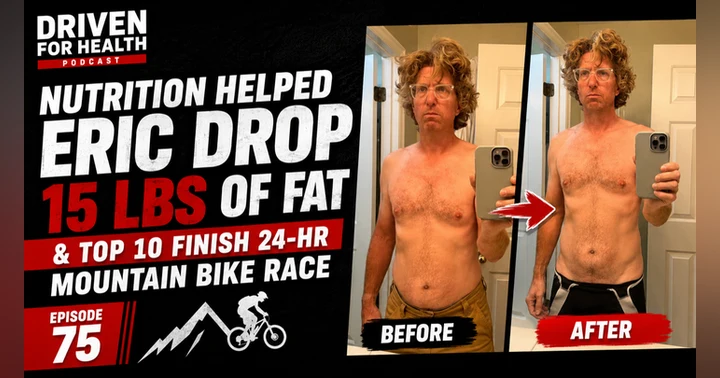
Nutrition Helped Eric Drop 15 lbs of Fat & Top 10 Finish 24-hr Mtn Bike Race - 75
Eric is a busy dad and business owner who was training for a 24 hour mountain bike race. He lost 15 pounds of body fat while eating up to 3,500 calories or more on his hardest days. Coach Brian walks through how his calories moved with his training. This one is for men who train hard and still carry extra weight.


 YouTube
 Eric is 42, a father of three, a business owner, and a mountain biker training for a 24-hour race. He lost 15 pounds of body fat while eating up to 3,500 calories or more on his hardest training days.
(Are you training hard and still carrying extra weight you cannot explain? See how Eric fueled his way to a leaner, stronger body at www.thecalltorise.com.)
Coach Brian talks with Eric about the training and nutrition that got him ready for a roughly 180 mile mountain bike race. They cover how his calories were adjusted around training days, some as low as 2,500 and others 3,500 or more, and how that approach let him lose fat without wrecking his performance. This is for men who are already active and still cannot figure out why the extra weight will not move.
By the end you will know how to fuel hard training instead of just cutting calories and hoping for the best.
Main Topics:
- Eric trains for a 24-hour, roughly 180-mile mountain bike race
- Losing 15 pounds of body fat while eating 2,500 to 3,500-plus calories
- Adjusting calories around training days instead of eating the same every day
- Why nutrition matters for endurance, recovery, and power output
- How a busy dad and business owner still trains with purpose
- Fueling performance instead of just cutting calories to lose weight
The Call To Rise is a 100-day fat loss challenge for driven men ready to take their body back. It combines strength training, personalized nutrition and real accountability. Most men drop 20 to 30 pounds and rebuild the confidence that comes with it.
This program also works if you are dealing with high blood pressure, high cholesterol or Type 2 diabetes. It was built for those men too. Many men see those numbers move in the right direction alongside their weight loss.
Inside the program you also join a Brotherhood of men doing the same work. Together you build a body you're proud of and start leading like the man you already are at work.
This is your wake-up call to rise. Learn more and apply at www.thecalltorise.com
Want help applying this to your own health, weight, energy, or lab numbers?
Coach Brian Parana offers Health Hot Seat coaching segments for men who want a clear next step with nutrition, fitness, weight loss, blood pressure, cholesterol, A1C, or daily consistency.
Learn more about The Call To Rise, a 100-day coaching program for driven men over 40 who want to lose weight, improve their health, and rebuild confidence:
To connect with Coach Brian:
brian@brianparana.com
Disclaimer: This podcast is for education and coaching support only. It is not medical advice. Always work with your physician before changing medication, treatment, or medical care.
- If you fuel your body properly, your body will just start shredding those unwanted pounds. And in my case, 1 to two pounds a week consistently of just body fat. Now, this helped ensure that I lost the fat and not muscle since I was performing and racing for a 24-hour mountain bike race that I'm training for. Well, that's Eric's story.
- In about 3 months, he transformed his body, shedding 15 lbs of body fat while maintaining a base calorie amount of 2500 calories or more a day. Some days he ate even 3500 plus calories depending on how much he trained. For today's episode, sure it's about weight loss, but even more importantly, racing and performing at your best or doing bigger things than you thought possible for yourself.
- At age 42, Eric raced 180 miles or so in 24 hours and placed top 10. That is incredible. We're blown away by his results and the impact that we had on his nutrition and recovery to race against, in quotes, the younger guys. Welcome to Driven for Health podcast episode 75. I can't believe I made it this far so fast. If you've been following this journey, it's been about 150 days since I started back on September 23rd.
- It was a day that I had one call and a lot of time and I figured, hey, now's the time better than ever. So, I started this podcast for you, my guys, to gain much needed knowledge, but more importantly, the application to the information. So, grab a seat. Let's jump into Eric's story at 42 and how he placed top 10 in his performance at the 24-hour mountain bike race and think you could do this too. Literally, you could.
- All right, there's Hey, welcome everybody. Today we have Eric. Eric and I met a couple months ago now. He's a cyclist. He's a father of three. He's a business owner. He juggles all the things. He has three kids. I have four. So, we automatically connected there as well. Knowing each other's schedule is bananas.
- So, what brings him to the call? He's a cyclist. He wants to feel like he's in his 30s cycling, not in his 50s. And he's actually in his mid-40s right now. So, welcome to this here, Eric. And just kind of introduce yourself to everyone who's watching here. >> Yeah, thanks, Brian. Um, yeah, my name is Eric.
- I uh I'm based out of Salt Lake City. Yeah, as Brian mentioned, I have three kids. I try to ride you and I've always ridden my bike. Um I work I have a couple different jobs. Um I have my own business and you know, time is super limited and you know, the reason why I reached out to Ryan was just, you know, trying to achieve some goals and and do some different stuff and and you know, needed some help.
- >> Yeah, we we got on a call. It was definitely you four a good four or five months ago or so. You're like >> July. >> Yeah. July. Okay. >> Yeah. >> And and it's December, so that's five months. >> It's like, hey, I want to ride a 24-hour mountain bike race. Oh, okay. All right. All right. Excellent.
- So, let's talk about that. What was the desire? You've actually done it more than once. And so, why did you want to get to it again and actually like cross the finish line in one piece? Yeah. So, I mean, it's a 24-hour mountain bike race. It's kind of a mental, it's almost more of a mental game sometimes than a physical game.
- Um, but I wanted to like feel good and I really wanted to like have my best chance of of doing well. Um, and so as I was getting older, you know, I was like feeling just harder and harder to like get performance and to get my weight down to where I wanted it and and yeah, so I reached out to Brian just because everything I told me that I read told me that, you know, nutrition, nutrition, nutrition, >> right? And in our time together, you you bought a new bike that was um pretty very nice bike.
- You got it resale value from some lady that just didn't realize what she had on her hand. So, you got a great deal on it. But we we kind of joked, you want to lose some weight and and certainly a lot of cyclists and and triathletes and road cyclists, they they want they'll get this top-notch gear and stuff, but it doesn't necessarily make you faster, per se.
- You still carry a lot of body weight or lack the power to to pump into that thing. So, you upgraded and and let's talk about some of the weight that you've lost because that that was one of the other things you wanted to transform your body, >> right? Yeah. So, with with any sports, I mean, if you're a runner or if you're a triathlete or a cyclist, I mean, you know, runners wear light shoes, you know, they're not running in heavy shoes, for example.
- And and losing weight was a big thing, you know, like kind of always hovered around the 175, 180, 170 range. And I mean, I really, you know, should be like the way I'm built, you know, like 155, 150 maybe if I'm super lean, but I could never lose it. Um, and so with with data and metrics and FTPs and all that stuff, it it all comes down to to power per per pound, right? That's what the kilos per, you know, your FTP is power per kilo and and all that stuff.
- So losing weight was, you know, a big thing for for the race, right? Like getting down and all of that stuff. If you're carrying around an extra 15 pounds every mile, you need more you need to burn more calories to sustain your weight and your power. So it was something on that, you know, that was big on my radar was to get get toned.
- >> Yeah. Actually look like a cyclist, right? Not just look like an average. I'm 42, so I'm like in there, too. I'm I'm very conscious of uh what I look like and feel like. I want to >> I want to look and feel the way I do now when I'm 50. And I'm going to keep doing the things I need to do to do that. And and ideally >> just maintain this this youth uh uh about us.
- So, we dropped how much we dropped? We definitely dropped some body fat, more specifically belly fat because the rest of your body you you look like a cyclist in in general except for the the midsection, >> right? Yeah. Lose that stubborn belly fat. >> Yeah. It was about 15 pounds. like 15 15 pounds, you know. And I was going to mention too, like um you know, I coached a lot of the high school kids and stuff and it's like yeah, you wanna like I'm like a cyclist stuck in a dad's body, you know.
- So wanted to look more like a cyclist than than a dad because you coach your kids, too. Uh yeah, we had plenty of Saturdays where you were out on the mountain in Salt Lake and and just cheering them on and and and definitely like even just for them alone, your kids, but also the team being a leader in like, hey, this is like this is what it takes.
- This is what it looks like. This is what it feels like. And a lot of things that we talked about could definitely transfer over to guiding them too. So what what I think go >> I was just going to say yeah to kind of before we move it on like I think the new with the kids and all of that like really being able to coach not only the students but like my kids in my house you know like they see you know when when I before my race you know it was like my boys I was like look at me you know and they were just like what the
- heck you just the nutrition side of it I mean it's a lot it's in the news a lot uh with with our our our health in the US and nutrition is a big thing and and I think it's important for for not only my kids but to be able to coach and talk to other kids about properly fueling and and what to eat and and if you want to get strong like you got to put the calories in on the off time.
- You got to preload. You got to do all those things right. even just randomly. Cycling is a lifelong activity and so you get them hooked when they're young and get them thriving and they can do that the rest of their life which is pretty cool. We we lost about a pound a week. That was one of the things we we had to in the first like two three weeks we're like dialing in the calories.
- And so what was some of the process that that you experienced through like getting our our base calories were 2500 is kind of where we ended up settling, but what was the experience the the the amount of food you're eating to just even hit to that base calorie and then some of those like long Saturday, Sunday multiple hour rides.
- We can talk about that in a moment of how we strategize some like on the bike calories and eating 4,000 plus and stuff, but how how did we settle in and and how'd that do for you? >> Well, I would just say first of all like and and I mean you nailed it. I mean, we went through at the beginning, we went through like what I was doing on the daily, like how many hours am I riding per week, per day, you know, what was my caloric intake at the time? And, you know, you you I think you came in right at like 2500 calories.
- >> Got checked. >> Yep. And so, we actually never really adjusted off of that based off of what I was doing. The feedback said that we didn't need to. >> Yeah, exactly. >> You know, still had the same amount of power, if not more, at the very beginning, right? We're talking about the beginning. >> Um, and it was good.
- You know, eating that much, I was never really tracking it, but like eating that much food, you know, sometimes was a little bit hard. You know, you you have to eat, especially, as we'll talk about in a moment here, like loading for the long weekend rides and, you know, getting up 4,000 calories in a Okay. I mean, that's a lot of food, but it was good.
- It was easy. You know, you coached me on like food prep and all of that, which I'm still doing today. I just cooked, you know, on Saturday uh um another another eight pounds of pork in the crock pot, you know, that you know, so um it was good overall. It was a great, you know, experience. And again, like kudos to you.
- like there was no there was no ramp up time of like oh okay like we're going to try this out and dial it in like you know maybe in some instances you have to do that but um with your knowledge like I would say like you know as you nailed it and and >> you did great >> that's thou 20 years of experience and thousands of conversations just kind of through yeah Eric's right ask him [clears throat] what his training is like, what his sleep's like, what he's doing in his off times, like, how much movements he's doing a day, is he doing any strength training, how much
- interaction is he doing with his family, like all these things and beyond are are just pieces of the puzzle that we have to put in place to then be able to start and and generally have a pretty good methodology of how I start people out no matter what. And then, yeah, there's feedback.
- This is a coaching client relationship. Eric was always sharing his updates, his workouts, which we'll talk about because it's like every single time he got on the bike, it was like, "Hey, I got a personal record or I went faster in this just section of the the race or ride or whatever and stuff." So, uh, so yeah, we we definitely nailed it and then we just went up from there.
- the the demands and we kind of settled it into a good flow and that's really important too that [clears throat] you don't have to like ride or die by tracking your food or anything that but or even like have all the the I burn this many calories per what my watch said and this that and have to do all this mathematical we we were able to break it down hey we're going to bike this much this is about how many calories we need to eat and and we kind of worked through that in in a couple weeks and it it worked beautifully
- because every time we talked on Sunday, you were always down like another pound. And that's what the appropriate amount of fat loss was for you to burn belly fat, not sacrifice performance or muscle. Especially being a cyclist, there's a heavy amount of potential catabolic activity that's going on. If you undereat, you could be burning muscle and and then thereby shooting yourself in the foot per se when it comes to actually performance and output and because the muscle is just not there or it's not recovering or for the love
- of you get an injury, right? You you really didn't have to deal with a lot of aches, pains, injuries for the hours and hours that you had put in on the bike. So, >> right. and and on that like I don't know if you remember remember I wasn't really eating very well on the bike. Oh yeah early on my stomach wasn't good with a lot of snacks that I was eating.
- um you know we were able to you know overcome that but um >> you know and then helping too like I had all the rides so we knew the data like we knew how many hours a week I was doing and although the apps are really good at tracking your heart rate and all these things and tell you how many calories you burn it's and and correct me if I'm wrong coach but like it's kind of somewhat negligent because it doesn't matter what the app is telling you because you just kind of come down to your basics of your formula like this is
- how much we're doing, this is how much we're moving, this is how much you need to eat. >> Right. Right. There is always some intuition that has to be brought into this so that you can just like [snorts] now months later you can just hey I am or I'm not like you're in Salt Lake so hey the trails are like looking good and I'm going to go out for a three-hour ride. Oh, nope.
- Snow just dropped and I have to abort a main ship. And then you can really quickly adjust however you need to, which is very important so you're not hung [clears throat] up or like I don't know what to do. So we we got up to what a good I know we did at least five five plus hours on some of those longer rides. So, we were eating and we have to adjust.
- If you're an endurance athlete and you're going over say two hours of high performance effort, you have to eat during that. It's just you you just you're going to run out of muscle glycogen, you're going to run out of calories, your muscles are going to be screaming to you, and that's where that bonk, that hit the wall type feeling or redlinining starts to come into play.
- And you just depreciate the longer you go and stuff. Y >> you had some training uh some of the screenshot I I was you're always lighting my phone up with just these really positive power outputs and and these you had in Straa you had each of the segments of some of your rides broken down and you're like hey this is so what what were some of those positive changes that we saw there and then even maybe FTP how that's changed.
- >> Yeah. Um I I would say the beginning, you know, like was it July, August, we were kind of settling in and then like September hit. We were definitely deep into the mountain bike like races for the kids. But I had to kind of modify my schedule to do um more intervals inside just because of time.
- But what we started what I started to notice like was you know I was just blowing away like my PRs on some sections like you know climbs where you're like you know all of a sudden you're not even really trying that hard and you're beating your times by just a couple minutes on the trainer on the indoor stuff on the intervals you know all of a sudden your um you know your power output for an hour was you know the best you've had and you know it's like I don't really think I would have ever been able to do it honestly without like
- proper nutrition and and just fueling the the you know I always tell my kids like your body's like an engine you know you got to put good good gas in it to get the most out of it um so properly fueling it and really really help but yeah I mean I'm even till today like I think it was last week I sent you when I had you know I'm starting to train for the next event and it was uh you know second place PR but I'm like at the beginning of my training and for this event was like not even really trying that hard and I'm putting out more power
- than I had, you know, or the same amount of power I did a month ago and not even really trying that hard. >> Yeah, it's awesome. >> I think we also saw it when you were riding with your buddies. >> Yes. Yeah. Yeah. [laughter] See, see you later, you know, like, oh, thought you wanted to ride with us and then next thing you know, they were they were gone, which is great, you know.
- I love that. >> Leave them behind. What what are you doing? like I'm just eating more food and [laughter] >> Yeah. >> So, >> yep. >> I love that. I love that. Those are some of my best. It's like, yeah, I just like kind of left my buddies. I have to wait for them at the top while they're like dying trying to get up.
- So, >> yeah, just the the overall power too, man. I got I get, you know, in the flat sections and mountain bound bike's a little different than road, but you know, when you're traversing across and you're, you know, you're flying, you know, and you're just putting throwing it down and, you know, you you're able to eat and keep it coming in and it's just a really the human body is really amazing when you when >> it Yeah.
- >> Yeah. I mean, you can go and just keep going. >> Yeah. And we had a wide variety of different things to eat, too. It wasn't just like I'm going to have my sports supplements and and just drink all this stuff and goo myself to death. A lot of food options that were a lot of food strategies, a lot of pre Yeah, I'm a big fan like today before refueling the muscle glycogen carb loading type situation stuff and it it worked out wonderfully.
- Oh, let's talk about that 24-hour race. They obviously called it because it was freezing and and what snow and and just the the conditions totally kind of fell apart on it. But that's something you can't plan for. But what did we plan for beforehand? Your spreadsheet, your gear, and and how do you end up placing? >> Yeah.
- Uh they did call the race early due to weather. It was >> all the things we planned for like who who would have planned for 35 degrees and raining and snowing and wind. >> Not fun on the mountain. >> Wasn't fun at all. But no, we planned. It was good. Um, you know, everything is always a process for learning. Um, but we had all the food, we had all the nutrition.
- We broke it, you know, spent some time broke it down into a spreadsheet of like how much water and salt tablets I had to bring to take on and um how many calories all that stuff went really well. Um felt great minus minus the weather and the suffering part of it. Um it lasted 17 hours >> 17 hours. 17 hours before they called the race. Umund almost 180 miles and finished 10.
- >> The next youngest person in the top 10, me being the oldest, was 23. >> Yeah. Wow. >> That that felt awesome. Uh the next oldest guy my age was 16th place and he was a l two laps behind me. So it was great. Awesome. Yeah. And I do recall your laps were um pretty darn consistent over almost what 90 minutes.
- You were just like like clockwork. >> Yeah. There was one where I was like I think I told you I was feeling great and I did not like I >> You didn't even plan. >> Other than that, they were all It was amazing because they were all within just a few minutes of each other. Like you know um >> they're talking about 90 minutes of like a lap. 990.
- He was like within like three minutes or less every single time >> except for the one where you got a little carried away. >> Yep. Um Yeah. No, and that was that was amazing. I mean like you if you you think about that like you know you start out my first lap was fast realized I had to kind of back off a little bit and then every lap you know I did 13 laps.
- nine of those laps, 10 of those laps were all within a few minutes. And so, you know, when you start thinking about nutrition and and obviously preparation, but properly fueling, >> yeah, >> knowing where you need to be, you your body can just throw down consistently every single time. Um, you know, and and after the the as the sun started to come up and life began to blossom again, as the new day came over, you know, it's like starting to feel good.
- Unfortunately, they canceled it, but like, you know, was ready. I was ready just to to keep going. >> Yeah. And you're confident to be able to keep going, too. >> Oh, yeah. >> But all the the plan, the food, the the strategies were all there. Your body was still feeling good at that point, even FR in. So, >> yeah.
- And this generally the plan you know was that I would start to turn up the heat a little bit because the you know the race doesn't the race isn't won um you know the first or second lap. >> So um other times that I've done that you know people really start to struggle at the end and was I was feeling way better than I did the first time um doing the event however they called it.
- I was ready to ready to just, you know, had five hours left of racing or six hours left and was like, "Okay, I got five laps in me. I can turn it up." >> Yeah. Yeah. Which is empowering. >> That's exciting. >> Yeah. Next time. >> So, we we got a couple other races that that we're planning for. We have other strategies that we're doing.
- He's also skiing, hence out in Salt Lake. So, he's hitting the powder quite a bit. So we're we're kind of maj putting it all together so that that he's getting, you know, fit and he'll be ready to roll when as soon as that that snow melts as well. His power output FTP is going to go up quite a bit here a little bit too >> as we just get going.
- What what made this approach different? Like why why do you think it worked? Well, I've never really done it, so I can't honestly tell you why this one in particular worked. I would say, Jen, my answer to people when I talk about it is it's common sense. Like, you bring a very common sense approach to it. Your experience shows, you know, right from the beginning when we nailed the calorie caloric intake and what what I needed to do.
- And you know, we didn't really dive into it, but the preloading of, you know, when I was going to do a big ride on a Saturday, we're eating, you know, 3,500 calories on Thursday and 4,000 calories on Friday, and then I'd go out and burn it all on Saturday. Like, all of that stuff. Like, the approach just works. It's simple. It's straightforward.
- Your diet plans, your meal prep, all of those components, looking at the nutrition, like it's all it's common sense. It makes sense. >> Yeah. Yeah. that I always joke with people if I hit you upside the head with too much logic let let me know because you know food when it all comes down we got three things movement that we're paying attention to food choices and then lastly portion control and in your situation we had a lot of movement we needed to make sure that we are having more premium fuels and that didn't mean
- that we weren't having simple carbohydrates specifically when they needed to be just had higher quality food and then our portions. The the great thing about you is you were very adapted that you could go on 2500 calorie days, 3500 to 5,000 if you needed to and still be able to execute, which made it easy for me.
- So, thank you. I'll ask Eric, >> one one thing there I want to add to, and this is probably for the people that were doing what I was doing. What was I doing before I met you, before I reached out? I was thinking that if I just rode my bike and I ate normally that I would lose the weight and it would go off. And that is not the case.
- If you fuel your body properly, your body will just start to shred those pounds, two pounds a week consistently. It's pretty amazing. like you know your body really needs the proper fuel consistently to to to not only perform the way you want to perform too but to get to the you know the physique that you want.
- So fuel fueling is not just for power and all that stuff like to get in shape got to eat. >> You'll you'll burn out or you get hurt especially amount of activity you're doing. Marathon runners triathletes that want to do more than a sprint try you have to fuel properly. It's you just have to do it. If someone was hanging out watching this and they were thinking that exact thing, what what would you tell them to do? What advice would you give them to get them moving in the right direction? I you know I work I work in sales and I do
- a lot of stuff and a lot of it a lot of the people in general have a lot of commitment issues and it's weird. People are really afraid sometimes to commit to themselves. Whether you're talking about buying something or maybe starting their own business or doing something else or making a career change, they they doubt themselves.
- And the same thing is with with you and nutrition. Like don't doubt yourself. Commit. That's what I would say. Like call Bri get Brian on the phone. Give Brian at least six or eight weeks, whatever his, you know, your minimum is to to try it. Like it'll be the best thing you do. Like I, you know, um I I still eat the same way.
- You know, I'm not tracking as much, but I know like the portions, you know, my my fist, my hand, how much I should be eating. I get my measuring cups, my two cups of Cheerios, my one cup of blueberries every morning, you know? So, my my message to you is like commit to yourself. Like, if it's something you really want, just do it.
- >> Believe in yourself because it'll happen. >> Yep. I I've committed to this for 20 years. Back in 2004, I got a degree, but started teaching group exercise classes in 2002. So, the only thing I've done in my whole career is help people improve their health, their fitness, their nutrition, their physique, whatever, their endurance.
- So, a lot of conversations and and and the knowledge experience just comes. So, you're awesome. I really look forward to what happens and comes this future. We're going to be thriving. FTP going through the roof. performance. The next time you ride with your buddies out on the trail, they're going to be like, you're like, "Hey, let me go ride an hour and then let's meet up for to do our group ride together because you guys are too slow for me now.
- " >> That's right. >> Totally. So, I appreciate you and we'll we'll catch you next week in our call and keep chipping away and you keep sharing those increased power outputs and like gold, silvers, and bronzes that they're giving you in Strava and stuff. So, I appreciate it. >> Yeah, man. Thank you very much.
- You have a great rest of your day. >> Yep. >> So, if you watch this and and you're inspired by Eric or things that we talked about, you reach out. We can have a conversation and just start something. see if we can if I can help you and we can work together and like teamwork makes the dream work just like we had with Eric.
- He he came on and that first call he's like, "Yeah, let's let's do this." And and then off we went and here we are. We're both really proud of his effort and his activities and and it's been a a really fun, enjoyable process. So, thanks so much for watching. Thanks, Eric. I really appreciate you. Keep crushing it and and off we go. >> Okay. Thanks, Brian. Have a good night.
- >> Thank you. I hope that you enjoyed our conversation with Eric as he performed at some of his best in years. He's down. He's a lean machine. A lean cycling machine. And that's exactly what he wanted. He came with the goal of racing that 24-hour mountain bike race, cutting fat, and we did just that.
- And he was blown away by the amount of calories that he was able to eat. That's just science to me. That's the process of the art of the coach in a sense of how I go about understanding someone's situation and translating it into real actionable impact that goes into his day-to-day life. And we didn't disrupt it.
- He didn't just start eating weird things. I mean, there's so many times he'd jump on a phone call with me and he was eating cereal. And that's the power of coaching. That's the power of application and consistency. Now, if you're looking for some help and you have fat loss goals, performance goals, that's exactly what I do in the call to rise.
- It's my 100 day fat loss challenge and more. I've helped people deal with chronic illness, as you've heard through some of the testimonial episodes, through losing fat, through gaining strength and confidence in a lot of different areas. So, we've got the five pillars of the call, which is your identity.
- reignite that internal idea of who you are as a man and how you need to step up to that, not just be passive in your 40s and 50s. Second one is the forge. This is the exercise piece, the the movement piece, the building your body back up. Third is the fuel. This is the nutrition piece where we apply sciencebacked information into your everyday life to make it as easy as possible. Four is the code.
- This is your mindset. the way you start thinking and seeing things with a different lens that works for you. And number five is the brotherhood. Doing it with like-minded men that are driven to s be successful and excel in their everyday life. And that's what I'm bringing together is like-minding guys that want to shape up and improve their overall health and the impact that it has not only on their personal health, their family, and their business, their career.
- So, if you're interested in transforming your body and doing it with me, the calltorise.com, check it out, fill out the form, and let's have a conversation to see if it's the right fit for you. Off we go to episode 76. Excited to have you guys along for the ride. Thanks so much,