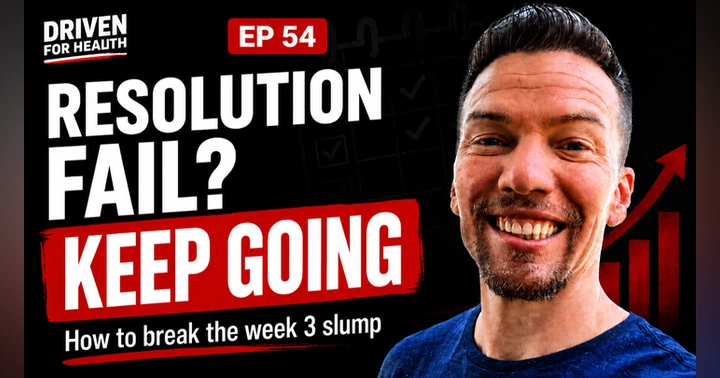
New Year’s Resolution Fail After 3 Weeks, Here's How To Keep Going - 54
Week 3 is where most New Year's resolutions fall apart. Work ramps up and sleep gets shorter. Coach Brian explains how to plan for those obstacles ahead of time. You leave with a weekly system and a 24-hour move for the day motivation is gone.


 YouTube
 Week 3 is where most New Year's resolutions fall apart. Work ramps up, travel happens, sleep gets shorter, and the plan that felt easy on January 2 suddenly feels impossible to keep.
(Have your resolutions ever made it past week 3? See what actually holds up once life gets busy.)
Coach Brian breaks down why motivation fails and what to build instead: fundamentals that hold up in real life, not just on your best days. He covers how to plan for the obstacle that always shows up, whether that is work stress, travel, or late nights, and what to do after one messy day so it does not turn into a messy week. He also shares a simple 24-hour move that creates momentum when motivation is gone.
By the end you will have a weekly system that keeps working even when business gets busy and life gets loud.
Main Topics:
- Why week 3 is the real test of any New Year's resolution
- The fundamentals that drive fat loss and energy for men over 40
- How to plan ahead for the obstacles that always show up
- What to do after a messy day so it does not become a messy week
- The 24-hour move that creates momentum when motivation is gone
- Building a weekly system that makes your health automatic
The Call To Rise is a 100-day fat loss challenge for driven men ready to take their body back. It combines strength training, personalized nutrition and real accountability. Most men drop 20 to 30 pounds and rebuild the confidence that comes with it.
This program also works if you are dealing with high blood pressure, high cholesterol or Type 2 diabetes. It was built for those men too. Many men see those numbers move in the right direction alongside their weight loss.
Inside the program you also join a Brotherhood of men doing the same work. Together you build a body you're proud of and start leading like the man you already are at work.
This is your wake-up call to rise. Learn more and apply at www.thecalltorise.com
Want help applying this to your own health, weight, energy, or lab numbers?
Coach Brian Parana offers Health Hot Seat coaching segments for men who want a clear next step with nutrition, fitness, weight loss, blood pressure, cholesterol, A1C, or daily consistency.
Learn more about The Call To Rise, a 100-day coaching program for driven men over 40 who want to lose weight, improve their health, and rebuild confidence:
To connect with Coach Brian:
brian@brianparana.com
Disclaimer: This podcast is for education and coaching support only. It is not medical advice. Always work with your physician before changing medication, treatment, or medical care.
- As of time of recording this, it's January 27th. It's late January, late into the New Year's resolution. Picture this. You pull in your driveway after work and you sit in your car for a minute. No email, no cell phone, just quiet pause, trying to collect yourself from the busy of your day. It's been a whirlwind.
- What's happening in January? A lot, right? There's the work stuff, the new quarter, businesses full go. Right now, my kids are in their fourth day in the last 10, it feels like, of no school, and the rest of this week, they're likely to be home. So, there's so much going on. And before you walk in the house, you want to collect yourself.
- You want to be a good father, a good husband, dad, a leader in the house. If that scene is familiar and you just sit in your car a minute trying to take a breath and collect yourself, you're not alone. I hear this from a lot of guys. Early January, they felt strong. They were motivated by their New Year's resolution and ultimately things are starting to settle in.
- They had strong momentum in the first week or two. Then the real schedules and the pressures built and they start showing up. Work's busier, calendar's more full. If you travel for work, you probably are on a plane already. And again, going back to kids are full-time. Mine, I've had to spend a lot more time with them in a good way, but also a lot more time that pulls me away from work.
- This is the episode that helps you push through these challenging third week, fourth week into your New Year's resolutions and actually set something up that lasts. And we definitely aren't in a lack of information, but motivation coming from information isn't going to work, right? It's not a stable foundation that's going to get you to actually pull through and get real results.
- And today, I'm going to give you a system that survives the calendar beyond New Year's resolutions. And it works with travel, and it works with kids. And it works when your schedule is packed to the brim. And I'm going to give you a couple proven ideas from people like Tony Robbins, John Wooden, Vince Lombardi, John Jim Ran, Ed Schoff, Gabriella Atingan.
- Then we're going to translate them into something that you can take away from this. So it's a star-studded lineup with real actionable systems and processes that work. And I have a bunch of analogies for you as well. And that's what's kicking off episode 54 of Driven for Health. And I'm Coach Brian Pra. And we're just going to keep rolling with this.
- First up, Tony Robbins talks about the law of familiarity. It's when you hear the basics that so often that you stop treating them like they matter. A lot of the principles that I work off of every single day with people I've coached with for 23 years are the basics and we've gone over those at Nazium and this being the 54th episode. There's plenty to go back to.
- Episode five is the nutrition pyramid to start from 5 to 11. Episode 17 is the strength pyramid. And it goes on and on and on and different ways to apply these things, different angles to think about it in your life. But the law of familiarity is what gets people challenged. So let's go over these basics real quick. Protein matters.
- Getting some strength training about two to three times a week. You want the protein will go about 140 or more depending on your size and your activity goals. Sleep six for sure, seven or more. Walking 10,000 steps a day. Keeping alcohol to a minimum. These are going to be really solid approaches. Getting lots of vegetables.
- These are the basics. How do we get them to make them simple and easy into your extremely busy life? And that's where the problem lies is that once we feel that it's basic like tying your shoe, the brain treats it just like a background noise. It's just not any relevant for you to to think about or put a lot of emphasis on how many times you just tie your shoe and just get up and go because most of the time it works, but occasionally it doesn't.
- And sometimes when it doesn't, your shoelace comes undone and you don't just stumble, trip or you actually fall and then you face plant. And that's often what happens inside say January. Everyone laced their shoes up and they're ready to go. But some of them didn't double knot the shoes. By double knotting your shoes, you would ensure that it would take even longer for you to be able to get your to to be able to keep your shoelaces from falling undone and allowing you to trip and fall.
- We don't want that. Okay? We need to make sure that we are working on stable understanding of these basics. So when things start coming undone, we start looking for new plans, new supplements, new hacks, new training splits. All these things sound exciting. Intermittent fasting and what else we have? We have keto was a big thing or the Atkins.
- It just keeps coming in waves these these new different approaches to the basics. You have to watch calories. You have to eat protein. uh drink your water. But the the novelty of the new thing is exciting and it gives you that dopamine. It gives you that I am motivated. I am driven. I'm going to do these things. And that's something that we want to borrow from but not necessarily leverage because the novelty doesn't necessarily create consistency and that's where things fall.
- The best coaches in the world did not win by inventing new fundamentals, new processes. They won by drilling the basics into their clients, into their systems, their processes, so it happens automatically. Think of John Wooden from UCLA or Vince Lombardi Lombardi in the NFL. They both had basics. I remember stories of John Wooden and the first thing he did with his guys was tie their shoes.
- That was the first lesson that they taught and allowed them to be very successful at pushing through, right? Building legacies off these and they won more than they lost and won in big ways and they created elite players and all sorts of different things came from them. So, picture this college kid's walking into practice and he can hit shots from everywhere and he wants to do the cool drills and the exciting stuff and he wants to feel like a star.
- Well, when it brings him close to the basket and they start working on free throws, they start working on basic layups. Why? Because in the final minute, nobody risks on these cool drills or the outside shot. Sometimes the outside shot has to be taken. But if I guarantee if the players can get the ball inside to score an easy layup or a hard layup, they're going to do that far more than take a three-point shot.
- Okay? Health works the same way. When you're tired and your body is not working for you, especially in week three, week four of the New Year's resolutions, this is when the old habits start to show up. The novelty wears off and if you don't have an ingrained new behavior patterns, you will falter. Next up is there's two things that we want to work on here.
- a goal that matters and a system to keep it alive. Here's some of the frameworks we're going to go over today and it's built around this to make it easy and memorable and you can pause it whenever we get to these things. One is the law of familiarity that we already went through. Second one is the Christmas Eve list. Third is the fundamental five.
- Four is daily drills. Five is the diamond pressure rule. Six, the Sunday scoreboard. Seven, the obstacle map or whoop. Eight, the rocking chair check. Nine, the 24 ignition move. 10, the Christmas Eve list to wrap it up. Most men fall into these challenges because they're tired, they're fatigued, and they keep filtering through what feels like realistic goals.
- So, right in the beginning of this the year, they push through to really work hard, but they aren't negotiating what actually is going to happen, the road map that has to be laid out and executed on, and they ultimately get disappointed. Tony Robbins has a frame. I love Tony Robbins. I've firewalked twice, been to his UPW twice, and he is just inspirational to say the least.
- I just got done watching he and Alex Hermoszi have a YouTube conversation. It was very insightful and you could see the master and masters at work and what they do and how to elevate themselves. It's very cool. Now, on Christmas Eve, we want to think about a question. If health was handled this year, what would it look like? Okay, if you're able to live a healthy, fulfilled life, how does it look? What would your weight be? Be very specific.
- Pause the podcast and write things down. What would your waist measurement be? How would your mornings go? How do you get out of bed? What do you do the first thing? What are you doing in the middle of the day when you normally are fatigued and tired? How do you change your approach there? What would your blood panels be at the end of the year? What would your body weight be? What would your body composition look like? What would confidence feel like in photos, in clothing, and next to your your partner, your spouse, your wife?
- How do you enter the room? So, let me give you a little coaching scene here. A guy says, "Coach, I want to lose weight." And I hear this every day, all the time. So, I ask, "How much?" He says, "I don't know. Just I just want to lose 5 or 10 pounds." Then I ask when, he says, "Soon." How fast can we get it off? This isn't really a plan.
- This is a hopeful wish on it. And so if we can get specific example being Clay this weekend we game plan he's doing the Rocky 4 challenge. He is in Salt Lake training for becoming an airplane captain. He's already a pilot but he's leveling up and he's there for a week. He's got that as a huge main focus of course.
- then health fitness in the other times. And so we I gave them four different challenges to do over that time frame. And we labeled the Rocky four because Rocky went to to Siberia and and Russia and then he had nothing to do but train. And that's exactly what Clay is doing. He was jazzed. He was juice.
- And for that we're able to really have very specific focus. Okay, there's a specific outcomes that inputs that he's going to be doing. We can't say, "Hey, I hope to be down three pounds this week." We can say, "Hey, I'm going to do 1,000 calories on the elliptical. I'm going to do 10 miles of hiking at a five% incline.
- " The Grandier Peak is what we were modeling that after out in Salt Lake. And then I had another two things for him to do. And he was juiced. He was excited. He was pumped. And off we went. And this is helps him have real targets that helps keep his energy up and he has very specific things to stay on track.
- The second one is fundamental five for busy guys out there with five fundamentals that we're focusing on is we already went through these protein steps, strength training, sleep, and lastly being a weekly review and everything else after those becomes secondary. And and the analogy is that we go back to Clay and this why I brought him into this conversation.
- But a pilot's checklist. A pilot does not skip the checklist because he flew yesterday. He doesn't skip it because he feels confident a plane's going to be able to make it to wherever it goes next. He doesn't skip it because he's in a hurry. They take their time because if they skip it, things can go bad. Especially when you're in a flying tube in the sky.
- Your health basics are the checklist. These things are it. And when a man says, "Coach, I know what to do." And I'll agree because we have these basics and it's not a knowledge gap, but it's an execution gap. And that's where I come in strong. Support and accountability have been the biggest metrics for my long-term success that I've been able to create for many, many, many people, thousands of people in the last 23 years because they have a clear checklist and they have exactly what to do and I'm there to make sure that they do it in the easiest way possible. Now,
- there's been thousands of different ways to get protein in and seps in and and all these things, but at the end of the day, that's where it's at. Number three is the daily drill. The daily drill is the version of your best plan that works in a normal day. Okay? The plan that we focus on for consistent every day, Monday through Friday, Saturday, and Sunday.
- And we don't always want to build the best day plan. Meaning, we don't want it to be this superstar day that's going to be perfect in every measure. No, we have to look for the most challenging days and figure out how to make those as easy as possible. And when we do that, then we're able to set up simple processes that allow you to stay on top.
- Think of it like this. A simple strategy for a daily drill could be, all right, I'm going to get 40 to 50 grams of protein in my first meal. I'm going to make sure that I am taking breaks every two hours, at least three hours to get in a minimum of a thousand steps in that time frame. I'm going to make sure that I always have water.
- If you're watching on video, I have water right here. And I have water right next to my coffee. And again, if you're on video, you can see it. So, what happens is that we've got plenty of water. I'm going to make sure I have a windown routine for bed that every single day I'm able to get to bed at the same consistent time. Okay? There's not usually much that happens after hours in a sense.
- In most people's lives, it's they're wasting time when it's all said and done. So, when we get this type of a a pattern of behavior in a normal day-to-day life, it gets so much easier for you to be able to be successful. You wake up refreshed, energized, and focused, knowing what to do, and you're not in the latter position of you wake up with hitting the snooze button three times, which I I hate the snooze button.
- I totally tell people never to use it ever. I haven't used this snooze button in a long time because it it it's the very first intention of your day that goes against what you already decided was good for you. That's why I don't like the snooze button because you wake up and you say, "Hey, I'm going to disregard what this this this decision is that I made.
- I'm going to get up at this time." No, I'm going to get up 9 minutes later. You're not going to get that much more sleep and it's just going to rush your day. And so many people say, "Oh, I didn't get breakfast in or I was rushed in the morning." And I just simply ask, "Okay, well, whoa, whoa, whoa, what happened? I was up too late, or I was tired, or I didn't eat really good yesterday, and I don't feel so well today.
- " Okay, that creates for a crappy day, to be honest, and you just get into the same rotation of just not actually getting things done the next day because you're tired. This is a common pattern but it can be fixed when we have these patterns of behaviors in having plenty of food in the house and available especially say protein sources or fresh frozen or canned produce allows for you to be able to easily get food in your mouth.
- Coaching story here. I had a client he swore he had no discipline at night to stay away from the ice cream. the potato chips, staying up an extra hour after he was supposed to go to bed. And he said he ate clean all day. He ate what we were supposed to be doing. And then afterwards, it just turned into ice cream. This is John. John ice cream.
- Chocolate. It was really chocolate for John. So, we had to figure out why is the chocolate coming in in the first place? Because it's not making him feel better. I mean, in the moment it does, but when we check back the next day, he's not very happy that he did it. And and so we dissected what he was doing.
- And the protein was always pretty low going into dinner. And that was a very easy fix for us to do is add an extra 30 grams to his already existing meal. And this allowed John to be way less likely to snack on chocolate. Within a week, things had gotten back to his normal new patterns of behavior where he's able to manage hunger and be successful there.
- Fundamentals in action there. Okay. Number four, the diamond pressure rule. What this is is pressure is applied to your health. And when the real goal gets set, the gap shows up between where life is now and where you want to be. That's the gap. And the gra gap creates tension. My job is to take you from where you're at, be able to navigate the gap, and get you to where you want to go.
- being long-term successful with a healthy body weight, good blood panels, and ultimately a happy healthy lifestyle. Now, that gap in the tension is what we need to lean into and focus on because when we are focused on that, we lean into the tension. Uh I'm going through that right now. This is this why I've been doing so many podcasts.
- If you have noticed in January, I've done basically one every other day and just leaning into this this build of can I get to 100 podcasts. So, I'm going to go well past 100, but how fast can I get there in a sense? And so, let's do some simple math. If I just hit 50 the other day and I maintain doing, you know, two uh what one every second or third day, that's 10 to 15 episodes per month that I can pump out, which then makes for five months or less at the very most.
- So, by June, I should be able to have my hundth episode and celebrate that. And I hope that you guys are here with me on the journey because I'm going to be talking about all sorts of different things for you to understand and make life better. So that's the gap that's creating this tension that drives me to be want to be successful here and keep producing and hopefully you get lots of value out of it.
- Right? I hope that you create some tension for yourself. Usually it's weight loss or a health chronic health issue or you the risk of getting a heart attack. That's that's really good pressure to avoid. All right. Number five, reasons first, answers second. The biggest line going back to good old Tony is that holds up in real life is that reasons come first, answers come second.
- If you have a big enough reason why, you will accomplish something and you will find a way. He's a big person of burn the boats. Let's go all in on making things happen. And when we have a strong reason why, to lose the weight, to get out of these chronic health issues, to grow a business, to whatever your goal is.
- If we have that, then we can be strong. reasons why. Pick one goal for the next 12 weeks. Just just one outcome, right? Lose 12 pounds in 12 weeks. Lose 2 in off your waist. Lift three times a week for 12 weeks. Drink 100 ounces or more every day for 12 weeks. hit 10,000 steps for if you hit 10,000 steps for 100 days, that's a million steps.
- And a lot of people don't ever fathom that they could walk that much. But that's the truth. Andy, who's in episode 53, was the first one that coined that for me. And since then, I've created a a million step challenge. And if you're interested in joining that, I can help keep you accountable, focused, and give direction on how to do that.
- You can just email me brianbriana.com and I can get you into that that little program there. A millionstep challenge. It's pretty wild. So, when we have the big enough reason, then it's not a motivational quote that you you found online or something. It it digs into the body, the belly, the it gets in your feet to take those steps.
- then you can see and look through different lenses of why you want to do it. So we have these re we have this goal, this task and then we find other deeper reasons to be able to leverage it and get even more in tune to it. Example, how do you want your kids to remember you p your present life? Uh, do they want do you want them to remember you as a happy, healthy father that was energized, always participated and did things with them or someone who was on the couch staring at a phone all the time? Last night I went out and I
- wrestled and sled road out in the zero degree weather to be with my kids and have a good time and create an experience with them. A side note, one thing I did realize a long time ago is that if I didn't take my kids out to sled riding, they weren't going to. They just weren't going to go. We don't have a hill that's around.
- We actually have to get in a car and drive. It's only There's one that's a half mile down the road and another one about a mile down, but the one that's half down half mile down the road is premium. It's great. The hill is fast. It's steep. is another part of it that gets a little bit longer and it doesn't take forever to climb back up because back in my youth I had a mountain what it felt like to climb at Goodyear metrop park.
- Holy moly, you went down that thing five times in an hour and you were lucky because it was just huge. It took so long. It was a good 10-minute plus walk up dragging your sled. So you would you get to top you'd ride down it's like oh gez I got this gigantic walk up. But this one by our house is premium. So I need to get out and make sure that I engage with them and create these opportunities so that they can have a blast right now.
- Jim Ran and Earl Schoff Jim Ran told a story about meeting his mentor Earl Schauff asked to see his written goals. Didn't have any. Said it was all living in his head. And you know where that story lands, right? It exposes something that people avoid. I finally figured out I'm on my computer more than I'd like to be, but it's just part of being an online business.
- I finally figured out a way to stay in tune with what my tasks are and my goals are. And those are sticky notes on my MacBook Pro. I finally Oh, shoot. That's right. You can put sticky notes on your desktop. And I have, if I look, there's a vision board. There's a to-do list. There's something that I'm doing with ads.
- There's other interest things that I have. There is a home task list. A bunch of different things that keep me very clear and focused so that I can knock them off. The cooler part is if I look at my to-do list, it's starting to get long because I am doing the things that I have on my action item list and then I put them in the done category.
- And then you just see this thing expand over time. And guess what? When you're doing the right things in your business or in life, like burning fat and moving your body, you will get the result because you can see these compounding interest happen at a significant amount of rate when you zoom out. Think about it.
- If you did three things a ye a day, three main needle movers a day, that's over a thousand action points that you made happen in the course of a year. And that is significant. Next up, looking at the Sunday scoreboard. Take 10 minutes and reflect. Game plan what happened last week? What's happening this week? For me, I'm looking at my week.
- to have some time open in different spots. And my goal is to make sure that I have all the way through 59 episodes or excuse me, edited and published for and scheduled to go out in a timely manner because on episode 59, I'm having coach John Sheldon back and he and I are going to have a coaching session about just diving in.
- And he was on episode 44. or if you want to hear our conversation about men's health, men's mental health, men seeking out support and that is a huge huge thing for him to be able to come on and share that. And then he works with executive leaders and teams and and that that type of arena. It's gonna be really fun. On Friday around a little bit earlier than this time that I'm actually recording and doing a live stream for this, we will be having a conversation about what we're doing, why we're doing it.
- Reflecting is a huge important. Again, going back to the main needle movers for me, for my clients that are looking to lose weight, we have two major ones. Usually, it's eating under a certain amount of calories and it's usually it's moving more than a certain amount of steps. And those are the two basic things I need to get things accomplished.
- And if you want to make sure that you understand this works, just listen back to episode 53. Annie and I go through how he lost 38 pounds in the call to rise 100 day fat loss challenge by walking a million steps and by and you think it it sounds audacious and crazy but 10k a day which is reasonable and he managed his calories and I helped him set up systems on how to do that.
- Number seven, the obstacle map. All right. This is by Gabrielle Atingan who studied why people keep wanting change but still do not follow through. I'll repeat this. Why people keep wanting change but don't follow through. Her big finding was simple. Most people can create a picture of the outcome that they want, but they skip the obstacle there.
- As we go down the road, there's a a wall or there's hurdles. Let's think of track and field. You're running down the track and we have hurdles that you need to overcome. And in these hurdles, you need to jump, skip, hop over them or climb over them or go around them one way or another. And each hurdle might pose a different challenge, a thought process, a an approach that needs a different tactic, a skill set or habits, routines to be changed and make more success there.
- And that's what the Whoop system was. Wish, outcome, obstacle, and pain. Okay, wish. Step one, pick one goal for the next week or two, which we've been outlining. And then two is the outcome. Picture the desired result in detail. I want a 100 podcasts this year. I want to run a marathon. This year I want to grow, get a lot of guys in my the call to rise program for male community and connection and success with the body and their health.
- Guys often skip that. Step three is obstacle. Name what is most likely to stop you. What is going to get in the way? How is it going to get in the way? And this is where again I come in huge [snorts] with just having thousands of reps of understanding someone's everyday situation and helping them navigate and understand how they will best overcome that.
- Okay? Whether it's travel or it's snow like we have now. We almost got snowed in. We literally had a foot or what felt like two feet of snow. I don't know if we actually got two feet, but we got a lot. And so once we understand those obstacles and we have a plan, a plan to overcome that creating tension and following through every single day.
- Next up is the next one is after we come up with our obstacle map and you reviewed it your past week on Sunday and then your present week, you actually look at it just like you would in a owning a business. You got to look at what the next week calendar looks like as far as meetings and times and all this stuff.
- you're able to really check the box and make sure you're moving forward in the appropriate way. Next up, we've got the rocking chair check. All right. What this is is when you are sitting in your rocking chair when you're 80, picture it. Slow down for a second because I'm 43. But if I stop and think what happens when I am 80 then I want to not have regrets.
- Okay. We want to make sure that we uh are focused on being a life full of success, a life full of happiness, a life that is fulfilled and you experience the things that you needed to in that life. And that's really important for you to be able to manage and be wildly successful. Okay. So with that, uh, what we need to do is ask yourself some hard questions now to be able to set yourself up with very specific situations so that you are successful in the long run.
- And you have to then look back and and to now and be present with how you're going to manage your time, your energy, your level of success in each of these areas. Because life is multiaceted. isn't just put a million dollars in your bank account. Even though quite honestly a million isn't enough to do much with, not for too long of a time and not with a family of six.
- But how do you manage these different facets of your time, your energy, your self-respect, your presence in the current situation where you're at, and how to make sure that you are moving through life, building into that respectable sighted 80-year-old self that you hope to make it to. Uh number nine is the 24-hour ignition move.
- And what is important there is to make sure that we are having something that is so powerful that gets us up off our tush and gets moving. Okay? We need to not just crawl toward our goal. We need to launch. Example, the very first day that I started my podcast, Driven for Health, I had one phone call at 7:45 in the morning and I had the rest of the day open and I said, "Hey, I need to do something about this.
- I need to create something that is going to create an impact beyond me and hopefully it is for you guys." And then I I went to work. Literally by midnight, I was publishing my very first Driven for Health podcast. You can go back. It's one of the most listened to obviously it's the first one but it talks about my story bit more what this podcast is about and I hope that even looking back on that episode that I have been able to maintain and sustain the genodcast in and of itself is providing all sorts of different opportunities for men to
- take a look under the hood in a sense and help them understand how their life is going to be and how it's going to change for you. What we need to do is look at what is your ignition move. What can you do in the next 24 hours to build a massive amount of momentum? Think of a rocket ship.
- A rocket ship, there's so much inertia to get us off the ground and so much fuel that gets used to get it going. But after that, it gets moving. Well, episode 54 is significantly easier than episode 1 2 3 4 5, right? I can just turn this thing on and let it rip. And I'm grateful that for that because it's just more reps and allowing me to be a lot more comfortable in the words and the way I say things and presenting stuff to hopefully resonate with my listeners.
- some self-check questions for you. Which fundamental slips first when life gets busy? I mean, is it do you skip out on protein? Are you not getting your sleep, your steps, your workouts, all these things? What falls first? And maybe that's a good insight for you to pay attention to doubling down on that. Secondly, what obstacle is most likely to be successful this week for you overcoming? Okay, if you think forward, what's the obstacle that you'll be able to overcome the most? Uh, for example, me, it's managing my kids
- on two. Today's Tuesday, so this is our second school day. Snow day, cold day, I should say. It's cold day. Monday was a snow day because there's an excessive amount of snow, but today's a cold day and it's going to be 10 or less the rest of this week. So, there might be more cold days and trying to figure out how to navigate those and keep my kids busy and trying to do some work.
- And then number three is what is the 24-hour ignition move after this episode ends that you can take that's going to launch it to the moon. All right, with that said, I hope that you went through these last 12 and you're excited about what they are. I'll go through them again when we get to the list I have here. Number one is the law of familiarity.
- We need to get past being familiar with stuff and get back to the basics. The Christmas Eve list, looking at what you're doing Christmas Eve and what you want the year to look like. the fundamental five. These are the core things that you need to focus on to be the most successful. The daily drill, constantly doing the reps every single day to do it.
- The diamond pressure rule is creating that tension and letting it ride and build you up to be successful. The Sunday scoreboard is about reflecting what happened last week and then pre-planning out what's going to happen this week. We got the obstacle map with the whoop. Okay, we have wish obstacle uh or organized obstacle and pain to be able to over a plan to overcome that.
- We've got rocking chair checked. What happens when you're 80 and what do you want to look for? And the 24-hour ignition move to get you launched into space. I hope that this episode was insightful. It gave you the tools and different ways to think about how to manage getting past the first three weeks, four weeks of the new year and launching yourself into a very successful 2026.
- And I appreciate you everything that you have been joining us. Now, if you are looking for results, weight loss, improved blood panels, community around other like-minded men, that's 2026 is a huge push for guys being surrounded by like-minded men that will encourage and lift them up a thousand% and get over all these challenges in their life.
- Well, that's what the call to rise is. Check out www.thecalltorise.com the calltorise.com and we will check you in the next episode. Thank you much. Off we go. As of time of recording this, it's January 27th. It's late January, late into the New Year's resolution. Picture this. You pull in your driveway after work and you sit in your car for a minute.
- No email, no cell phone, just quiet pause trying to collect yourself from the busy of your day. It's been a whirlwind. What's happening in January? A lot, right? There's the work stuff, the new quarter, businesses full go. Right now, my kids are in their fourth day in the last 10, it feels like, of no school, and the rest of this week, they're likely to be home.
- So, there's so much going on. And before you walk in the house, you want to collect yourself. You want to be a good father, a good husband, dad, a leader in the house. If that scene is familiar and you sit in your car a minute trying to take a breath and collect yourself, you're not alone. I hear this from a lot of guys.
- Early January, they felt strong. They were motivated by their New Year's resolution and ultimately things are starting to settle in. They had strong momentum in the first week or two. Then the real schedules and the pressures built and they started showing up. Work's busier. Calendar's more full. If you travel for work, you probably are on a plane already.
- And again, going back to kids or full-time mine, I've had to spend a lot more time with them in a good way, but also a lot more time that pulls me away from work. This is the episode that helps you push through these challenging third week, fourth week into your New Year's resolutions and actually set something up that lasts.
- And we definitely aren't in a lack of information, but motivation coming from information isn't going to work, right? It's not a stable foundation that's going to get you to actually pull through and get real results. And today I'm going to give you a system that survives the calendar beyond New Year's resolutions and it works with travel and it works with kids and it works when your schedule is packed to the brim.
- And I'm going to give you a couple proven ideas from people like Tony Robbins, John Wooden, Vince Lombardi, John Jim Ran, Ed Schoff, Gabriella Atingan. Then we're going to translate them into something that you can take away from this. So it's a star-studded lineup with real actionable systems and processes that work.
- And I have a bunch of analogies for you as well. And that's what's kicking off episode 54 of Driven for Health. And I'm Coach Brian Pra. And we're just going to keep rolling with this. First up, Tony Robbins talks about the law of familiarity. It's when you hear the basics that so often that you stop treating them like they matter.
- A lot of the principles that I work off of every single day with people I've coached with for 23 years are the basics and we've gone over those at Nazium and this being the 54th episode. There's plenty to go back to. Episode five is the nutrition pyramid to start from 5 to 11. Episode 17 is the strength pyramid.
- And it goes on and on and on and different ways to apply these things, different angles to think about it in your life. But the law of familiarity is what gets people challenged. So let's go over these basics real quick. Protein matters. Getting some strength training about two to three times a week. You want the protein will go about 140 or more depending on your size and your activity goals.
- Sleep six for sure, seven or more. Walking 10,000 steps a day. Keeping alcohol to a minimum. These are going to be really solid approaches. Getting lots of vegetables. These are the basics. How do we get them to make them simple and easy into your extremely busy life? And that's where the problem lies is that once we feel that it's basic like tying your shoe, the brain treats it just like a background noise.
- It's just not any relevant for you to to think about or put a lot of emphasis on how many times you just tie your shoe and just get up and go because most of the time it works, but occasionally it doesn't. And sometimes when it doesn't, your shoelace comes undone and you don't just stumble, trip or you actually fall and then you face plant.
- And that's often what happens inside say January. Everyone lace their shoes up and they're ready to go. But some of them didn't double knot their shoes. By double knotting your shoes, you would ensure that it would take even longer for you to be able to get your to to be able to keep your shoelaces from falling undone and allowing you to trip and fall.
- We don't want that. Okay? We need to make sure that we are working on stable understanding of these basics. So when things start coming undone, we start looking for new plans, new supplements, new hacks, new training splits. All these things sound exciting. Intermittent fasting and what else we have? We have keto was a big thing or the Atkins or it just keeps coming in waves these these new different approaches to the basics.
- You have to watch calories. You have to eat protein. Uh drink your water. But the the novelty of the new thing is exciting and it gives you that dopamine. It gives you that I am motivated. I am driven. I'm going to do these things. And that's something that we want to borrow from but not necessarily leverage because the novelty doesn't necessarily create consistency.
- And that's where things fall. The best coaches in the world did not win by inventing new fundamentals, new processes. They won by drilling the basics into their clients, into their systems, their processes, so it happens automatically. Think of John Wooden from UCLA or Vince Lombardi Lombardi in the NFL. They both had basics.
- I remember stories of John Wooden and the first thing he did with his guys was tie their shoes. That was the first lesson that they taught and allowed them to be very successful at pushing through, right? Building legacies off these and they won more than they lost and won in big ways and they created elite players and all sorts of different things came from them.
- So, picture this college kid's walking into practice and he can hit shots from everywhere and he wants to do the cool drills and the exciting stuff and he wants to feel like a star. Well, when brings him close to the basket and they start working on free throws, they start working on basic layups. Why? Because in the final minutes, nobody risks on these cool drills or the outside shot.
- Sometimes the outside shot has to be taken. But if I guarantee if the players can get the ball inside to score an easy layup or a hard layup, they're going to do that far more than take a three-point shot. Okay? Health works the same way. when you're tired and your body is not working for you, especially in week three, week four of the New Year's resolutions, this is when the old habits start to show up.
- The novelty wears off and if you don't have an ingrained new behavior patterns, you will falter. Next up is there's two things that we want to work on here. a goal that matters and a system to keep it alive. Here's some of the frameworks we're going to go over today and it's built around this to make it easy and memorable and you can pause it whenever we get to these things.
- One is the law of familiarity that we already went through. Second one is the Christmas Eve list. Third is the fundamental five. Four is daily drills. Five is the diamond pressure rule. Six, the Sunday scoreboard. Seven, the obstacle map or whoop. Eight, the rocking chair check. Nine, the 24 ignition move. 10, the Christmas Eve list to wrap it up.
- Most men fall into these challenges because they're tired, they're fatigued, and they keep filtering through what feels like realistic goals. So, right in the beginning of this the year, they push through to really work hard, but they aren't negotiating what actually is going to happen, the road map that has to be laid out and executed on, and they ultimately get disappointed.
- Tony Robbins has a frame. I love Tony Robbins. I've firewalked twice, been to his UPW twice, and he is just inspirational to say the least. I just got done watching he and Alex Heroszi have a YouTube conversation. It was very insightful and you could see the master and masters at work and what they do and how to elevate themselves.
- It's very cool. Now, on Christmas Eve, we want to think about a question. If health was handled this year, what would it look like? Okay, if you're able to live a healthy, fulfilled life, how does it look? What would your weight be? Be very specific. Pause the podcast and write things down. What would your waist measurement be? How would your mornings go? How do you get out of bed? What do you do the first thing? What are you doing in the middle of the day when you normally are fatigued and tired? How do you change your approach there?
- What would your blood panels be at the end of the year? What would your body weight be? What would your body composition look like? What would confidence feel like in photos and clothing and next to your your partner, your spouse, your wife? How do you enter the room? So, let me give you a little coaching scene here.
- A guy says, "Coach, I want to lose weight." And I hear this every day, all the time. So, I ask, "How much?" He says, "I don't know. Just I just want to lose 5 or 10 pounds." Then I ask when he says soon. How fast can we get it off? This isn't really a plan. This is a hopeful wish on it. And so if we can get specific example being Clay this weekend, we game plan.
- He's doing the Rocky 4 challenge. He is in Salt Lake training for becoming an airplane captain. He's already a pilot, but he's leveling up and he's there for a week. He's got that as a huge main focus, of course. Then health, fitness, and the other times. And so we I gave him four different challenges to do over that time frame.
- And we labeled the Rocky 4 because Rocky went to to Siberia and and Russia and then he had nothing to do but train. And that's exactly what Clay is doing. He was jazzed. He was juice. And and for that we're able to really have very specific focus. Okay, there's a specific outcomes that inputs that he's going to be doing.
- We can't say, "Hey, I hope to be down three pounds this week." We can say, "Hey, I'm going to do 1,000 calories on the elliptical. I'm going to do 10 miles of hiking at a 5% incline." The Grandier Peak is what we were modeling that after out in Salt Lake. And then I had another two things for him to do. and he was juiced.
- He was excited. He was pumped. And off he went. And this is helps him have real targets that helps keep his energy up. And he has very specific things to stay on track. The second one is fundamental five. poor busy guys out there with five fundamentals that we're focusing on is we already went through these protein steps, strength training, sleep, and lastly being a weekly review and everything else after those becomes secondary.
- And and the analogy is that we go back to Clay and this why I brought him into this conversation, but a pilot's checklist. A pilot does not skip the checklist because he flew yesterday. He doesn't skip it because he feels confident a plane's going to be able to make it to wherever it goes next. He doesn't skip it because he's in a hurry.
- They take their time because if they skip it, things can go bad, especially when you're in a flying tube in the sky. Your health basics are the checklist. These things are it. And when a man says, "Coach, I know what to do." And I'll agree because we have these basics and it's not a knowledge gap, but it's an execution gap.
- And that's where I come in strong. Support and accountability have been the biggest metrics for my long-term success that I've been able to create for many, many, many people, thousands of people in the last 23 years because they have a clear checklist and they have exactly what to do and I'm there to make sure that they do it in the easiest way possible.
- Now, there's been thousands of different ways to get protein in and seps in and and all these things, but at the end of the day, that's where it's at. Number three is the daily drill. The daily drill is the version of your best plan that works in a normal day. Okay? The plan that we focus on for consistent every day, Monday through Friday, Saturday, and Sunday.
- And we don't always want to build the best day plan. Meaning, we don't want it to be this superstar day that's going to be perfect in every measure. No, we have to look for the most challenging days and figure out how to make those as easy as possible. And when we do that, then we're able to set up simple processes that allow you to stay on top.
- Think of it like this. A simple strategy for a daily drill could be, all right, I'm going to get 40 to 50 grams of protein in my first meal. I'm going to make sure that I am taking breaks every two hours, at least three hours to get in a minimum of a thousand steps. In that time frame, I'm going to make sure that I always have water.
- If you're watching on video, I have water right here and I have water right next to my coffee. And again, if you're on video, you can see it. So, what happens is that we've got plenty of water. I'm going to make sure I have a windown routine for bed that every single day I'm able to get to bed at the same consistent time.
- Okay? There's not usually much that happens after hours in a sense. In most people's lives, it's they're wasting time when it's all said and done. So, when we get this type of a a pattern of behavior in a normal day-to-day life, it gets so much easier for you to be able to be successful. You wake up refreshed, energized, and focused, knowing what to do, and you're not in the latter position of you wake up with hitting the snooze button three times, which I I hate the snooze button.
- I totally tell people never to use it ever. I haven't used this snooze button in a long time because it it it's the very first intention of your day that goes against what you already decided was good for you. That's why I don't like the snooze button because you wake up and you say, "Hey, I'm going to disregard what this this this decision is that I made.
- I'm going to get up at this time." No, I'm going to get up 9 minutes later. You're not going to get that much more sleep and it's just going to rush your day. And so many people say, "Oh, I didn't get breakfast in or I was rushed in the morning." And I just simply ask, "Okay, well, whoa, whoa, whoa, what happened? I was up too late, or I was tired, or I didn't eat really good yesterday, and I don't feel so well today.
- " Okay, that creates for a crappy day, to be honest, and you just get into the same rotation of just not actually getting things done the next day because you're tired. This is a common pattern but it can be fixed when we have these patterns of behaviors in having plenty of food in the house and available especially say protein sources or fresh frozen or canned produce allows for you to be able to easily get food in your mouth.
- Coaching story here. I had a client he swore he had no discipline at night to stay away from the ice cream. the potato chips, staying up an extra hour after he was supposed to go to bed. And he said he ate clean all day. He ate what we were supposed to be doing and then afterwards it just turned into ice cream. This is John. John ice cream.
- Chocolate. It was really chocolate for John. So we had to figure out why is the chocolate coming in in the first place because it's not making him feel better. I mean, in the moment it does, but when we check back the next day, he's not very happy that he did it. And and so we dissected what he was doing.
- And the protein was always pretty low going into dinner. And that was a very easy fix for us to do is add an extra 30 grams to his already existing meal. And this allowed John to be way less likely to snack on chocolate. Within a week, things had gotten back to his normal new patterns of behavior where he's able to manage hunger and be successful there.
- Fundamentals in action there. Okay. Number four, the diamond pressure rule. What this is is pressure is applied to your health. And when the real goal gets set, the gap shows up between where life is now and where you want to be. That's the gap. And the gra gap creates tension. My job is to take you from where you're at, be able to navigate the gap, and get you to where you want to go.
- being long-term successful with a healthy body weight, good blood panels, and ultimately a happy healthy lifestyle. Now, that gap in the tension is what we need to lean into and focus on because when we are focused on that, we lean into the tension. Uh I'm going through that right now. This is this why I've been doing so many podcasts.
- If you have noticed in January, I've done basically one every other day and just leaning into this this build of can I get to 100 podcasts. So, I'm going to go well past 100, but how fast can I get there in a sense? And so, let's do some simple math. If I just hit 50 the other day and I maintain doing, you know, two uh what one every second or third day, that's 10 to 15 episodes per month that I can pump out, which then makes for five months or less at the very most.
- So, by June, I should be able to have my hundth episode and celebrate that. And [snorts] I hope that you guys are here with me on the journey because I'm going to be talking about all sorts of different things for you to understand and make life better. So that's the gap that's creating this tension that drives me to be want to be successful here and keep producing and hopefully you get lots of value out of it.
- Right? I hope that you create some tension for yourself. Usually it's weight loss or a health chronic health issue or you the risk of getting a heart attack. That's that's really good pressure to avoid. All right, number five. Reasons first, answers second. The biggest line going back to good old Tony is that holds up in real life is that reasons come first, answers come second.
- If you have a big enough reason why, you will accomplish something and you will find a way. He's a big person of burn the boats. Let's go all in on making things happen. And when we have a strong reason why, to lose the weight, to get out of these chronic health issues, to grow a business, to whatever your goal is.
- If we have that, then we can be strong. reasons why. Pick one goal for the next 12 weeks. Just just one outcome, right? Lose 12 pounds in 12 weeks. Lose 2 in off your waist. Lift three times a week for 12 weeks. Drink 100 ounces or more every day for 12 weeks. hit 10,000 steps for if you hit 10,000 steps for a 100 days, that's a million steps.
- And a lot of people don't ever fathom that they could walk that much. But that's the truth. Andy, who's in episode 53, was the first one that coined that for me. And since then, I've created a a millionep challenge. And if you're interested in joining that, I can help keep you accountable, focused, and give direction on how to do that.
- You can just email me brianbbrandprana.com and I can get you into that that little program there. A millionstep challenge. It's pretty wild. So when we have the big enough reason, then it's not a motivational quote that you you found online or something. It it digs into the body, the belly, the it gets in your feet to take those steps.
- then you can see and look through different lenses of why you want to do it. So we have these re we have this goal, this task and then we find other deeper reasons to be able to leverage it and get even more in tune to it. Example, how do you want your kids to remember you p your present life? Uh, do they want do you want them to remember you as a happy, healthy father that was energized, always participated and did things with them or someone who was on the couch staring at a phone all the time? Last night I went out and I
- wrestled and sled road out in the zero degree weather to be with my kids and have a good time and create an experience with them. As a side note, one thing I did realize a long time ago is that if I didn't take my kids out to sled riding, they weren't going to. They just weren't going to go. We don't have a hill that's around.
- We actually have to get in a car and drive. It's only There's one that's a half mile down the road and another one about a mile down, but the one that's half down half mile down the road is premium. It's great. The hill is fast. It's steep. is another part of it that gets a little bit longer and it doesn't take forever to climb back up because back in my youth I had a mountain what it felt like to climb at Goodyear metrop park.
- Holy moly, you went down that thing five times in an hour and you were lucky because it was just huge. It took so long. It was a good 10-minute plus walk up dragging your sled. So you would you get to the top, you'd ride down, it's like, "Oh geez, I got this gigantic walk up." But this one by our house is premium. So I need to get out and make sure that I engage with them and create these opportunities so that they can have a blast right now. Jim Ran and Earl Shoff.
- Jim Ran told a story about meeting his mentor Earl Schauff asked to see his written goals. Didn't have any. Said it was all living in his head. And you know where that story lands, right? It exposes something that people avoid. I finally figured out I'm on my computer more than I'd like to be, but it's just part of being an online business.
- I finally figured out a way to stay in tune with what my tasks are and my goals are. And those are sticky notes on my MacBook Pro. I finally Oh, shoot. That's right. You can put sticky notes on your desktop. And I have, if I look, there's a vision board, there's a to-do list, there's something that I'm doing with ads, there's other interest things that I have, there is a home task list, a bunch of different things that keep me very clear and focused so that I can knock them off.
- The cooler part is if I look at my to-do list, it's starting to get long because I am doing the things that I have on my action item list and then I put them in the done category. And then you just see this thing expand over time. And guess what? When you're doing the right things in your business or in life, like burning fat and moving your body, you will get the result because you can see these compounding interest happen at a significant amount of rate.
- When you zoom out, think about it. If you did three things a ye day, three main needle movers a day, that's over a thousand action points that you made happen in the course of a year. And that is significant. Next up, looking at the Sunday scoreboard. Take 10 minutes and reflect. Game plan what happened last week? What's happening this week? For me, I'm looking at my week.
- I have some time open in different spots. And my goal is to make sure that I have all the way through 59 episodes or excuse me, edited and published for and scheduled to go out in a timely manner because on episode 59, I'm having coach John Sheldon back and he and I are going to have a coaching session about just diving in.
- And he was on episode 44. or if you want to hear our conversation about men's health, men's mental health, men seeking out support and that is a huge huge thing for him to be able to come on and share that. And then he works with executive leaders and teams and and that that type of arena. It's gonna be really fun. On Friday around a little bit earlier than this time that I'm actually recording and doing a live stream for this, we will be having a conversation about what we're doing, why we're doing it.
- Reflecting is a huge important. Again, going back to the main needle movers for me, for my clients that are looking to lose weight, we have two major ones. Usually, it's eating under a certain amount of calories and it's usually it's moving more than a certain amount of steps. And those are the two basic things I need to get things accomplished.
- And if you want to make sure that you understand this works, just listen back to episode 53. Annie and I go through how he lost 38 pounds in the call to rise 100 day fat loss challenge by walking a million steps and by and you think it it sounds audacious and crazy but 10k a day which is reasonable and he managed his calories and I helped him set up systems on how to do that.
- Number seven, the obstacle map. All right. This is by Gabrielle Atingan who studied why people keep wanting change but still do not follow through. I'll repeat this. Why people keep wanting change but don't follow through. Her big finding was simple. Most people can create a picture of the outcome that they want, but they skip the obstacle there.
- As we go down the road, there's a a wall or there's hurdles. Let's think of track and field. You're running down the track and we have hurdles that you need to overcome. And in these hurdles, you need to jump, skip, hop over them or climb over them or go around them one way or another. And each hurdle might pose a different challenge, a thought process, a an approach that needs a different tactic, a skill set or habits, routines to be changed and make more success there.
- So that's what the Whoop system was. Wish, outcome, obstacle, and pain. Okay, wish. Step one, pick one goal for the next week or two, which we've been outlining. And then two is the outcome. Picture the desired result in detail. I want a 100 podcasts this year. I want to run a marathon. This year I want to grow, get a lot of guys in my the call to rise program for male community and connection and success with the body and their health because guys often skip that.
- Step three is obstacle. Name what is most likely to stop you. What is going to get in the way? How is it going to get in the way? And this is where again I come in huge with just having thousands of reps of understanding someone's everyday situation and helping them navigate and understand how they will best overcome that.
- Okay? Whether it's travel or it's snow like we have now. We almost got snowed in. We literally had a foot or what felt like two feet of snow. I don't know if we actually got two feet, but we got a lot. And so once we understand those obstacles and we have a plan, a plan to overcome that creating tension and following through every single day.
- Next up is the next one is after we come up with our obstacle map and you reviewed it your past week on Sunday and then your present week. You actually look at it just like you would in a owning a business. You got to look at what the next week calendar looks like as far as meetings and times and all this stuff.
- you're able to really check the box and make sure you're moving forward in the appropriate way. Next up, we've got the rocking chair check. All right. What this is is when you are sitting in your rocking chair when you're 80, picture it. Slow down for a second because I'm 43. But if I stop and think what happens when I am 80 then I want to not have regrets.
- Okay. We want to make sure that we uh are focused on being a life full of success, a life full of happiness, a life that is fulfilled and you experience the things that you needed to in that life. And that's really important for you to be able to manage and be wildly successful. Okay. So with that, uh, what we need to do is ask yourself some hard questions now to be able to set yourself up with very specific situations so that you are successful in the long run.
- And you have to then look back and and to now and be present with how you're going to manage your time, your energy, your level of success in each of these areas. Because life is multiaceted. isn't just put a million dollars in your bank account. Even though quite honestly a million isn't enough to do much with, not for too long of a time and not with a family of six.
- But how do you manage these different facets of your time, your energy, your self-respect, your presence in the current situation where you're at, and how to make sure that you are moving through life, building into that respectable sighted 80-year-old self that you hope to make it to. Uh number nine is the 24-hour ignition move.
- And what is important there is to make sure that we are having something that is so powerful that gets us up off our tush and gets moving. Okay? We need to not just crawl toward our goal. We need to launch. Example, the very first day that I started my podcast, Driven for Health, I had one phone call at 7:45 in the morning and I had the rest of the day open and I said, "Hey, I need to do something about this.
- I need to create something that is going to create an impact beyond me and hopefully it is for you guys." And then I I went to work. Literally by midnight, I was publishing my very first Driven for Health podcast. You can go back. It's one of the most listened to obviously because it's the first one but it talks about my story bit more what this podcast is about and I hope that even looking back on that episode that I have been able to maintain and sustain the genodcast in and of itself is providing all sorts of different opportunities for men to
- take a look under the hood in a sense and help them understand how their life is going to be and how it's going to change for you. What we need to do is look at what is your ignition move. What can you do in the next 24 hours to build a massive amount of momentum? Think of a rocket ship.
- A rocket ship, there's so much inertia to get us off the ground and so much fuel that gets used to get it going. But after that, it gets moving. Well, episode 54 is significantly easier than episode 1 2 3 4 5, right? I can just turn this thing on and let it rip. And I'm grateful that for that because it's just more reps and allowing me to be a lot more comfortable in the words and the way I say things and presenting stuff to hopefully resonate with my listeners.
- some self-check questions for you. Which fundamental slips first when life gets busy? I mean, is it do you skip out on protein? Are you not getting your sleep, your steps, your workouts, all these things? What falls first? And maybe that's a good insight for you to pay attention to doubling down on that. Secondly, what obstacle is most likely to be successful this week for you overcoming? Okay, if you think forward, what's the obstacle that you'll be able to overcome the most? Uh, for example, me, it's managing my kids
- on two. Today's Tuesday, so this is our second school day. Snow day, cold day, I should say. It's cold day. Monday was a snow day because there's an excessive amount of snow, but today's a cold day and it's going to be 10 or less the rest of this week. So, there might be more cold days and trying to figure out how to navigate those and keep my kids busy and trying to do some work.
- And then number three is what is the 24-hour ignition move after this episode ends that you can take that's going to launch it to the moon? All right, with that said, I hope that you went through these last 12 and you're excited about what they are. I'll go through them again. Let me get to the list I have here. Number one is the law of familiarity.
- We need to get past being familiar with stuff and get back to the basics. The Christmas Eve list, looking at what you're doing Christmas Eve and what you want the year to look like. The fundamental five. These are the core things that you need to focus on to be the most successful. The daily drill, constantly doing the reps every single day to do it.
- The diamond pressure rule is creating that tension and letting it ride and build you up to be successful. The Sunday scoreboard is about reflecting what happened last week and then pre-planning out what's going to happen this week. We got the obstacle map with the whoop. Okay, we have wish obstacle uh or organized obstacle and pain to be able to over a plan to overcome that.
- We've got rocking chair checked. What happens when you're 80 and what do you want to look for? And the 24-hour ignition move to get you launched into space. I hope that this episode was insightful. It gave you the tools and different ways to think about how to manage getting past the first three weeks, four weeks of the new year and launching yourself into a very successful 2026.
- And I appreciate you everything that you have been joining us. Now, if you are looking for results, weight loss, improved blood panels, community around other like-minded men, that's 2026 is a huge push for guys being surrounded by like-minded men that will encourage and lift them up a thousand% and get over all these challenges in their life.
- Well, that's what the call to rise is. Check out www.thecalltorise.com the calltorise.com and we will check you in the next episode. Thank you much.