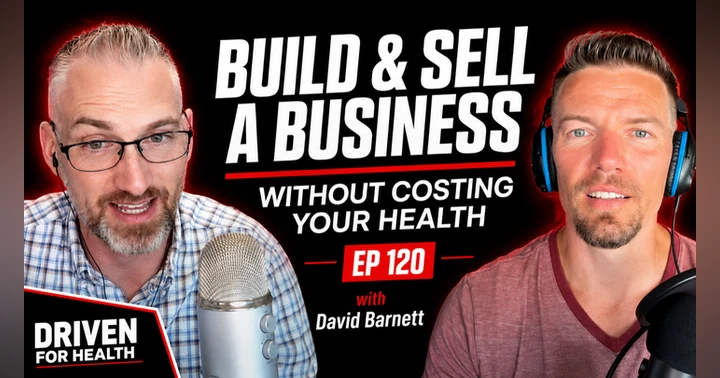
How to Build and Sell a Business Without Costing You Your Health with David Barnett - 120

David C. Barnett has sold 36 businesses. His biggest lesson came from a sore spot he found in the shower on a family trip across Canada. It led to a cancer diagnosis and a reset on how he thinks about risk. You leave seeing why your body needs the same planning as your business exit.


 YouTube
 David C. Barnett has sold 36 businesses. He knows what makes a company sellable and what kills a deal before it closes. But the biggest lesson in this episode has nothing to do with a spreadsheet. It came from a sore spot he discovered in the shower during a family trip across Canada.
(Have you ignored a health warning sign while you were busy building something else? See what changes when you stop waiting at www.thecalltorise.com)
That discovery led to a testicular cancer diagnosis, a climb to 244 pounds, a vitamin D breakthrough, and a hard reset on how David thinks about risk in business and in his body. Coach Brian sits down with David to connect two worlds that rarely get discussed in the same room: exit planning and personal health.
In this conversation, you'll learn:
- Why 80% of small businesses never successfully transfer to a new owner
- The two questions every buyer asks before writing a check
- Why waiting until you want to sell is already too late and what to do 10 to 15 years out
- How David dropped from 244 pounds to 171 pounds after his cancer diagnosis
- The morning walk habit he has maintained since 2022 and why it started because of jet lag
- Why a real exit plan protects your health as much as your money
- How your body is the most important asset you will ever own and why it needs the same preparation as your business
About David Barnett:
David C. Barnett is an author, consultant, and international speaker. He has helped thousands of entrepreneurs avoid bad deals and achieve successful business exits. His YouTube channel and podcast reach a global audience of small business buyers and sellers. Find him anywhere by searching David Barnett Small Business, or pick up any of his 10 books on buying, selling, and investing in businesses on Amazon.
https://www.DavidCBarnett.com
LinkedIn http://ca.linkedin.com/in/davidbarnettmoncton
The Call To Rise is a 100-day fat loss challenge for driven men ready to take their body back. It combines strength training, personalized nutrition and real accountability. Most men drop 20 to 30 pounds and rebuild the confidence that comes with it.
This program also works if you are dealing with high blood pressure, high cholesterol or Type 2 diabetes. It was built for those men too. Many men see those numbers move in the right direction alongside their weight loss.
Inside the program you also join a Brotherhood of men doing the same work. Together you build a body you're proud of and start leading like the man you already are at work.
This is your wake-up call to rise. Learn more and apply at www.thecalltorise.com
Want help applying this to your own health, weight, energy, or lab numbers?
Coach Brian Parana offers Health Hot Seat coaching segments for men who want a clear next step with nutrition, fitness, weight loss, blood pressure, cholesterol, A1C, or daily consistency.
Learn more about The Call To Rise, a 100-day coaching program for driven men over 40 who want to lose weight, improve their health, and rebuild confidence:
To connect with Coach Brian:
brian@brianparana.com
Disclaimer: This podcast is for education and coaching support only. It is not medical advice. Always work with your physician before changing medication, treatment, or medical care.
- A man can spend decades building a business with the belief that one day he can sell it, walk away with millions and finally have freedom. Isn't that what we all want? Right? Then when he gets ready to exit and the truth hits, the business might not be worth as much as he was wanting it to and actually far less than he thought.
- The buyer may see risks everywhere. the company may depend too much on them and in some cases it might not be sellable at all which is the worst case there and you're trapped 75-year-old business owner that wanted to retire 10 years ago. This is a hard lesson to learn after decades of work and the same kind of lesson happens with health as well.
- A business owner can spend years chasing growth, solving problems, serving clients, and carrying tremendous amounts of pressure while juggling family responsibilities too. And at this time, his body is keeping the score with rising blood pressure, cholesterol, blood sugar levels, weight, stress, lack of sleep, energy is plummeting, and all this shows up.
- Now, the goal is to build a business that you can exit from and a body you can live in when you get there. not just spend all your wealth on health care and someone wiping your your behind. So today I'm joined by David C. Barnett and David is an author, consultant, international speaker, a small business buy, sell expert.
- He has helped thousands of entrepreneurs understand the real numbers behind buying, selling, and investing in businesses. David has written multiple books on small business deals. He's got a YouTube channel that will be linked in the show notes, a podcast that reaches buyers and sellers around the world. So, this guy knows what he's talking about.
- And today, we're going to talk about the exit plan, about knowing your numbers, why assumptions can cost a business owner years of work and how health has to be part of the conversation, too. We are going to touch on David's personal health journey, too, as he has had testicular cancer in 2020. He's experienced weight gain, weight loss, and how to rebuild his body so he can be strong, fit, capable.
- David, I'm glad to have you on. >> Hey, Brian, thanks for the invitation. I I I love to talk about all of this stuff and uh I can't wait to get into it with you. >> Yeah, definitely. Definitely. Let's set the stage. What is the one thing that you want guys listening in to take away from our conversation? >> Yeah.
- Um, people think that a business is like a car or a house and one day when you decide, "Oh, I'm done. I'm going to sell it." That suddenly you can just put it up for sale and and someone will come along and buy it from you. The the reality is is that you could find that person, but if the business is not properly prepared for sale, the deal likely won't happen.
- Or if it does, it'll happen under terms and conditions that will not make you happy. It won't be a clean break at all. you'll end up tied up with with the exit process, maybe even for years. >> Yeah, I have a personal experience with this, not necessarily myself, but a client I was working with. We're working on he's in his young 60s and we were working on we were about 30 pounds down, but he still needed to lose another 20 to 30 and he had just gotten out of shape, poor health from juggling consultancy business with defense
- contracts with the government. Now, what happened was he was ready to make a definitely a solid seven almost eight figure exit and he had one bad month in the the mix of the the year span that he was taking a snapshot before he posted to make that deal happen. And it cost him about one to two mil on the exit.
- And he was there for three more years trying to get out of it tied in to make sure that it because his name was on the billboard, right? His name was on the door. >> It was his name consultancy. So yes, I I I have seen this happen more than a few times. >> But first, you see, Go ahead. Go. >> Okay.
- Well, I was just going to say business owners who are in their business every day understand the business and understand the risks and they've learned to live with them. And it it's really difficult for a lot of business owners to appreciate that someone on the outside who is not as familiar with their business. Uh you know, when they look at your business, their number one worry is that you are trying to hide something, that something's really wrong, that that they're going to have a hard time discovering that.
- And so when they start to realize that they are open to risks, both the the regular risks of being in business, but also the risks of some kind of deception in the transaction, then they go looking for ways to mitigate those risks. And this is where they get very uh they scrutinize very carefully, you know, financial records. So a hiccup in the in the performance like what you mentioned would be something that would be causing fear for those buyers.
- Uh, and then they're worried that, you know, you know, something that is bad about the outlook for the business that you haven't disclosed and and they want to try to see if they can figure that out because they're they're worried that you're trying to, you know, pull a fast one on them. And this is why you get different kinds of deal structures that involve payments over time.
- And it sounds like this guy had to remain involved in the business for quite some time until the the buyers felt that the goodwill really had transferred from that seller to to them. >> Exactly. Right. that acquisition cost for him was he had less pressure because he wasn't the man writing the checks, but he still had to show up every day and he actually was working now instead of he was the boss for so many years.
- And so that's a change of pace as well. >> Now, let's jump into some of the health stuff. I always like to start here because that's what we're talking about. Driven for Health is the name of the podcast and I talk a ton about health, fitness, nutrition, lifestyle, and you've experienced some some hard health issues, but you're out on the other side feeling strong, confident, taking care of yourself.
- So, let's talk about what some of your health journey has been and the things that you're doing to proactively keep yourself as healthy as possible. >> Sure. Well, you know, I've always been a guy who was working out and being active, let's say. You know, going on long hikes in the woods, uh, you know, camping, going for a walk when I felt bored outside, that kind of thing.
- And, you know, I probably was carrying more weight than I should have been. I was probably around 225 pounds through the mid 2010 teens there. >> And I'm 6'2. So, >> you can you can make that work a little bit, but >> well, you know, and the thing is you you kind of deceive yourself, right? Because if you wear the right shirt, you you look okay and and you know, but really I had a little bit of extra weight on.
- And I I took my kids on this big long adventure trip. We were gone for about 5 weeks and when we were in an accommodation, it was actually an RV that we had rented for a couple of days in the mountains. Uh, I was taking a shower and I felt a soft spot, like a sore spot on the side of one of my testicles and, you know, my first thought was, did I walk into a countertop, you know, sometime today? Like, did I did I bump something like without really noticing? >> Um, and and you know, you kind of shrug your shoulders and you're like, oh, you
- know, it'll be fine. And then and then about a week later, I felt it again and I thought that I had been I was back from the trip at that point and I thought, you know what, this is how some guys get into a lot of trouble. So called my doctor. I got in about a week after that, you know, she examined it. She poked at it and stuff and said, you know, I I don't know what's going on inside.
- My concern was, is this cancer? And she said, well, she said, you know, there's this condition where the vein going into the testicle can kind of start going varicose. can be painful, it could be that, you know, she kind of had a list of things that it might have been. And she said, "Really, we need an ultrasound.
- " So, uh, a few weeks later, I went to the ultrasound. Uh, the, um, radiologist report was kind of inconclusive. There was not really anything that he could tell. And so then my doctor said, "Look, the only option I have is to refer you to urologist." And she said, I I live in Canada, by the way. So, she said, "You know, right now in the city there's like a a a year wait to see a urologist, but I can send you 90 minutes away to the next city and you might be able to see one in about 4 weeks.
- " And I said, "I don't mind driving." So, so she sends my file off to the neighboring city. And it was, I guess it was a a very experienced urologist who took one look at the file and fired it right back to one of the urologists here in town. And I got a call a week after saying, "Come on in. We want to see you." And so the this urologist here in town examined it and he said look he said you know my first question was is it cancer? And he said he said I get a lot of that in here.
- I don't think it is but we don't know what's going on inside you know the testicle. There's nothing we can do to repair a testicle. All we can do is like ultrasound you every six months and if it gets worse we'll take it out. And by this time it was getting worse and it was starting to be uncomfortable when I was driving a car if I sat in the wrong way.
- And so I said, 'Look, I I I think it's going to be a problem. We should probably take it out. But I I questioned him. I said, 'Am I going to have any kind of problems with like testosterone or anything like that if I if I lose this? And he said, "No." He said, "No, your your other one's going to be able to handle things just fine." So this again was now January of 2020.
- And I got scheduled for what they call an orchtomy. That's what they call it. Uh for April 2020. Now, if you recall 2020, there were some big events that happened there that spring and uh when when all of these, you know, travel restrictions and public health rules started to fall into place, uh the hospital believed that they were going to have a big rush of all these people with these respiratory problems.
- So, so they stopped doing multi-day recovery surgeries. And what they did is they looked for people in the schedule that were going to have quick one day in andout kind of trips. And I got a call on March 27th saying, "Hey, we can handle you tomorrow. Be here at 9:00." And so I actually got the surgery done a couple weeks early.
- And a month after the surgery, the urologist called me up and he said, "I got good news and I got bad news." And he said, "The bad news is it turns out you really did have cancer and the good news is I took it out of you." >> So >> So it was a feeling of relief. I I don't like to lump myself into the cancer survivor camp because you know people are suffering with the anxiety of knowing they have this terrible disease.
- I never knew. So I I didn't have that quite hanging over me. Um I did spend the next five years in an observation program. So I was going for blood tests every three months and an CT scan every six months over the course of the the five years that followed. >> So things didn't get worse. >> Yeah.
- Well, and it turned out I was fine. In fact, three years into that program, I qualified for a new life insurance plan. So, like I I was back and things were good. But the postsurgery, um, what started to happen is I started to grow more and more lethargic. And so, I I I I really didn't have energy. I started to slow down.
- And as we got into the fall of 2020, all I wanted to do, honestly, Brian, was lay on the couch, eat potato chips, and drink beer, I kind of lost all my ambition for being outside, for exercising, especially as the days started to get shorter. And of course, my thought immediately was, I have some kind of testosterone problem.
- This, >> you know, surgery, the surgery has created a problem for me. And so I started to do a little bit of research online and what I learned is that uh your your testes actually produce testosterone and they use vitamin D uh as a as a precursor to that. And so I was reading some articles talking about how if you feel the symptoms of low tea, maybe you just need more vitamin D.
- So I I started to I went to a pharmacy. I had a conversation with a pharmacist. Started to supplement much more heavily with vitamin D. Um, and within two weeks, my entire attitude, my feelings, my, you know, what I was craving as far as food entirely changed. I went from that beer and potato appetite to seeking fresh, crunchy, crispy things, like looking for a salad and, you know, good wholesome food.
- Um, and then that's when the weight loss started. So the top most weight I was at was 244 and a year and a half later I was 171 pounds. >> Yeah, that's significant difference. >> Tremendous weight loss and and then I had to start to rebuild. So then it was watching macros. I I downloaded a a calorie counting app.
- put a pin here real quick and just say that >> anyone listening in, even myself, could be in the exact situation you are. You just woke up one day and things felt off and we don't know if or when or how or what it is, any certain body part that you might have that can come down with something as really horrible and terrifying as cancer.
- or you go and get your blood pen all tested one time finally you just like all right I'm going to go to doctor and listen to my wife and do it and then you've got red flags everywhere like a >> a really bad day at the beach but it's the especially when we're in our 40s for the guys 50s the risk of disease and something trying to take you out is significantly more than when it was when you're 20 and therefore it is important to make sure that you are going to the doctor, that you are taking care of yourself, that the average age,
- I do bring it up on this podcast a lot, is 76 for the average male. So 40s to 50s, you're 50% done >> or 60. >> And that's not an exciting fact or percentage statistic, but it's the truth. And again, that risk goes up. So, gentlemen, just going to throw out one thing here. Go to the doctor. Get some checkups.
- Make sure things are going all right. Especially if you have not been taking care of yourself in some way, you're overweight, you're overstressed, there's lots of pressure, there's you haven't been as active as you once were when you were in high school. And if that's your default pattern of behavior or thinking is like, oh, I used to be an athlete back in high school.
- like, well, that's a many moons ago. We need to get some some tests in. So, you you had the health scare, you you got the surgery, you are then you realize still wasn't in good shape and you finally we have this change of tune in your life and and how you started to do that. So, I talk a lot about how to maintain long-term successful weight loss here.
- So, what did you do to lose the weight and be able to keep it off? Did you look great? >> So, it it it does feel great. It was a it was a two-step process. So, step number one was doing the things my mother always told me I shouldn't do, which was stop snacking at night and stop eating junk food, things that are clearly not good for us, right? You know, if if you feel hungry, you know, count to 10 and ask yourself, are you really hungry or are you bored? And should you have a handful of potato chips or should you eat a banana? Right?
- Like what what should you put in your body? So I probably lost I got down from 244 to 200 just by limiting my window of eating. So uh skipping breakfast, doing the intermittent fasting thing, not having anything to eat after about 7 p.m. and and just being strict about that. And I used >> as calories people whether you fasted or not. That's not the important thing.
- did the important things. He practiced portion control and he gave himself boundaries around when he should or shouldn't be eating in his day. And that worked for him, which is great because then he was able to repeatedly do it, which is keeps him in a calorie deficit for a long time, which allows him to lose a pretty decent amount of weight and be able to not make it super hard.
- Okay, I'm just going to push in quotations breakfast off and then I'll just make sure I'm not snacking after dinner. Pretty simple. >> That and that's and that's all it was. And there were a couple of times I got stuck, you know, like I plateaued and and what I did to get over that was I did a a just a one-day fast.
- And then as soon as I did the one day fast, it's like it kickstarted things again. >> But when I got down to 200 lb, I still knew that I needed to lose a little bit more. That's when I first downloaded a calorie app and that's when I learned my notion of portions was out of whack. >> Yeah. >> Uh I I thought I was doing like healthy snacks during the daytime.
- Like if I was hungry instead of the potato chips, I'd grab like a handful of almonds. But then when I got the calorie counting app, I got a food scale and I realized, oh my god, I'm eating six or 700 calories worth of almonds a day. it. I had no idea just how some of these calorie dense foods are, >> you know. >> Exactly.
- And I I love this, David, because you started off with lowhanging fruit, pun intended, >> and then you then got more uh skilled at and and more complexity as you went. And that's oftentimes what I do is what's the next best thing for this person? And in the programs I've ever run with people is what are what is their tolerance? what are their abilities, their skill set, their knowledge, their desire to do whatever that next step is.
- And it might just be walking and drinking more water or eating vegetables or can we stop eating after dinner. Those are very easy things to agree to for someone to start making better choices for themselves. And this is great because you you realize, okay, I've got a roadblock here. I need better skills. I need to understand more.
- and you started tracking. And that's oftentimes what can happen in in my world is people if if we're not having progress and yes, you will be tracking because you are eating more calories than you're supposed to to lose weight. Doesn't matter how healthy the food is or whatever, it's a problem. So kudos to starting off easy and realizing, hey, I need more skill.
- And and this is going to pair well. This is a good foreshadowing of what we're going to talk about with buying and selling and and exiting and all this stuff of of having skills to to be able to get the outcome that you want. So, keep going. I love this so much. So, good. >> Well, I in addition to that, I did a trip.
- I I went to Europe and when I came back, my my clock was all off, right? I was waking up super early in the morning because of the time change. Yeah. Yeah. >> And I woke up one morning at 5:30 and it was it was springtime then, so the days were long, so the sun was already up here and I just thought, I'm going to go for a walk. >> And it stuck.
- And so since 2022, I've been getting up at 5:30, 6 a.m. and going for a walk to start my day. And I usually walk for about 90 minutes. I usually get my 10,000 steps in right in the very beginning of the day. >> Wonderful. >> Come back. >> Yep. come back and, you know, have a cup of coffee and then get to start my workday.
- But the the walking has been consistent and and I always worked out with weight resistance before like for my whole life. But and I've continued with that. So I've got a regimen of twice a week, Tuesdays and Thursdays about 35 minutes of weight training and then on Sunday like a like a 75 to 90 minute sort of longer >> full full workout and and that's it.
- Um, and since I hit the bottom weight, you know, back around 2022 or so, I've been focused on macros and making sure I eat enough protein. And then it's like rebuilding myself the way I want to be, which is, you know, much leaner, more muscle mass. I feel great. I look much better at the beach. And, uh, I >> it's it's really rewarding.
- If anyone's out there thinking, "Oh, gez, it's a lot of work." As soon as you start to lose some weight, you you become self motivated because you you realize, hey, I'm making progress and then somebody brings out, you know, like some, I don't know, crazy kind of cake or something that you used to like and you you say to yourself, I've worked so hard to get where I'm at.
- I don't want to sabotage myself >> in that cake that I'm >> Right. It's like it's like, you know, just give me the cherry on top. I'll just eat the cherry or whatever. like you know you you you realize it's it's not worth sort of flushing your progress down the toilet for a slice of cake in that moment. >> And so the discipline is self-reinforcing.
- >> Yeah. Your identity change. The way you think about how you interact in social settings is now different. It's changed from what society says. Oh, it's someone's birthday. we should have pizza, ice cream, and cake and whatever else. And and that's just because society that that you do not have to do that to celebrate someone's birthday.
- So true. True. We like to travel a lot. >> We still do ice cream, but we travel a lot and that's what we have done for people's birthdays in our in our house for our kids and and uh our wife and I and all. So the >> these cards here, these are sort of like daily affirmation cards. I put stuff on them to remind me of what I want.
- And and there's one in here that's been in here now for four years. I'll show it to the YouTube viewers. >> If you can read, can you read that? >> It says, I look like that. >> I look like this. And it's a picture that I found on Google images. It's just a male model that kind of has the same sort of facial hair as me, but he's definitely fit.
- >> Yeah. Yeah. I see. >> And so, so I I just I look at this guy and I say, "I look like this." And and you know, I ask myself before, you know, eating something, I'm just like, would that guy be eating this? >> Right? >> And the answer is often no, >> right? One more thing on this is it's who you surround yourself in these situations that influences what you do in the first place.
- So, if you showed up to a birthday party with fitness folks, there's probably not going to be cake there anyways because it doesn't align with what their general goals are. But in this situation and normally there's cake and ice cream and stuff and it just is. So there's lots of different reasons things are what they are and food is love and happiness and sadness and all sorts of different things but we can have a different identity different relationship with it as we change our identity and develop skills.
- And sure if you want the cake you can have some but we do are going to make other choices in the day and and do what I call the three lever system. We've got movement, >> we've got food choice, and we have portion control. Those are it. That's the basics of >> taking care of yourself. >> So, let's shift into actual the the basics of selling and and what you really do good at.
- And that's why I have all these guys coming on to my podcast is to expose my audience to subject matter experts. And David stood out and and here we are. So let's jump into the levers of why taking care of yourself of yourself is important especially when it's comes into building business and being able to exit business at all. >> Sure.
- So so let's um let's think about most people's perception. We mentioned a little bit earlier that a lot of people think that their business is an asset like a house or a car. Whenever they want to sell it, they can just put it up for sale, right? And and um you know, I spent a career as a business broker and then I did that for three years.
- I sold 36 companies and then I got out of that because it's a terrible business by the way. Uh ups and downs in cash flow and you only get paid when a business is sold and deals fall apart at the last minute all the time. I I went into banking afterwards for a few years before coming back into the space. And my current business model is that I'm a consultant.
- So I work with buyers and sellers. I work with them on their deals. I don't work for commission. I just charge fees for the work I do with people as they go through the process. So when buyers look at a business, they look at that business and they ask two questions. And the first question is, what is the demonstrable sustainable cash flow? And so what they're looking for is they're looking for actual documentation of profitability over the course of time that is fairly regular because they're likely going to want to use a bank loan to buy your business.
- And if the cash flow is irregular, like if you made a million dollars one year of profit and then $200,000 the next year profit and then 250 of a year after that and you lost some money the following year, no banker is ever going to agree to make a loan on that business. There are ways to sell them, but again, it's not pretty from a seller's point of view.
- So, the the buyer wants to say wants to see the demonstrable cash flow, and then they're going to ask themselves the next question, which is, will this cash flow continue once I'm the owner? >> And that's when they start that's when they start to examine, you know, are the people actually loyal to the business or to its current owner? Are the systems in place for me to be able to do what the current owner is doing? Am I going to be able to take over the operation? Most businesses that are sold are sold to individual buyers who are going to go in
- and replace the current owner in their day-to-day management role. And so, which is in complete uh opposition to what you read online, which is that businesses get sold to private equity groups and they convert to ESOPs and they get bought out by strategics and all this kind of thing. Those are abormally successful deals that make great news and great stories and great things for people to talk about on podcasts.
- The vast majority of businesses that get sold transfer from one owner operator into to someone else who's going to run it and operate it just the same way. And the number of businesses that actually successfully change hands is not that great. So the best data we have says that about one in five businesses are actually able to transition from one owner to another >> which means I'll take a a little quick here.
- I am actively seeing this with another client right now. They're that client works for their father in a financial advisor business. So they manage people's funds for retirement investing and all. And then the client works for dad and manages business and all the backend stuff. Dad's the the the face, right? But then they bought a wine company off of a family friend.
- And it's it's it's interesting to watch the whole process of them doing their due diligence, looking at all the ins and outs of the backend stuff, of assessing the cash flow, of assessing what the profitability is and how to make that say next jump and and to get even more profitable and what do they need to do? And and so I'm I'm watching this from this this wine seller and sure they're really excited about going to Italy to buy wine and get winded and ded and and have wine evening out to taste testing and all this stuff, but also they're in
- the evenings or in the weekends picking up deliveries of and moving pallets of wine randomly whenever this truck shows up and all too and making sure that someone else can and deliver the goods to the the place that that they they sell to. So, it's a very interesting to see that they they did just do this in the last couple of months and I believe because of the the my client, they are very good at business managing that they will be successful because they they did their due diligence.
- They they understood what they were buying. they understood the opportunities. They are recruiting the right type of people to then make it profitable and successful and and grow their networking relationships and all. So I I do foresee that it turning from a lifestyle business that the older owners had and they would just ride off trips to Italy and and bottles of wine and stuff and just maybe make some money on it to actually doing something with it.
- So >> yeah. Well, the so so here here's where we want to attack assumptions is like the first assumption is just I can sell it, right? >> And so number one, what is the demonstrable regular cash flow that you can prove and that the buyer can prove to their banker? That's the person who really has to be convinced.
- And number two, can you show them that they're going to be able to run the business? And so a lot of businesses can't meet those targets. They can't jump over those hurdles. And so those are the ones that don't get transferred. Where people stumble and get trapped in these businesses is that they just make the assumption that they're going to be able to sell and then they also make an assumption about what the business is worth. And here's the problem.
- They start to plan around the assumption. So I spoke to a conference of financial planners. You mentioned someone in the money business. I spoke to a conference of financial planners and one of the biggest problems in their industry is that they meet people that are 40, 45 years old who maybe own a business and they create a financial plan and they'll ask that person, are you going to sell your business one day to help fund your retirement? And the answer is usually yes.
- And then the financial planner might say, "Well, how much do you think you're going to sell it for? A million, $2 million, $5 million?" and then they put it in the plan >> and now they've got a financial plan >> based around a transaction that could occur in 20 years time without really knowing if the business will hold that value, if a buyer could ever be found, etc., etc.
- So what I caution business owners about is that number one that small business is very risky and as a result of that they tend to sell for very low multiples of cash flow. The the most common comment that I hear from business owners when I show them what their business would likely sell for is they go that's crazy.
- If I just owned it for a few more years I could have the same amount of money. And in every case they are correct. People don't sell small businesses to cash out like Mark Zuckerberg cashes out of his Facebook stock. The benefit of of having a profitable small business is not ever in selling it. It's in owning it and collecting the profits as you operate the business.
- People only sell a profitable small business when pressing personal concern is actually forcing them to. So these are burnout, boredom and fatigue, divorce, poor health, the need to relocate or a plan for retirement. And and because of that, what ends up happening is people become very um presentoriented. They start to make the decisions that you know cause their tax bill to go down.
- They try to put money in their pocket. Maybe they put the personal expenses in the business. You mentioned all the you know family trips to Italy in the wine business, right? So, so they start to do those lifestyle things because they want to maximize the benefit today. And then one of those personal pressing concerns appears and suddenly now they have difficulty demonstrating the cash flow of their business >> because they didn't operate it in a way that was preparing for transfer.
- And and this is one of the key things that I want to get across to people is that 80% of the time the reason you will sell your small business is not for retirement. It's for some other thing you never planned for. Now, we're talking about health, and health is one of the big ones. Is somebody gets a health condition that causes their their their situation to deteriorate and they realize, I've got to get rid of this thing.
- I don't want to leave it to my heirs or I don't think they can manage it or what have you and they suddenly have to sell. You can just imagine under those circumstances, you become a highly motivated seller, which is not a good thing. >> No, it's I remember trying to offload my house back in the day. >> Yeah.
- And I I was willing to take a like a 25k hit and the house wasn't that expensive in the first place. It was my first house and but the times there was no one buying. So fortunately it didn't sell and we ended up finding a renter. Five years later it sold for uh 40k more than what we bought it for. It was during like the COVID wild times of real estate and such.
- So we got we completely lucked out there. But yeah, we couldn't give this thing away and we were very motivated to offload it because we wanted to move on to the next phase of life. >> Yeah. And that's what happens with sellers as well. They they need to move on to the next thing. What what uh what I recommend people do is I recommend that 101 15 years before you plan to retire, get your business evaluated.
- So, so this is one of the things I do with my clients is I do what's called a most probable selling price evaluation, which is not the same as what uh an business appraiser would do for a tax problem or something someone would do for a court if you're in a legal dispute or something like that or or a family law thing.
- It's what would it really sell for if it was put up for sale in the market. And that's going to give you an idea of of what you've got and it can help to inform the decisions you have going forward about how you're going to manage that business, how you're going to replace things. Maybe you have to buy equipment or something in your business >> or upgrade your your employees and their skill sets.
- >> Well, here here's here are some of the surprises that people get. you know, they'll if they if they realize the business is worth far less than they ever thought, sometimes people then realize, well, the whole selling it to somebody is probably not even a plan open to me. >> And so once you realize that, then you make a whole different plan.
- You start to plan for retirement like employees do. You say, "Well, I need a savings program. I need some kind of investment strategy. Maybe they'll buy an apartment building >> 15 years, then you build a 401k or whatever to as a retirement vehicle, >> right? So, you have a timeline. If if you learn that the business could be worthwhile because of its cash flow, but there's a transferability problem, then you can spend your time working on the transferability problem.
- People will get stuck thinking there's only one way to get out of the business. And the basically the the better you are at preparing your future, the more different pathways open up in front of you. So some of the other people I've worked with have squirreled away millions of dollars in their retirement accounts and other investments.
- They own the businesses producing cash flow, but they don't need to sell it to fund their retirement. When you're in a situation like that, there's so many more doors. This is where people get into things like I'm going to transfer it to my employees or I'm going to do it transfer it to someone who's going to put more of an emphasis on, you know, the role the business plays in the community and maintaining my legacy in this community and and you know, keeping the headquarters here and stuff that I was referencing the father, he's been
- grooming a younger gentleman to take his place and transfer at a certain time because he's near 60 and his protege is 30 young family and so it'll be a natural and they've been working together for I don't know a good 10 plus years so there's trust and and all this stuff and then they just brought in another adviser to help out with extra workflow and and bring in more so the the older gentleman the owners is working on ways to develop the people to transfer and to create his exit in that sense >> well what you're describing and what
- happens in financial planning firm and other profession practices too like law firms and accounting practices and things. It is it's the problem of transferability because people go to those practices because of the individuals. >> Exactly. >> So so the the senior gentleman he built the practice he met those people everyone trusted him to do their investing etc.
- And now if one day they called that office and somebody new answered someone 30 years younger how would they feel right? Would they keep their funds there? Would they be happy? Like it would be a problem. And so the exit strategy for that kind of business is exactly what you describe. You bring on a a junior person.
- You work together over a long period of time so that all the customers get a chance to develop a relationship with a new person. >> And then you know I describe this as the transferring of goodwill. One of the one of the tools I use when I'm doing a business analysis is one that I developed called locus of goodwill calculator.
- So it determines where the goodwill resides. It's either in the owner, the business's brand, or the location. So, if you if you think about a a local corner store that you might stop in to pick up a few things, you don't need to know who owns that place. You just want to know how late they're open, right? And and the owner could change all the time and you won't care as long as they're open.
- You know where they are, the service is good, the product is there, >> reasonable. >> Yeah. Well, the the other end of >> Well, yeah. and and and the you could even argue that part of the goodwill of that particular business, a corner store, is the location. >> Yes. >> Like the the business could change its name tomorrow, but if it sold the same goods, most of the customers wouldn't care.
- >> Right. >> Right. And so it's it's one of those three things, the the the owner, the brand, or the location. And so we we calculate that by scoring different questions to to show people uh because if you're heavily weighted in one of the three areas, it gives you a different sort of road map as to what kind of uh work you need to do to make sure your business ultimately becomes salailable.
- >> It's me. I'm the >> absolutely just me. There's no there's nobody else. I'm working on building a personal brand, hence what this podcast is for and all the extra social media promotion and different things that I've been doing lately is to build awareness and build that personal brand that everyone talks about online and such to then create more no- like and trust to then win over business and produce more transformations to then maybe in five years I have a actual business that produces client results but I might not
- necessarily be the main feature 100%. There'll be other a team and a backend and different things to support. >> It's it's possible. You just have to look at people like Tony Robbins, right? At at some point in his career, people called up Tony Robbins and they spoke to Tony Robbins like that he was the guy.
- >> Uh and then there was an evolution there. And now if you do training from Tony Robbins, you don't expect to talk to Tony Robbins like right. You know you're going to talk to some other person. But that but that that was a very intentional journey and you know a lot of work on systems and training and you know creating the the road maps etc.
- >> I had a Tony Robbins coach before in the past back in 2011 but I had a Tony Robbins coach and it wasn't Tony but at that time the running bill was a million a year and he had a weight list a mile long. I think what it was when when uh I just remember that off the top of my head, >> but yeah, you weren't going to talk to Tony unless you you were >> Was it helpful to you at the time? >> Yeah, totally.
- Yeah, it was it was a lot of certainly I I remember at the time we talked about business, but then we also talked about life and how that intersected. I was a a young family, like super young, just like two to three kids under five basically, and and juggling a very full schedule. I mean, I literally woke up at 4 in the morning and would go to bed at midnight to and juggle trying to create this business to be profitable. And it was it was work.
- That was that's for sure. I learned a lot. um I've talked about in other podcast episodes, but it it was definitely tough. Uh that was a business that could have potentially sold because of the formation of it. It was a gym, not based around Brian or the other owner or any one of the coaches that were in there.
- You came because we offered transformational results and people loved it there. We had 300 members when I left. and on a reoccurring membership. So, it was doing very well and then I left and it crashed and burned. So, >> and what and what so what ended up happening? Was it the the programs being offered fell apart or the way that the customer experienced? >> There was just a lot of distrust all of a sudden and the the other person just wasn't I did a lot of buffering.
- I didn't realize from from the the business guy and I was the coach guy >> and the business guy just >> was just not that nice and just wasn't as personable or forward facing to the clients and and he was just mean to other coaches and there's a number of different things but in general it's the easiest way to say it.
- So the the trust and the the the say the the quality started to feel like it was lacking. So when someone's paying 150 200 bucks a month for a gym membership like yeah I can just go somewhere else. Plus at that point CrossFit was a CrossFit gym. They are becoming big and mainstream >> where when we started it two years prior, we were one of >> one of the very few on the block and all a sudden it started getting crowded.
- Multiple gyms that could >> I noticed the saturation even here where I live that there was one, you know, early CrossFit place and I think they did really well and then I think it grew to six now there might be three. >> Right. Right. Exactly. And so people come try it and depending on their experience, they love it, it's okay, or they got hurt because they either had not great coaches, da da da.
- But that that was the experience. But that business we did two years, we collected three quarter million dollars off of a startup gym, which is pretty good. We were 50k a month when I left and 300 members on reoccurring $150 to $200 monthly memberships and it was thriving. So that that would have been a profitable gym to be able to sell if it were maintained that that you know the the saturation of the market and the the people cycling through going through that program, right? because it was it was CrossFit, then it was Orange Theory,
- then it was boutique little workout places and and all these different phases. >> Fitness is really driven sometimes by fads, isn't it? Like the the the next the next big thing. It's one of the challenges >> it's spinning things pop up. I'm not sure what the the big thing is right now.
- I can't put my finger on any one mass thing that's just taken over. It was like Pelaton was I guess one of the bigger things but that also had has faded quite a bit >> when if you talk about uh franchises in particular you named a couple that are there uh that are franchises. One one of the warnings I give to people actually you know do I have a copy of it here? One of the one of the books that I wrote in 2014 and updated last year was called franchise warnings.
- And one of the one of the things I talk about in that book is examining the timeline of the growth of the franchise because for most franchises they've got to have a certain net worth to qualify with the franchise or to be a part of the brand, right? And then if they go and they have to take a retail location like a gym would, you know, often they're leasing >> fitness, it's a $2 million buyin, I believe, or it was the last time I remember it.
- >> So, so you got to have net worth, you got to be qualified at the bank, and you have to sign a commercial lease, and the most standard commercial lease out there is a 5-year term, often with renewal periods. But if you're getting into that business, the franchiseor, they're taking a royalty of your sales.
- So whether you make money or not, you still have to pay royalty fees. And so what'll happen is if you have a whole bunch of new locations roll out, they may not be profitable, but people are still keeping the locations open because it's more cost-effective for them to keep financing their losing franchise than to close early and then suffer the personal guarantee from the landlord or the bank.
- Right? And so, so I I caution people when you see a quickly growing franchise network, you want to know how many locations have been open for more than 5 years and how many of them are still owned by the same owner because because the other thing that franchiseors will do is they'll they'll encourage people to, you know, turn them over to sell them to other people because they don't want the locations to close because it's when the location closes, they have to disclose it in their FDD that they had a closed location. And that's that's sort
- of the the beginning of the, you know, negative spin on on that brand. And you can literally talk to people in the franchise industry who will describe these explosive growth arcs in some of these brands. They're successful in marketing, but then they don't get a good track record of success with their franchises.
- They don't get the renewal of the locations and they end up fizzling out. So it's that you know especially in in in areas like fitness that are heavily uh you know fad driven uh it's it's a it's like a tiger by the tail situation. As long as you can hang on you're probably going to do well but then the rules can change at any minute and suddenly demand dries up.
- It's >> all businesses risky >> media that that changes things super fast. >> Yeah. >> Yeah. Uh let's tell talk some stories. Tell us some stories about people you've worked with where let's go both both roads where the one person came to you and wow this is a gold mine. Let's do this.
- And then the other one is just like yeah you're going to be 75 still owning this thing or or just wrapping it up and taking whatever out of it that you can. >> Yeah. So, so the number one thing like like for for people that are that are going to buy a business, um, you know, the the business brokerage industry talks about these different cash flow levels, seller discretionary earnings, EBIDA, and and what those are is they're they're not real levels of profit.
- They're just these what we call notional cash flow levels that are designed to allow you to compare one business versus another, ideally, in the same industry. And so what'll happen is people that aren't that familiar with business or financial statements will think that those numbers are profit.
- Like if they buy the business, that's what they'll end up with in their pocket. >> But it's not the case because out of that notional cash flow level, the discretionary earnings for example, you've got to do your debt service, you have to take home a salary as the operator, you have to uh pay taxes, you got to cover capex.
- You know, one of the big traps that I see gym owners fall into is that they'll buy a whole all new equipment for a new gym and then they don't make a proper allowance for the renewal and replacement of that equipment. >> And what'll happen is >> it gets it starts to get old. It starts to get dated and then somebody opens a new gym nearby and now all of a sudden that's the attractive place, right? and then you lose the the customers and it's it's because they don't understand like you know even though depreciation is a a what they call a non-cash expense it
- still costs money to build new to buy a new machine right and in in in many businesses that require like trucks and forklifts and all that other kind of stuff like that's that's expensive stuff that has to be acquired so my my caution for people when they want to get into business through doing an acquisition is you really should know something about the industry that you're looking at buying buying into.
- So because if if you are completely new and you don't know anything about a given industry um and you get the successful LOI in there and you're going to buy the business, one of the questions I like to ask people is why are you so lucky? If this is such a great business, why are you the guy that gets to buy it? You know, why, you know, if the plumbing business is up for sale, why don't why doesn't another plumber in the next county buy it? Why aren't they, you know, falling all over themselves to buy it? because there there are naturally
- better buyers for certain businesses and some industries are very naturally uh set up for strategic acquisition. This is some of the things that that business owners should be thinking about and and I I'll tell you a great story that comes from the gym space. Um, here where I live on the east coast of Canada, there was a a gym chain called New Bodies and they had like 15 locations and there's a big national gym chain here in Canada called Goodlife.
- And the New Bodies people wanted to sell their chain to Goodlife and they went up to Toronto and they made a presentation and the Goodlife guys were like, "We operate hundreds of locations. You've got like 12. It's really not big enough. we we can't really put the effort into doing an acquisition until you have at least 25 locations.
- So So what these new bodies guys did is they started to build new locations, but as they needed to replace carpet, they replaced it with the same color carpet that Goodl Life used. And when they started to need to buy new machines, they bought the same brand of machines that Goodl Life used. So they they literally built what looked like Goodlife locations with their name on it.
- And when they got to 25 locations, they went back to Toronto and they said, "Hey, we're ready for you to acquire us and you don't have to do anything except change the signs >> because we've got the right color carpet. We've got the right brand of equipment." And they literally grew themselves into the perfect acquisition target. >> Super smart >> for that big company.
- And of course, the, you know, Good Life couldn't say no. And they they did a deal and now all of those locations >> like, "All right, >> that's right." And so so you as a business owner, you know, part of the part of the advantage of doing uh, you know, a most probable selling price evaluation is that's the kind of discussion that would be explored.
- Are you in in in an industry that is uh, you know, ripe for this kind of consolidation, what they call rollups, where people are going to want to buy multiple locations and put them all together into one company. And so if that's the case, there could be things that you could do to make it easier for yourself. So for example, auto repair.
- There are a couple of big common software packages in the auto repair industry. If you're not using one of them, you are going to make yourself more difficult to acquire, >> right, >> than an auto shop that is using one of the common software packages. Because if the buyer is already in the industry and they're familiar with the software, then that means it's going to be easier for them to uh take a look at your numbers and figure out what's going on in your business.
- And uh that preparation, making yourself transparent and easily examined for the buyer's due diligence is really really important. Um, one of the other exercises I do quite often with business owners is I will provide them with a due diligence checklist. Uh, I actually built an AI tool that will you can put a real business name into it or you know real business name.
- It will research the jurisdiction of that business, the industry, etc. and create a due diligence checklist. So, if it's like a plumber in California, it'll have everything about, you know, the licensing required for plumbers in California and, you know, all of the banking stuff, all of the financial stuff, the tax stuff, like everything required.
- Sometimes these due diligence checklists can stretch over a hundred items. And I've handed this list to owners and told them like you should have a place where you're gathering this stuff now because if you actually got into a negotiation, you sold your business, you might be given two weeks to gather all that stuff. I've had some people tell me they've decided they don't want to do a deal to sell their business because of the due diligence requirements, >> right? They work, right? They just don't understand what is ahead of them because
- it it is the most thorough examination that anyone could ever come up with because people are borrowing money. Like once once somebody borrows a million dollars at the bank to buy a business from someone, that's it. They owe the million dollars. So, they're going to do whatever it takes to try to manage the risk as as best they can.
- And that means asking for every single little thing. And here's the worst part. It's not that they're asking because they want to read it and file it away. They're looking for further questions when they go through the due diligence items. They're looking for things that don't quite add up or cause other questions so they can come back to you and ask for more >> and get clarifications, etc.
- >> And also ask for less when it comes. >> Well, if if they find a bunch of problems, that is typically what happens is they'll they'll come back at the end of due diligence and they'll say, "Look, you told us this. we found this. You told us this. We found this. You didn't tell us about this, but we found it.
- You know, and and here are our concerns. And so the the renegotiation could be after you've spent 90 days or even 180 days in this due diligence process and then you're committed, you've spent all this time and effort and you have now legal and accounting expenses too because you've had to generate a lot of this stuff.
- Uh they'll come back and they'll say, "Look, we either have to reduce the price or we have to change the terms." And by changing the terms, what I mean is you're not going to get all the money on closing. So, they're going to want to pay you over time. You know, maybe you agreed to finance 20% of the deal. Maybe now they want you to finance 40% of it because of due diligence.
- And so, being prepared, knowing what the business is worth, what the due diligence is going to look like, what the likely terms of sale are going to be. All of this stuff is incredibly valuable, but you don't want to learn it 90 days before you decide to sell. >> You you want to know this stuff and start preparing yourself years before you want it.
- >> Yeah. And and to your sake is if the intention is to sell, then we need to do like get you to start doing the things that will then be able to make it sellable for what the reasonable amount would be in the marketplace so that you get the retirement from and >> or or you learn that it isn't going to sell for what you So you can create another plan.
- >> Exactly. Y >> and give yourself options, >> right? >> Yeah. >> Exactly. Excellent. Excellent. >> This is good. This is really good. I I don't have my business set up to sell. That's not been on my my brain. My the last decade has been spent with my family. Uh we've traveled a lot. We've given my kids lots of opportunities.
- I end up stop working at whatever time any given time to be able to support family and do things or take kids here or pick them up there and that's been a big important part and a lifestyle uh business ends up being what what I have created so far and as the kids grow older they could change to be something different but uh it's it's definitely afforded Listen, I'm I'm I'm on the same plan as you because I I raised two kids as a single dad.
- And so I needed to have flexibility in my time too, which is which is why I've been self-employed for the longest time. And you know that that trip I was on in 2019 when I discovered uh the problem that that ended up leading to cancer. Uh that was a uh five day or five weeks sorry I think it was I think it was like 29 days or so.
- It was a cross Canada train. So it took seven days for for us to get from where we live on the east coast out to Vancouver. >> We spent three days there. Then we took the train back to Jasper and we spent four days between Jasper and Ba in the mountains. >> And then we spent five days coming back and that was 2019.
- And if we hadn't done that trip in 2019, it never would have happened because the following year with all of the the the stuff that happened that it never would have happened >> and my kids were 11 and 12 at the time >> probably love the train and this is all about it, right? it the the memories that we created were just outstanding and and I was working in this business by myself and I part of my routine was posting on social media every week, you know, with some videos and stuff that like my YouTube channel's been going for 12 years. If you want to see Chubby
- David, just go to the old videos. Um, but but I remember I set all of that up in advance as drafts so that when I was on this trip, all I needed was a Wi-Fi signal or a cell signal and I could go and like make them live. And so so none of my audiences ever knew that I was away on this big trip.
- And it was uh so worth it. And I I kudos to you for choosing to to make their childhood and their experiences your number one goal because it's going to pay off in spades because they're going to develop into responsible healthy people. That is what you want. confident, independent people that don't rely on dad or at the very least I always think of this and I'll share this with others >> is hey if you can lead yourself and your health and and your family and show up and all I do not want my conversations with my wife when my kids are in their
- 20s to be about my kids needing money, being in needy relationships, going nowhere with their careers, if they even have careers or jobs and all. do not want that. I need them to be bold, confident, and independent people so that they can take care of themselves ultimately, but they still love and appreciate their parents and and realize the opportunities that we have given them.
- >> Yeah. Yeah. >> Which is I think at the end of the day, why you have a business anyways is to afford a lifestyle that creates the outcomes that you're after. And for for you and I, it's family. And for other people, it's money or other things that mean success to them. And that's okay. Everyone can have a different viewpoint of what means to be successful uh for them and but this is mine right now.
- Excellent. Excellent. Well, Dave, let's wrap up. Where >> Sure. >> Can we find you? What are I guess what's one closing remark for you on business selling and and taking care of yourself and and all these things that we've been threading together on our our conversation today. >> Yeah, I I think it's I think it's about risk.
- So, you know, small businesses are risky. >> Um the things we do every day, what you know, the food we eat, the activities we partake in all have risks associated with them, too. And if you have a lot to live for, you know, people counting on you like your children, you you have to think about managing those risks. And and people don't think about it, but when you stuff your belly full of bad empty calorie food, you are heightening your risk for a bad thing to happen, you know, heart problem or whatever.
- And uh you know, it is not okay to be obese. That is not healthy. And you have, even if you're not obese and you don't do any exercise, that's still not healthy. You got to keep your heart pumping, you've got to be in, you've got to do what you can to try to maintain your health. I I used to work with a a co-orker who was uh always exercising.
- He drank a bit too much, but he ate pretty well. And he had a massive uh heart attack. and he ended up having to be taken to a special cardiac trauma center which is an hour's drive from here. Um, and he made it there and they performed the surgery and saved his life and the doctors said, you know, if you weren't in the shape that you were in, you never would have made it here.
- >> And and that's that's the kind of sort of savings account or investment account you make when you take care of your health is that you are you have the opportunity to have better outcomes when something bad does happen. um and you're able to recover more quickly from things.
- It's it's an important like if if you wouldn't miss a business meeting with a potential new client because you think you might be able to make some money, then you shouldn't be missing your morning walk. In my book, it's exactly the same thing. >> Agreed. And that's the part that really resonated with bringing you on in the first place is you recognize the importance of taking care of yourself and it and when you do it right, you plan the most important things for yourself early.
- when you're undistracted and then you have all the other things in your time and schedule and all to then work on say the business. So you check the box on your health and then you don't have to worry about that a meeting getting booked over your gym appointment later in the day which is nice >> and and you know you know what I used to have to do at one point to be motivated to do my workouts because after a workout everyone feels great.
- Oh, >> but be before the workout, you might have a voice in the back of your head saying, "Do I really want to do the workout?" So, so what I used to do, Brian, is I used to schedule time in my calendar for the workout, and then immediately after, I would put a 15minute appointment that said, "Feel good about the workout.
- " >> Yeah. >> And it it when I saw them in the calendar, it would just remind me, yeah, I I need to do it because I'm going to feel good if I get it done. >> That's so good. I've never that. That's really >> I I I don't have to do it anymore, but it was I did that for about a year and a half and this was when I was much younger, but it it it got me on track.
- >> Yeah, that's just such a say a ninja move. I've not come across something like that, but you actually plan for the outcome, scheduling the time for that. So, it just it's like as you said, it's a reminder when you look at it go, yeah, that's right. I will feel good as doing this because it's not always easy.
- I I myself don't always want to do it and I try and stack the deck in whatever way and favor I can to want to do it. So >> yeah. >> Excellent. Excellent. Excellent. Well, where can we find you? Uh certainly everything will be in the show notes. >> What's important for you to where to send us and what to look at books and all that stuff.
- Well, if people are interested in this small business deal making stuff, just look up David Barnett Small Business in any podcast catcher or YouTube. You will find my channel. I've been I've got almost a thousand videos out there right now. But for the for the business owners out there, if you want to dig more deeply into what it's really going to be like when you decide to sell your business, if you go to how to sell myownbus.
- com, that's a a page where I talk about how I work with business owners. There is a free download there for the second edition of my book, How to Sell My Own Business. And it's a it's a PDF. It's like 100 pages, small, 6 by9 pages. You can read it in a couple hours, but it actually takes you through the step by step of the the process, what really happens, what how buyers are going to look at your business, how they're going to value them, and what the common terms of sale are.
- And it's not what you're hearing on the media and podcasts and stuff like that. The vast majority of businesses that change hands, it's not nearly as exciting as what you see on these big fancy shows. >> Right. Right. Yeah. the more subject matter experts that I have on the show, that's the undertone that I I hear from a lot of them as well.
- Even a gentleman I'm going to be recording with tomorrow, there's some real estate and he's like, "Yeah, HGTV is not it." I said, "Oh, it's good to know because my wife back in the day, I don't know, 15 years ago, HGTV and was big in our house like we're gonna flip and we're gonna d It's like that's that's not quite how it works.
- There's some learning lessons in there if you want to do it that way. It's >> Well, I think the lesson is they know how to make entertaining and engaging television. >> Exactly. Yep. >> Yeah. Yeah. Yeah. Yeah. Yeah. >> Excellent. David, thanks so much for coming on. And if you're listening in and the things that David talked about are real important, you a lot of guys listening in, people I work with are business owners, entrepreneurs, and and have some form of ownership because they realize that's really important and and
- owning things is how you get ahead in life pretty typically, especially with financial success over time. So you have to own things and you have to be responsible for things so that you get to the outcome that you want and there's skill development and there's all sorts of different things that come in that process and even where David was saying there's opportunities from a wide different wide range of different ways of exiting a business and it could be from a traditional sale or a transfer or turning into an investment opportunity
- that when it's time to close up shop my dentist. He had health issues and he is done. I have to go find a new dentist literally now. I do not have a dentist. My dental appointment was November 20th or something and I that doesn't exist anymore. So, I have to go through because of health issues for him. And speaking of that is why you need to be taking your care of yourself anyways along the road.
- The journey is life, not a destination, right? We've heard that from Aerosmith and beyond. Life's a journey. not a destination and and we have to be preparing yourself on so many different angles and and different ways to be successful. So take care of yourself so that you can then take care of the other important things in your life from your relationships, your family, your kids, your assets like a business or a home and and real estate and whatever else.
- So that will be it for us today. Take care of yourself, guys listening in. You'll be able to find David's stuff in the show notes. Please check. I mean, if the guy's done a thousand YouTubetubes. I've I know what that looks like, feels like. It's it's he's he's put in a lot of work and there's probably thousands of hours of him talking laying out golden nuggets on this stuff.
- So, you can really get into his bubble and get a lot of knowledge growth and and go to his website to grab his book and and and continue with getting into his bubble. So that's it for this session of Driven for Health. Thanks so much. >> See you. Thank you.