How a Busy Pilot Lost Weight Eating on the Road (Real Story) - 27
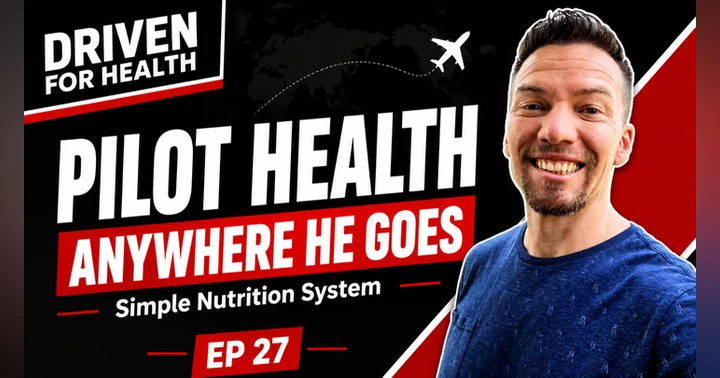
Your eating plan falls apart the moment you travel for work. An airline pilot who lives in hotels and airports tells Coach Brian how he fixed that. He went from daily headaches and energy crashes to steady energy. You learn how he packs food for a five day trip.


 YouTube
 Tyler is an airline pilot who spends most of his life in hotel rooms, airports, and new time zones. He came in dealing with headaches, low energy, and the daily struggle of trying to eat healthy on the road.
(Does your routine fall apart the moment you travel for work? See the system Tyler built to run anywhere.)
Coach Brian talks with Tyler about how he built a system he can run at home, in a hotel, on the east coast, or the west coast, three months after he started struggling with constant travel. Tyler explains how he went from daily headaches and energy crashes to steady energy with simple nutritional adjustments, and how he packs for a five-day work trip without relying on airport food. He also shares how tracking for a short period gave him years of nutritional confidence, the same way he reads his instruments in the cockpit.
By the end you will know how to build meals that fit your schedule instead of forcing your schedule to fit your meals.
Main Topics:
- Going from daily headaches and energy crashes to steady energy
- How Tyler packs for a five-day work trip without relying on airport food
- Why tracking for a short period gave him years of nutritional confidence
- Building meals that fit your schedule instead of the other way around
- The difference between knowing nutrition and applying it in real life
- How to enjoy good food while traveling and still stay on track
If you want the skills and structure to take control of your health no matter how busy your life is, visit www.thecalltorise.com.
Want help applying this to your own health, weight, energy, or lab numbers?
Coach Brian Parana offers Health Hot Seat coaching segments for men who want a clear next step with nutrition, fitness, weight loss, blood pressure, cholesterol, A1C, or daily consistency.
Learn more about The Call To Rise, a 100-day coaching program for driven men over 40 who want to lose weight, improve their health, and rebuild confidence:
To connect with Coach Brian:
brian@brianparana.com
Disclaimer: This podcast is for education and coaching support only. It is not medical advice. Always work with your physician before changing medication, treatment, or medical care.
- I have never regretted reaching out for professional coaching in anything, whether it's this or dancing or flying for some kind of career thing. It always works way better than just going at it through books. Welcome everyone. This is coach Brian Prana talking with Tyler. He is a gentleman has came into my program and has had a lot of success around improving his nutrition, his overall health, he lifestyle and pretty cool thing is he's a pilot.
- This guy lives two different lifestyles. He lives his home life and then he travels transcontinental. This guy's east coast, west coast and then sometimes he has more regional spots where he's in and out of places like three or five different cities in [music] one trip. very eager and interested to dive into that part of how we figured that out for him because a lot of people just naturally in their head say, "Oh, I travel a lot. I can't do this.
- I can't take care of myself." [music] And that's simply not the case. He loves cycling. He loves country dancing. This guy is a man of many talents. Welcome, Tyler. >> Good morning. Thanks for having me on, Brian. >> Yeah, definitely. Definitely. In one or three sentences, what were the biggest thing that we accomplished together? We'll dive into a bit more of who you are and and our process together.
- >> Biggest thing we had collectively is we I have a plan now for nutrition. Whether I'm either at home and I can meal prep or I'm on the road and I'm I'm running out of food that I brought from home or I'm in a restaurant. Now I have a game plan to go and make sure that I'm properly fed for my life.
- And that transitions into all sorts of other things where now I'm not getting headaches and I'm not hangry and things like that. It's a fantastic chain. >> Yeah, that was one of the things that we had originally, hey, I'm getting headaches. I'm not feeling very well. Why? I think it might be nutrition. And we were able to resolve that.
- We'll talk a bit more about how we troubleshoot and problem solve. Tell us a little bit more about what life looks like for Tyler, how he travels and for work and and in hotel rooms and while he's at home. Well, when I'm at work, I have a bag at the cooler that I can take food with me, and I'm traveling all across the country.
- Sometimes I'm near a grocery store. Sometimes I'm not, but even when I am, I don't have cooking stuff with me. I can't just go get the things that I would normally eat at home. What that means is I usually cook a lot of food at home and bring it with me. But sometimes I'm gone so long that I can't do that for the entire trip.
- Uh, I just got to plan accordingly depending on what my schedule is going to have. and that that uh I'm much better off when that happens. >> And anyone listening in, Tyler is interpers pilot or flight attendant that I've worked with, they will go for a three or five day trip pretty regularly. And a lot of them pack.
- Why? Because yeah, you get some pdeium and money to pay for food, but when everything's 20 plus dollars for every single meal, you start to get smart and realize, hey, I probably should pack some food with me at least for some meals while I'm gone and not rely on just restaurant food or eating out.
- That that was your take, right? I'm sure that maybe there's a phase where you just, oh, this is fun. and I'm eating out and then you realize, wow, I came back and my credit card bills a little bit higher than I wanted to be. >> Absolutely. There's there's a lot of free food that they'll give you sometimes from it's the hotel breakfast, odds and ends here and there, and it's free, but that's really the high point that most of those types of foods have.
- It's not necessarily nutritious, right? >> And when I have better food in me, I perform way better, >> right? and flying a tube in the sky, [laughter] an airplane, it's important that you are up and up on where with your energy, your focus and ability to land that plane, fly it and land it right. >> Of course.
- >> Now, what were the one of the initial reasons was getting headaches, just not feeling great energy-wise? And often times I have that a lot of people even if you're not flying around the US but you're flying around your office and you haven't done well nutritionally you'll end up with headaches or 3 p.m. crashes.
- Energy is a big thing especially for a lot of high performing clients that I have. They want to just get up and go and drive like they did in their 20s now in their usually in their 40s or 50s and they want a nap or like why don't we have siesta at work? But tell me about some of those initial problems that were just seemingly challenges for you that brought you my way.
- A huge part of it was just lack of knowledge and understanding of what nutrition not what it was, but how everything goes together. Uh, I've heard about calorie tracking and macros and sort of thing, but I never really figured out what a proper balance was and how to make sure I'm getting the right fuel in my body. We didn't start by tracking, but eventually I said, "Hey, Brian, I think that might not be such a terrible idea after all. Let's let's do that.
- " you know, and eventually we did that and it just kind of evolved into this educational process for the three months that we had worked together to a much better spot where now I'm like, okay, I don't I don't think I'm feeling so well today. Why? >> This is why I don't have enough protein or I have way too much fat in this meal and it isn't evenly spaced throughout the day. Now, I know how to fix this.
- That education pack made the biggest difference in what we did. >> Right. Definitely. What were some of the problems that you were recognized? Now, if you were to maybe three or five bullet points or something, if you were to tell Tyler in the beginning of this of the knowledge and insights that you have now, what would you say? Hey, Tyler, you're feeling this way because you've had 500 calories and it's 4:00 today and no wonder you don't feel so well with energy.
- What were some What would some of those be? >> Well, yeah. It it's the proper amount of food, whether it's too much or too little. It's the proper spacing of meals where you don't need to eat a crazy amount uh let's say right before bed that if I'm doing that, it's usually because I'm behind during the day. I've eaten too much or too little.
- I've underfueled or the right balance. I have a bunch of carbs and nothing else or a bunch of fat. Yeah, you need to get some protein in there. There's there's some protein in cheese, but there's not a ton. something as simple as water and just staying hydrated. >> Balancing kind of planning and calculating out how much of that kind of stuff I have throughout the day uh is was the biggest change.
- >> Yeah, most definitely. Now, you still took advantage of some of the free food options, right? the inflight meals or the breakfast and such, but what were some of the strategies that we implemented to balance or to you leverage some of that free opportunity to still work for you? Yeah, it just says back to planning that that works great.
- But if I didn't know and understand what that type of food had as far as the macros was concerned, I can't really plan for that. It's okay. There's an omelette from the hotel breakfast station. Well, that's got a lot of fat in it. It's not just an egg white omelette. Most likely, I'm going to have to have a lower fat day for my lunch and dinner to balance that out.
- If I just went in assuming that that was a bunch of protein and it was fine, that was not going to work. That was my old strategy. But now I can look at that free food, whatever it is, and understand what it's going to do to impact the rest of my day and plan accordingly. >> Right? What he's saying, if you're listening in, is he's got a different lens at which he looks at nutrition.
- He's got more of a Brian lens in a sense. When I see an omelette at a restaurant, I'm thinking Embassy Suites. We've been to plenty of those through all of our travels throughout the c the whole United States and and all. They serve up omelets, very tasty ones. Well, what do they put in first? The oil. And then they put in this egg blend, which is usually whole eggs, which implies that you've got just 14 g in a tablespoon of oil, usually more, plus the yolks, which is about five to six per yolk. And you could have a generally
- a three egg omelette, you're looking at 18 + 14. And ultimately we start to see and then you add cheese all of a sudden you have a 40 or 50 gram of fat in that omelette where we want something more around 10 or 15 grams of fat and 50 grams of protein. But if you didn't specifically ask for an angle omelette and ask for no oil then yes you are getting a lot of fat.
- And that's what Tyler's implying. He understands these things now. Whereas in the past, he would just label the omelette as a protein source, which is only half accurate because of just basically macronutrients, understanding what's in the food that he's eating. And that was a big jump in our opportunity together. We went from taking pictures and practicing food balance of a protein, vegetables, fruits, starchy carbs, and fat to then he said, "Hey, I I actually think this would be a good idea to learn a bit a little bit deeper. I understand
- why people do track and it's just a tool in the nutritional toolbox." And and that's exactly what we did. We we pulled out that tool from the toolbox and now he knows how to use it and therefore we used it for just a couple weeks, but you learned infinite amounts of nutritional knowledge through just asking questions, going through the experience with me.
- How was the overall experience of learning nutrition from the beginning all the way through where you're at now, which is a lot better? It was fantastic having a a private coach that I could always go to for questions. Google is is great for a lot of things and with the AI out there, I'm sure it can kind of zone in on all kinds of specifics maybe, but to have somebody there to cater to my scenario with my questions and explain it three different ways if I don't understand it the first time was invaluable.
- >> Definitely. and and being a man of many skill sets. Just being a pilot in and of itself requires a significant amount of time and study to learn that skill. I could be a pilot. Probably not at this point. They probably wouldn't allow me to check some of the boxes at least for the big planes, right? But I could do that because it's a skill set.
- Nutrition is a skill set in this in in just how to feed yourself. What were some of the say major skill sets that you took from just the learning experience? So, you understand balance. You said you understand uh let's maybe even go into what packing for a 5day trip looks like or how does that differ at home living your normal everyday life? Maybe we could talk about some of those things.
- >> Oh, sure. I tend to look at, I guess, the most vulnerable parts of my schedule nutritionally. And in the mornings for me, that's when I'm kind of up early and I've got to go, I don't have a lot of time. It would be easy to grab something from the hotel breakfast area or some some cheap thing to throw in the microwave and like a hot pocket and out out the door.
- But that's going to be the the the best plan where I can make the most impact on my nutrition when I'm on the road. I'll bring some yogurts. I like hard-boiled eggs or some other things I have in the morning. And that's my my breakfast that I'll go to. And there's two or three that I can rotate through.
- I'll plan to have those most of the days. And then lunch, I can I can pack my own sandwiches and make sure there's lots of protein in there from, you know, whether the lunch meat I'm using or other things to pair with it. And depending on the day, I know, hey, I'm going to get a meal here. I'm going to I want to I want to eat at this restaurant here, >> right? >> Maybe for dinner.
- >> Yeah, we talked about you being a foodie, right? You enjoy the food in the places that you go. Why not? If you're going to they're going to fight you there, might as well. So, I can plan that in and incorporate into the diet ahead of time. So, I know that, okay, I can have the extra fat or whatever it is with with dinner that day, but I have to prep for it in lunch.
- When I go put stuff in my cooler to take with me now, I have that kind of accounted for. Um, and then I can do that with food that I buy on the road sometimes. Maybe there's a grocery store that's right down the street from the hotel and I stock up mid trip or I'll make food at home that I know is going to be good, freeze it and and bring it with me in the bag and do it there.
- >> You deep freeze to be able to be a lot more versatile with your cooking and preparation and having food available a lot easier, which was great. Real quick I want to just inter throw in if you hear him talking he is explaining the knowledge base understanding that calories make up the food then protein carbs and fats make up the calories that are in the food.
- Not all calories are equal. A candy bar has a lot of carbs and fats and sugars in it. Usually a candy itself say Skittles is just sugar. Whereas an apple has a lot of carbs, but no protein and no fat. They're good, healthy carbs with some fiber, but it's not like a chicken breast that has lots of protein, a little bit of fat, and that's why everyone eats them when they're on a in quotations diet verse olive oil, which is just fat.
- When you understand where the food gets categorized, then you can it's puzzle pieces that you can start putting into place and when you get to the end of the day, you can complete the puzzle. And even if say a bunch of puzzle pieces get used up in this one part of the day, you still understand how to put the rest in at the end of the day.
- Uh let's talk a little bit about the food situation at home. How did that change from whatever you were doing to what you do now? >> Well, at home, I think what I eat is very similar probably to what I had before, but it's more intentional. It's tweaked. I have all of my kitchen available to me. I can make all kinds of different stuff.
- And it's it's order of the operation. It's certain foods that I wouldn't have had before. I discovered PB2. Um, that's a cool thing to do. >> Tasty. Yeah. Uh, egg white wraps that I can have for breakfast. Um, just as as pancakes. That's kind of fun. I'll stock up with a bunch of good stuff. Know if I'm hungry, I've got my my food ready to go.
- And it's it's just tweaked a little bit. I can have hot chocolate. I was like, "Hey, you know what? Let's take chocolate protein powder and just mix it up with hot water instead of putting it in a shake. Now I can get 20 grams of protein from a cup of hot chocolate instead of this this junk from Swiss that's all sugar. >> This is pretty cool. >> Yeah.
- Yeah. A little bit of milk uh cool whip on the top and you got yourself a party serving up protein hot chocolate. Insightful. >> Way better. >> Yep. Yep. Way better. Here >> one thing I want to point out if you heard Tyler didn't just say flip his kitchen table upside down. He didn't clear out his pantry and go all organic or something.
- He ate similar foods in better portions and better timing and found better ways to cook and prepare it to make it easier and more enjoyable, which is what the whole point of understanding nutrition is. You eat foods you enjoy and better portions to get to the outcome that you want. Tyler wasn't necessarily concerned with weight loss because he's already at a healthy weight, but now he has the lever, so to speak, to be able to change his physique if he wants.
- If he wants to get hit the gym and and and go six-pack mode, he totally can. He'll understand how to change the calories, the protein, carbs, and fats in a way that allow his body to transform that. If he wants to go cyclist, then he knows, hey, I'm gonna do 50 miles this week on the bike on on the over the weekend in one go, I know that I need to have carbs on my bike ride. And I know exactly which carbs.
- It could be gummy bears to goose to honey to peanut butter and jelly sandwich. And all of that works because he understands nutrition. Now, what what's so different about this approach that we did to maybe other ones that you've done in the past? Well, it like you said, it wasn't the big turn the table inside out or the kitchen inside out kind of thing and let's get rid of everything.
- Um, I had those those quote protein cookies that I was having for breakfast, which I was >> not necessarily great protein source or at least if it was, there's a lot of other macros that went along with it, >> right? [snorts] But we were able to to finish the rest of the ones that I had with other things for proper food and it worked out macros-wise.
- We just kind of went through the food that I had and then as that depleted shifted into some other things. It was not this crash diet, change out everything in your cabinetry and and you know start from scratch so to speak. It was a very progressive educational process where I was making the decision based off of what a Brian had taught me to kind of work it into my life in a pretty seamless way.
- This was a very smooth transition over 3 months. It took two months for me to want to start tracking. For goodness sake, >> it was it was >> that wasn't something I told him to do. He said, "Hey, I think I should do this now." He was ready because we went through the process to make him curious, excited, [clears throat] interested in doing it in the first place, which then made it easy.
- Whereas a lot of people think, "Oh, I have to track and it's boring. I don't know what I'm doing." Any of that. He got a lot of value out of using that tool. >> Yeah. Maybe Brian has the uh the David Gogggins package and he'll come over and yell at you and all that sort of things, but that never happened throughout our time together.
- It's it's all varies on who's on the other side, right? If I had sweet sweet grandma Molly, I'm probably gonna approach her different than I did with you, right? Whereas if I had boot camp s drill sergeant Tom, it might be a little bit different than I would with Molly the grandma, right? Because I'm a coach. I understand people. I listen.
- I I can match pace and cadence with what their energy needs were. If I came in and demanded that he start tracking and he does this and he throws those Lenny and Larry cookies away, that might cause more friction, which then might cause less desire application to get to the point where you were at now.
- And and my job is to make it seamless that you are learning the whole time. You ask questions, you get relevant answers that make sense that you're in the moment of, hey, I'm about to land in San Fran. I want to go to this place because it's the best. What should I get on the menu? And you share the menu and and we talk about how to create that experience and make it really enjoyable while moving you forward with your health goals, not taking you back.
- Was there any challenge you had getting signed up in the first place? Sometimes people don't even think about working with someone on their food. >> Well, this is something I'd kind of tossed around for a while is getting better with my nutrition and I think I have that, you know, the the complete idiots guide.
- those those black and yellow books you see. I think I have one of those for nutrition. I've never cracked it really. >> No. >> And I I think it was just finding somebody that was able to help me uh kind of one-on-one like this. And so I was introduced to you through a friend of mine who had come for for weight loss. And he had had a great experience.
- I don't know quite how long you two work together. >> We've been a couple months now. >> Okay. He said, "Give this give this guy a call. We he he kind of vetted me for a little while. I'm like, "Yeah, like I I want to do this, Clay, and like, "Okay, yeah, we'll go go talk to Brian here." >> Um then we we linked up and [clears throat] it was it was great.
- >> Yeah. He's over 60 pounds, which is wild. And and Clay is he's getting married. He's got a lot of pilot life left and he's got his he's starting to roll into his next phase of life. 60 pounds down is going to help him and marriage and fatherhood and and just fitting in the pilot seat and and and having longevity in that career path because you guys spend a lot of time on the front end learning and practicing and building up through the ranks to get to a a point where you can fly whatever airline and whatever route or time that
- you want. and you're you're a little ahead of him in in terms of the the pilot approach in a sense of of career path. If someone was in a similar position to you, just thinking they they know they need something do different with their nutrition, they don't feel well, they're overweight, they're facing chronic illness.
- What would advice would you give them on moving them forward in their own journey? >> I just reach out and get some help and some professional assistance to do it. For me, if I was trying to do it by myself, I I was getting the results that I was getting from my knowledge, from my accountability buddy, which is no one but myself, you know, me, myself, and I.
- And it just it just wasn't working. I have never regretted reaching out for professional coaching in anything, whether it's this or dancing or flying for some kind of career thing. It always works way better than just going at it through books. And there's a certain amount of base knowledge that you can get through, sure, but having somebody to go to for help like that that helps in your situation is going to be so much more impactful.
- You'll quit wasting all the time, which for something like this could have amounted to years, if not decades. I'm glad that I I did it. >> Uh definitely under 100 days, you have transformed your knowledge and experience with nutrition in a very positive way that will impact you the rest of your life. And a 100 days or so in your lifetime is a blip, right? You don't you want to remember hopefully you remember me, you know, years from now, like, oh yeah, Ryan, that's right.
- He helped me with my nutrition and I feel so good about it. Well, thanks so much for sharing your story. Anyone listening in, that doesn't matter if you are at home, you have family, you've got lots of responsibilities, you travel a lot as Tyler does. The point is you can get the skills, the level of understanding to apply to your everyday life that gets you to thrive, get you to energy, [music] get you to a better health as you grow older because sorry, every everything's trying to kill you.
- That common cold is ready to take you down if it can. And and therefore, we need to make sure that we're as resilient as we can to keep up with the demands of the day and your lifestyle and so that you thrive as we get into legal life. Now, Tyler can thrive while he's in his professional career. He can thrive while he's on his cycle.
- He can thrive when he's dancing it up on the dance floor. He can thrive in 10, 20 years from now when he doesn't have to spend so much time or energy with nutrition. If you're interested, the call torise.com is a great place at Coachbrian Piranha. It's a great place to find me and follow. Tyler, thank you so much for your time, you sharing your journey with us.
- that really appreciate just how many questions you brought, the curiosity [music] you had and desire to improve your health, your nutrition, and you were great. You're a great client to work with, and I look forward to our next call here in a couple weeks. >> Thanks for having me on, and thanks for helping me out last couple months.
- [music] This has been a great experience. >> Yep. Thank you. Bye, everyone. Catch you in the next