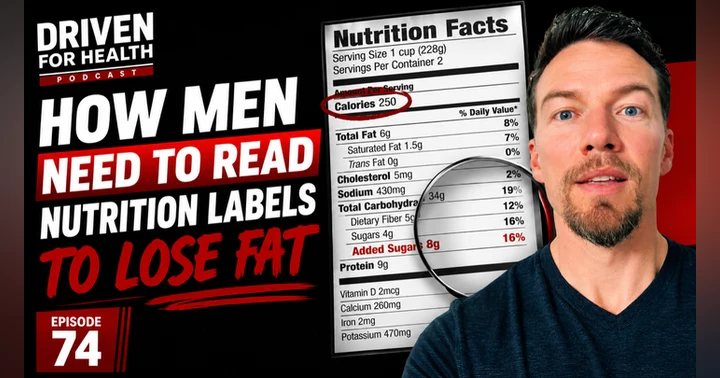
How Men Need To Read Nutrition Labels To Lose Fat - 74
In one study a low fat label on the package was enough to make people eat more food. Coach Brian shows you how to read a nutrition label so marketing claims stop fooling you. You leave able to check calories and protein and sodium on any label in seconds.


 YouTube
 Researchers studied whether the words low fat on a label change how much food people eat. A low fat label alone was enough to make people eat more. The label changed behavior even when the nutrition inside did not change at all.
(Do you trust the front of the package more than the actual label? Grab the free breakfast guide below and start reading labels the right way.)
Coach Brian breaks down exactly how to read a nutrition label so marketing claims stop fooling you. He covers calories, protein, added sugars, fiber, and sodium, and how to spot the tricks food companies use to hide the real numbers. He also explains why protein matters most for men who want to protect muscle while losing fat.
By the end you will be able to read any label in seconds and know exactly what you are putting in your body.
Main Topics:
- How to read the calories, protein, and serving size on any label
- Spotting added sugars hiding under different ingredient names
- Why fiber and sodium numbers matter more than most men realize
- How low fat and other marketing claims can trick you into eating more
- Why protein is the number one number to track for muscle and fat loss
- The Man's Ultimate 5 Power Breakfast Recipes, a free 7 day starter guide
Free resource: The Man's Ultimate 5 Power Breakfast Recipes. Five real breakfasts, each built around 40 grams of protein, with macros and a shopping list included. Download it, pick one, and run it for 7 days.
https://brianparana.short.gy/proteinbreakfasts
Research referenced in this episode:
Wansink B and Chandon P, Can Low-Fat Nutrition Labels Lead to Obesity, Journal of Marketing Research. https://pubmed.ncbi.nlm.nih.gov/17429957/
Hersey JC et al, Effects of front-of-pack and back-of-pack nutrition labels on attitudes and behavior, Journal of the Academy of Nutrition and Dietetics. https://pubmed.ncbi.nlm.nih.gov/23375698/
Want help applying this to your own health, weight, energy, or lab numbers?
Coach Brian Parana offers Health Hot Seat coaching segments for men who want a clear next step with nutrition, fitness, weight loss, blood pressure, cholesterol, A1C, or daily consistency.
Learn more about The Call To Rise, a 100-day coaching program for driven men over 40 who want to lose weight, improve their health, and rebuild confidence:
To connect with Coach Brian:
brian@brianparana.com
Disclaimer: This podcast is for education and coaching support only. It is not medical advice. Always work with your physician before changing medication, treatment, or medical care.
- The average man over 40 makes over 200 food decisions a week. Most of them are done in under 10 seconds. And if you don't have a plan, a process, a system of approach around how you pick food, you're not only just guessing, but you're probably making a choice that's going to grow your belly, your A1C, cholesterol, and a lot of things you just don't want to happen, like shorten your life.
- And that's what this episode is about. Welcome to Driven for Health podcast episode 74. I'm Coach Brian Piranha and this episode is super practical. Okay, we're going to go into very tactical about nutrition. We're talking about nutrition labels, how to read them in about 60 seconds, and what numbers actually matter for fat loss, better labs, and what the food industry does not want you to notice.
- Now, I've worked with thousands of clients and thousands of men throughout the last 23 years, and they're busy. They're running around. They have family. They have careers. They often have no idea what they're eating at any given day and they're on the road and they just grab stuff and off they go to put it in their mouth and almost every single one of them have a blind spot when it comes to the grocery store.
- They ignore the labels completely. They only only look at the front shiny part of the label saying, "Oh, this must be healthy because it says so on the front and it's shiny." and I get distracted easily by shiny objects. Right? That's exactly what nutrition labels ultimately or the at least the front of the packaging, the marketing is doing.
- A simple example, how many times have you heard how great Tony the Tiger has said Frosted Flakes are? When you look at the nutrition label, it is just a bunch of carbs, sugars, and empty calories that multiply and add up quickly. And if you ignore labels or look at them the wrong way, you're going to end up overeating and be shocked at how much calories and how much impact it has on your overall health, how you feel every day.
- By the end of this episode, you'll have a simple system that works on the next time you go to the grocery store, the gas station, or just go to your pantry, look at the label, and understand what the heck you're doing. Let's get going. How we got here in the first place, let's talk about the nutrition label itself.
- All right, this is super important. And before we go to the how-to, I want to give you say the 30 secondond context because understanding why nutrition labels exist in the first place, it'll help tell you a lot about how to use them. Up until 1990, nutrition nutrition labels, they in the US, they were largely voluntary.
- Food companies could put whatever they wanted on the package or nothing at all. In 1990, Congress passed the Nutrition Label and Education Act known as ELA. That law made standardization a of the nutrition facts, nutrition labels real. So, companies had to comply and it was mandatory to put the facts of what is in the package on the label.
- So, you knew the FDA rolled out the first standardized packaged format in the early 1990s and for about 25 years, it stayed pretty much the same. Then in 2016, the FDA issued its first biggest label update since the original rollout. The new format was most which most manufacturers were required to implement by January 21.
- So that is a 4year roll out that gave companies plenty of time to adjust to the new standards. It made some meaningful changes along the way such as added sugars became their own separate line item. Added sugars are the amount of sugar that they put into the product, not that was already existed in it. Say fruit. Fruit has sugar in it.
- But if it has added sugar, say appleauce, then they added five extra grams of sugar to make it taste better. The white stuff, cane sugar, syrups, and all the things that are derived from it. Now, when you know that, then you can understand the impact of sugar and how it's going to impact your body.
- Serving sizes were updated to reflect how people actually ate. The calorie count got bigger and bolder in a sense. So you could actually see what it is. And we can see that on the front of different types of like beverages. Think of Coke Pepsi products and the two the 2 L all the way down to 20 ounces. You'll see the calorie count on the front of the package and say the it's like a oval rectangle thing on on it.
- And vitamin D and potassium got replaced vitamin A and C because deficiency shifted over the decade. So we are more deficient in vitamin D and potassium over vitamin A and C. Vitamin A and C are not they're not as big of an issue as vitamin D. The reason this history matters is these labels were designed by regulators, not everyday people or coaches, and their starting point, but not necessarily a complete picture.
- Your job is to know which of the five metrics I'm going to go through actually move the needle toward your goals and what to ignore when it comes to reading the nutrition label. And here's what the science says. the honest version of the research because that's what you deserve. Let's jump into that. There's consistent evidence from large observational studies that adults who regularly read nutrition labels tend to have lower BMI and make better diet decisions and have better diet quality.
- A study in 2015 showed in pub public health nutrition analyzed NHS data from over 5,000 US adults. And what it found was that label users had significant lower BMI and consumed fewer calories, less fat, less sodium. Okay, that's super important. Then and other multiple R reviews have found similar results as well.
- So when people look at the label, they make generally better informed decisions. Now does that mean that reading labels causes better health? Not necessarily. There's a confounding factor though. You have to understand this. People who read labels also tend to be more health consscious in general. So we can claim that labels are magic.
- We just can't claim that because people just are naturally I look at nutrition labels and I have been able to maintain a healthy body weight for decades. What we can say is this. People who pay attention to the information they're putting in their body make better decisions on average. And that's not a surprise.
- It's literally just the data of what the reality of the situation is. What the research also shows is that how you use a label matters. In 2014, another review, the journal of the Academy of Nutrition and Dietetics looked at label comprehension. This means that you understand what is on the label and in the food and found that most people misread serving sizes, underestimated calories in larger packages and weren't able to understand what the percentage of daily value meant.
- Right? They always had these percentages on the right side. You just have no clue what it is. In other words, the label works, but only if you know what you're reading. One more thing we're saying clearly is the front of the package in all of its marketing claims. Low-fat, natural, multi-grain, hearthealthy, those are largely unregulated and just statements rather than facts and they can be misleading.
- When you say buy Cheerios because they're supposed to help with your cholesterol, that is just a statement that not might not be necessary fact, especially with eating those on a regular basis. Now, studies have also shown that these claims can actually cause people to underestimate the calorie content and eat more food because they are confused at how much a label is.
- For example, it Lenny Larry cookie. That Lenny Larry cookie can have as many calories as almost 500. And a lot of people think that they are a lot less, that they are around the the half the size because it it says it's 240 calories, but then the serving size says half the cookie. And this found that people end up overeating because they don't realize it.
- The short version, the nutrition facts panel on the back is your tool to help understand what you're doing, why you're doing, how you're doing it, and the marketing language on the front is just noise that you don't want to pay attention to. Now, think about this. In your day-to-day life, guys, you are pretty successful.
- You've got a lot of things figured out. You're running the show at work. You are implementing all the things you need to in business, your family. You're you're busy. But food is the main thing that keeps you alive. And you have to understand what is going into your body because no one ever gave you a clear system on what or how to read nutrition labels.
- That could be a huge disadvantage and why it's causing you to be overweight, especially in times of craziness when kids are just hungry or you have to grab something on the go and there is no time to truly assess what you are putting in your mouth. And when you do that, that is when you end up causing a problem for overeing.
- And we definitely don't want this to be an issue to where you go to your doctors and they are all over you about being pre-diabetic or having bad blood panels, high LDLs, low HDLs, high total cholesterol, things like that. These are impacted those those numbers are impacted by the foods that you eat. Let's jump into an actual label reading operating system here that you can use and take away from this conversation and be actually know what you're looking at.
- Okay, when you're going in, we have five metrics and it takes it doesn't take a lot. You look at it and you can quickly assess soon as you know what you're looking at. So the five metrics, number one is calories. Calories per serving and calories per container. This is your say budget line. Okay, this is what you understand of how much you can eat of that particular food in the portion that there is. That's huge.
- Everything else after that is not as important. It's calories first always. Then it goes to macronutrients. That's the first thing you look at is serving size. Then immediately check how many servings are in the bag. Just like that Lenny Larry cookie. If you thought it was only 250 calories, you're eating twice as much and you would have had no idea why you weren't losing weight and the cookie every day because you had a protein cookie was actually throwing your numbers off because 250 calories can keep you more toward maintenance
- rather than a calorie deficit. Now, going on another example, if a bag of chips says 250 calories per serving, there are three servings in that bag. That's 750 calories if you eat the whole thing. And oftent times, space say with chips, people's hand goes all the way to the bottom of the bag.
- And that's the challenge, right? People end up overeing all the time because of it. And they aren't making good choices. And for fat loss, you need a calorie deficit, guys. to get shrink your bellies and get fit and healthy, you need to eat less calories than you burn. You don't need to track every calorie, but when you are super duper calorie aware, that allows you to be approximately close enough to it.
- And if you do say track your calories, then you're going to be even closer to it. And looking at nutrition label, whenever you're looking at with working with me is a non-negotiable. You have to do it. Calories, then protein. Protein number two. And for guys over 40, protein is so important because of fat loss and muscle preservation.
- We want to keep muscle on the body. And our goal, we've gone over this in episode six with the nutrition pyramid on macros, but one, we have.7 to one gram per pound of body weight is generally it. And most guys are going to fall in between somewhere on the low end 140 to 175 to 190. I don't know if guys necessarily need to eat more than that.
- They have to have specific goals and reasons why. When you're looking at a label and you're asking yourself, does this product pull its weight on protein? And an easy way to help you understand that a a snack with three grams of protein and 300 calories is not the same as 20 grams of protein and 300 calories.
- One is a filler and the other one is actually fuel for your body. And even more important, we look at say a a protein bar. Most protein bars going to fall around 20 grams for 220 calories. And that's important to know. If a product has one tenth the one and one/10enth protein to calorie ratio or better meaning roughly 10 grams per protein per 100 calories.
- So 20 gram of protein for a 220 calorie protein bar. Good. But if it has 12 gram of protein for a 200 calorie protein bar, that's not a protein bar. That's not even a good ratio. That's just some protein in that bar. And it's usually going to be carbs and fats. All right? So that's really important.
- And it also will have to understand if it is lower than that, it should be at least delivering some fiber and other micronutrients to justify the calories, not just a low protein candy bar in a sense. Number three is added sugar. This one's super important because one of the best additions from the two 2021 label update is the added sugar's own separate line.
- And this helps you understand how much of the white stuff that they put in it. Not sugar isn't necessarily poison. You can have some, but it is highly addictive and makes the food easier to eat in a lot of different ways. I'm big on having ideally 50 grams or less of sugar and even more importantly say 20 to 30 grams of added sugar or less when you look at the label.
- That'll be important. Number four is fiber. Last thing on the the sugar. If 50% of the total carbohydrates should be sugar or less. So if something has 20 carbs in it and has 10 grams of sugar, okay, this is in consideration. If it has less than 10, then great. But if it has 20 carbs and 15 grams of sugar, that's implying that it's mainly a sugar source.
- Fiber, super underappreciated and underrated. Fiber and protein paired together slow down digestion, blunt blood sugar responses, and keeps you full longer. And it helps with impacting lower risk of cardiovascular disease. The list goes on. And you just are satiated. Your digestion is more regular.
- I always like to tell guys to do at least 30 grams or more in there. And most Americans, most guys are under 15. So there's a huge gap there. It's like 50% less. So when you're looking at the label, we want to aim for products that have at least three grams of fiber per serving. And if it's carbohydrateheavy food, rice, beans, pasta, things like that, and it has almost no fiber, so rice and pasta, but beans and lentils do.
- You just have to understand the impact that it might have on your blood sugar, especially if you eat it alone. If you pair it with a protein and vegetables, then we're good. But if you just eat say pasta or potato or rice alone, it has a high gly glycemic index and that can cause your blood sugar levels to spike and also leave you feeling a lot hungrier in say 90 minutes. The fifth one is sodium.
- If you're dealing with blood pressure and just in general, if you're eating a lot of processed food, you're definitely don't want sodium. Okay, it's 2,000 milligrams or less is usually the pretty typical FDA recommendation. And most men, especially if they're eating out, are going to eat clear 3,000 every single day.
- Now, it comes from packaged food. It comes from canned food. It comes from preserved foods, seasonings of food. And just, for example, a can of soup can have a,000 milligrams per serving. Okay? Just one serving. And if I had two, then it has your daily limit of sodium. Processed meats, frozen meals, condiments, these things add up quickly, especially if you're eating from a package.
- Here's the 60 second scan. We start with checking the serving size. Then we want to look at what is how many times there are how many calories are in each serving for that. So you can check, okay, is there 100 calories in this or 400 calories because it's four servings. From there, we want to check the protein and make sure that there's adequate amounts if it does have protein in it.
- You'd have to discern if it is a protein product or it's just another product. You're not going to get protein and rice because that's not what it is. But you'll get protein in other things and you have to understand how much goes in there. We have to look at added sugar. Okay, under five to six grams per serving is helpful.
- And we have to make sure we keep in track the total amount of added sugar in, especially if you're not moving a lot or getting your heart rate up and even need the sugar to say boost your workouts and blood sugar for that. For fiber, we're looking for ideally two or three grams is going to come in most cups or servings of fruits, vegetables, and other fruits.
- So, it adds up slowly over time. And to get over 30, that would be 10 servings of vegetables and fruit in a day. That's a lot of volume. Can keep your calories in check. We want to check the sodium and make sure that we ignore the front of the package immediately. All right. So, these are going to be the reality checks of this situation.
- Foods like granola. Granola is not healthy. It is a high calorie food that's super popular, but a quarter cup can have 200 calories. That's like a size of a golf ball. Uh we can look at protein bars. They wide there's a wide range of them. Some have 20 grams of protein like Quest or One bars, built bars and stuff, but others don't.
- And you want to look at the fiber content there. 20 grams of protein and get as much fiber in there as you can. Canned soups are going to have tons of them. We'd always go with a low sodium soup and even add water to dilute it. Greek yogurts verse flavored Greek yogurts, we can totally see how much sugar is in them.
- Some of the Greek yogurts are tasty without lots of sugar. And others, say with fruit added to the bottom, can have lots of extra sugar added. And low sodium crackers. We just have to be careful because there could be a lot of sodium in five crackers and a lot of carbs. in calories if you're not careful by what you actually do.
- Other common traps are natural or organic trap. You have to pay attention to those because they are can be largely unregulated by the FDA. Organic sugar is still sugar. Natural ingredients like high fructose corn syrup is still sugar and this can cause problems. Serving sizes can be challenging to see or understand.
- multi-grain versus whole grain can be a challenge because multi-grain can still mean that there are not whole grains in there. There's enriched wheat flour. And those are some of the the biggest things that we have to pay attention to. And the per serving, we want to make sure that we check on how much the actual serving is. Is it a cup or 100 grams? It can create some confusion what it is.
- So, I hope that today for the five metrics and 60-second scan of [music] calories, protein, added sugars, fiber, sodium, and ignoring the front [music] package help you have a reality check on this nutrition get you on track. [music] So, one of your action items coming from this episode is I want you to look at the next five [music] food items that you eat.
- turn over the label and look at it and see. You can always email [music] me at brianbrienfor.com and send me a picture of it and I'll literally give you [music] access. You can sign up for the health hot seat and be have an interview, a coaching interview on the podcast as well. You will just email me there as well. That will allow me to actually coach you through and help you understand [music] what the challenges are. And that's a free thing.
- guys come on here regularly and I coach them through the process and give them an actual step. [music] And lastly, if you do want some actual real help with this guidance, lose 20 plus pounds in 100 days, that's what they'll call it. It's a solid program that had massive [music] amount of success helping guys shed body fat and reclaim their life back to a healthier.
- That's it for this [music] episode. 74 trim for health. Thanks so much.