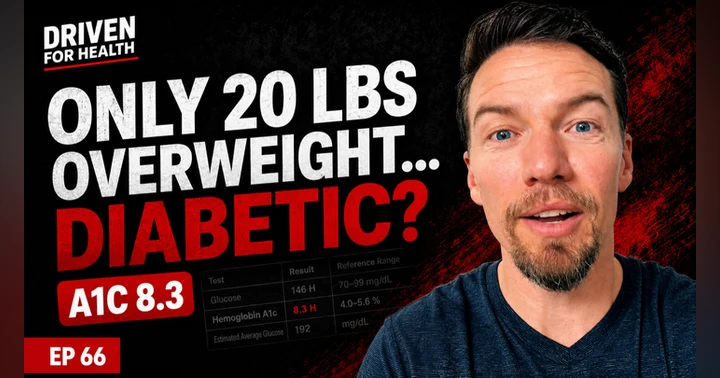
Diabetic and ‘Only’ 20 Pounds Overweight… (8.3 a1c) Sound Familiar, Neil's Story? - 66
Being only 20 pounds overweight can feel good enough until your blood sugar says otherwise. Coach Brian explains what most men and many doctors get wrong about blood sugar. He covers what structured exercise looks like for a busy man. You also get a nutrition plan that works with travel and client dinners and family meals.


 YouTube
 Neal is a 45 year old sales director, husband, and father of two. He thought he was doing fine until he checked his labs mid-workday and saw an A1c of 8.3.
(Have you told yourself your numbers are good enough for now? See what Neal found when he stopped saying that.)
Coach Brian breaks down Neal's story and what most men and even most doctors get wrong about blood sugar. He covers why "manage it" with medication alone rarely fixes the real problem, how blood sugar issues show up as brain fog and afternoon crashes, and what structured exercise actually looks like for a busy man. He also shares a nutrition framework built for travel, client dinners, and family meals, and how to track your health like you track your business.
By the end you will know the real levers that move blood sugar and bodyweight, and how to start using them today.
Main Topics:
- The moment Neal realized good enough was costing him his health
- Why blood sugar problems show up as brain fog, crashes, and low drive
- What most doctors offer, and why it usually turns into managing instead of fixing
- What structured exercise actually looks like for busy men
- A nutrition framework that works with travel, client dinners, and family meals
- How to build a health scoreboard like you run your business
Research referenced in this episode:
Exercise training and HbA1c, structured exercise improving glycemic control, JAMA (2010). https://jamanetwork.com/journals/jama/fullarticle/186960
Weighing in on Type 2 Diabetes Remission, Diabetes Care (2022). https://diabetesjournals.org/care/article/45/1/28/139162/Weighing-in-on-Type-2-Diabetes-Remission
The Call To Rise is a 100-day fat loss challenge for driven men ready to take their body back. It combines strength training, personalized nutrition and real accountability. Most men drop 20 to 30 pounds and rebuild the confidence that comes with it.
This program also works if you are dealing with high blood pressure, high cholesterol or Type 2 diabetes. It was built for those men too. Many men see those numbers move in the right direction alongside their weight loss.
Inside the program you also join a Brotherhood of men doing the same work. Together you build a body you're proud of and start leading like the man you already are at work.
This is your wake-up call to rise. Learn more and apply at www.thecalltorise.com
Want help applying this to your own health, weight, energy, or lab numbers?
Coach Brian Parana offers Health Hot Seat coaching segments for men who want a clear next step with nutrition, fitness, weight loss, blood pressure, cholesterol, A1C, or daily consistency.
Learn more about The Call To Rise, a 100-day coaching program for driven men over 40 who want to lose weight, improve their health, and rebuild confidence:
To connect with Coach Brian:
brian@brianparana.com
Disclaimer: This podcast is for education and coaching support only. It is not medical advice. Always work with your physician before changing medication, treatment, or medical care.
- Neil sat in a conference room on a Tuesday morning. He's leading his weekly sales pipeline review with his 50 sales reps watching him on Zoom. He's crushing the quarter. They are leading. They're they're accomplishing what they need to making deals happen. Everything's looking great. The fun buzzes in the middle of it and the lab results results are in.
- He swiped up to check it out between slides on a a short little intermission in there in in the sales meeting and A1C was 8.3. He was shocked. He had to go back into the meeting and start talking and presenting again, but his brain froze. He's 45, sales director, married 19 years, two teenagers at home. He goes to the gym. He eats pretty good.
- He was only 20 pounds overweight and he still felt like he was that fit guy among his buddies. But now he's a diabetic and he had no idea. If you're listening right now and you're that you've been told that you're a diabetic or you're pre-diabetic, that means that your A1C is above 5.7. and a diabetic is 6.2. Here's what nobody's telling you.
- That type 2 diabetes can be reversed. You don't have to take medications rest your life. You don't have to be subjected to that or having a continuous blood glucose monitor with an app on your phone to manage where your blood sugar levels are. If you use the right system approach around nutrition, fitness, it can be reversed soon as you get those levels back down to 5.
- 5 or below or you are not a diabetic or pre-diabetic anymore. There's several large trials show that intensive lifestyle interventions can push type 2 diabetes just away and they have lasting results when you obviously keep it up. Today I'm going to walk you through Neil's story. What actually changed were his numbers, the scienceback strategies that we helped put in place, and how I've helped hundreds and hundreds of men over the last 20 years reverse their type 2 diabetes without quitting their careers, without abandoning their family dinners
- and eating keto or something like that. Welcome to Driven for Health podcast 66, episode. I'm Coach Brian Piranha and this show is for driven guys that want to be in charge of their health. They know that their bodies are super important, especially at this stage of the game and they want to be the best and that's why you listen in.
- Today's episode's going to be on diabetes and we're going to go through Neil's story to help show how he not only lost fat, build strength, gained energy, his blood work, got back on track, and some of the daily habits that we were able to create into his normal everyday life so that he could be successful with it.
- So important. Let's get into it. Neil scheduled a follow-up after that diagnosis after the lab results came back and he sat across from his doctor to talk. He got the talk actually you [snorts] have type two diabetes. Here's Metformin. Take it daily. We'll monitor you. Metformin is standard firstline procedure for doctors to prescribe for diabetics to help manage their blood sugar levels immediately.
- It helps your body use insulin better. In trials, it can drop A1C's levels by about one percentage point, similar to what structured exercise alone could do too if you worked out. Neil walks out with a prescription, a handshake, and the same message that I've heard so many guys talk about. We'll manage it. Not talk about reversing it, not talk about what is the nutritional approaches that I need.
- Here's a pamphlet maybe, but there's never dialogue on what to actually do about it. And nobody told him that it could even be reversed. The metform in reality. Okay, this is how it shows up in pipeline reviews and bathroom sprints. Let's be real. The first few months on Metformin with Neil, the doctor said it would help and he didn't mention any of the side effects.
- Neil found himself mid review with his sales team, sweating, silently calculating the distance to the nearest bathroom. What you don't know is that metformin can give you diarrhea, nausea, a lot of other GI issues that you don't want to deal with in the middle of your day. He's too busy trying to track deals, overcome objections, closing dates, and doesn't want to pay attention to where the bathroom is wherever he goes, whether it's at work or even say a family restaurant.
- He doesn't want to know exactly where it's at in the building. If you've been on Metformin and you felt your stomach flip upside down during a client call, you know exactly what I'm talking about. Here's what frustrated him the most. The med the medicine was managing all the the symptoms but not actually dealing with root cause.
- Sure, it lowered his blood sugar readings, which were helpful to start correcting the issues at hand, but it wasn't fixing the overall problem. The insulin resistance and the fat that was packed around his liver and organs, that's the visceral fat in his belly, were causing huge issues.
- Think of it like pouring fuel additives into a clogged engine. The clog is still there. You're just trying to manage the symptoms and not actually get the clog out. I think of it just the other day I had pipe back up and I ended up getting the Green Goblin to do instead of Drano. Said it was a little bit more uh friendly on my septic tank.
- Okay. Then I got a the the the augur, the sewer augur, drain augur, and it didn't clear it up and I end up having to pay 300 bucks to have someone come and basically do the same thing I just did in 10 minutes and have my pipes clean in a sense. Here's the other feelings that you don't think about in a dayto day because you're just grinding on caffeine.
- But at 2:45, Neil is trying to do a forecasting call with his VP in 15 minutes, and he's tanked. He's got no energy. His brain just can't compute and feels like wet cement. Is just not operating. Neil was doing the sales director shuffle, standing in his office, not because he was ergonomically correct or he's trying to get more movement, but he's trying to stay awake because he wasn't sure if he sat down he'd get fall asleep.
- He's pounding diet cokes, grabbing a handful of almonds, and trying to make sure that he got awake. He even grabbed some candy from the office candy jar. Now on camera he looked confident he can play that game. But off ca camera he was fighting to keep his eyes open hoping that nobody noticed the two second delay between questions and answers.
- Now, in Tony Robbins world, the pause is actually a good way to do. Someone asks you a question, you pause and it gives you this re reaction that you are thinking about what your answer is and you're going to come back with this great insight. In Neil's world, he was just trying to get some energy. This isn't just being tired.
- This is unstable blood sugar levels, insulin resistance, and that's what it feels like when you're carrying all this pressure in the day as well. Now, 6 months go by, that's 7.5. Well, nothing really changed except the pill bottle on his countertop. His day-to-day blood sugar levels got better, but the lifestyle didn't change.
- And he was masking, thinking that he was actually doing better. But he was his life was still really busy. Still grabbing hotel breakfast on the road. Still eating client lunches, bread baskets, fries, desserts, still doing late night meals alongside emails or snacking with a beer or two to unwind at night.
- And when he traveled, he'd just not sleep. He would just work and work and work running on caffeine. Now he got his labs back. He did go from an 8.3 down to a 7.5. So we do have some progress, but in six months, come on, Neil, we can do way better than that. And this is still being labeled as a type 2 diabetic. His doctor looked at him and said, "Hey, we really need to change your lifestyle.
- We can add more medicine if you want." And he said, "No, not not interested." The doctor handed him next a trifold pamphlet on a generic food pyramid with little pictures of grains and fruits and told him to eat less sugar and move more, eat more vegetables. Neil runs a lot of big level decisions in his company day-to-day for a living.
- And you can't just say tell a sales director to sell more and expect that to be the strategy. He needed specific targets, levers to move, scorecards, goals to be working towards. But that's how his health was being handled. Do better with no clear protein or no clear scoreboard on what to actually do and look at.
- In my world, it's move more, eat less, or have more protein, or go look on Tik Tok and look up more protein recipes. That's not going to help you. that is that is just going to solve a a symptom but not the actual root cause because we need to go into the issues and the dealings that are causing Neil to have the higher A1C in the first place, the blood sugar level issues.
- And it starts with the food that he's eating and diagnosing that and corrective behaviors and strategies that actually align with who he is, what he does, what he likes, what he prefers, what his family enjoys and how hectic and stressful his work is. Now the breaking point for Neil was on the outside his life looked successful. Married 19 years, two teenagers watching him as a as he was trying to model manhood, be a provider, a leader, a guy who gets things done.
- I personally identify with that. at work. He carried the quota for himself, the 50 guys that he was responsible for, got bonuses and and all these things to hit the numbers. But inside, it's a different story. The 3pm crashes were getting worse. He had to reread emails three times because the words just wouldn't stick at that time of the day.
- He was just mentally overwhelmed. He'd snap at his kids when he got home over small things. and his wife says, "Are you okay?" And he said, "Yeah, I'm just tired. Big quarter." Then one morning he was getting ready for his his QBR, his quarterly review, and his business review, and he reads for his Navy suit.
- And the last time he put it on, it it fit and within reason. But he used to joke that the the dry cleaner shrunk it. But the truth was he couldn't button it without holding his breath. He stood there, arms in his sleeves, pulling it across his chest. The button strained as he sucked in, held it, and buttoned the bottom button. Then he just had to unbutton it, and then hung it back up.
- This was not going to work. That was a moment that finally got him to say, "Hey, I actually need to change my life. I need to change a direction that it's heading and I have to start with my health. Sure, I've got a great business situation, a career. I have my family, my kids, they all love me, but I do not want to be a type two diabetic.
- This is not how I want to be a role model for my family. And I don't want to just be another statistic that I go into my doctor's office next and I nothing changes. So when he saw at 7.5, if I keep going like this, I'm going to be on more meds, maybe insulin, maybe I end up developing other health issues, and I'm going to miss a lot of the best years that are to come later on.
- Sometimes guys are shortsighted. They think of what's in front of them immediately, but they don't think about what happens further down the road. Talking 10 years, 20 years from now. I'm 43. 10 years is 53. 20 is 63. For the love, I I sure hope I'm alive. I sure hope I'm doing well. I'm more than just a bank account for my kids.
- I want to be a part of their lives. Now, there's something that he told me later. I would never accept the 7.5 performance score in my business, my career, but I was doing it in my health. Well, think about that. Are you walking around with a C, maybe a D+ in your body and your health and you're okay with that? Whereas in other areas of your life, you strive for that A+ rating? That's when he was looking for more than just a packet.
- Here's where Coach Brian enters in. Somehow he found me. I think it was through this podcast. Actually, he started searching for how can I reverse diabetes and found some of my content, my Instagram, and the call to rise 100 day program. It's a fat loss challenge to lose 20 plus pounds in 100 days. Focus on five pillars. Pillar one, the call. It's your identity.
- is who you are on the inside and matches the body that you are and out. So if you're a high achiever, we want to look and feel that way indefinitely across all of the areas of your life. Number two is the forge. This is the exercise piece, the movement piece, the building the body that you feel like you're 20 again or at least maybe 35.
- Uh then we've got the third one is the four the the fuel. The fuel is all about nutrition. How do we eat the right foods at the right times in the right amounts to lose weight, to manage blood sugar levels, insulin, all the things that were challenging them? The onthe-go meetings with clients, the late night meal snacking things that were going on because of stress, the pizza night the kids always wanted.
- The fourth is the code. This is the mindset. The way you perceive yourself and think about different things and and you see things differently. And that's a huge factor of what I do is get people to think differently and their mindset changes around what it actually is to live a healthy active lifestyle.
- And my goal is to make that as simple and easy as possible. And the fifth and last pillar is the brotherhood. Doing this with like-minded men, individuals that live and breathe excellence in so many areas but struggle to find that same level of success in their body. and we come together and make things happen. That's what the call to rise is.
- It's a call out to rise up, be your best self from your health, fitness to match and elevate who you are as an individual. Unfortunately, he never got in six plus months, he never got the education, the understanding and the actual application to be held accountable to make real things happen.
- what we focused on clear targets goals we were very evidence-based sciencebacked information implemented into the easiest way possible is so important and it's sustainable for Neil we had to focus on A1C dropping down managing blood sugar levels every day and defeating insulin resistance so that what that means is that when you eat a bunch of carbs and you have this much level of of carbohydrates and blood sugar levels rolling around in your body, your body needs to keep pushing more and more insulin out because your body needs more of it. So, just gotten
- used to this level of insulin getting released and it doesn't work for just simplicity sake and you have to release more. We were able to fit it into his everyday life no matter what was going on. late night calls, emails, sports practices, traveling, whatever his wife had him do on Honeydew list on the weekend.
- Let's go over some of the science first on some of the things. Several major trials show, and there'll be some link in the show notes, that people with type two diabetes, especially in the first year after diagnosis, can achieve remission and get rid of being a type 2 diabetic when they lose significant amount of weight and maintain it.
- For Neil, we need to lose to 20 pounds for sure. Just get his stomach flat and he can actually see his feet again and something else. You know what I mean? In the direct trial, about 46% of people on intensive structured weight management protocols were in remission at 42 12 months to beyond.
- And this was important because once you get off the diabetes medication, then you can maintain it. Okay, that's super important. The weight loss was about 22 pounds in that study. Meta analysis also show that structured exercise more than 150 minutes per week can drop your A1C by.7 to.9 percentage points equivalent to adding another medicine.
- The translation for you to hear is your habits, your body weight and the everyday lifestyles you have can be way more powerful than taking medicine. the personal fat threshold and why only 20 pounds matters. Well, let's simplify why someone like Neil, only 20 pounds overweight, ends up diabetic, while his heavier bodies weren't.
- Your body has what it's called a personal fat threshold. Imagine your fat storage like a bath tank, a bathtub, excuse me, like a bathtub. Once it's full, the extra water spills over the sides and floods the floor. Nobody wants that. It's a headache and can be very costly in repairs. Think about that. If your bathtub flooded and you're and it's on the second floor and it just totally destroys the floor to the point where the tub balls through the ceiling, you have yourself some major repairs.
- So, imagine that it's overflowing. For Neil, the tub was smaller than he realized. Those 15 to 20 pounds were not just sitting under his skin, but they were going into the visceral fat where surrounding his liver, his pancreas, his organs. That overflow fat blocks the insulin signals and that is what pushes you towards diabetes.
- So for Neil, just a little bit of weight paired with not the best nutrition habits caused him to be more likely to have a higher A1C and have trouble maning blood sugar levels because of insulin resistance. So when his doctor say lose weight, it wasn't just about being vain and vanity. It was about getting the water below the bottom edge of the tub and his organs can function properly again.
- That's why the direct trials, link in the description, saw such strong remission rates when people lost an average of 22 pounds. They didn't just get smaller, but the personal fat threshold fell back into a normal range and they weren't overflowing the bathtub causing that overflow to be excessive splat stored causing all sorts of complications.
- Now we have three levers that we need to move here. The first lever was nutrition. That's the point where I always focus first with my clients. That is so important. Everyone wants to go to the gym and work out harder and it might work, but so many people go to gym and don't actually change. We focused on a protein first, then fibrous carb second.
- So these two questions, where's my protein? Where's my fiber? super duper important for you to be able to get 30, 40, 50 grams of protein with ideally five to plus grams of fiber in your definitely your first meal of the day. That will help stabilize your blood sugar levels. And let's not skip and go into high sugar coffee or something like that or just have a protein bar.
- It's just not high quality enough to to maintain healthy energy and attitude and everything that you need. Now, Neil had two main food problems. He skipped meals because of a busy work life and then he'd graze all night and end up overeating later in the night. The hidden carbs of bread, fries, desserts, these things, candies at the office spiked his blood sugar.
- Now, we didn't turn Neil into a chef. I didn't even ask him to eat differently than what his family ate. He got some simple rules. And you could totally take these and run with them. protein first, 30 to 40 grams minimum at breakfast and even at every meal throughout the day.
- Because of this, protein and fiber help stabilize blood sugar levels and preserve muscle mass. Especially in your 40s, 50s, as you continue to grow older, guys, you will lose muscle. Just look at good old Arnold Schwarzenegger. Not quite the Austin he once was. We control carbs. We focused on high-fiber vegetables and fruits first and smaller servings of starchy carbs.
- Focus on whole foods. Yes, rice, beans, potatoes as well, fruits, oatmeal. We avoided high calorie white sugary type things and managed his constant need to snack because he'd actually eat real food. His daily fiber 20 to 30 grams was minimum and I would always encourage him get at least 30 from sources of vegetables, beans, whole grains that are slow to digest and they do improve blood sugar and we just literally portioned out those as well to about 100 to 150 calories at a meal.
- It made a big difference. The one plate rule, just to think about this, you take a plate and we look at it. We've got a quarter of the plate being protein, a quarter of it being starch carb, and over half of it being a fibrous carb, a vegetable or maybe a piece of fruit. Okay, we had to skip on the endless bread baskets, skip match, and pace with his bar buddies or the client meetings that had just endless apps and and beverages.
- We had to recalibrate his strategies there. We also used the constant eating window. I love 12 hours. It's really easy to manage. When you eat your last meal, you're going to eat again in 12, maybe even 13, possibly 14 hours. I'm not a big wild fan of the 16 hours because to be honest, people get hungry. I do. I get really hungry and I'm way liable to make worse decisions.
- So, we're not fasting. I'm kind of against intermittent fasting in a sense. I think it's just a time restriction that helps you manage calories. But again, if you intermittent fast and you overeat anyways, then you're still going to be in trouble. Number two is the movement. Okay, we got really focused with what he actually did at the gym.
- He wasn't just going to the gym and wandering around aimlessly doing what he thought was his high school workout. Gave him a lot of structured strength training sessions that were focused on the big compound lifts. We did full body to start because he needed to utilize a lot of muscle glycogen and burn lots of calories.
- And we worked out for at least 45 minutes to 60 minutes. There were two days of more longer intentional cardio for Neil specifically because he had the time. But then we also always, no matter what he did, workout or not, got 10,000 steps. You'll hear me time and again talking about in episode 34 with Lucas and episode 43 with Mike and episode 53 with Andy about the 10,000 steps.
- Those are three guys who graduated my call to rise program, the 100 days. And in episode 60, I dive in specifically to they lost 98 pounds, all three of them combined in the time that they went through, which is completely bananas. And I explain their situation. So if you want to go listen to it, please do. Now, because of the structured exercise, remember the study talks about how that can help lower even up to a point percentage point down in your A1C without adding medication, which is important. So, combining nutrition with
- a better structure and a process into his busy day, managing movement and making sure it was non-negotiable and part of his calendar and it became part of his identity. He took walking breaks on his lunch. That was really important to be successful and move enough because some days his playing gym time
- couldn't be 5:00 a.m. or it couldn't be after school because he needed to be there for his kids. And sometimes at 9:00 p.m. he's just tired and actually just needs to go to bed. Neil was right over 20 pounds where he wanted to be. And through this realistic goal, we were able to lose 22 lbs and he is happy. Now, that meant a modest calorie deficit. We're not starving.
- We're not doing anything crazy. The protein first, high fiber helps you eat a lot of food volume and protect your muscle alongside doing the exercise and the the modest and moderate amount of movement, not super high intensity, so you're burning muscle. Okay, this is important because it wasn't about say vanity or just weight loss, but this was about relieving pressure off of his pancreas and the insulin, relieving the visceral fat layer around his inner organs, and preserving muscle mass to help manage blood sugar levels and keep
- him strong and healthy going into his 50s and beyond. The shift unlocked everything for Neil in sales, if you know what I mean. You're selling stuff. You have leading indicators and lagging indicators in the the sales pipeline of how things are going. And in health, A1C is a lagging indicator that is a three-month average.
- And it tells you what's been happening the last three months. So therefore, we would need to make sure that we made changes and we can get NEO from an 8.3 to a 7.5 down to a 5.5 and back into a normal range through the things that we did. So we built these leading indicators, these simple questions that helped hold him to a higher authority, most importantly for himself and not me just being there.
- Did he eat 40 plus grams of protein for breakfast? That's number one. Number two, did he get 10k steps? Number three, did he lift three times a week? Okay, this guy's not living in the gym. And number four, did he be responsible when he was going out to all these client dinners when he traveled and not? These were four basic questions that we were able to live and grow around to help make sure he got healthy.
- Now Neil sales director role, 50 plus teams, travels for con conferences, has lots of client meetings, he has two teenagers that are involved in school and sport activities, a marriage that deserves his attention and not just to be the old out of shape version of himself. And we focus on the constraints, the most common constraint that allowed him to be successful.
- So, example one, hotel, he we had eggs, Greek yogurt, fruit, and black coffee. Pretty simple. That was his rule. When we were in the airport, we focus on my eating on the go guide and what to pick protein heavy meals and make sure we had water before we boarded and walk laps in between the flights.
- so he could get steps on a long travel day sitting in an airplane flying cross country. In meetings, we avoided the candy, the dessert tray, and we focus on if he did eat in there, picking the only best choices, or if he didn't, then we managed our calories across the time that he was there. At dinner, we found high protein, high vegetable, high volume foods that worked really well.
- taco bowls, stir fries, sheet pans of food. Kids could add rice and wraps and different or tortilla chips and stress management. We found key times in his day to take a breath, to go move his body, to decompress between meetings or before he walked in the door so that when he got home, his family got the best version of himself.
- So, we didn't quit his job. probably didn't have to do weird things in the gym and weird exercise routines or avoid a whole food group like say keto. So Neil committed to the 100 days. He got very strong oversight, direction, accountability, support from myself, the other guys in the program.
- He dropped 23 pounds several inches off his waist. his consistent energy throughout the day. His wife was really happy that coach Brian was afraid in the house because it forced him to pay attention to his health. And in the course of the time, a 7.5 is now at 5.8. Okay? And we still have a little bit of work to do, but we can get a little bit lower. And that's the best part.
- His doctor had conversations about, okay, let's get off the medicine since you clearly are doing this. in a completely drastic way uh different from what you were doing before. So we can don't have to manage chronic illness like diabetes with medicine. So next time that he had that quarter business review with his boss pulled out that navy sweat the this the suit jacket and it fit. He felt comfortable.
- He felt confident and it showed up in a lot of his work and life. What actually moves the needle? Pay attention. Losing 20 pounds, carrying in your belly fat itself. Moving 150 minutes in a week at a moderate exercise or 10,000 steps, prioritizing the protein and fiber first. Let's reduce the refined carbs and the liquid sugars.
- Most definitely. And work with your doctor on meds if you have to. You don't want to just stop on your own. Okay? Don't do that. Say with blood pressure. If you don't do it right, you will faint, pass out. You'll get dizzy because of it. And that is actually a sign. I have multiple times people say, "I'm starting to get dizzy.
- " Well, they were on blood pressure medication and they lose weight and they're doing things better. Their blood pressure medication is actually lowering their blood pressure too low. That in and of itself is a problem. All right? If you're dealing with type two diabetes or even pre-diabetes, use this story as an inspiration to change.
- The real story here is that you take action and you better improve yourself, your body, your health, your identity of who you are, and how you want to show up for those most important to you. I promise that your life will unfold in such a better way. Now, if you are interested in Neil's story and how he transformed his body, that's what the call to rise is.
- I outlined it earlier as a 100 day fat loss challenge and we're focused on guys who thrive in lots of areas of their life, but they can't find that same level of success in their body. They're overweight. Maybe they have chronic health issues that are going on. They don't feel like themselves. They have kids and they want to be a better role model for them.
- driven guys. This isn't just for just like I just want to lose weight. No, get that out of here. You can go chat GBT that stuff. These are guys who are want clear, quick answers that align with who they are, what they're about, and help them move toward better health quickly in a controlled, supported way.
- So, that's the call torise.com. Check it out. If you're interested, fill out an application form. There's plenty of red buttons there to do so and then I'll be in touch with you to have a conversation to see if we're a good fit for you. This is Coach Brian. I hope that you if you're here at this point in this conversation that Neil's story resonated with you.
- Okay, you can change if you're dealing with a high A1C and you're not sure what to do. don't want med metformin, other medications. Don't want insulin, blood glucose monitors or any of that stuff in your life to I don't know what my blood sugar levels are. I don't have to worry about them because I manage my overall health and my calories and my portions, my nutrition, my activity, and it all lines to keeping me healthy.
- I'm at the same body weight I've been in for two decades. Okay, it's important. So if you want that, you can change. We have to have specific targets and you have to have a plan and an action to follow through on and support more than just your wife or a friend or something because yeah, best intention, but they're not going to be there to hold you to that higher standard because you you don't want your wife being that person. All right.
- Well, that concludes our episode, Driven for Health. I hope that episode 66 was exciting to hear Neil's transformation. You can do it, too. Thank you.