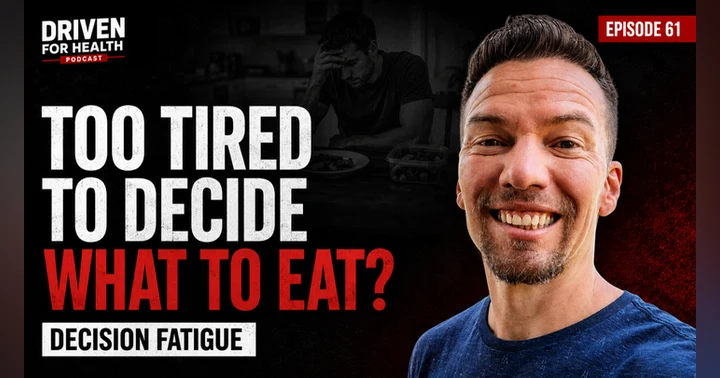
Beat Decision Fatigue: What to Eat Without Overthinking It (Men Over 40) - 61
Your workday ends and your brain is tired from a hundred decisions. The kitchen becomes the easy place to slow down. Coach Brian explains why tired choices at night keep men stuck. He gives you a way to plan meals ahead so you stop deciding from scratch every evening.


 YouTube
 The workday ends, your brain is still spinning from a hundred decisions, and the kitchen becomes the easiest place to slow down. That is the exact moment most men make the food choices that keep them stuck.
(Do your best intentions fall apart every night after dinner? Here is a simple way to fix that.)
Coach Brian breaks down decision fatigue and how it drains your body weight, energy, and focus one bad choice at a time. He explains why the end of the day is when most nutrition mistakes happen, and why tired choices, not the late hour itself, are the real problem. He shares how to plan meals ahead so you are not deciding from scratch every night, plus simple meal prep options for busy men, travel, and long workdays.
By the end you will have a repeatable system that keeps your nutrition steady even on your busiest, most draining days.
Main Topics:
- Why the end of the day is when most nutrition mistakes happen
- How decision fatigue drains your ability to make good choices at night
- Why tired choices, not the late hour, are the real problem
- How to plan meals ahead so you stop deciding from scratch
- Meal prep options that work for travel and long workdays
- Building repeatable meals that support fat loss and steady energy
The Call To Rise is a 100-day fat loss challenge for driven men ready to take their body back. It combines strength training, personalized nutrition and real accountability. Most men drop 20 to 30 pounds and rebuild the confidence that comes with it.
This program also works if you are dealing with high blood pressure, high cholesterol or Type 2 diabetes. It was built for those men too. Many men see those numbers move in the right direction alongside their weight loss.
Inside the program you also join a Brotherhood of men doing the same work. Together you build a body you're proud of and start leading like the man you already are at work.
This is your wake-up call to rise. Learn more and apply at www.thecalltorise.com
Want help applying this to your own health, weight, energy, or lab numbers?
Coach Brian Parana offers Health Hot Seat coaching segments for men who want a clear next step with nutrition, fitness, weight loss, blood pressure, cholesterol, A1C, or daily consistency.
Learn more about The Call To Rise, a 100-day coaching program for driven men over 40 who want to lose weight, improve their health, and rebuild confidence:
To connect with Coach Brian:
brian@brianparana.com
Disclaimer: This podcast is for education and coaching support only. It is not medical advice. Always work with your physician before changing medication, treatment, or medical care.
- Have you ever had a day where you made decisions nonstop? I mean from the even before you woke up your brain's firing and all of a sudden you realize you are awake but that decision stream of conscious has just been going and going and going and all day you're flying through and next thing you know you lay your head down on the pill you're like wow that day went fast and you probably didn't even remember eating anything as well.
- That happens a lot and decision fatigue is a big part of how you control your food, your nutritional choices, and ultimately how your body looks and feels. You want to pay attention to that and make sure that you are making the decisions. And this episode is going to hit you if it's you you are struggling with your food and understanding the daytoday times the challenges and everything that comes up.
- There's just literally no plan for food because you haven't even thought about it. Welcome back for Driven for Health. I'm Coach Brian Piranha. This is episode 61. Today we're talking about decision fatigue. It's a real thing. It happens in a lot of people's lives, different areas of their lives as well. From business to parenting to adulting to taking care of yourself.
- I want to help you understand how to make less decisions and how to make better decisions, how to get better results when it comes to your body and your nutrition, your eating. We're not talking theory. We're going to talk about real situations that come up. I'm going to give you examples and help you understand how to take some actions from this conversation.
- If you're a business owner, you're a leader, you're a bother, you're working day in day out, and you're carrying a lot of responsibilities. Nutrition is always typically, in my experience, the one that takes a back seat, especially at nighttime, because there's no more bandwidth. There's no more willpower or motivation to take care of yourself.
- Here's what most guys don't understand. They think that they have a food problem. Most of the time, it is decisions that they have a problem with. Again, think about the day you wake up. You're already making decisions, calls about what your day is going to look like, meetings, deadlines, people in your life, people that aren't in your life that are going to come in your life, schedules. Then work starts.
- You have one fire after another. You're handling responsibilities, adjusting and handing things off, delegating as best you can endlessly, checking texts or emails, managing problems, and then you get home and you can't clock out because you have kids and different routines and logistics that you have to manage with your spouse.
- There's homework for the kids. Fortunately, my kids do pretty well in school and I haven't had to deal with the homework thing. But if your child needs a little more help with homework, then you understand, oh, math's going to take 20ome minutes. For my house, it's bedtime. Bedtime, I'm pretty sure, takes 45 plus minutes to get the kids in bed.
- I'm only dealing with two of them. Usually, just my my daughter, Emily, and I end up reading to her at night. But that whole process takes a long time. At that point, I'm tired. I I do love and enjoy book reading with her. Right now we're doing The Phantom Toll Boots by Norton Jester. Love this book.
- It's just silly and it's fun, but I'm tired. I'm falling asleep. I'm reading myself to sleep at that point. Then I got to get back up and get moving. I have other responsibilities. And then I still have an hour it feels like before I got to go to bed. You get the gist. If you feel like and tomorrow you're going to wake up like I'll do better for myself.
- Well, the food is a big challenge because the setup isn't established. There's no rhyme or reason to what you're doing around your food. You're trying your best to make the decisions that are going to serve you best and your brain is trying to keep up with everything around you. And this happens to a lot of people in a lot of different areas of their life.
- But where they are successful in areas, say I I can't tell you how many people are making plenty of money, they have great relationships, but they struggle with their their food, their health, their nutrition, their exercise. They aren't taking care of themselves. These guys aren't lazy by any means, but they're overwhelmed. They're overloaded.
- A quick story of someone I talked to about Andrew. He's a client and this guy coached him in mid-40s, busy midtier executive level, managing a lot of people, a lot of responsibilities, two kids, teenagers. He's a great guy, but his nutrition would fall apart. Not at breakfast, not at lunch, but oftentimes dinner and 900 p.m. 1000 p.m.
- was when the wheels really fell off. Sometimes even 2:00 a.m. you just decide to wake up and go grab a snacky when he's supposed to be sleepy. That's not good. Well, the mental and cognitive load and the lack of any type of a plan is where the decision fatigue actually takes place. The decision starts when you start your day.
- And let's think about this. Every day you make tons of decisions. There's stats that I've seen. Don't quote me on this, but uh one is that people make 35,000 decisions a day. Another is about 226 or so around food. This is not an exact number and it varies from one person to another but the main point is that we are constantly getting inundated with food with challenge with things to overcome with advertising with our phones. Here's my phone.
- It's actually on do not disturb right now if you're watching on the video. I constantly have that thing quiet as much as possible because it is very disruptive. in episode 59. That's what I cited as one of the biggest challenges that I have is managing my phone and all the inputs that it's it's sending me because there's straight access to me and it's challenging.
- So, let's get back to the the nutrition thing. The point is that food creates way more decisions than you realize. I always say this, too. You and I, you listening in on this and I, we're going to think about food every day because we have to. It's the way we stay alive. But the emphasis on which you think of food and I think of food are going to be different.
- Okay? It's not going to be as say five 10% of my efforts today, not 80% of my efforts. Sure. Yeah. I make decisions around food that aren't always the best or I actively choose to eat a certain way that may or may not be in my best interest. I'm human, too. But in general, the general tone, I have a plan.
- I have a process, and I have an approach around how I approach my food, especially in context to my movement. Movement being right now, it's been 0 to 10° a lot. It's actually 20ish today. Sure, it could go outside. is still freezing and not likely to and my movement isn't going to move as much which means I need to eat less and I need to be very conscious of my carbs, my fats and calories.
- Most importantly, when I focus on those things then and I have a plan around it, I'm able to manage my decision fatigue and ultimately lead myself to the success that I'm looking for. Some choices and questions that you have. Here's the list. What should I eat? When should I eat? Should I have a snack? Does the person that brought in a snack taste? Is it tasty that whatever they brought in? Do I cook? Do I order out? What's for dinner? Do I want a dessert? Does it just a few basic ones that can come into your day? What's for breakfast? Oh, I
- don't have any time. Should I grab something on the way in or just force it and not? These decisions take energy and bandwidth throughout your day. Here's what's interesting. The average person, unfortunately, in our country is overweight. And the average person has weight to lose. So, if you want a different result, you cannot keep doing and eating and operating the same way the average person does.
- One of the fast ways to get better results with food is to reduce the number of decisions that you make about it. Okay? Control your food. Have pre-planned meals. I say this all the time, PPA, plan, prepare, act. Makes it way easier to take a decision out of the loop. Monday nights we go to Titos. I already know what my order is.
- Then I bring half of it home to have for Tuesday's lunch. I had that at 11 something. It's almost 4. I'm good. I don't need to eat until dinner and I might have something later after that. But I'm okay. I already know what dinner is. I'm going to brown some ground turkey, lean ground turkey and add some spaghetti squash and some pasta and just in case my kids want to revolt, but they should like spaghetti squash.
- But that's what dinner's going to be tonight. So that's already planned and out of the way. Then if I have anything, I'm g have a cottage cheese protein mix tonight to get my protein needs met and I'll be good. I'll manage my calories and make sure that say with my tacos, leftover tacos, I had broccoli and some green peppers on the side to help fill me up and then eat bunch of tortilla chips.
- This is why food preparation works. This is why planning your meals work. This is why packing your lunch and eating what you pack works. This is why too much variety can be a problem when you're already too busy. When you go to work and you let John down the hall decide what lunch is for you, you've got problems.
- When you allow whoever brings food in to the break room decide that's what you're going to eat for lunch, depending on who it is, you got problems because a lot of people are just bringing in carbs and tasty foods that are going to move you in the wrong direction. Each of these every extra options become just yet again another decision.
- Do I eat this? Do I not? Do I avoid this? Do I not? and they all stack up at the end of the day. This is when most everyone I've ever worked with is just toast. Uh Colton was a great example. Super driven guy, had this insurance business and he wanted to lose some weight. We ended up losing 30 some pounds, but his initial problem was he just binge at night.
- That's was his problem. He didn't have calories in his day to binge eat. And we made a simple shift with how where he put his calories and what he ate at those times. As soon as we framed it in, then he went off like a rocket and just was super successful. But what happens when you get to the end of the day and you're depleted? You grab whatever is easiest.
- Guilty is charged. I do that, too. It's not because you don't care. It's you're in a aware but don't care mode. aware but don't care mode. It's a real thing. Just don't care. You're just gonna put it in your mouth because you're hungry right now. Not actually that you are hungry. It's just because you want some extra food and such.
- And that's the problem is that extra food all adds up and it ends up costing you extra calories that you weren't allowed to have. that mental fatigue and that mental energy that shows up cost you more calories cuz well I already just splurged. Why don't I splurge some more and fall apart even more tonight? I'll start over again on Monday.
- Right? That ends up being the culprit of the the the challenge that most people ever face. If you're stuck right now and your weight isn't moving, you're plateaued a lot of times is because you're eating based off this con this sense of convenience instead of intention. This is why so many men struggle after 8:00 p.m. because it's not that there's some magical time where your body changes or you're not allowed to eat after.
- Just again spend all day and you're toast. Let me throw this at you pretty directly. People love to say don't eat after 8, right? It's I think it came from the 1950s. Don't eat after dinner time. Right? That is a very logical frame of reference. Or if you follow the intermittent fasting crew, then in that group, you're going to eat 12 to 8, something like that, or 4 to 8.
- And usually it's the time frame that most intermittent fasting happens. But don't eat after 8. For me, eating after 8 isn't automatically bad. I regularly eat between 9, 10, 11:00 at night and go to bed with a full stomach. Honestly, I think it makes me sleep better and I enjoy sleep and I want to make sure that I can always enjoy sleep and it's that that I go go to all that caroma it ends up doing really well for me.
- The issue is is what you choose after eight and what are people what are guys choosing? Cookies, chips, desserts, alcohol, snacks that turn into second snacks. But we're doing the Hobbit second dessert after the first dessert, right? You're still full from dinner time as well. That's what actually kills your progress.
- You just put down 1,000 calories or something like that of carbs, fats, sugars, sodium, and you go to sleep on that. I'm going to have my protein. I love this one. And it's my go-to cottage cheese with chocolate protein powder whipped up with a little bit of oat milk for creaminess and some whipped cream. Delicious. I got a protein bomb.
- Sometimes I'll add some powdered peanut butter and voila, I've got a chocolate protein a chocolate peanut butter protein bomb. There you go. When you eat those high calorie foods, your body cares a lot about the total intake across the day. If the goal is to be in a calorie deficit and you are in a calorie deficit with having those thousand calories before you go to bed, you will lose weight.
- You might not the scale might not be as say responsive at 6 a.m. when you wake up a couple hours later because you just put a bunch of food in your mouth, but over the course of a week, you will lose weight if you're in a calorie deficit. Okay? You don't have to try to have a a bedtime rule or I don't eat after this time.
- But we do need to make sure that it fits into the overall timing of your day. When we do that, then we're good. Oftentimes, I literally just ask people, "When in the day does it make the most sense for you to put food in your mouth?" They'll want to give me all these rules and regulations and all this. I'm like, "No, no, no, no, no, no, no. Stop, stop.
- " I asked, "When in your day does it make sense to eat?" And when we focus on that answer, you get a real choice, real decision, real action that comes of it. All right, this is a a big part. Most men spend their day making all those decisions for other people in their life at work, their teams, their employees, their clients, their family members, their kids, and their health always takes a back seat.
- Okay, this is a normal part of a very busy life in our society now. And we think about like a date night and you ask your wife where she wants to go eat. She says, "I don't care. Pick and you're like, "Oh, not not this one. Not this question." Right? Just yet another decision. You're trying to appease her, but you really want to go to this place, but it's also consider she's made tons of decisions all day, too.
- She doesn't want to wait make another decision either. So, you go back and forth, ultimately end up sorting something that neither of you want, and you both feel sad after that. Sometimes that happens with these situations. When we see guys having success in lots of areas of life and let's just pick one uh say work, they intentionally reduce their decisions.
- This is important. That's why you see some people wearing the same style of clothing over and over again. Mark Zuckerberg, President Obama. I even was reading on the other Stephen Bartlett from Diary of CEO. The points is simple. They don't want to waste any mental energy on decisions that don't actually matter. They want to save their energy for the decisions that do.
- Food can be the same thing. I've literally had guys have wild success eating a sandwich with adequate amounts of protein, a fruit and say two handfuls of vegetables on lower calorie bread. There it is. Rinse and repeat that meal ongoing and you can be successful. Okay. Then you can save your decisions for other times.
- And you then also consider deciding that I am not going to eat this food that got brought into the office. We just don't need that. When you decide that I'm either going to partake in food brought in from the outside world or not, when you decide no, then it's easy. You just don't go into the break room ever and you don't eat that food.
- But Brian, that sounds boring. Well, you can be boring and fit or have a donut and be fat. It ultimately matters that much. So, the trap that also messes people up is they keep searching for new recipes. They keep changing things. They just want this constant variety. And it sounds fun in the beginning, but again, it creates more decisions.
- How long does it take for you to look up a recipe and decide if you want to watch or not? Or the same thing on Netflix. It's it takes an endless amount of time to pick a new movie to watch. That's the worst part of trying to figure out what you're going to watch with your lady. Don't like that part either.
- So, we want to have to manage those situations and not get overloaded as well. And I I say this about recipes. If you literally just pick one recipe a week, at some point you be like, "Brian, I can't do anymore. I just can't. There's just not enough days of the week to put more recipes in. And I'm good with these." When it boils down to it, we have to always remember meals that you're going to be eating.
- Episode 5 through 11 is my nutrition pyramid episodes. But you are looking for a protein, a vegetable, sometimes a fruit, and a stretchy carb mainly, occasionally a healthy fat. But that's the building blocks of what a actual food and recipe and everything looks like. Okay? So we don't need to get, oh, I need this recipe, that I literally always look at recipe like, hey, let's back up.
- We're looking for different keywords to search around. High protein chicken recipe or fish recipe or something like that. A high protein, low carb would be a great keyword search for you to search to find a couple key things. In our house, we do a lot of say Mexican style dishes. There's pasta. There's a kabasi with perogi meal.
- There's chili there. Chili actually sounds pretty good. I might go up and look and see if we have some chili, but also I have spaghetti squash. So, here we go. Decision fatigue. Maybe I'll focus on chili tomorrow and I'll cook the spaghetti squash that I got today because or I got that on Sunday and today's Tuesday and I don't want them sitting on my counter.
- My wife's Amber's like, "Why did you buy these if you're never going to cook them?" Is that that all would end up being the response that I'll get from that one? We want to make sure that we can have some variety in our food. And usually we leave that for dinner or eating out or with friends, but we don't need the variety necessarily a breakfast, lunch, or a midday meal.
- We can just eat the same things on repeat because then it's consistent. Let's touch on meal prep and find a way that fits your real life. Meal prep doesn't have to look like Sunday you're in the kitchen all the time and then you put stuff into Tupperware containers. One option is just prep the components, not full meals.
- You have your chicken, your steak, your round turkey cooked for the week. There's things like rice and potatoes or beans that you have cooked and and mass- prodduced to then be able to easily add vegetables to fresh, frozen or canned. makes it so convenient to be able to then pull from and put together meals. Example, I chopped up three zucchinis, threw them in the air fryer.
- While that was happening, I had frozen chicken in the Instant Pot and within it was about a half a container of Instant Pot. So about 30 minutes later, I had pulled chicken and then I put minute rice into a large container inside the stove and that was dinner. I have a bunch more chicken and rice that I can then make quesadillas with that my kids enjoy.
- Um, but shoot, I forgot the tortilla wraps when I went to the store last time for some reason. But having bulk prep and having foods really available is such a big win and it can really cut down on say decisions and all. Option two is you just do meal prep twice a week. Usually they say Sunday and Wednesday are the best time to do it.
- And then third option is prep the night before. If you want to be super lazy, you just cook dinner, make an extra two servings, and have it for breakfast and lunch. Now, nobody needs to define breakfast as eggs or oatmeal. It could literally just be a dish that you end up eating from last night. Again, breakfast can be whatever you want.
- It doesn't have to be defined as something. This will help you manage a lot more convenience into it and a lot more smart moves planned into the day too. And then also, sure, we can use protein shakes and protein bars, but we want to be more strategic with that and not just rely on those as being the the go-to option.
- Okay? You just don't want to do that. Some of the strongest strategy I have and I want you to steal is don't make your food choices the day when you're tired. Don't go to the grocery store when you're hungry. Right? Make them earlier. Have a grocery list. Have a plan week schedule. Maybe Monday is a a steak, Tuesday's tacos, Wednesday's chicken, Thursday's pasta dish, Friday is pizza, this weekend is whatever it's going to be because it's so varied.
- And that's just the way it is. When you have meals like that or at least a script to play, then you actually do pretty well. Then you can manage it. And I have my clients do this all the time. Plan ahead. Or for tracking some some of my guys track, then we need to track before maybe the day before or the day of or always track before you eat to make sure that you're successful and you're not just running into the I don't really care anymore.
- Planning like this does require a little bit of effort up front and sometimes people think it sounds strict, but the truth is that if you want freedom from a unhealthy body and poor health, you need structure. And the boring path usually creates the best results. If you're successful in business, because you do the same things on repeat to be successful in business.
- If you are successful in your health, you're moving your body. You're making good healthy choices. You're cooking a lot of your foods. These are the typical things that are going to create a long-term success with you. Pick five or 10, five to 10 go-to meals. They can be simple. A protein, a vegetable, a starch, say three breakfast, three lunches, three dinners.
- And definitely don't say two, three, four ingredients per these meals. Maybe a fifth one with a topping. and all of a sudden you got yourself really simple rotation of food and then you can manage it with seasons and sauces and different swaps around things to make a little bit more variety. But it can be that simple. I I hope that some of these decision fatigues can help and the the options I gave you, the strategies to help less choice and more structure.
- I hope this helps. Now, if you are listening and you I actually want more help with this and it's like, coach, this makes sense, but I still can't stay consistent. It's blatantly obvious what you're saying, but I need help. I need some accountability, support, and that's what the call to rise is all about.
- It's my 100 day fat loss challenge for busy guys in their 40s and 50s that are looking for help. >> [snorts] >> In episode 60, I dropped three guys, lost 98 pounds in total. I shared their stories, their strengths or weaknesses. I broke down the five pillars of what the program is about, especially around nutrition and fitness and and some support and and brotherhood.
- Check that out. Check out the website thecalltorise.com. And if you need some help figuring this out and actually making real results stick and last for years to come, join me. Moving into the fast five as we wrap up. Number one, what time do you usually start snacking at night? Well, I wouldn't say snacking. I eat my last meal around 9, 10, or 11:00.
- It happens and it's built in my day and I already generally have an idea what I'm eating. Either dinner or that protein snack of sorts are two options that I usually do and it's always controlled in the overall portion and calories that I need for the day. Two. What is your go-to convenient food when you're tired? Well, we don't have a lot of junk food in the house, per se.
- Sure, we'll have occasional bag of chips, very rare. We'll have pretzels, not a lot. Well, goldfish, but again, my go-to ends up I'm so driven and focused on protein, protein, protein. I mean, I literally have ingrained it in my brain that I usually go to a protein concoction of the right now the consistent go-to cottage cheese, chocolate protein powder, a little bit of oat milk for to stir it up, and whipped cream. It's dynamite. Love it.
- What is one breakfast you can repeat for five days a week? Well, I'll do a ka cheese or yogurt with berries with flax seed or chia seed and some protein powder. Usually chocolate or vanilla and whipped cream. I've been doing a lot of whipped cream or sometimes I'll mix oatmeal in it. I'll do dry oatmeal on top of it and stir it in.
- Depends on if I need carbs or not. If I don't, say right now it's cold out, I'll move a lot. I don't need the oatmeal. But when I'm busier and I'm moving every day and I'm running a lot more. Hopefully I can do a marathon this year, then I'm going to have more starchy carbs there. Question four is, when are you going to decide tomorrow's dinner, lunch, and snacks? And if I didn't have a handle on food, I would make decisions earlier.
- I would make sure that I knew what I was eating. And but in my real life that's built around moderation, flexibility, and and a balance, I have to go with the flow. I have an idea of what I think dinner's going to be tonight, but it might not be. I have to be okay with that. But I will still control the amount of food that goes in my mouth.
- Question five, one decision you can remove this week so your health gets easier. I offload my training, meaning that I have my buddy Dan or Chris come over and work out with me. I've got those two guys, I've got Levi, sometimes Everett, Maxwell now, he's my third son, working out with me. So, I have five Andy, six, I have six people that I can move my body with and it's less decision.
- And my wife, Amber, she'll walk and I'll work out. So, that's seven people I can offload my exercise to and I don't have to worry about it because when I show up, I'll I'll do it. But if I'm don't have that plan, then it's likely that things will slip or slide or just not get done. Is because my life's real, too. It's just super busy.
- One thing to the next and doing these podcasts and all the other things that I do. Decision fatigue is real. If you're busy, you need to focus on how many calories you're putting in your mouth to make sure you stay in control of the amount of calories and the body weight. And if you want to lose fat, you need to be in a calorie deficit.
- So, a decision around nutrition is super important. I give you tons of ideas on how to do it. The fewer food decisions, the better. Portion out your food. Simply keep eating the same things on repeat in the portions that you need. Have a little bit of variety here and there, but it will get so much easier for you. If you got a buddy that's struggling with this with decision fatigue and he just constantly just doesn't know where to go, send them this episode.
- I hope that it helps you and it can help them too. Off we go to the next