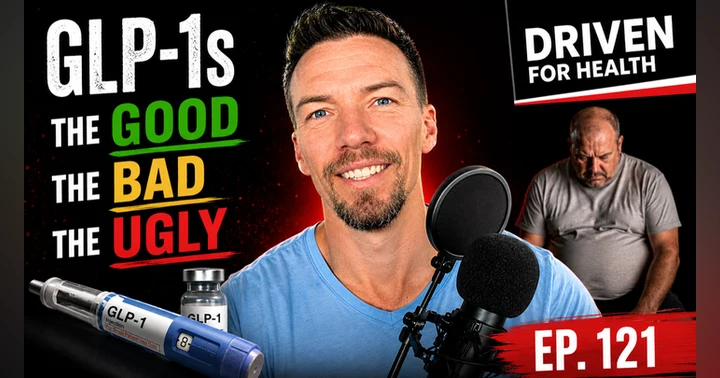
GLP-1s, The Good, the Bad, and the Ugly - 121
Your doctor wrote a script for a GLP-1 like Ozempic or Mounjaro and the box is still unopened. Coach Brian walks through the trial data with no hype and no fear. You hear the good news on weight loss and heart protection. You also hear about muscle loss and counterfeit drugs. Use it to make the call with your own doctor.


 YouTube
 Neal's got a box sitting on his bathroom counter. His doctor wrote the script 3 days ago. It's still unopened.
His buddy at the gym won't stop talking about the one he's on. His wife lost thirty pounds on hers in four months. Neal's labs aren't where he wants them either. Part of him wants this box to be the answer. Part of him doesn't trust it yet.
(Have you got a script sitting unopened because you don't trust it yet? See what the real research says at www.thecalltorise.com)
If that's you too, this episode is for you.
Ozempic, Wegovy, Mounjaro, Zepbound. One in eight adults in this country is currently on one of these drugs. Coach Brian breaks down the real research behind them, the actual trial data, not hype and not fear.
-The GOOD: the weight loss numbers, the heart protection benefit most people never hear about, and the kidney trial that could change how you think about your own labs.
-The BAD: the muscle loss nobody warns you about, the real cost most guys underestimate, and what happens to your body a year after you stop.
-The UGLY: the counterfeit drug problem the FDA is actively trying to shut down, the vision risk worth knowing about, and the scare that turned out to be nothing after two years of research.
Every claim in this episode is backed by a real study. Full sources and links are in the show notes so you can check the work yourself.
This is the full picture. Use it to make the call with your own doctor instead of guessing.
The Call To Rise is a 100-day fat loss challenge for driven men ready to take their body back. It combines strength training, personalized nutrition and real accountability. Most men drop 20 to 30 pounds and rebuild the confidence that comes with it.
This program also works if you are dealing with high blood pressure, high cholesterol or Type 2 diabetes. It was built for those men too. Many men see those numbers move in the right direction alongside their weight loss.
Inside the program you also join a Brotherhood of men doing the same work. Together you build a body you're proud of and start leading like the man you already are at work.
This is your wake-up call to rise. Learn more and apply at www.thecalltorise.com
Coach Brian Parana is not a doctor. Nothing in this episode is medical advice. Talk to your own physician before starting or stopping any medication.
Fact-check sources:
John Eng, Gila monster, exendin-4: VA Research 1992, Byetta approved 2005. | STEP 1 semaglutide: NEJM, 14.9% loss vs 2.4% at 68 weeks. | STEP 1 extension: Wilding 2022, regained two-thirds of lost weight within 1 year of stopping. | SURMOUNT-1 tirzepatide: NEJM, up to 22.5% avg loss, 52 lb at 15 mg.
SURMOUNT-5: NEJM 2025, tirzepatide 20.2% loss vs semaglutide 13.7% at 72 weeks. | SELECT: New England Journal of Medicine, 2023, 20% reduction in MACE in adults with CVD and no diabetes. | FLOW: NEJM 2024, 24% reduction in kidney outcomes, 18% fewer CV events, 20% lower all-cause death.
Lean mass loss: Obesity journal meta-analysis, 30.8% of weight lost was lean mass, broader range 20 to 40%. | Gallbladder risk: JAMA Internal Medicine 2022 meta-analysis, 1.37x relative risk. | Side effects: Ozempic data, 48% any side effect, 37% nausea. | Cost: KFF late 2025, 56% say hard to afford, 27% pay full price with insurance, 14% quit due to cost.
Counterfeit risk: FDA, 1,700+ adverse events as of May 2026. | NAION vision risk: AAO/NANOS May 2026 consensus statement, JAMA Ophthalmology. | Thyroid C-cell warning: FDA data, rodent-only finding, no confirmed human cases. | Pancreatitis: mixed data, one 2025 meta-analysis found RR 1.44.
Surgery guidance: ASA 2023, revised October 2024. | Suicidality warning: FDA January 2026, label removal after finding no increased risk. | Usage: Gallup/Statista late 2025, 12.4% of US adults on a GLP-1 for weight loss.
Want help applying this to your own health, weight, energy, or lab numbers?
Coach Brian Parana offers Health Hot Seat coaching segments for men who want a clear next step with nutrition, fitness, weight loss, blood pressure, cholesterol, A1C, or daily consistency.
Learn more about The Call To Rise, a 100-day coaching program for driven men over 40 who want to lose weight, improve their health, and rebuild confidence:
To connect with Coach Brian:
brian@brianparana.com
Disclaimer: This podcast is for education and coaching support only. It is not medical advice. Always work with your physician before changing medication, treatment, or medical care.
- Picture this. There's a little box sitting on your bathroom counter. Your doctor wrote you a script three days ago. You picked it up from the pharmacy and it's just been sitting there since. It's unopened for today. Let's call this guy Neil. He's 46. Runs a business or leads a team somewhere in a company and he's hustling every day.
- He's got a wife, few kids, and a kind of a schedule that never slows down, especially on the weekends, and he's been carrying around 40 plus extra pounds for the last few years now. At the last physical, his doctor looked at his labs and told him his A1C was sitting at a 6.1, which is on the high end of pre-diabetes.
- His triglycerides were high. His blood pressure had crossed the range and where they needed to have a real conversation. Not necessarily about having medication just yet. The doctor made it clear that if he didn't get things in order, medication was going to start coming in multiple different ways from blood pressure to even metformin for potentially getting type 2 diabetes.
- Maybe your buddy is already on it and won't stop bringing it up at the gym. Same as Neil's is. Maybe your wife has been on it for 4 months and lost 30 pounds and you don't really know what to say about it. Same thing with Neil. part of him, he just wants that little box to be the answer and another part doesn't trust it. Okay.
- Well, either way, you got questions and nobody around you is giving you straight ones. Your doctor gave you seven minutes and a pamphlet. Your buddy's just hyping you up and wants you to jump on to the little black box and your wife's group chat is either obsessed with it or scared of it.
- Nobody's giving you the real picture. So that's what we're talking about today is GLP1s, the good, the bad, the ugly. And welcome back to Driven for Health. I'm Coach Brian and this is episode 121. I've said it before in the show, no GLP1s, peptides, shortcuts. That's kind of been my line for years. Let's do it the oldfashioned way.
- just eating healthier and moving your body and setting real life behavior change and lifestyle change. And I have 20 plus three years in the industry proving it every single day. Even check my Instagram this week which was July 1 as recording. I posted on what June 29th. I had four guys lose almost 15 plus pounds in the last week or two because of doing the basics right. And that's really important.
- Here's the truth. These drugs aren't some fringe thing anymore. They're literally everywhere always. You're getting advertised to them by them. You're getting celebrity endorsements. Everyone seems to be on them. More of my own guys are asking about them whether it's taking peptides. I've worked with clients on them that come to me on them or that want to get off of them or thinking about them and all some of them have decided that you just doing the work is right for them and others want to use the GOP one. Now, being me being
- a coach, I that I say that I am, I can't just wave my hand and dismiss something that 12% of adults in this country are currently using. And that's a real number for national surveys last year. One in eight adults. You probably know more than one person that is taking them, whether they're having success with it or not.
- Today, I'm here not to sell you into starting one of these, not to talk you out of it, not to throwing the box away in the trash either. My job is to give you a full picture. The good, the bad, the ugly, same as I break anything else down for one of my guys that I work with. Listen, I'm a coach, not a doctor. I'll say that right now.
- This is not medical advice and you need to consult your doctor before starting or stopping anything. Where did all this stuff start with GOPs? Before we get into the good, I want to tell you where these drugs actually came from because it's a pretty wild story. Most people have no idea. Early in the 90s, there was a doctor named John.
- He was working out of a VA hospital in the Bronx and he had no clue what he was stumbling upon with a weight loss drug. He just was curious about a lizard in the desert called the Gila monster. It's a really ugly venomous bite monster. And this litterer can go months without eating a single meal and somehow keep its blood sugar levels normal and stabilized the whole time which is really hard.
- Most animals, living creatures, need to eat on a regular basis to do that. Dr. Ang got his hands on some dried venom from the lizard. He started digging through it in the labs and got buried in the venom that it was a peptide, a little chain of amino acids that worked almost exactly like a hormone our own gut actually makes called GLP1.
- Except the lizard version was and dirt. It was built to last. It was homegrown in a sense from mother nature. Our own natural GOP1 breaks down in minutes and humans. The lizard's version survived for hours. That discovery then turned into a drug called Yeta. It was approved back in 2005. And yet is the great grandfather of every drug we're talking about today.
- Zmpic, WGOI, Mangaro, Zepbound. All of these trace back to the guy in the Bronx studying the lizard spit. I tell you that because I want you to understand more before we go any further. There's not some shortcut some company cooked up in a marketing meeting. The science is real and it's took about 30 years to get where it's been now.
- So, let's actually look at what it does. Part one, the good part. Let's start with why Neil is even tempted to open the box in the first place. He lost the weight before. 25 lbs one year and 32 lbs came back within 12 months. 16 pounds another time and he gained back 20. At one point he's actually got serious and dropped close to 60 pounds overall in a year and a half is about 18 months and he's still 40 pounds overweight today.
- And this is because lifestyle and behavior change didn't change. He used he he used a certain method to do it but never change actual life. So he knows what to do. He has a not necessarily a weight loss problem, but a weight maintenance problem. He can't maintain his weight for the life of him. He's proven that he can do it. What he just doesn't know is how to manage it.
- And that's where Neil is at now. Number one, the weight loss numbers are definitely real when it comes to OMIC and and all. And they're bigger than almost anything that we've ever had before. So there's real promise in using a GOP1 such as Ompic or WGOI and the biggest trial on semiglutide that's a the drug in ompic and wgoi it's called step one almost 2,000 adults tracked for over a year.
- The group on the drug lost close to 15% of their body weight. The placebo group only lost about two. So real evidence 86% of the people on the drug lost at least 5% of their starting rate. So that's really good and significant. 86 sit with that for a second. Okay. So that's a large number and most diet programs will kill for that level of effectiveness and number of the people coming into the program or doing the protocol and being successful.
- And most people weren't doing anything different with their training or their food. It was just the drug doing all the heavy lifting. When Neil hears a number like that, and you too, something shifts a little bit. He's been stuck at this weight and this yo-yo cycle for years now. His doctor is starting to use the word pre-diabetic at his last visit.
- his triglycerides were high enough that she circled them on the printout and handed it to him and you know his cholesterol is around 240 which is a limit the higher limit that we do not want. 86% of people in that trial hitting a meaningful result that has very specific changes in their body, their body weight, their body image, how they look, they feel about themselves.
- And that is really important for a guy who's started to wonder if his body is just broken, that it's his metabolism doesn't work and he's going to be stuck being a fat guy. Now, Tzepicide, that's Marjaro and Zepbound, did even more in its own trial called Surmount One, and links will be in the show notes for people to click on these to look at them.
- People on the top dose lost an average of 52 pounds. And when they finally ran both drugs head-to-head, the trial called surmount five tepatide won again about 20 average loss against roughly 14% for the semiglutide over the same stretch. So we heard oepe come out first, but then zeppamound and majaro the tresepatide came out and it did even better.
- But number two, there is a heart benefit hiding inside the weight loss story. Most guys don't hear about this. And the trial called Select shares this with 17,000 adults. All of them already had heart disease. All of them were overweight or morbidly obese and none of them had diabetes.
- semiglutide cut their risk of heart attack, stroke or dying of a cardiac cardiac event by 20%. That's pretty significant. 20% of people in the study who are already dealing with heart disease on their chart and they were able to reduce that. That is huge in cardio in basically cardiology guidelines of helping people live longer higher quality lives for longer.
- And that's where some of the magic around these drugs continually show up is it can provide a higher quality of life. Number three, and this one is important. If you've ever looked at your own lab work, your blood panels, and felt that little knot in your stomach, and with red flags showing up like a bad day at the beach.
- There's a kidney trial called Flow. It was ran on people with type 2 diabetes who already had kidney disease. Kidney disease has multiple different stages. I've worked with clients with kidney disease of stage one, two, three, and four. And it's not great. Global filtration rates for that are normal at 90, but I've had people as low as 11.
- That is dangerous for people to live. And so we have type 2 diabetics with kidney disease. The semiglutai cut major kidney problems by 24%. Cut cardiovascular events by 18%. cut the risk of death from any cause by 20%. If your doctors ever mentioned your kidney numbers trending in the wrong way or your A1C sitting say 10 or 12.
- I've had someone as high as 15. We can go listen to episode 89 where I broke down the whole diabetes reversal piece literally from I didn't know I had it to I got diagnosed to what do I do in the next 30 to 60 days. So that's episode 89 of Driven for Health that you can leverage. Number four, and this is brand new.
- You don't even need a needle anymore. Our new pill called Pandaro just got FDA approved this year and I'm already getting YouTube ads. I like to listen to music when I work out in my barn here and the YouTube will be right over there on the screen next to me and this is already getting marketed or row is marketing to me about it.
- Oh my goodness, so many marketing on why you should join in and and get healthy and fit and be your best self and just like any other drug. And then there's that list of side effects that they try and rush through that they have to say. Now this one pill once a day anytime, no fasting required. There was an oral semiglutide pill before that one too.
- but you had to take that one on an empty stomach and wait 30 minutes before eating anything. So, this skips that and makes it even easier for you to hopefully achieve the weight loss that you are wanting to experience. So, for every guy who's been avoiding this whole category because he hates needle, that excuse is now gone too.
- That is the good real weight loss numbers are happening that most diets can't touch. they can't consistently produce that type of an outcome. A heart benefit that shows up even without weight loss and kidney benefit for guys managing diabetes, there's now a pill for that instead of a shot. And this is and if you're in an obese, morbidly obese state with chronic disease-like states of diabetes, cholesterol, blood pressure, this can be a lifeline for you to start the process to change your body for the better. And that's one reason
- why I highly advocate for looking into a GOP1 as an initial solution to start get you to the next phase of what life is. Okay, we can start getting you into a healthier body weight, healthier body image, and getting your blood panels back to normal so you can live a higher quality life.
- But then how do we get that into a lifestyle? And if someone is morbidly obese and and overweight and can't function very well and is living a restricted life, meaning they don't go out and do things, that they don't participate, that they are more isolated. And humans need humans and humans need to be out and about and doing things and this can be a pivotal first start. Now part two, the bad.
- Neil doesn't want to be all hyped up from his body. He wants the truth so he can make his own call. So let's give some truth. Number one, side effects are real and they're common. Right around half of the people have these on the drugs get them at least once. Most common is nausea. You just literally don't want to eat.
- You feel sick from food. And this shows up in around 37 to 40% of users, especially while taking the dose and while it's going up in its titration and in its rate of usage. And it it does settle in and settle down after a couple weeks. It's It can be uncomfortable, but it's not the one that you or Neil should be worried about.
- Number two, and this one I want every guy listening to actually slow down and listen in. Tune in here. When you lose weight on these drugs, somewhere between a quarter and 40% of the weight is muscle, not fat. This is huge. One review pulling pulling data across nine separate trials is called a metadata study put that number right around 31% 30% on average.
- So let's do the math together on it. What does that actually mean for you if you were to lose more muscle than fat? And no matter what I just want to be straight here people, you will lose muscle as you lose weight. It's just a fact of the mechanism of being in a calorie deficit and losing weight and losing metabolically active tissue.
- The goal that I have for any single one person I've ever worked with for 23 years is to lose fat, not muscle, not water, not muscle glycogen. We're specifically targeting fat loss. And if you want to see a good example of that, episode 113 has Mike talking about he just graduated my call to rise program, the 100 day fat loss challenge.
- He lost 17 pounds in 100 days, but 12% body fat at age 59. That is incredible. We didn't. We just ate real food. Got him to pay more attention to do the basics that I keep talking about creating a lifestyle that he can live and maintain. And even a month later, he's still happily maintaining his goal because I just checked in on him yesterday.
- Why? Because that's what coaches do. They they check into the people. They It's a vested interest. And that's what the whole program is. It's an accountability program. It gets you to do the thing that you know you should be doing. So, let's break that math down. All right. Say 30% of it because numbers me just talking or things written down don't quite hit the same as seeing it on your body.
- So, say Neil loses 40 pounds on one of these drugs. 31% of the 40 is 12 pounds. That'd be 12 pounds of that loss would be muscle. It could be muscle. Neil steps on the scale and sees a huge win. Holy cow, I'm down 40 pounds. Part of what actually walked out the door was the strength and the functionality for the long term of what he's going to need and at age 60.
- And guys, when you're in your 40s and 50s, you are paying deposits with every exercise session that you're doing to be stronger, faster, capable, and functional. When you're 60 and 70, you want to make sure that you can stay alive and functioning. And there are science, research studies that say that the more muscle that you have on your body, the more likely you are to live a longer, higher quality life.
- Neil's not just trying to get small just to lose weight. He wants a body that he can still peel the shirt off at the beach and feel confident in and actually get out into the backyard and do hours of work that his wife wants him to do, right? Because we all have honeydew lists. If you don't, you're lucky.
- I would find that really weird if a guy didn't have a honeydew list. Unless obviously you didn't have a wife, but side tangent here. I've got plenty of a honeydew list. is always something to do and I need to be able to work all day and to right now I'm marathon training and be able to run and then still do more work after that.
- So we don't want to just get small doing something that it looks good. So losing 12 pounds of muscle while the scale goes down is not it. That is a different problem wearing smaller pair of pants. Yay for smaller pants, but even with that much muscle loss, you might still not fit in the clothes like you thought you would. Whereas, if we lose body composition, you're significantly more likely to be toned, look, and feel that's going to add to the added benefit of this the fat loss that we're doing.
- And again, I want to reiterate, this is exactly why training and protein matter more than ever when you're on this drug, not less. If you want to go listen to episodes 5 through 11, I have the nutrition pyramid as a refresher for you. And I literally tell you protein is non-negotiable. I give you specific numbers and calories and all this stuff for you to start to build your own approach for.
- In fact, just the other day, about a week ago, I had a gentleman that listens into this podcast. Stan, I thank you for sending me an email. He sent me an email. Brian andBrian.com said that, "Hey, I'm really grateful for your podcast. I have started at 280, I'm at 268 now from implementing the things in a one-mon time frame. So, let's go Stan.
- " And if there's someone else listening into this podcast, please share. This is a a labor of love in a sense of of doing this podcast. It takes time and effort and energy and money and all these resources and such, but I love doing it and this is how I can impact the world. So, I hope that you guys get value and share, ask a question, jump on as a health hot seat.
- I'd love to interview a couple more guys to give them real life strategies and have a real conversation with us a professional who does this for a living to have a key plan and a blueprint. And that's what the health hot seat is. So, side note there, but if Neil's not lifting weights and you're not lifting weights and you're not hitting your protein numbers every day, you can finish the year off on this drug lighter on the scale and weaker in real life.
- So, it's not just because you're in a calorie deficit. It's literally your muscle, your grip, your legs, they're shrinking. You're going to look smaller in photos. So, not in a good way. And things over time might feel more labor. That's not what anyone signs up for. Number three of the bad gallbladder problems start to go up.
- There's a big review in JAMAMA. Internal medicine found roughly a 37% higher risk of gallbladder disease in people on these drugs. Yes. Unfortunately, there are side effects to drugs that we put in our body. Nothing's just this perfect situation where you pop a pill and you're amazing and all good. Part of the reason of the gallbladder issue is the same mechanism that makes the drug work.
- It slows everything down, including your gallbladder. And a slow gallbladder forms stones easier, and that's not something you want. You do not want gallbladder stones at all. Now, this is just worth knowing. If you ever get a sharp pain under your right rib after a heavy meal, that's the gallbladder area. Number four, cost stops a lot of guys cold in their track before they even start.
- Brand names can run over $1,000 a month if you don't have insurance. And most insuranceances won't touch that price tag unless you have a diabetes diagnosis on your file and you've been prescribed it. National survey found over half of current users say the cost is hard to manage. Yeah, that with rising grocery costs, gas costs, just living expenses.
- And then you throw a couple hundred to thousand dollar on top per month. That's that can be backbreaking in terms of a budget that you have in your house and starts to take up way too many funds. So more than a quarter pay full price even with insurance and about one in seven quit specifically because they can't keep paying for it.
- So financially is a bad downside of this drug. I won't go into any more than that of why it could or couldn't be better for you or the drugs or whatever, but this is the reality. Number five, this is a big one and it's one that I want Neil to actually think about. The step one trial followed people after they stopped taking the GOP1 drugs.
- They lost over 17% of their body weight on treatment and within a year stopping they gained back 11 of those 17 pounds. That's not good. the the percentage points there. That's almost twothirds of it come back and in 12 months the moment the drug stopped and that's just falls back into any other diet situation.
- If you have done a diet where you just cut out a food group or you stopped eating or any of this stuff and you didn't change your knowledge, your skill level around nutrition and fitness and lifestyle and how you apply it every day and make it fit into a normal everyday life, then you're going to be like any other diet situation that pops up.
- You will lose long term. The GOP1s is not a cure for anything. You we really want to think about it as a tool in the toolbox to help you manage your body weight. Especially if you are again o very overweight, obese or morbidly obese. If you have to lose 20 pounds, yeah, sure this could help, but it's in that situation it's probably more lifestyle anyways that's causing the 20 pounds to be there in the first place.
- The second you put down anything built underneath it, the old patterns show up very quickly. It's true in Neil's situation. Even when he was not on drug, he would do some type of a diet or program and then he'd gain the weight back. He'd lose it and gain it. Lose it and gain it. So, whatever is holding you back is the challenge itself.
- And before we get into the ugly, well, let's talk about real life challenge. That's what I have been doing for decades is helping people overcome lifestyle behavior change and educating them on what food is because marketing has been selling you what nutrition is, not actual science. I mean, think about it. When was the last time you even looked at a food label? And if you did look at the nutritional label, do you even know what it says or the context of what it means for you to have brought into your everyday life of should I eat this food?
- How much of this food should I eat? And why am I eating? That's what I teach and that's what the call to rise program is. It's a 100 day fat loss challenge. I have ample amount of testimony built into my episodes of real guys and real life with real families talking about real problems and how they're able to overcome them with real food and exercise and changing their behaviors.
- And that's what we do. We have five pillars in this. First pillar is your identity. You have to change who you think you are and who you see yourself as. Especially when you look in the mirror, we need to see a fit, strong, capable man that has confidence and energy in all areas of his life. Not just he can pad his bank account, but he has padding in his waistline.
- That's not going to work for you. So, we change your identity and get it to align with who you actually are on the inside. Second one is the forge. This is the exercise piece. We build a body, build muscle, maintain muscle, and burn body fat as we go. So, there's exercise built into the program that fits into your day without spending hours and hours and hours in the gym.
- There's pillar three, which is the fuel. This is nutrition. Simply put, eating the right foods at the right times in the right amounts. That is so paramount to understanding. And they have to be tasty and delicious and have built-in pizza nights and whatever. My wife and I, we went out to a really nice restaurant to celebrate our anniversary and the success of her launch. She's a travel adviser.
- She sends people on bucket list trips. She just sold out her women's only puya trip in Italy and it's going to be epic and it was just a massive celebration. So I we went to an Italian place and I had pasta and cheese and and all that stuff. hit some octopus and bara things I don't typically do but I build it into my day and I woke up feeling strong lean and I didn't worry about if I put a pound on or not from the day prior.
- It's just not how I operate anymore. So when you understand nutrition then you can be successful. The fourth pillar is mindset. You have to think differently. All this is between your ears anyways. and changing your view, your lens point, your perception of how you approach nutrition, food you eat, the way you live your life every day that moves toward your health goals.
- Then that's it. And the last one is the brotherhood. You've got me as the lead. I am the tide. I rise all boats. You talked to listen to one of those episodes. 117 for Chris, 113 for Mike. We've got Danny is at 93. We've got Lucas at 34, Mike at 43, Andy at 53, and there's a ton of John at 10.
- There's so many different ones throughout the process that you can listen to and hear real life stories. But the brotherhood is where it comes together is that you have other like-minded individuals, guys, successful guys that are doing this together. And it was really just getting to this motivation and this drive and this energy.
- And it's just it's awesome actually because most guys don't have a social network especially around taking care of themselves. They have buddies that that'll go to the bar with them or do this that or the other but they don't have the actual backbone of what being successful in their health looks like. And that's what we provide.
- So that's the call to rise.com 100 days. The guarantee is lose 20 plus pounds in 100 days. And then that guy's lost 30 plus. It's crazy. I got Jamie. We're gonna have Jamie on here. He's at 37 pounds, 38 pounds in 12 to 14 weeks, which is insane. So, there's that. Now, let's get into the transition. And I don't want to scare you, but this is real life.
- And you need to hear about it because no one's really talking about the ugly part of this. And I have seen this. I'm getting marketed to on this. I have experience with clients that are in the trenches using the drug and don't feel very well. Number one, the compounded and counterfeit market around these drugs is a hot mess.
- Past May, the FDA had logged over 1,700 adverse events reported tied to compounded semiglutide and transepide. Real counterfeit ompic got seized off the market as recently as this past December. Here's how it usually goes wrong. A guy orders a compounding far from a compounding pharmacy or some online source because it's half price and then he's trying to measure it on his own dose in a vial he's never really used before and give himself shots mixing up milligrams and milliliters.
- Some of these guys end up in the hospital just from getting the math wrong. It's real. on top of having no real idea what was even in that vial to begin with. It's a clear liquid. What is this? It just has a label that says it's this thing and that's a problem just like any supplements on the market. There's no FDA realization here and that's a big challenge.
- So the FDA is actually trying to shut this whole loophole down for good and the public comment period on that closes within days of this episode going up, right? It's the FDA really wants and needs to have some blueprint in this. Bottom line is if you're not getting this from a licensed pharmacy with a real prescription from your own doctor, you could be gambling on what's actually in that syringe.
- And this is exactly where Neil has to pump the brakes here. The real pharmacy quoted him around $1,100 a month with his insurance covering none of it since he isn't diabetic. Remember his di his A1C is 6.1. That's pre-diabetes. It's not aimed diabetes. He still needs another 0.1 to two to get into that diabetes.
- But again, who wants to go up in their diabetes A1C to be able to qualify for this drug for the low? just fix it. Let's not do that. The guy at the gym tells him he's paying $200 a month through some online source and someone in a Facebook group has a link to the same thing. I'm literally seeing that right now from a guy on my news feed.
- He set up a shop that now because he's using this, he's losing weight and he's set up his own shop that is now selling peptides. He's got no qualifications. He's a film guy. He's got he's just using his guy that then gives him a link to be able to sell through his own website and market it and use himself as the say the crash test dummy in a sense of this.
- So yes, he's losing weight, but to what degree and for how long and what happens in a year or five as well. Now Neil's not trying to do stupid things here. We don't want to do something stupid. He's trying to solve a real problem without paying so much money or potential challenges in his health.
- But these three drugs specifically save $900 a month on something you can't verify is a serious risk. It's really not a smart trade. So going with the $200 a month instead of a $1,300 or whatever that is. Yeah, that's you you want to do it just like getting advertised by Row or any of the other ones that pop up all over the place.
- Sure, it sounds appealing, but it's still there's a time, energy, and money cost to it. Number two, there's a vision risk worth you understanding. A handful of large studies have linked these drugs to rare eye conditions called Nion and it can cause sudden vision loss. The numbers from study to study shift around but they show that the risk roughly doubles.
- Others show it several times higher in certain groups. A joint statement from the major eye specialty groups. this year said the overall risk stays low and a direct cause has not been proven. Sure, but there could be some form of a causation here. Still rare even with the increase. Okay.
- The the the eye issue disease is rare, but it's it's been noted. And the so there's a practical line underneath it all. If your vision suddenly changes while you're on one of these drugs, that's definitely an emergency room visit, not just wait and see, pun intended. Number three, drugs carry a thyroid tumor warning right on the label.
- Thyroid is directly related to your metabolism. That warning comes entirely from a rodent study, not a human case. Okay? So what happens in rodents and humans are different. Okay. There's no confirmed human cases exist yet after years on the market and the receptors for these drugs act that they act on isn't even present in normal human thyroid tissue, but it's still on the label as a precaution.
- If thyroid cancer runs in your family, that's definitely a strong conversation you should be having with your doctor before you think about getting started. Number four, the evidence on pancreas problems is generally mixed. And I want to just make you aware with you instead of picking whatever version sounds scary on a podcast.
- Some big trial reviews find no increased pancreatitis risk at all. At least one newer study found a modest increase. Nobody's got a final answer yet. Of course, there hasn't been enough time to see these play out. What are the challenges of taking these drugs and what does it do to the human body? So, what you should actually walk away with is the warning sign of what I'm trying to say here, that there are severe stomach pain that doesn't let up, that you can't just push through.
- And that's a same day doctor visit as well. I've had clients where they have had severe nausea, aches, pains, and a lot that has caused. And while we're on body stuff, if you've got surgery coming up, tell your surgical team you're on one of these. These drugs slow your stomach emptying, which raises aspiration risk, okay? Or your breathing risk under amnesia.
- So, the anesthesiologist actually needs to know the the situation in your body and be able to understand what the proper anesthesia looks like if you were to go into surgery and how do you manage that gastric emptying and come out of surgery. Number five, and I want to end the ugly se section on on this one because it's it's a good lesson, not just a scary fact.
- Back in 2023, reports started coming in linking these drugs to societal thoughts. The FDA spent over two years digging through the data on this this this challenge. This past January, they came back with their own answer. No increased risk found. they actually asked the drug makers to remove that warning label from the label entirely. So, just something to do.
- All right? Something to think about. Be informed about what you're doing to your body and putting into it from if you're going to take a GP1 or you're going to put food in your mouth. Fast food. You got to understand that's the system working the way it's supposed to work is when and it tells you that something useful for the next time you see a scary headline about anything, you always want to look at the data and not the drama of headlines because you'll be able to then get some help.
- So, where do I land on this? Coach Brian here. Where am I? The data behind these drugs is some of the strongest you'll find for any medications that come out in the last 20 years. They work. There's a lot of money and time and energy getting put back to them because they can be an actual really good, helpful way for someone to improve their health and get out of the morbid obese or super high A1C and start getting into a healthier lifestyle. That's the rub.
- That's what we want. They help with just more than weight as we saw, but they're also not magic and they don't replace the basics. Not even close. Remember back with episode 117 with Chris? We talked about the lottery winner thing. Guy wins the lottery, doesn't have the skill set to manage money, and a few years later he's broke again.
- Sometimes worse off than before he won. Same exact thing happens here. The drug can hand you the weight loss. It cannot hand you the skill set if you don't build the training habit, the protein habit, the sleep habit, the walking habit while you've got a head start on the drug. I have one client that he's been using it. He calls it the rocket powered roller skates, but also he still is having trouble losing weight over the long term because of some of his behavior around what he does and how he does it.
- All right. So, they'll give you a head start and you're going to if but if you don't change your behaviors, you'll end up right back to where you started the day. The prescription runs out and that'll start going in the back direction. Except now you've also lost some muscle along the way.
- And that's the the double-edged sword here. One sword is it cuts through fat, but it also cuts through muscle. So, if you're on one of these drugs right now, train like your strength depends on it because it literally does. Protein on your plate every meal, ideally 40 or 50 grams for sure. It's not a negotiation.
- And you have to have habits built around how to make it easier to get protein into your diet every time. Anyways, now you're going to need this after this prescription is gone. You have to maintain some form of strength training because the weight can come back fast when there's nothing supporting it. New system, processes, behaviors.
- And if you're not one of on one of these drugs, none of this changes your job either. You still need to lift a few times a week. Still need to do protein and vegetables first. Get 10,000 steps in. Drink 100 ounces or more water. Make sure you're paying attention to your labs instead of avoiding them. Getting when you get called out on specific numbers, you need to address them and not put your head in the sand.
- The standard doesn't move based on what's sitting in a syringe or a pill bottle or on your counter, any of that stuff. The more time, one more time, just throwing this out there before we wrap up. I'm a coach, not a doctor. Nothing you heard today is medical advice. Talk to your own doctor before you start or stop anything.
- If you're Neil and that box is still sitting on your bathroom counter, here's what I want you to think about before you open it. Talk to your doctor first. Ask real questions. Shoot, just plug in the chat GBT. Here's my height, weight, this is who I am, what I've been doing the last five years.
- I'm thinking about a GOP1. I want to go have a real conversation with my doctor. or what are questions I should ask right there. That'll give you way more informed decision on if you should do it or not and understand what you're actually signing up for. Okay? Don't just get sold a pack pay. I had one guy came to me looking to lose weight and then he ended up going on peptides.
- But when he sent me a picture of what it was, it was just this single page printout sheet that wasn't even in black. It was in black and white, not even in color. And it just looked like a promo that this company was running to help pay their overhead lights. Like, well, if we can get this guy taking this this these peptides, then they then they can, you know, we have another 200 reoccurring revenue every month from this.
- That's literally what it felt like. This is a marketing get more income and revenue out of the clients that we're working with. You have to build real habits. Learn how to eat for your actual life. Whether you're at home, traveling, busy, bored, stressed, whatever, tired, you know what to do when the prescription runs out.
- Because at some point, I hope that you wouldn't want to just live on this thing the rest of your life. And then the medicine doesn't decide what kind of man you are on the other side of this. You do. You decide who's in control of their health, their body weight, and you have to take action.
- Here's one more thing I want you to actually go do after this episode. I put together something called lose three pounds in three days. It's very simple. I laid out the nutrition approach that I use with my guys and it'll kickstart your weight loss with in a sustainable way. No gimmicks or starving for three days straight or just not eating carbs.
- It's really a standard approach and how I help everyone in the call to rise the 100 day fat loss challenge. So you can head over to the calltorise.com3 pounds in three days. That's lbs pounds and I'll send that in the show notes. You want to click the red button on the page, drop in your best email and you'll get instant access.
- That'll be it. And if you want the full structure actual real coaching for the 100 day plan that's the call to rise with the identity pillar the forge which is the exercise fuel nutrition the code is the mindset and brotherhood is doing it with other men and having real community and with AI being everywhere we want community. Humans need humans.
- Men need men to support and all. So it's built for guys exactly like Neil. It's the same website, the calltorise.com. If someone in your life is sitting on one of these as a prescription right now, trying to make a decision, send them this episode. Leave a review on Apple or Spotify if if this helps you out or any of the episodes I've ever done help you out.
- I read every single one of them and I would appreciate that so much. Share, pass it along. That's it for this episode of Driven for Health. Train hard, eat smart, and I'll catch you on the next one.